You have just received the keys to your brand-new home. After months of planning, budgeting, and watching the construction process unfold, the day has finally arrived. You walk through the front door, expecting to be greeted by gleaming floors and sparkling countertops. Instead, as the sunlight streams through the windows, you notice a hazy cloud hovering in the air. You run your finger along the kitchen island, and it comes away coated in a thick, chalky layer of white grit.
Welcome to the reality of post-construction. While builders do a phenomenal job bringing your dream home to life, new construction inevitably leaves behind a massive amount of dust, debris, and chemical residues.
You might be wondering why a simple wipe-down isn’t enough. The truth is, construction dust is completely different from the everyday household dust you are used to. It often contains microscopic particles of drywall, sawdust, and, most importantly, silica. Silica dust is a byproduct of cutting bricks, tiles, and concrete. If left unchecked, these fine particles can circulate through your home’s air system, triggering allergies, asthma, and significantly lowering your indoor air quality. Poor cleaning does not just risk your comfort; it risks your long-term health.
Essential Tools and Supplies for Construction Cleanup

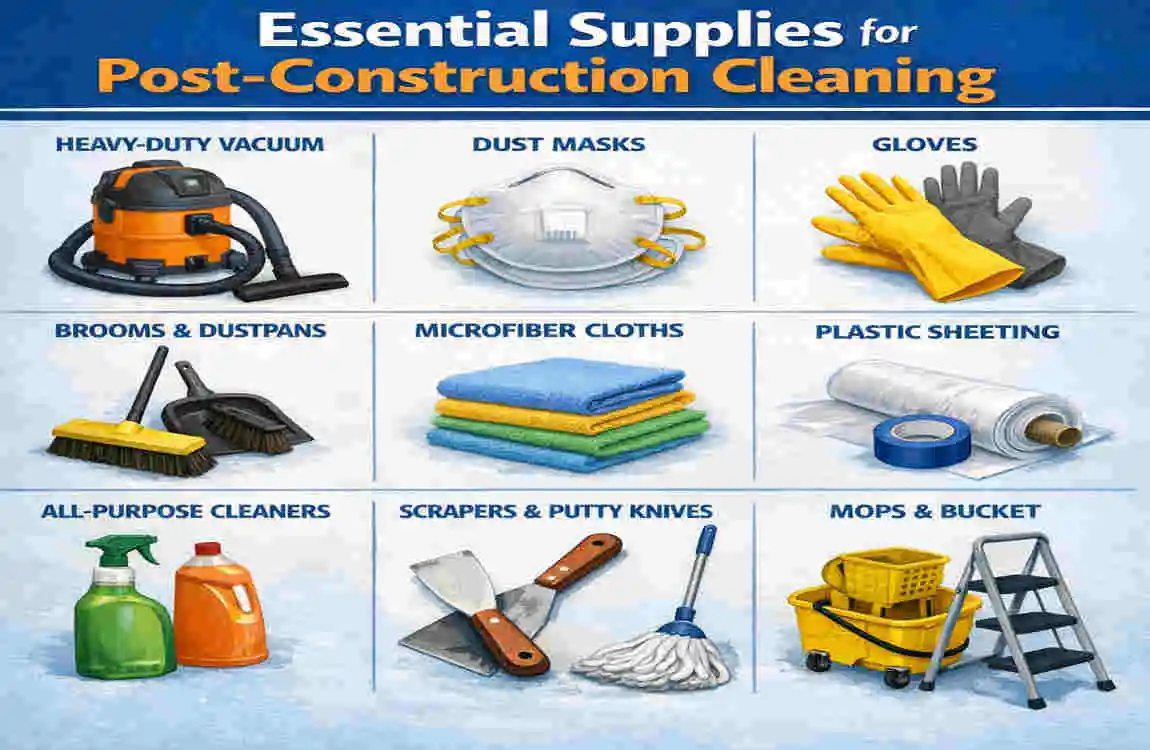
Before you can learn how to clean a new house after construction effectively, you need to arm yourself with the right tools. Trying to tackle drywall dust with a standard household broom and a feather duster will only leave you frustrated. Fine construction dust requires heavy-duty solutions.
To make your shopping trip easier, we have organized the must-have items into a scannable table. You can expect to spend anywhere from $100 to $200 on these supplies, but consider it an investment in your home’s air quality and your family’s health.
Category Items: Why You Need Them
Debris Removal: Heavy-duty trash bags, push broom, dustpan, shop vac. To safely clear away large, sharp debris like wood scraps, screws, and nails first.
Dust Control: HEPA-filter vacuum, microfiber cloths, tack cloths. To trap microscopic fine particles without blowing them back into the air.
Cleaning Solutions: All-purpose cleaner, white vinegar, degreaser, and glass cleaner. To tackle stubborn paint splatters, adhesive residues, and greasy fingerprints.
Safety Gear: Thick rubber gloves, N95 masks, safety goggles, and drop cloths. To protect your lungs and eyes from harmful silica dust and chemical fumes.
Floor Care Microfiber flat mop, double-sided bucket, wood/tile-specific cleaners . To provide a final, scratch-free polish to your brand-new hard floors.
Why a HEPA Vacuum is Your Best Friend
If there is one item on this list you should absolutely not compromise on, it is a HEPA vacuum for construction dust. HEPA stands for High-Efficiency Particulate Air. Unlike a standard household vacuum that sucks up dirt and often blows fine dust right back out the exhaust, a true HEPA filter traps 99.97% of airborne particles.
When you are trying to remove construction dust from a house, a regular vacuum will redistribute the drywall powder into the air, creating a vicious cycle of dusting and settling. Renting or purchasing a commercial-grade HEPA shop vacuum will save you hours of redundant labor and protect your lungs in the process.
Preparation Steps: Setting the Stage for Success
Preparation is the secret weapon of any successful cleaning project. If you rush unthinkingly into wiping down counters, you are going to make a bigger mess. Let’s take a strategic approach to prepare your home for its deep clean.
Seal Off the Airway
Your first instinct might be to turn on the shiny new air conditioning or heating system to make the house comfortable while you work. Do not do this.
Before you sweep a single floorboard, you must seal off your HVAC vents. Use plastic sheeting and painter’s tape to cover every return and supply register in the house. If your HVAC system is running while you stir up construction dust, that dust will get sucked directly into your ductwork. Every time the air kicks on for the next three years, you will be blasted with a fresh coat of drywall powder.
Maximize Ventilation
Instead of using your central air, rely on natural ventilation. Open all the windows in the house. Place box fans in the window frames pointing outward. This creates negative pressure, actively pulling the dusty air out of your rooms and blowing it into the yard.
Clear the Canvas
Remove any stray personal items, tools left behind by contractors, or unpacked boxes from the rooms. You need a completely blank canvas. If there are delicate fixtures or newly installed appliances that you want to protect from flying dust, cover them with lightweight plastic drop cloths.
The Top-to-Bottom Rule
Finally, memorize the golden rule of how to clean a new house after construction: always work from the ceiling down to the floor. Gravity dictates that dust falls. If you mop your beautiful new hardwood floors and then decide to dust the ceiling fans, you are going to ruin all your hard work on the floors. Plan your attack room-by-room, starting at the highest point and ending at the baseboards.
Remove Large debris
This is the first official phase of our new build cleaning steps. Before we can worry about the fine, powdery dust, we have to get rid of the physical trash.
While a good contractor should handle about 90% of the post-construction debris, there are almost always things left behind. Do not assume your home is free of hazards just because the builders have handed over the keys.
The Walk-Through and Collection
Grab your heavy-duty construction trash bags—do not use flimsy kitchen bags, as stray nails will slice right through them. Walk through every single room with a keen eye. You are looking for:
- Stray nails, screws, and staples on the floor.
- Offcuts of wood, baseboard, or drywall.
- Empty caulk tubes, electrical wire clippings, and lunch wrappers left by the crew.
Sweep these larger items into a heavy-duty dustpan. Be incredibly careful not to drag heavy or sharp debris across your brand-new floors, as this is how deep scratches happen before you even move in!
Check the Hidden Corners
Contractors often sweep things out of sight when they are in a hurry. You must play detective. Open every single closet and look into the back corners. Check behind every door. Look inside the bottom drawers of your built-in cabinets.
Use the Shop Vac for the Heavy Lifting
Once the large, pick-up-by-hand pieces are in the trash bags, bring in your shop vac (equipped with a standard filter for this heavy phase). Vacuum the corners of the rooms, the tracks of sliding glass doors, and the edges where the carpet meets the baseboards.
Pro Tip: Do not forget to check your exterior spaces. A very common pitfall for new homeowners is ignoring the roof gutters and the patio. Construction debris often blows into gutters or gets swept off the porch. Take an hour to verify that your outdoor drainage is clear of shingle grit and nails.
Depending on the size of your home and how tidy your builders were, this debris removal phase will take anywhere from two to four hours. Once the large trash is bagged up and disposed of off-site, you are ready for the main event.
Dust All Surfaces (The Invisible Enemy)
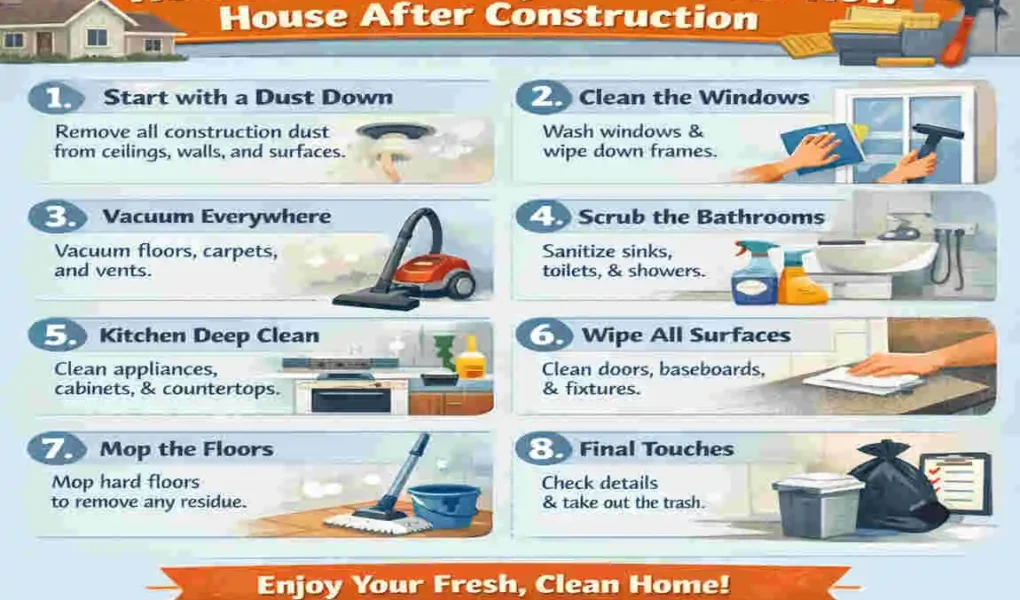
Welcome to the core step of the entire move-in cleaning guide. If you want to know how to clean a new house after construction, mastering dust removal is the absolute key.
Construction dust is insidious. It does not just settle on flat surfaces; it clings to walls, sneaks into microscopic crevices, and floats in the air for days. This is where your HEPA vacuum and microfiber cloths will earn their keep.
Start at the Very Top
Remember our top-to-bottom rule? We are starting at the ceiling. Grab an extension duster or use the brush attachment on your HEPA vacuum wand. Gently run it along the edges of the ceiling where it meets the wall, capturing any loose drywall dust or fresh cobwebs. Carefully dust the blades of your ceiling fans, the tops of your light fixtures, and the grilles of your exhaust vents.
Wiping Down the Walls and Trim
Believe it or not, your brand-new, freshly painted walls are covered in dust. If you leave it there, it will eventually dull the paint color and trap odors.
Take a clean, dry microfiber cloth or a flat mop fitted with a dry microfiber pad, and gently wipe down the walls. Start at the ceiling line and swipe in long, downward strokes all the way to the floor. Do not use water on painted walls right now! Water will mix with the drywall dust to create a stubborn, muddy paste that can stain your fresh paint. Dry dusting is essential here.
Tackling Baseboards and Windowsills
Baseboards and windowsills are notorious ledges for thick layers of dust. This is where you want to break out your tack cloths. Tack cloths are sticky, resin-coated rags used by carpenters and painters. They are phenomenal for grabbing and holding onto fine dust without releasing it back into the air. Gently wipe down all the wooden trim, door frames, and baseboards in the room.
The Double-Pass Method
Here is a secret from professional construction cleanup crews: you have to dust twice. After your first pass of dusting the ceiling, walls, and trim, the air will be disturbed, and some dust will inevitably resettle.
To counteract this, implement the “double-pass” method:
- Dust the room (ceilings, walls, ledges).
- Vacuum the air and floor (leave the HEPA vacuum running in the center of the room to pull dust from the air, then vacuum the loose dust that fell to the floor).
- Wait 30 minutes (let the remaining airborne dust settle).
- Dust the room a second time using a fresh, damp microfiber cloth on hard surfaces for a final polish.
Yes, it is time-consuming, but this repetitive process is the only guaranteed way to remove construction dust from a house truly.
Clean Floors Thoroughly
Now that you have successfully brought all the dust down from the ceilings and walls, your floors are likely looking like a sandy beach. Protecting and cleaning these surfaces requires a delicate touch. Let’s break down how to clean a new house after construction floors without causing accidental damage.
The Danger of Dry Sweeping
Let’s address a major rule right away: Never rely on dry sweeping alone for fine construction dust. Using a standard bristle broom on a floor covered in drywall dust will launch a massive cloud of particles right back into the air you just spent hours cleaning.
Instead, use your HEPA-filter vacuum with a hard-floor attachment (one with soft bristles, not a spinning beater bar) to slowly suck up the dust. Take your time. Overlap your vacuum strokes to ensure you are capturing every grain of grit.
Caring for Hardwoods and Laminate
Once the loose dust is vacuumed, it is time to mop. For hardwood and laminate floors, excessive moisture is the enemy.
- Fill a bucket with warm water and a splash of white vinegar (or a manufacturer-approved wood cleaner).
- Dip a high-quality microfiber flat mop into the solution and wring it out until it is barely damp.
- Mop the floor in small sections, following the grain of the wood.
- You will likely need to change your mop water multiple times per room. If the water looks murky, dump it. Mopping with dirty water smears the dust around, leaving a hazy residue behind.
Rescuing Tile and Grout
Tile floors are more resilient, but the grout lines are magnets for construction dust and paint splatters. Use a slightly wetter mop for the tile, utilizing a gentle, neutral pH all-purpose cleaner. If you spot dried joint compound or paint flecks on the tiles, use a plastic scraper to pop them off gently. For the grout, a soft nylon brush and a paste of baking soda and water work wonders to lift out embedded dust without using harsh chemicals.
Deep Cleaning Carpets
If your new home has carpeting, vacuuming is your first line of defense. Go over the carpet slowly in one direction, and then vacuum again in a perpendicular direction to agitate the fibers and pull up trapped dust. However, for a truly move-in-ready home, we highly recommend renting a steam cleaner or hiring a professional carpet cleaning service for this final step. Carpets act like massive air filters, and extracting that deep-seated construction dust with hot water extraction will vastly improve your home’s air quality.
Wipe Kitchen and Bathrooms
The kitchen and bathrooms are the high-traffic hygiene zones of your home. You want these areas to be impeccably sanitized before you unpack your toothbrushes or your dinner plates. Learning how to clean a new house after construction means paying hyper-attention to these complex spaces.
Deep Cleaning Cabinets and Drawers
Your brand-new kitchen cabinets might look stunning from the outside, but open them up, and you will likely find a layer of sawdust hiding inside.
- The Interiors: Use your HEPA vacuum hose with a crevice tool to suck out the dust from all the corners. Pay special attention to the metal tracks of the drawers; dust mixing with the track grease creates a sticky mess. Wipe the insides down with a damp microfiber cloth.
- The Exteriors: Builders often leave behind smudges, greasy fingerprints, and pencil marks on cabinet faces. Use a gentle wood degreaser or a mild dish soap solution to wipe down the exterior doors and handles.
Sinks, Faucets, and Counters
Plumbing fixtures in new builds are frequently coated in hard water spots, calcium dust, or tiny flecks of paint.
- The Scrub: Use a non-abrasive cleaner (like a specialized stainless steel or porcelain cleaner) to shine up the sinks.
- Pro Hack: If you find stubborn paint splatters on your bathroom counters or chrome faucets, lightly dampen a Magic Eraser and gently rub the spot. The micro-abrasion will lift the paint without scratching the metal.
- The Stickers: One of the most annoying parts of a new build is the sheer volume of manufacturer labels and energy stickers on every surface, window, and appliance. To remove these without scratching your surfaces, soak a cloth in warm, soapy water or use a dedicated adhesive remover (like Goo Gone). Let the solution sit on the sticker for a few minutes to soften the glue before gently peeling it away.
Disinfecting the Space
Even though the house is “new,” dozens of contractors have been using the bathrooms and touching the surfaces. Once the physical dirt and dust are gone, go back over the high-touch areas—like toilet seats, bathroom counters, and kitchen islands—with a gentle disinfecting bleach solution or an antibacterial spray to kill any lingering germs.
Windows, Fixtures, and Final Touches
You are in the home stretch! The heavy lifting is done, and now it is time for the final touches that will truly make your new house sparkle and feel like a home.
Crystal Clear Windows
New construction windows often arrive with protective films, sticky tape residues, and layers of environmental dust.
- The Tracks: Start by opening the windows and using your vacuum’s crevice tool to suck the dirt out of the tracks.
- The Glass: Mix a simple, eco-friendly solution of equal parts white vinegar and distilled water in a spray bottle. Spray the glass and wipe it down with a lint-free microfiber cloth or a squeegee. The vinegar naturally cuts through adhesive residues and leaves a brilliant, streak-free shine.
- The Screens: Don’t forget to take the window screens outside and hose them down, as they trap a tremendous amount of airborne dust.
Shining the Fixtures
Walk through the house with a slightly damp microfiber cloth. You are looking for all the small details you might have missed during the broad sweeping phases. Wipe down all the doorknobs, light switches, electrical outlet covers, and thermostat faces. These small touches instantly elevate the cleanliness of the space.
The Critical HVAC Filter Swap
Do you remember how we sealed off the HVAC vents at the very beginning of the process? Now that the cleaning is complete, you can remove the plastic coverings. However, before you turn on your air conditioning or heating system, you must replace the HVAC filters. Even with the vents covered, some construction dust inevitably makes its way into the system during the building process. Swap out the contractor-grade filters for high-quality pleated filters to ensure the air blowing into your newly cleaned home is as fresh as possible.
The Air-Out Period
Once every surface is gleaming, and the new filters are in place, leave the windows open and let the house air out for 24 to 48 hours before moving your furniture in. This crucial window allows the off-gassing from new paints, fresh carpets, and chemical cleaners to dissipate completely.
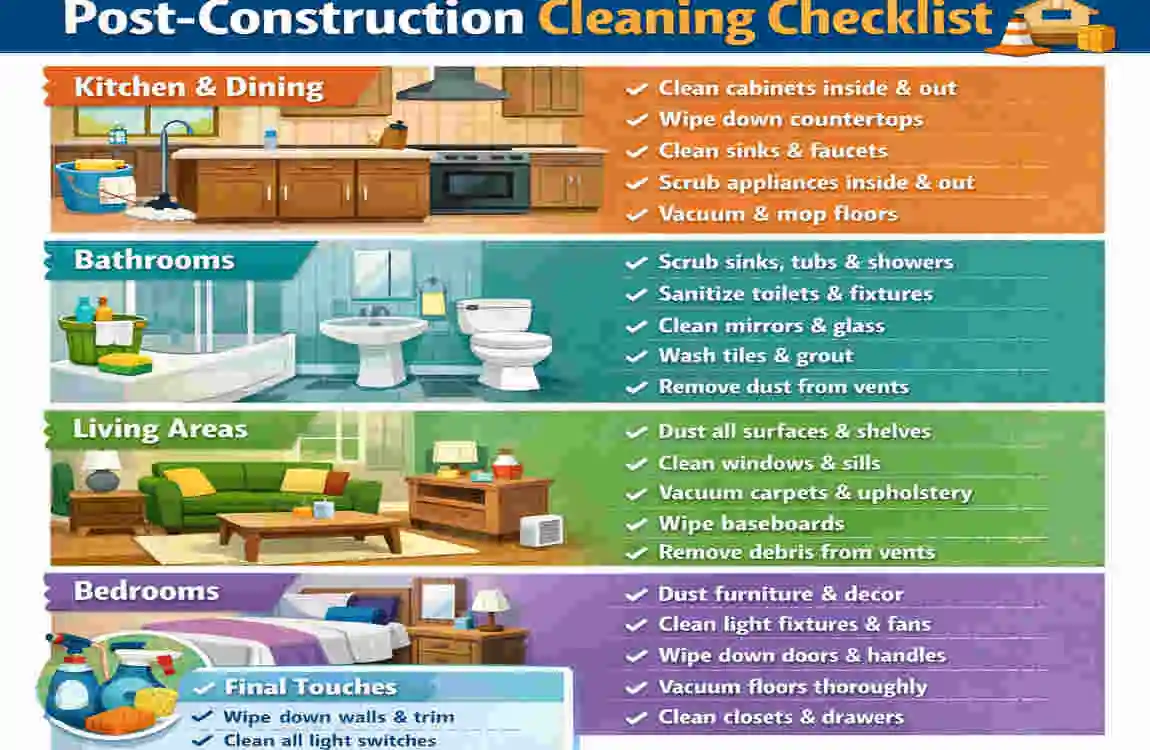
Do a final walk-through with your post-construction cleaning checklist in hand to ensure nothing was missed!
Common Mistakes to Avoid During Construction Cleanup

When figuring out how to clean a new house after construction, knowing what not to do is just as important as knowing what to do. Avoid these common pitfalls to save yourself time and frustration:
- Dry Sweeping Dust: As mentioned earlier, pushing a dry broom across a dusty floor launches the particles back into the air. Always opt for a HEPA vacuum or a slightly damp mop.
- Skipping Personal Protective Equipment (PPE): Never underestimate the health risks of breathing in silica dust or volatile organic compounds (VOCs) from construction materials. Always wear your N95 mask and safety goggles.
- Rushing the Floors Before Dusting: Gravity always wins. If you clean your floors before wiping down your ceilings, walls, and ceiling fans, you will have to clean your floors a second time. Follow the top-to-bottom rule strictly.
- Ignoring the HVAC System: Failing to seal your vents during cleaning or forgetting to change the air filters afterward guarantees ongoing contamination. Your home will never truly feel clean if the ductwork is blowing dust back into the rooms.
When to Hire Professionals

While this move-in cleaning guide provides all the steps you need for a DIY approach, cleaning a new build is a massive, physically demanding undertaking. You have to ask yourself: DIY vs. pros?
If you are on a tight time crunch with your moving company, or if the sheer scale of the project feels overwhelming, it might be time to hire professional post-construction cleaners.
Professionals typically charge anywhere from $0.10 to $0.50 per square foot, depending on the level of detail required and your location. The primary benefits of hiring a crew include access to industrial-grade tools (like commercial HEPA scrubbers and heavy-duty steam cleaners), extensive insurance coverage in case a surface is accidentally damaged during cleaning, and the luxury of saving your own time and energy. If you are located in a bustling urban area where construction is booming, there are likely dozens of highly rated, specialized local services ready to tackle the job in a fraction of the time it would take a solo homeowner.
FAQs About Post-Construction Cleaning
How long does it take to clean a new house after construction? If you are doing it yourself, expect the process to take between 1 and 3 full days for a standard 2000-square-foot home. This accounts for the double-pass dusting method and the necessary waiting periods for dust to settle.
Is the new house safe for kids and pets right away? No. Due to the high levels of particulate matter and the off-gassing of volatile organic compounds (VOCs) from new paints, adhesives, and carpets, it is highly recommended to clean the house thoroughly and let it air out for at least 48 hours before allowing children or pets to sleep in the home.
Are there eco-friendly cleaning options for construction dust? Absolutely! You do not need harsh industrial chemicals to get a new house clean. White vinegar diluted in water is incredible for mopping floors and cleaning glass. Baking soda mixed with a little water creates a fantastic, non-toxic scrubbing paste for grout and stubborn sink stains.