Smart glass film has quickly become one of those features that shows up in modern homes, offices, and renovation inspiration boards. The idea is simple and appealing: glass that can turn from clear to opaque with a switch.
But once you move past the novelty, a more practical question comes up:
Where does smart glass film actually make sense — and where might it be unnecessary?
Because like many design upgrades, it’s not about whether something is “good” or “bad,” but whether it fits how a space is used.
What Smart Glass Film Is Really Solving
At its core, smart glass film is a privacy solution built around switchable glass technology. It is designed for modern interiors that need a balance between openness and privacy.
It works by using electrically controlled liquid crystals that shift between transparent and opaque states when power is applied or removed.
In simple terms, it allows you to:
- keep glass open when visibility is needed
- switch to privacy when required
- avoid permanent visual barriers like curtains or blinds
This makes it especially relevant in flexible or multi-use spaces.
Where Smart Glass Film Makes The Most Sense
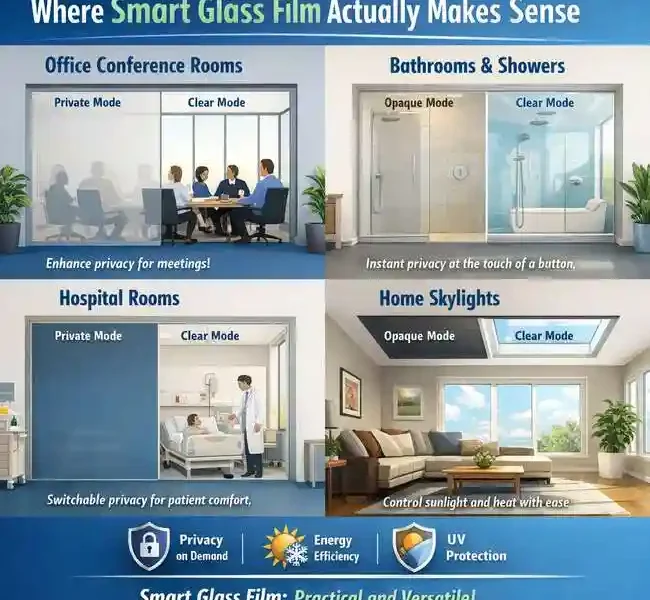
1. Multi-Use Spaces
In areas where a space serves more than one function, flexibility becomes important.
For example:
- home offices that double as meeting rooms
- living spaces connected to private areas
- glass partitions in open-plan layouts
The ability to switch between open and private modes improves usability without adding physical barriers.
- Bathrooms With Glass Elements
Bathrooms are one of the most common applications.
Instead of permanently frosting glass:
- glass remains clear when not in use
- switches to opaque when privacy is needed
This works well in modern layouts where openness is part of the design intention.
- Spaces That Prioritise Clean Design
For minimalist interiors, traditional blinds or curtains can feel visually heavy.
Smart film helps maintain:
- uninterrupted glass surfaces
- natural light flow
- a cleaner overall aesthetic
In these cases, it supports both design and function.
- Retrofit Situations
In renovation projects, replacing full glass panels is often not practical.
Smart film can usually be applied onto existing glass, making it suitable for upgrades without major structural changes.
Where Smart Glass Film Doesn’t Always Make Sense
1. Spaces That Always Require Privacy
If a space needs constant privacy, such as certain enclosed rooms or utility areas, a permanent solution like frosted glass is often simpler and more practical.
In these cases, switching functionality adds little real value.
Projects With Tight Budgets
Smart film typically involves:
- higher upfront cost
- electrical integration
- more detailed installation planning
For budget-focused projects, simpler solutions may be more appropriate.
- Areas Without Easy Electrical Access
Because the system relies on power, installation becomes more complex if wiring is not planned early.
This is often overlooked during renovation planning stages
- Low-Usage Spaces
If switching between open and private modes is rarely needed, the benefits of smart film may not justify the investment.
A Common Misconception
One of the biggest misconceptions is treating smart glass film as a universal upgrade.
In reality, it is situational.
It works best when:
- privacy needs change throughout the day
- flexibility is important
- design simplicity is a priority
Outside of these conditions, simpler solutions often perform just as well.
How Most People End Up Deciding
Most decisions eventually come down to a few practical questions:
- Will this space benefit from switching between open and private?
- How often will that actually be used?
- Is the added flexibility worth the cost?
- Can it be integrated easily into the existing layout?
When usage is frequent and functional value is clear, smart film becomes easier to justify.
Best Smart Glass Film in Singapore
1. Pramie
Pramie provides smart glass film solutions designed for integrated architectural and interior applications, allowing spaces to shift between transparent and opaque states electronically.
Their systems are commonly used in:
- office environments
- commercial interiors
- residential feature glass
- design-led renovation projects
Best for:
Projects that require structured, design-integrated smart glass solutions with planned installation.
Things to consider:
More suitable for planned builds or coordinated renovation works rather than simple late-stage retrofits.
- Magic Glass
Magic Glass focuses on switchable smart film systems that allow existing glass to be upgraded with privacy-switching capability.
Their systems are commonly used for:
- residential glass partitions
- office meeting rooms
- bathroom glass panels
- modern open-concept spaces
Best for:
Users looking for retrofit-friendly smart film installations with flexible privacy control.
Things to consider:
Requires proper electrical setup for optimal performance and reliability.
- Shield Perfect
Shield Perfect provides privacy film and smart glass solutions aimed at both residential and commercial applications, focusing on functional glass upgrades and privacy enhancement systems.
Their solutions are commonly used in:
- office partitions
- residential renovations
- commercial glass installations
Best for:
Users looking for practical privacy film solutions with a focus on functionality and straightforward installation.
Things to consider:
Product range may vary depending on project requirements and installation scope.
Honest User Experience
In evaluating smart glass film solutions, one factor that often shapes the final decision is how clearly the system is demonstrated and understood before installation.
A user experience with Pramie’s smart glass reflects this well:
“Visited Pramie’s showroom by appointment and was impressed with the whole experience. The team took the time to explain how their smart window film works and demonstrated it too. The film gave my office the flexibility it needed without sacrificing any natural light. Installation was quick, and they were super attentive to all my questions. Highly recommend.”
Here we can see that what stands out is not only the product itself, but how the switching functionality becomes meaningful only when experienced in real use.
This aligns closely with the broader point discussed throughout — that smart glass film is best evaluated not just by features, but by how well it fits the actual daily use of a space.
Final Thoughts
Smart glass film is not meant to replace every privacy solution.
It is designed for spaces where flexibility matters.
In the right context, it changes how a space is experienced — shifting between openness and privacy seamlessly. In the wrong context, it can become an unnecessary layer of complexity.
The key is simple:
Start with how the space is used, not what the product can do.
That’s usually where the right decision becomes clear.