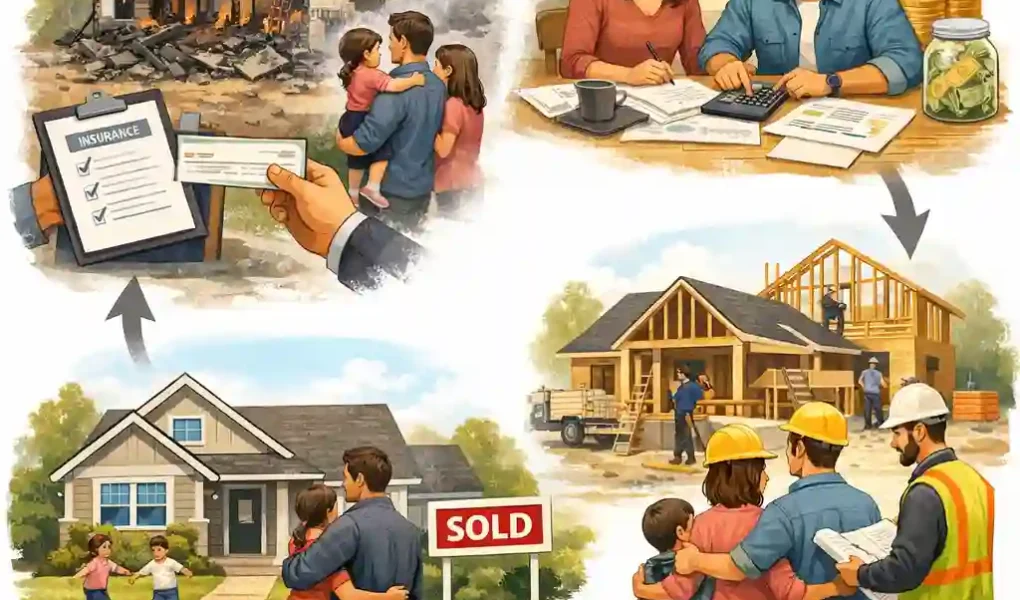
Financial recovery after a house fire runs on three tracks at once: getting the insurance claim paid in full, keeping the bills that did not disappear from wrecking your credit in the meantime, and deciding what to do with the property itself. Most families who come out of it intact do so because they treated the claim as a job, documented everything obsessively, and made a clear decision about rebuilding versus selling within the first six months rather than drifting into year two.
The hardest part is that the money and the expenses arrive on completely different schedules. Your mortgage payment is due next month. Your dwelling settlement may take eight months to a year to finalize, and your contents payout arrives in pieces, often with a chunk held back until you prove you actually replaced things. That mismatch is what pushes otherwise stable households into debt, and it is largely predictable, which means it is largely plannable.
What Insurance Actually Pays and How Long It Takes
A standard homeowners policy has four buckets, and understanding them changes how you file. Dwelling coverage rebuilds the structure. Other structures covers fences, detached garages, and sheds, typically at around ten percent of the dwelling limit. Personal property covers contents, usually somewhere between fifty and seventy percent of the dwelling limit. Additional living expenses pays for your temporary housing, and that is the bucket families burn through fastest.
Replacement cost versus actual cash value is the single most consequential line in your policy. Actual cash value pays depreciated value, so a seven year old sofa gets you a fraction of what a new one costs. Replacement cost policies pay you the depreciated amount first and release the rest (the recoverable depreciation) only after you buy the replacement and send receipts. Families who do not know this assume the first check is the whole contents settlement, and they are often looking at twenty to forty percent less than what they are actually owed.
Timing varies enormously. Advance payments for immediate needs usually come within days to a couple of weeks. Contents settlements commonly take three to six months because the inventory takes that long to build. Dwelling settlements on a total loss can take a year or longer if the adjuster’s estimate and your contractor’s bid are far apart, which they frequently are. Reporting from major fire events has repeatedly shown adjuster figures landing well below contractor quotes, sometimes by thirty or forty percent, and closing that gap is a negotiation, not a formality.
The contents inventory is where most of the recoverable money sits and where most people give up early. Insurers expect an itemized list, ideally with age, brand, and estimated replacement cost for everything from kitchen utensils to socks. It is tedious and genuinely painful to write down every object you owned. Families who push through it, often with help from a public adjuster who works on a percentage of the settlement, routinely recover substantially more than those who submit a rough estimate and accept the first offer.
The Bills That Do Not Stop After the Fire
Your mortgage survives the fire. So do property taxes, HOA dues, and any home equity line you had drawn on. Skipping payments while you wait for the insurer is how a housing crisis becomes a credit crisis, and mortgage servicers do not automatically know your house burned down. Call them within the first week and ask about forbearance, which many servicers grant for ninety to one hundred eighty days after a disaster, and get the terms in writing so you know whether the paused payments come due as a lump sum or get added to the end of the loan.
Insurance proceeds for the structure usually go to the lender, not to you. The check arrives with both names on it, the servicer deposits it into a restricted escrow account, and funds get released in draws as construction hits inspection milestones. This surprises people constantly. If you are planning to rebuild, ask your servicer for their draw schedule in month one so you know how much cash you need to float between stages.
Then there is the housing cost you now have twice. Additional living expenses coverage typically caps at a percentage of the dwelling limit or runs for twenty four months, extended to thirty six in some states after declared disasters. Rental prices in a burn zone spike almost immediately as thousands of displaced households compete for the same units, which means your coverage buys fewer months than the policy math suggests. Track that balance monthly.
How Selling the Property Can Be Part of the Recovery
For a lot of families, the fastest route back to financial stability is not rebuilding. If your settlement leaves a six-figure gap, if construction in your area runs two to three years, or if you simply cannot manage a build while working and raising kids, converting the property to cash and moving on is a legitimate strategy rather than a defeat. Selling a damaged lot lets you pay off the mortgage, keep the contents settlement, and buy or rent somewhere stable now instead of carrying two housing costs indefinitely.
There are two ways to do it. Listing on the open market can work if there is buyer demand in your area, though burn-zone values often drop sharply and lots can sit for months. Selling directly to a buyer that specializes in fire-damaged property trades some price for speed, and firms like We Buy Fire Damaged Houses close in as-is condition without repairs, cleanup, or financing contingencies. Before you take either path, settle your dwelling claim first if you can, because selling the property can complicate what the insurer owes you on the structure.
Recovery also looks different depending on who you are. A household with substantial equity and full replacement cost coverage is usually fine given time. Renters, who often carry no contents policy at all, lose everything with no mechanism to recover it. Retirees on fixed incomes rarely benefit from taking on new construction debt at seventy. Landlords face a straight investment calculation with no emotional weight attached. Knowing which category you fall into should shape the decision more than what your neighbors are doing.
Where Families Find Money Beyond the Claim
Federal disaster declarations open doors that are not available after an isolated house fire. SBA disaster loans are the largest of them, offering low-interest lending to homeowners for rebuilding and for replacing personal property, and they are worth applying for even if you think you will not need the money, since declining an approved loan is easy and reapplying later is not. FEMA individual assistance helps with immediate needs but is a much smaller number than most people expect.
Tax treatment matters more than families realize. A casualty loss deduction is generally only available for federally declared disasters under current rules, but a separate provision lets you defer capital gains when you receive insurance proceeds that exceed your basis in the property, provided you reinvest in similar property within a set window. Property tax relief is also available in many states through reassessment when a home is substantially destroyed, and in California specifically, base year value can often transfer to a replacement property. A CPA who has handled casualty losses is worth the fee.
Local support fills gaps the official channels miss. Red Cross assistance, community foundation grants set up after major fires, employer hardship funds, and crowdfunding all do real work in the first sixty days, particularly for the costs nobody plans for like replacing prescription medications, work tools, car seats, and identity documents.
Set a review date now, roughly six months out, where you sit down with the actual numbers and decide whether your current plan still works. Claims stall, construction bids come in high, and the plan you made in week two while running on adrenaline is often not the plan that fits month eight. The families who recover well are usually the ones willing to change course once, deliberately, rather than the ones who kept pushing a rebuild they could no longer afford because reversing felt like giving up.