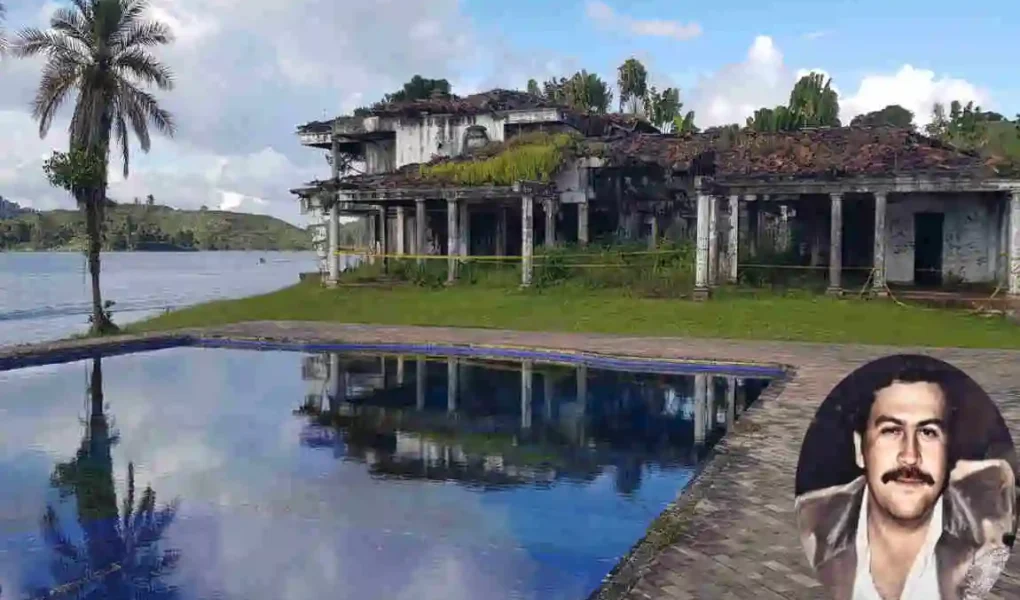
Imagine having so much cash that you have to spend $2,500 a month just on rubber bands to hold the stacks together. Now, imagine having so much wealth that you don’t just buy a house; you build an entire fortress, a private zoo, or a lakeside resort that rivals the properties of modern billionaires. This wasn’t a fantasy for one man; it was a Tuesday.
We are talking, of course, about Pablo Escobar.
When you think of the Medellín Cartel, you probably think of the violence, the drugs, and the chaos. But there is another side to this dark history that is equally fascinating: the real estate. The sheer opulence of a Pablo Escobar house symbolized his narco empire. These weren’t just homes; they were statements of power, monuments to excess, and, eventually, gilded cages of paranoia.
Hacienda Nápoles: The Crown Jewel Pablo Escobar House
If there is one property that defines the excess of the drug lord’s life, it is Hacienda Nápoles. This wasn’t just a house; it was a kingdom.
Located in Puerto Triunfo, about 150 kilometers east of Medellín, this estate was the centerpiece of his empire. Acquired in the late 1970s, the land spanned a staggering 7,000 acres. To put that in perspective, that is roughly eight times the size of Central Park in New York city.
A Grand Entrance
When you drove up to the estate, the first thing you saw was a small, single-engine plane perched atop the blue and white entrance arch. This wasn’t just decoration. It was a replica of the Piper PA-18 Super Cub that flew Escobar’s first shipment of cocaine to the United States. It was a brazen symbol of how he made his fortune, displayed for everyone to see.
Inside the Private Zoo
Escobar wanted to be larger than life, so he decided his estate needed more than just dogs and cats. He built a full-scale private zoo.
He flew in exotic animals from all over the world. We are talking about:
- Elephants
- Giraffes
- Ostriches
- Camels
- and, most infamously, Hippos.
He imported four hippos (three females and one male) from Africa. This private collection allowed him to play the role of a benevolent king, often inviting locals to visit the zoo for free. It was a calculated move to win the hearts of the people, cementing his status as a “man of the people” despite the violence of his trade.
The Mansion and Amenities
Step inside the main Pablo Escobar house at Hacienda Nápoles, and you are met with a colonial-style Spanish mansion that oozes wealth. The house featured open-air terraces to take advantage of the tropical climate, shimmering marble floors, and multiple swimming pools.
But the amenities didn’t stop at the house. The estate included:
- A Bullring: Because Escobar loved traditional entertainment.
- A Private Airstrip: For his fleet of planes to land directly at his doorstep.
- Fake Ancient Ruins: He actually built a “Jurassic Park” style dinosaur park with concrete statues and fake ruins, just for the aesthetic.
- Formula 1 Track: A go-kart track where he would race with his family and fellow cartel members.
Life Behind the Gates
Daily life at Hacienda Nápoles was a mix of family vacations and high-stakes criminal meetings. By day, Escobar would watch his daughter play with baby giraffes. By night, he would host lavish parties for politicians, beauty queens, and hitmen.
It was a surreal existence. You could be sipping champagne by the pool while armed guards patrolled the perimeter and millions of dollars in cash were being counted in the back rooms.
Post-Escobar Fate
Today, the main house has crumbled. After Escobar’s death, locals tore into the walls looking for a hidden stash of gold and cash (a common occurrence with any Pablo Escobar house). The estate was seized by the government and, in a strange twist of fate, has been turned into a theme park.
You can now visit the Hacienda Nápoles Theme Park, swim in the pools, and see the descendants of those original hippos, which have now become an invasive species in Colombia.
Nápoles House and Urban Hideouts in Medellín
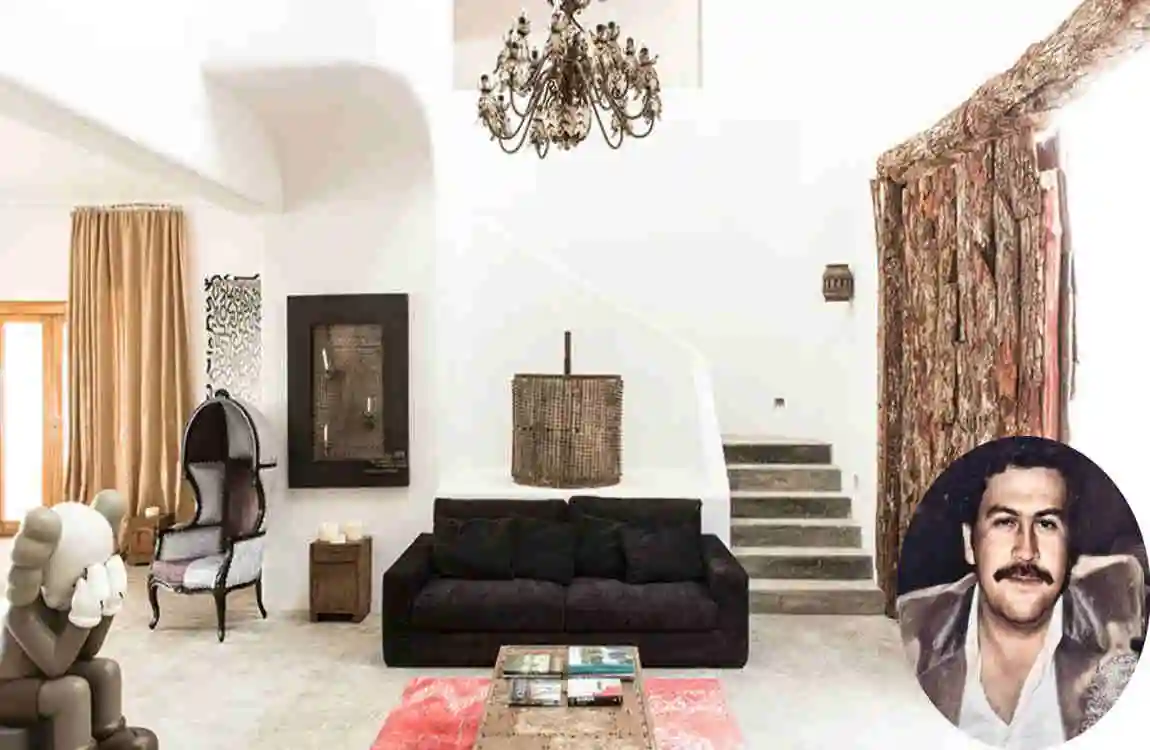
While the Hacienda was his country retreat, Escobar needed bases of operation in the city. Medellín was his home turf, and he owned dozens of properties there. When searching for a Pablo Escobar house in Medellín, you will find a mix of luxury apartments and fortified bunkers.
The Monaco Building
Perhaps the most famous of his city residences was the Monaco Building (Edificio Mónaco). Located in the upscale El Poblado neighborhood, this wasn’t just an apartment; Escobar owned the entire building.
It was an eight-story fortress. The penthouse was reserved for his family, filled with art, luxury furniture, and unrivaled views of the city. The basement held his classic car collection. The roof had a helipad.
However, the Monaco Building is famous for a violent reason. In 1988, the rival Cali Cartel detonated a car bomb with 800kg of dynamite outside the building. It shattered windows for miles and deafened Escobar’s daughter, but the family survived. This marked the beginning of the open war between the cartels.
The “Nápoles House” of the city
Escobar maintained other safe houses in the city that were less about luxury and more about Survival. Often referred to simply as “The Blue House” or other nondescript names, these locations were outfitted with:
- Secret Tunnels: Escape routes leading to the sewer system or neighboring properties.
- Panic Rooms: Reinforced steel rooms with oxygen supplies.
- Machine Gun Nests: Hidden firing positions to ambush police raids.
Barrio Pablo Escobar
We cannot talk about his real estate without mentioning the Barrio Pablo Escobar. Unlike his personal palaces, this was a housing project he built for low-income residents.
In the early 80s, Escobar launched a program called “Medellín Without Slums.” He built over 400 houses for people who were living in a garbage dump called Moravia. He gifted these homes.
To the people who received a roof over their heads, he wasn’t a monster; he was Robin Hood. This loyalty was crucial to his Survival, as these neighborhoods provided him with a safe harbor when he was on the run.
Comparison of Medellín Properties
Here is a quick look at how his different Medellín properties compared:
Pablo Escobar HouseLocationSize (approx)Key FeaturesCurrent Status
Hacienda Nápoles Puerto Triunfo 7,000 Acres Zoo, Airstrip, Bullring Public Theme Park
Monaco Building, El Poblado, Medellín, 15,000 sq ft Rooftop helipad, Penthouse Demolished (2019)
La Catedral Envigado Mountain Estate Prison/Resort, Waterfall Monastery/Ruins
Barrio Houses Medellín Slopes Varies Community gift, Brick construction, Still inhabited.
The Infamous White House: Escobar’s Presidential Fantasy
Escobar had an ego that knew no bounds. He didn’t just want to be rich; he wanted to be President of Colombia. This ambition bled into his architecture.
Among his many properties was a mansion that locals and historians often refer to as his “White House” fantasy, or simply one of his most “presidential” estates. While sometimes confused with other properties, a specific Mexico-inspired replica built near Medellín around 1982 showcased this delusion.
A Design Fit for a Leader?
This particular Pablo Escobar house was designed to mimic the grandeur of a head of state’s residence. It boasted 65 bedrooms. Yes, you read that right. Sixty-five.
The centerpiece of the exterior was an enormous swimming pool. But this wasn’t just a rectangle. The pool was shaped like the map of Colombia. It was a not-so-subtle metaphor: Escobar wanted to swim in his country, to be immersed in it, and ultimately, to own it.
Gold and Guns
Inside, the extravagance was cranked up to eleven.
- Gold Fixtures: The bathrooms featured solid gold faucets and fixtures.
- Car Collection: A massive garage housed his ever-growing collection of vintage and luxury cars.
- Shooting Range: Because even a presidential hopeful needs to keep his aim sharp.
This house marked the peak of Escobar’s “legitimate” phase, during which he was elected as an alternate member of Congress. He hosted political rallies here, trying to wash his blood money clean.
The Destruction
Like many of his dreams, this house met a violent end. As the war with rival cartels heated up in 1984 and onwards, his enemies targeted his symbols of power. The property was bombed and raided, leaving the presidential fantasy in smoldering ruins.
Hidden Palaces and Global Properties: Beyond Colombia
While Colombia was his stronghold, Escobar’s reach was global. A man with that much money diversifies.
The Miami Connection
In the 1980s, Miami was the main entry point for Colombian cocaine. Naturally, Escobar needed a presence there. He purchased a massive waterfront mansion in Miami Beach.
This pink-hued Pablo Escobar house (technically owned under a shell company) was a party central for his associates. It had four bedrooms, a pool, and a view of the bay. Years later, after the US government seized it and sold it, the new owner demolished it. During the demolition, they found a safe stolen from the walls—though it was empty.
Caribbean Retreats
The cartel needed logistical hubs in the Caribbean. The most famous was Norman’s Cay in the Bahamas. While technically run by his partner, Carlos Lehder, Escobar utilized the island as a transshipment point and a vacation spot. It was a private island paradise where the laws of the outside world didn’t apply.
He also reportedly owned ranches in Nicaragua and hidden retreats in the Panamanian jungle, used for when the heat in Colombia got too intense.
Finca La Manuela
Back in Colombia, near the town of Guatapé, sat La Manuela. Named after his daughter, this lakeside mansion was his favorite recreational spot.
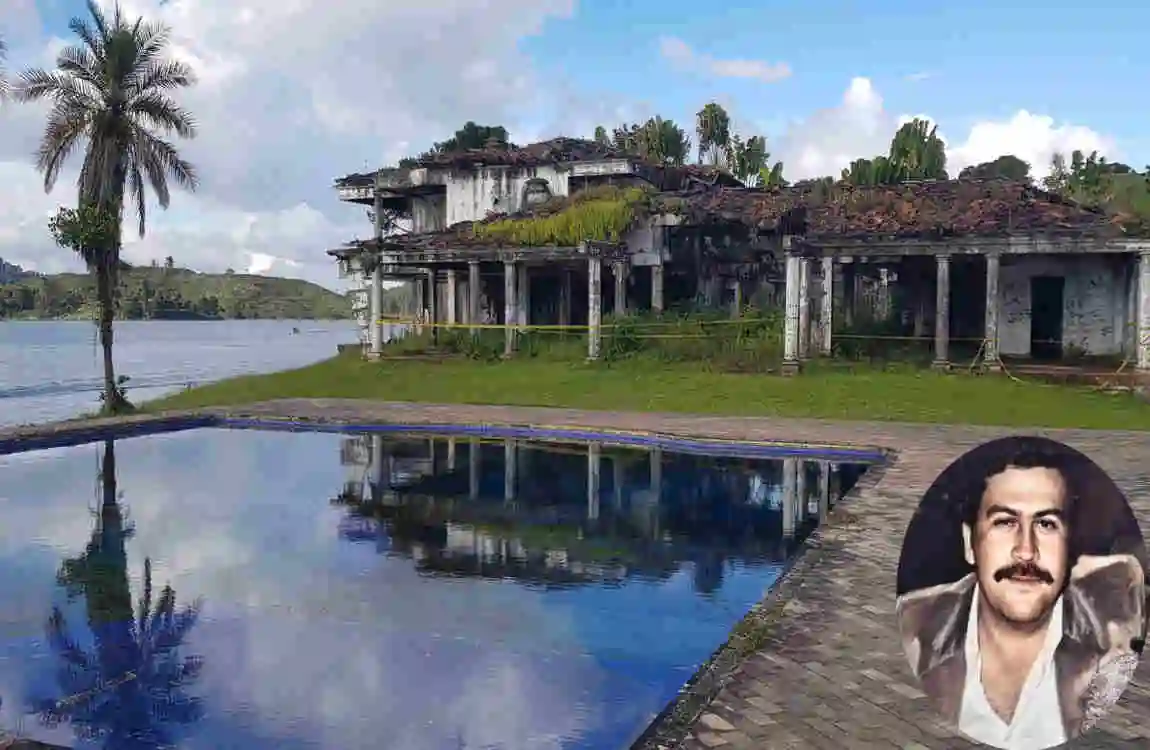
It was accessible by boat or helicopter. It featured a disco, a sunken bar, and double-layered walls to hide cash. It was the ultimate party palace. In 1993, a vigilante group known as Los Pepes (People Persecuted by Pablo Escobar) bombed La Manuela. Today, the skeletal remains of the house still stand by the lake, covered in graffiti and jungle vines.
Luxury and Excess: What Made a Pablo Escobar House Unique
So, what exactly sets a Pablo Escobar house apart from a regular mansion? It comes down to a specific blend of tacky luxury and extreme paranoia.
The Furnishings
Escobar had a taste for the “nouveau riche” aesthetic. He loved:
- Imported Italian Marble: Floors were often cold, hard, and expensive.
- Custom Gold Toilets: Nothing says “I have too much money” like a golden throne.
- Dinosaur Bones: He reportedly bought dinosaur fossils to display in his homes.
Tech and security
Because he was the most hunted man in the world, his houses were high-tech fortresses.
- Grenade-proof walls: Standard drywall wouldn’t cut it.
- Early CCTV: He utilized state-of-the-art surveillance systems long before they were common in residential homes.
- Sensors: Perimeter sensors detected movement miles away from the main house.
The Staff
A Pablo Escobar house wasn’t a home; it was a corporation. A single estate could have over 100 employees. This included maids, chefs, gardeners, and, of course, a small army of hitmen (sicarios) acting as security guards.
Estimates suggest that Escobar spent over $50 million on his real estate portfolio alone. But in the grand scheme of his wealth, that was merely pocket change.
Downfall: Raids, Explosions, and the End of Escobar’s Houses
The higher you fly, the harder you fall.
By the early 90s, the Colombian government, aided by the US DEA and the vigilante group Los Pepes, was closing in. One by one, the houses fell.
- The Monaco Building was bombed.
- La Manuela was torched.
- Hacienda Nápoles was seized.
The luxury turned into a liability. Escobar spent his final months not in a marble palace but moving between safe houses, sleeping on dirty mattresses, and hiding in the jungle. The man who owned hundreds of toilets eventually died on a rooftop in a middle-class neighborhood, barefoot and bloody.
Legacy Today: Visiting a Pablo Escobar House
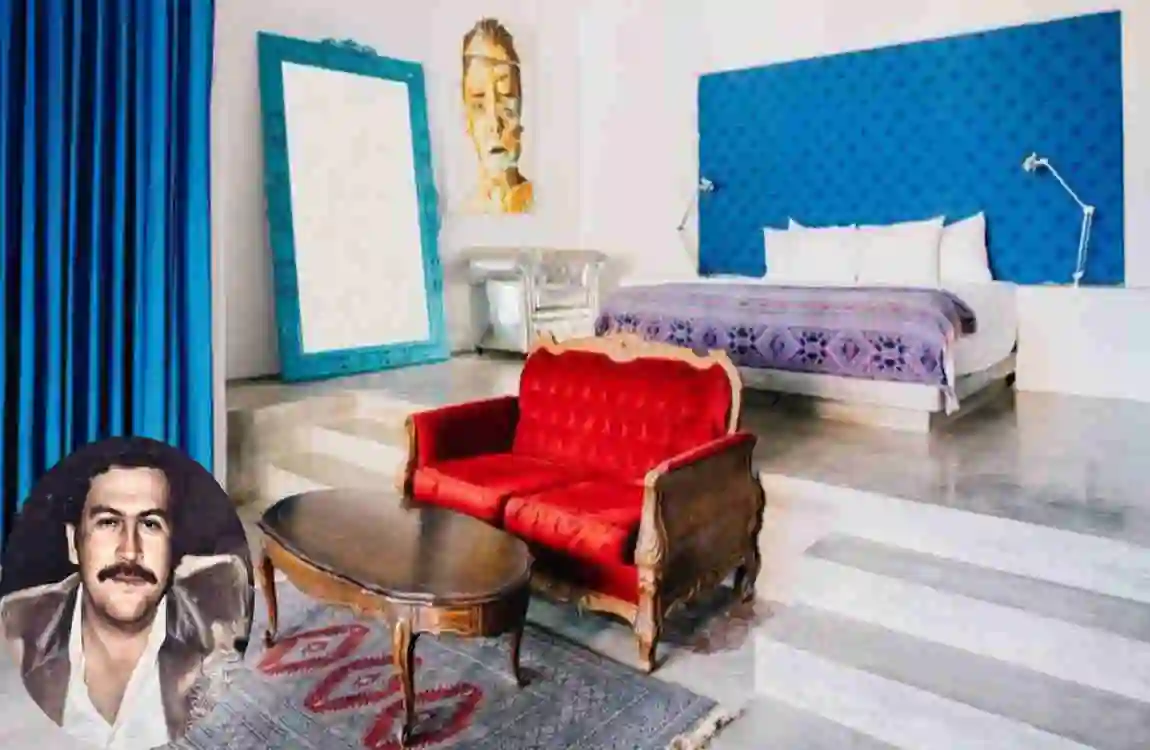
Decades after his death, the fascination remains. Tourism centered around the cartel leader is booming in Colombia, though it is a controversial topic.
Hacienda Nápoles Theme Park
As mentioned, the great estate is now a family-friendly park. You can take a “safari” to see the hippos, visit a water park, and walk through a museum dedicated to the victims of the cartel (a move to shift the focus from glorifying Escobar to honoring those he hurt).
The Ruins of La Manuela
You can take boat tours in Guatapé that stop at the ruins of La Manuela. Guides will walk you through the bombed-out shell of the disco and the pool. It’s a haunting experience—seeing the physical decay of an empire.
The Monaco Demolition
In 2019, the city of Medellín made a bold statement. They imploded the Monaco Building in a televised event. In its place, they built a memorial park dedicated to the thousands of victims of the Medellín Cartel. It was a clear message: The city wants to heal, not celebrate the narco lifestyle.
Ethical Considerations
If you plan to tour a Pablo Escobar house, it is important to be respectful. For many Colombians, this isn’t a Netflix show; it was a traumatic reality. While the tours are fascinating, try to choose operators who focus on Colombia’s history and resilience rather than just glorifying violence.
Here is a short, snappy FAQ section to complement the article, maintaining the same engaging and professional style.
Frequently Asked Questions About Pablo Escobar’s Houses
Can you still visit a Pablo Escobar house today? Yes, but it depends on which one. Hacienda Nápoles is now a popular public theme park and zoo open to tourists. You can also take boat tours to see the bombed-out ruins of La Manuela in Guatapé. However, many of his city safe houses are private property or have been destroyed.
What happened to the famous Monaco Building in Medellín? For years, the Monaco Building stood as a reminder of the cartel wars. However, in 2019, the city of Medellín demolished the fortress in a controlled implosion. It was replaced with a memorial park to honor the victims of narcoterrorism, rather than the man who caused it.
What was La Catedral? La Catedral wasn’t just a house; it was a luxury “prison” Escobar built for himself. After surrendering to the government in 1991, he agreed to jail time on the condition that he could build his own facility. It featured a soccer field, a bar, and a waterfall, and he continued to run his empire from inside until he escaped in 1992.
Are the hippos still at Hacienda Nápoles? Yes, and they are thriving. When the estate was abandoned, the original four hippos were left behind because they were too heavy to move. They have since multiplied into a wild population of over 80 hippos. They roam the area freely and are considered the largest invasive species on the planet.
Did Pablo Escobar own a house in the United States? Yes. In the 1980s, the cartel seized a massive waterfront mansion in Miami Beach. It was a pink, 6,500-square-foot estate. The U.S. government eventually seized the property in 1987. The house was later bought by a private owner and demolished in 2016 to build a modern home.
Where Does Pablo Escobar Currently Live?
Pablo Escobar does not currently live anywhere. He died on December 2, 1993, during a rooftop shootout with Colombian authorities in Medellín, Colombia, at age 44.
Pablo Escobar’s House photo