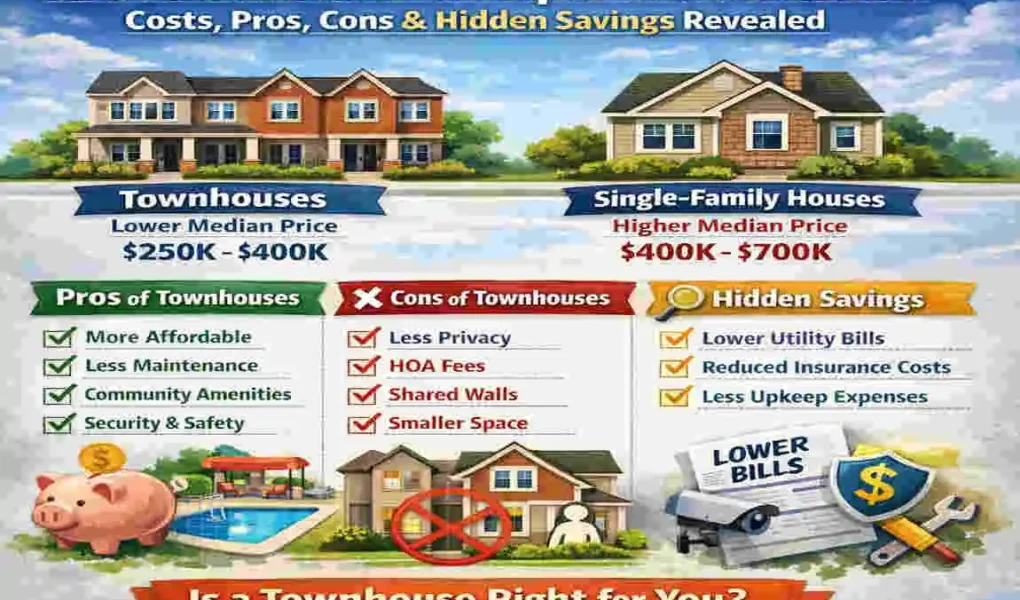
To make the best decision for your wallet and lifestyle, you need to understand the fundamental differences between these two property types. A single-family house is a standalone structure. It sits on its own piece of land, and it does not share any walls with neighbouring properties. You own the building, the land beneath it, and the sky above it.
A townhouse, on the other hand, is a multi-level home that shares at least one wall—and sometimes two—with an adjacent property. You still own the interior and the land directly beneath your unit. Still, you are part of a larger, connected community.
When we look at the numbers, the price gap is hard to ignore. In the United States, the average price of a townhouse sits around $350,000, while a traditional single-family house averages around $450,000. If we look at international markets, like the bustling city of Lahore in Pakistan, we see similar trends. A modern townhouse in a good area might cost you between PKR 20 million and 40 million. At the same time, a standalone house in a comparable neighbourhood can easily cost PKR 30 to 60 million.
Upfront Purchase Costs: Townhouses vs. Houses
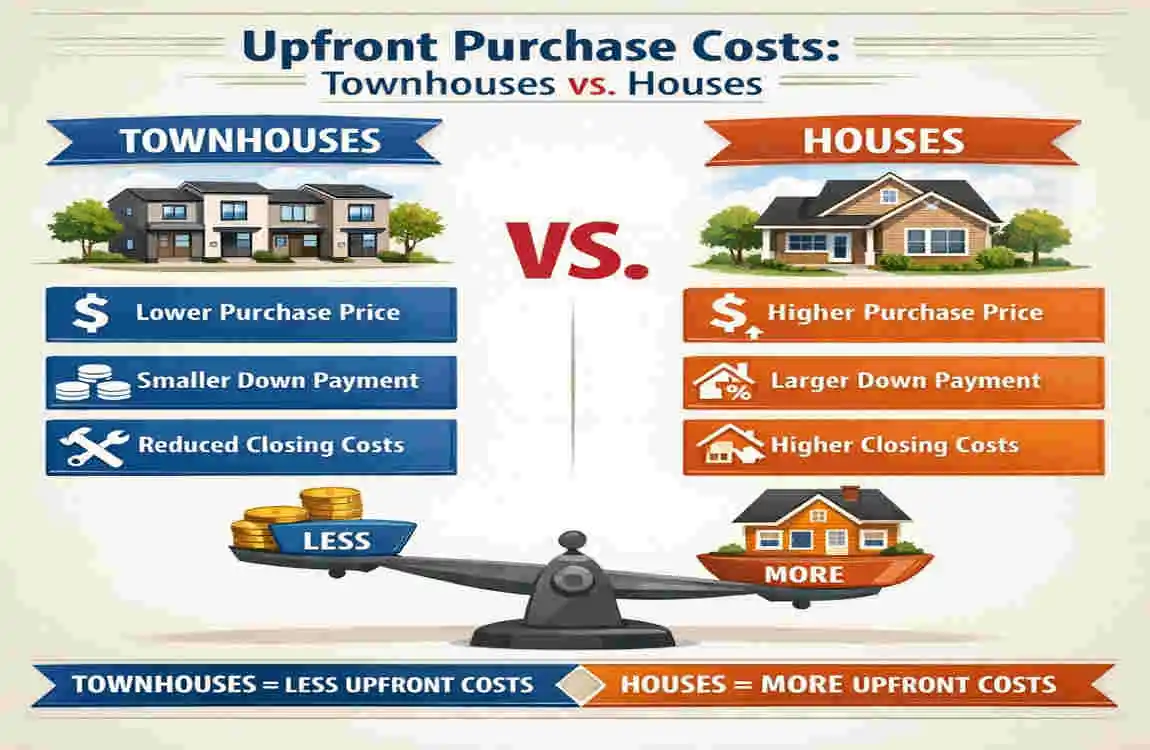
When you start browsing real estate listings, the first thing that jumps out at you is the asking price. As we mentioned, townhouses almost always win the battle of upfront affordability. But why exactly is that the case?
The biggest factor influencing this price difference is land costs. When you buy a detached house, you are paying a Premium for the sprawling front yard, the private backyard, and the space between your walls and your neighbour’s fence. Land is incredibly expensive, especially in highly desirable neighbourhoods.
Because townhouses are built upward rather than outward, and because they share walls, developers can fit more homes onto a single plot of land. This high-density building strategy drastically lowers the cost of the land associated with your specific unit. The developer passes those savings directly on to you, the buyer.
Size also plays a major role in upfront costs. Generally speaking, townhouses offer a smaller footprint. A standard townhouse might give you anywhere from 1,500 to 2,500 square feet of living space. In contrast, a typical single-family house often ranges from 2,000 to 3,500 square feet or more. You are simply buying less square footage when you choose a townhouse, which naturally lowers the purchase price.
Whether you are looking at brand-new constructions or older resale homes also matters. A brand-new townhouse with modern amenities will cost more than a twenty-year-old house that needs a new roof. However, if you compare a new townhouse to a new house in the same neighbourhood, the townhouse will reliably be the cheaper option.
To help you visualise these differences, let us look at a simple side-by-side price comparison chart.
Real Estate Cost Comparison Chart
Category Townhouse Average Single-Family House Average Estimated Savings
Purchase Price (US) $350,000 $450,000 $100,000
Purchase Price (Lahore) PKR 25 Million PKR 45 Million PKR 20 Million
Average Size 1,800 sq ft 2,500 sq ft 700 sq ft less to clean!
Down Payment (20%) $70,000 $90,000 $20,000 cash saved
Regional Variations: Urban Thrills vs. Suburban Sprawl
It is crucial to remember that real estate is hyper-local. The price gap between a townhouse and a house changes depending on where you are looking.
If you want to live in a dense, highly populated urban area—like downtown Chicago or the upscale DHA phases in Lahore—single-family houses are incredibly rare. Because they are so rare, they command astronomical prices. In these urban environments, buying a townhouse is often the only realistic way for a normal buyer to enter the market.
Conversely, if you move out to the deep suburbs or rural areas, land becomes much cheaper. Out in the country, the price difference between a townhouse and a house shrinks significantly. In some rural towns, a sprawling house costs nearly the same as a newer townhouse located closer to the city centre.
When deciding what to buy, ask yourself what kind of environment you crave. Do you want the bustling energy of the city, or the quiet isolation of the suburbs?
Ongoing Ownership Costs Breakdown
Getting the keys to your new home is an amazing feeling, but that is just the beginning of your financial journey. Homeownership comes with a parade of ongoing monthly and yearly expenses. Let us break down how townhouses and houses compare when it comes to keeping the lights on and the roof over your head.
Mortgage and Financing
Your monthly mortgage payment is usually your biggest expense. Because townhouses are cheaper to buy upfront, your loan principal will be significantly smaller. A smaller loan means you pay less in interest over the life of your mortgage.
Furthermore, townhouses often qualify for highly favourable loan programs. For example, if you are a first-time homebuyer in the United States, you might use an FHA loan. These loans require very low down payments. Because townhouse prices fall well within FHA loan limits, securing financing is often much easier.
Let us look at a practical example. If you lock in a standard interest rate, your monthly mortgage payment on a $350,000 townhouse might sit around $1,800. If you buy the $450,000 house, your monthly payment could jump to $2,300 or more. That is a $500 difference every single month, which equates to $6,000 a year staying right in your pocket.
Property Taxes and Insurance
Nobody likes paying taxes, but it is an unavoidable part of owning real estate. Luckily for townhouse owners, property taxes are generally lower.
Local governments calculate your property taxes based on the assessed value of your home and the land it sits on. Because your townhouse occupies a much smaller footprint of land compared to a sprawling single-family estate, your tax bill will reflect that smaller size.
When it comes to home insurance, townhouse owners enjoy another brilliant financial perk. When you buy a detached house, you must buy a comprehensive insurance policy that covers the entire structure—from the foundation to the tip of the chimney.
When you buy a townhouse, your Homeowners Association (HOA) usually holds a master insurance policy that covers the exterior of the building, the roof, and the shared spaces. You only need to purchase a “walls-in” insurance policy that covers your personal belongings and interior fixtures. Because you are insuring against less risk, your monthly insurance premiums are often 20% to 30% lower than those for a traditional homeowner’s policy.
Utilities and Maintenance Fees
This is the section where the financial debate between townhouses and houses gets truly interesting.
When you buy a townhouse, you will almost certainly have to pay a monthly Homeowners Association (HOA) fee. These fees typically range from $200 to $400 a month, though luxury communities can charge much more. When you buy a standalone house, you usually do not pay HOA fees.
At first glance, this makes the townhouse look more expensive every month. However, you have to look at what that fee actually buys you.
For a townhouse owner, the HOA fee usually covers exterior maintenance. If the roof leaks, the HOA pays to fix it. If the driveway cracks, the HOA repaves it. They mow the lawns, trim the trees, plough the snow in the winter, and keep the neighbourhood looking pristine.
If you own a single-family house, you are the HOA. You have to buy the lawnmower. You have to pay for the landscaping. If your roof needs replacing, you are on the hook for a massive $10,000 bill. When you factor in the cost of a full yard, constant upkeep, and major structural repairs, the standalone house often ends up costing much more in the long run.
Here is a quick checklist of things you must pay for out-of-pocket with a house, but are often covered by a townhouse HOA:
- Roof replacements and patching.
- Exterior painting and siding repairs.
- Lawn care, weed control, and tree trimming.
- Snow removal and driveway salting.
- Trash pickup and sometimes basic water utilities.
- Maintenance of community amenities such as pools and gyms.
Furthermore, do not forget about energy efficiency. Townhouses are sandwiched between other homes. Those shared walls act as massive, thick layers of insulation. During the freezing winter, your neighbour’s heat helps warm your walls. During the scorching summer, your home retains cool air much better. Townhouse owners consistently see their heating and cooling bills drop by 10% to 15% compared to owners of drafty, detached houses.
Pros and Cons of Townhouses vs. Houses
Every real estate purchase requires a compromise. There is no perfect home, only the perfect home for your specific lifestyle. Let us lay out the honest pros and cons of both property types.
Townhouse Pros
The absolute biggest advantage of a townhouse is the lower buy-in cost. It is the ultimate stepping stone for people who are tired of renting but cannot quite afford a half-million-dollar mortgage.
Beyond the price, townhouses offer an incredibly low-maintenance lifestyle. If you are a busy professional, a frequent traveller, or someone who hates doing yard work on the weekends, a townhouse is a dream come true. You get all the benefits of owning a home without the physical labour of maintaining the exterior.
Location is another massive pro. Townhouses are often built in highly desirable, prime locations. You are much more likely to find a townhouse within walking distance of coffee shops, grocery stores, transit lines, and vibrant downtown areas.
Finally, do not overlook the community amenities. Many townhouse complexes feature beautiful swimming pools, modern fitness centres, tennis courts, and private parks. If you tried to build a pool and a gym at a single-family house, it would cost you a fortune. In a townhouse, it is included in your monthly lifestyle.
There are hidden savings here, too. You do not need to buy heavy-duty tools, lawn equipment, or exterior maintenance supplies. Furthermore, when it is time to move, townhouses often sell much more quickly because young professionals and downsizers alike seek them out.
Townhouse Cons
Of course, townhouse living is not for everyone. The most common complaint is dealing with HOA rules and restrictions.
When you live in a townhouse, you have to play by the community rules. You usually cannot paint your front door a wild colour. You might face restrictions on the type of pets you can own or how many cars you can park in your driveway. If you value absolute, unchecked freedom, an HOA will quickly get on your nerves.
Privacy is another concern. You share walls with other human beings. Even with great soundproofing, there is always the potential for noise from neighbours. You might hear muffled footsteps, a loud television, or a barking dog next door.
You also sacrifice outdoor space. If you dream of hosting giant backyard barbecues, planting a massive vegetable garden, or giving your golden retriever an acre to run around, a townhouse patio will not cut it.
House Pros and Cons Comparison
To give you the full picture, let us quickly look at the detached house.
The Pros of a House: You get absolute privacy. You have no shared walls, meaning zero noise from your neighbours. You get total creative freedom to renovate, paint, and landscape exactly how you want. You get significantly more space, both indoors and outdoors, which is perfect for growing families.
The Cons of a House: You pay a massive Premium upfront. Your property taxes are much higher. Most importantly, you are solely responsible for all upkeep. When things break—and they always do—you are the one writing the check and doing the heavy lifting. The sheer amount of time required to maintain a single-family house can feel like a part-time job.
Hidden Savings and Long-Term Costs Revealed
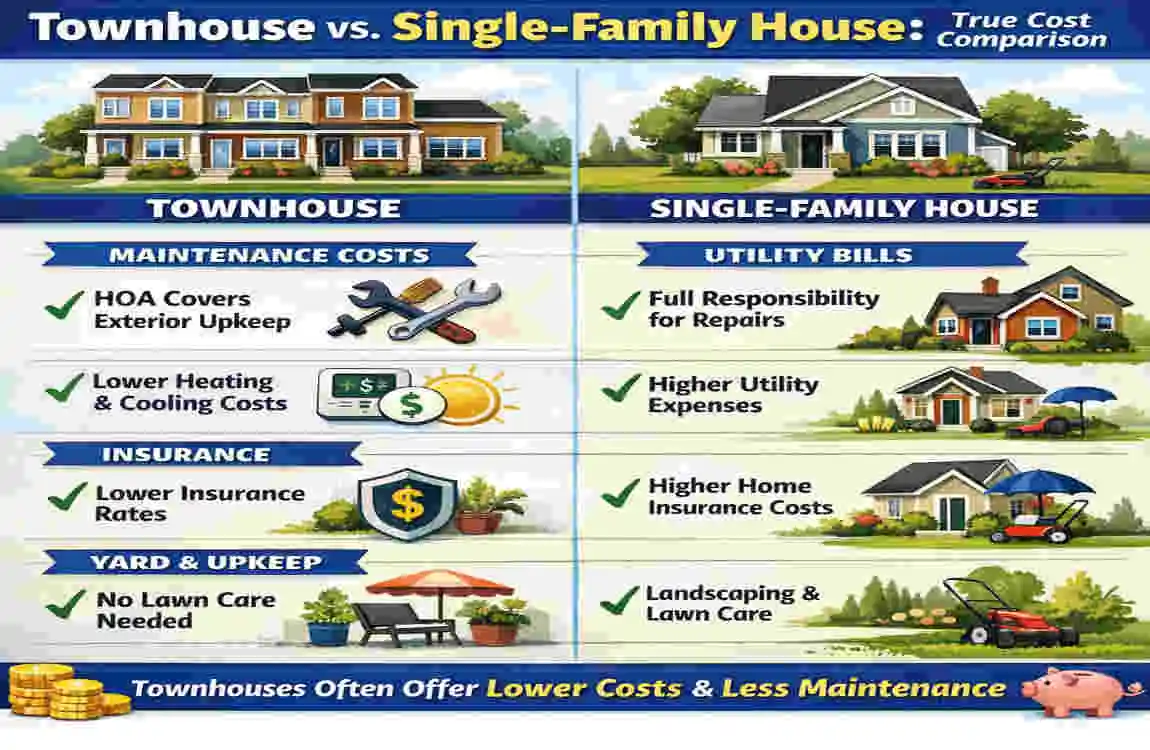
Now that we have covered the basics, let us dive into the advanced economics of homeownership. This is where we uncover the hidden numbers that most buyers never even think about until it is too late.
If you are trying to figure out if townhouses are truly cheaper, you have to look at these five specific hidden savings.
Massive Energy and Utility Savings
As we touched on earlier, shared walls are a financial superpower. Think about a detached house; it has four exterior walls constantly battered by freezing winds or baking in the summer sun. A townhouse usually only has two exterior walls (the front and the back).
Because of this thermal insulation advantage, it takes significantly less energy to regulate the temperature in a townhouse. In real-world scenarios, a townhouse owner can easily save $500 or more a year on electricity and gas bills compared to someone trying to heat and cool a sprawling house.
The True Cost of Maintenance and Repairs
When a massive hailstorm damages your roof, what happens next? If you own a house, you have to panic, call a roofer, and drain $10,000 from your emergency savings to fix it.
If you own a townhouse, you call your HOA. Because they collect a portion of everyone’s fees into a reserve fund, they handle the massive structural repairs. According to real estate experts, the average homeowner spends roughly $5,000 each year on DIY projects, general upkeep, and emergency repairs for a standalone house. Townhouse owners rarely face these sudden, terrifying financial hits.
Resale Value and Appreciation
Many people mistakenly believe that townhouses do not appreciate as fast as detached houses. In modern markets, that is not true.
As housing affordability becomes a global crisis, more and more people are turning to townhouses. This high demand means townhouses appreciate brilliantly, especially in urban areas and desirable suburbs. On average, townhouses in strong markets appreciate at a healthy rate of 4% to 6% annually. When you eventually sell, you will likely walk away with a fantastic profit.
Lifestyle and Commuting Costs
Where your home is located dictates how you live. Because townhouses are often closer to urban centres, public transit, and commercial hubs, they boast fantastic “walkability” scores.
If you can walk to the grocery store, commute via a nearby train, or bike to your favourite restaurant, you use your car significantly less. This translates to hidden savings on gasoline, vehicle wear and tear, and expensive city parking fees. A detached house deep in the suburbs usually requires you to drive everywhere, drastically increasing your monthly transportation budget.
The 5-Year Ownership Case Study
Let us look at a realistic five-year projection.
Imagine you buy a townhouse. You pay $350,000 upfront. Over five years, your mortgage, taxes, lower insurance, and HOA fees bring your total out-of-pocket housing cost to roughly $280,000.
Now, imagine you buy a house. You pay $450,000 upfront. Over five years, you have a higher mortgage, higher taxes, expensive homeowner’s insurance, and zero HOA fees. Still, you have to buy a new HVAC system, pay for weekly lawn care, and fix a leaky roof. Your total out-of-pocket housing cost climbs to roughly $380,000.
Over just five years, the townhouse owner has saved a staggering $100,000 in total cash outlay.
Are Townhouses Right for You? Decision Factors
Numbers are incredibly important, but real estate is deeply personal. Your home is where you build your life. Even if a townhouse is mathematically cheaper, it has to fit your lifestyle. So, how do you decide?
Let us look at the common buyer profiles.
First-Time Homebuyers: If you are buying your very first property, a townhouse is usually the smartest move. It allows you to stop paying rent, build equity, and learn the ropes of homeownership without being overwhelmed by maintenance.
Empty-Nesters and Retirees: If your kids have grown up and moved out, do you really want to spend your retirement cleaning a four-bedroom house and shovelling snow? Townhouses offer downsizers a secure, maintenance-free lifestyle that frees up time for travel and relaxation.
Urban Dwellers and Young Professionals: If your priority is being close to the action—restaurants, nightlife, and your office—a townhouse is your best friend.
However, we must look at when single-family houses actually win the debate.
If you have a large, growing family with three rambunctious kids, a townhouse will quickly feel cramped. Children need space to run, and teenagers need privacy. If you own multiple large dogs, the lack of a private backyard will become a daily frustration. Furthermore, if you are a DIY enthusiast who loves woodworking in a massive garage or building extensive gardens, a standalone house is the only way to satisfy your hobbies.