There is no single standard UK door size. What the industry calls “standard” is shorthand for “commonly manufactured” and it has never meant every home in Britain uses the same opening. The most common internal door size in England and Wales is 1981 x 762mm. In Scotland, 2040 x 726mm is more typical. Those are catalogue starting points, not a guarantee your opening matches them.
The real buying risk comes from assuming your home fits the catalogue. Older properties, extensions, and conversions routinely fall outside these sizes. Ordering the wrong door triggers restocking fees, extra joinery work, and delays to follow-on trades. Measure first, and measure correctly.
Is There a Standard Door Size in the UK?
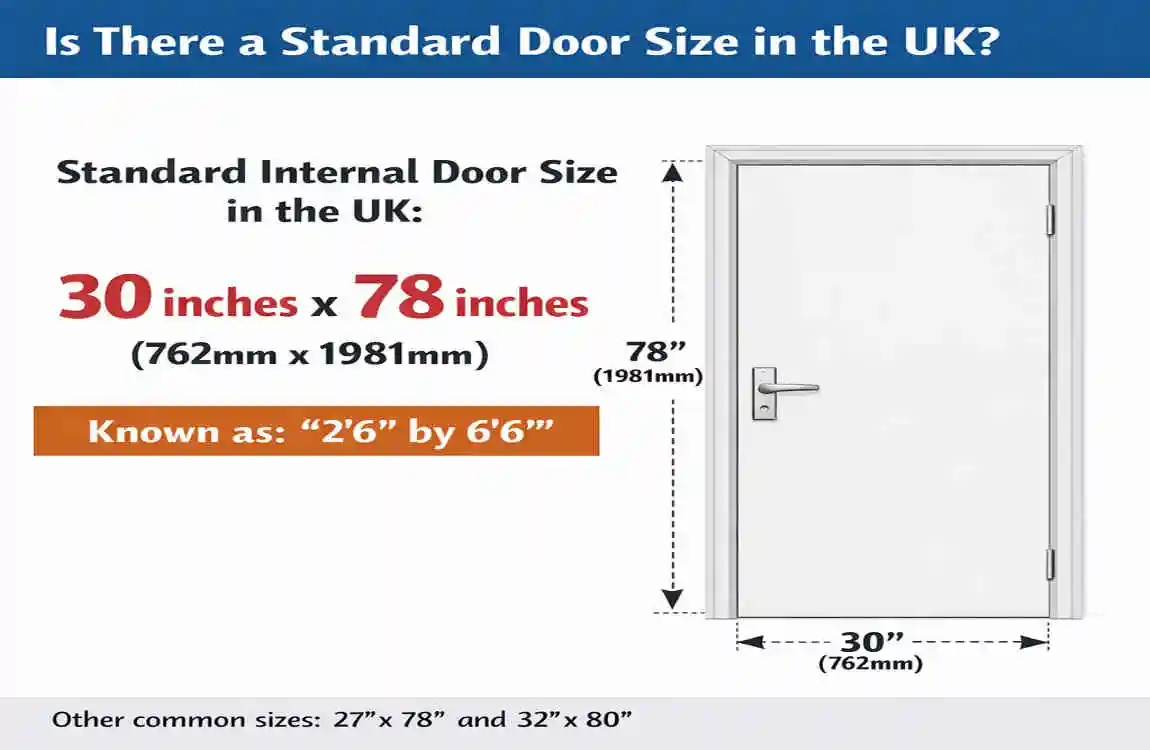
No. There is no legally mandated single door size for UK homes. “Standard” describes dimensions that manufacturers produce in volume and merchants stock and it makes doors cheaper and faster to source, but it says nothing about your specific opening.
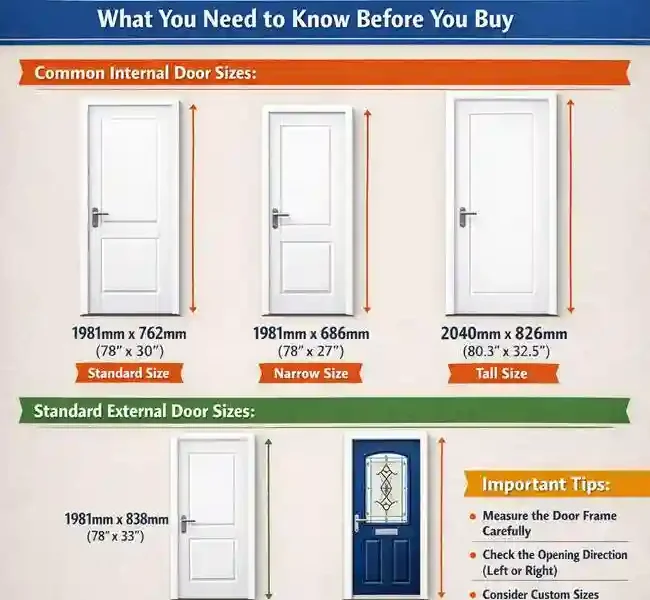
The most commonly stocked internal door leaf sizes are:
- 1981 x 762mm (6ft 6in x 2ft 6in): most widely stocked in England and Wales
- 1981 x 686mm (6ft 6in x 2ft 3in): bathrooms and smaller rooms
- 1981 x 610mm (6ft 6in x 2ft 0in): older housing stock and cupboard openings
- 1981 x 838mm (6ft 6in x 2ft 9in): wider openings, often specified for accessibility
- 2040 x 726mm: the common internal size in Scotland
External doors vary more than internal ones. Frame systems, security specs, threshold requirements, and manufacturer ranges all introduce variation. Common external sizes include 2032 x 813mm and 2032 x 914mm, but these are rough guides rather than reliable defaults.
Common UK Door Sizes at a Glance
| Width (mm) | Height (mm) | Width (imperial) | Height (imperial) |
| 610 | 1981 | 2ft 0in | 6ft 6in |
| 686 | 1981 | 2ft 3in | 6ft 6in |
| 726 | 2040 | 2ft 4.5in | 6ft 8.25in |
| 762 | 1981 | 2ft 6in | 6ft 6in |
| 838 | 1981 | 2ft 9in | 6ft 6in |
Door thickness
Standard internal doors run at 35mm or 44mm. External doors are generally 44mm. Fire-rated and security-rated doorsets require specific thicknesses to maintain their certification; a thinner leaf substituted into a rated doorset invalidates the rating. If replacing a single leaf into an existing lining, check the rebate depth before ordering.
What BS and EN Standards Actually Mean
Standards referenced in door product listings (particularly EN 14351-1, the product standard for external pedestrian doorsets) govern performance, testing methodology, and product consistency. They do not define the dimensions of your opening. When a doorset is CE or UKCA marked against EN 14351-1, it tells you the product has been assessed as a complete doorset with declared performance characteristics (wind resistance, water tightness, thermal transmittance, and so on). It does not tell you what size opening you should have.
Dimensions do intersect with building regulations in specific situations. Approved Document M sets minimum clear opening widths for accessible and adaptable dwellings; the key figure is 775mm clear opening width for doorways on accessible routes. An 838mm door leaf in a standard frame typically achieves close to that, which is why wider internal doors are specified on accessible new builds. If your project falls under Part M, work from the required clear opening width backwards to the leaf size you need.
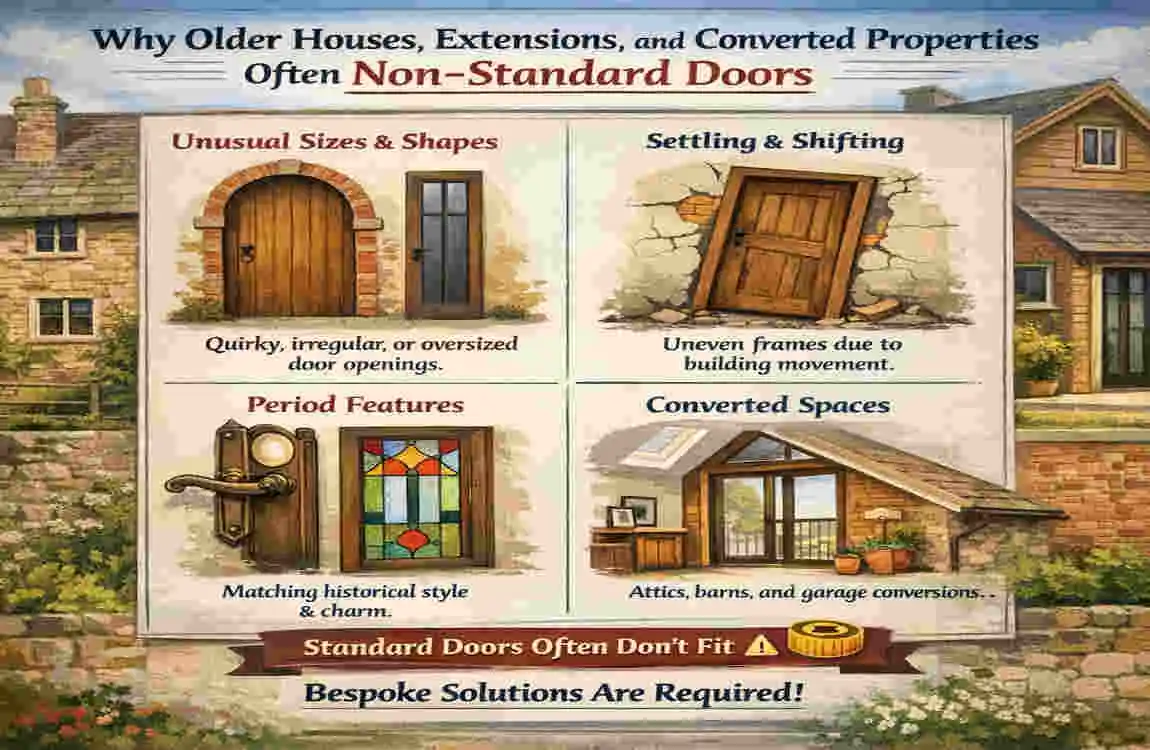
Why Older Houses, Extensions, and Converted Properties Often Need Non-Standard Doors
Older houses
Properties built before metric sizing was adopted often have openings that do not align with current catalogue dimensions. Settlement shifts masonry openings over time. Door linings and frames get replaced and rebuilt. A Victorian terrace or a 1930s semi that has had its linings replaced more than once is unlikely to sit exactly at 1981 x 762mm without fitting work.
Extensions and conversions
Extensions introduce different floor build-ups, insulation specifications, and threshold heights compared to the original house. A rear extension with underfloor insulation may have a finished floor level 50-80mm higher than the main building, which directly affects available door height.
Conversions add further complexity. Loft, flat, and commercial conversions frequently introduce fire door requirements on escape routes, minimum means-of-escape widths, and access obligations that prescribe clear opening dimensions.
The rule for any period property, heavily renovated building, or conversion: measure first, assume nothing.
The 3 Measurements People Get Wrong
Measuring the existing door leaf
The most common mistake is taking the dimensions of the door currently in the opening and ordering to match. That leaf may have been trimmed when first fitted, swelled over time, or simply be the wrong size for its frame. Always measure the frame opening, not the door sitting inside it.
Ignoring frame allowance and fitting tolerance
A doorset frame needs a structural opening larger than itself to allow for levelling, packing, and fixing. A 762mm-wide doorset typically needs a structural opening of 800-820mm or more. Latham’s guide to UK standard door sizes addresses this directly: if the frame is not yet fitted, frame width and fitting tolerances must be factored in: the structural opening and the door leaf are not the same measurement.
Confusing leaf size with clear opening width
Clear opening width (the usable gap when the door is open) is always narrower than the leaf width. A 762mm leaf in a standard frame gives roughly 726mm clear. An 838mm leaf gives approximately 800mm clear. This distinction matters for accessibility compliance, for moving large furniture, and for anything that needs to pass through the opening in practice.
How to Measure Correctly
Measure width at the top, middle, and bottom of the opening. Measure height at the left, centre, and right. Use the narrowest reading in each direction as your working dimension, as openings in older properties are frequently not parallel.
Check wall depth (this determines frame or lining depth) and use a spirit level or large square to check squareness. An out-of-square opening must be corrected before fitting, or the door will not operate or seal correctly.
Finally, know which dimension you are measuring:
- Door leaf: the panel itself, the number on the product listing
- Frame opening: the internal clear gap within the fitted lining
- Structural opening: the raw gap in the wall before any frame is installed
Confusing these three is the root cause of most door-ordering errors.
Why Getting the Size Wrong Costs Money
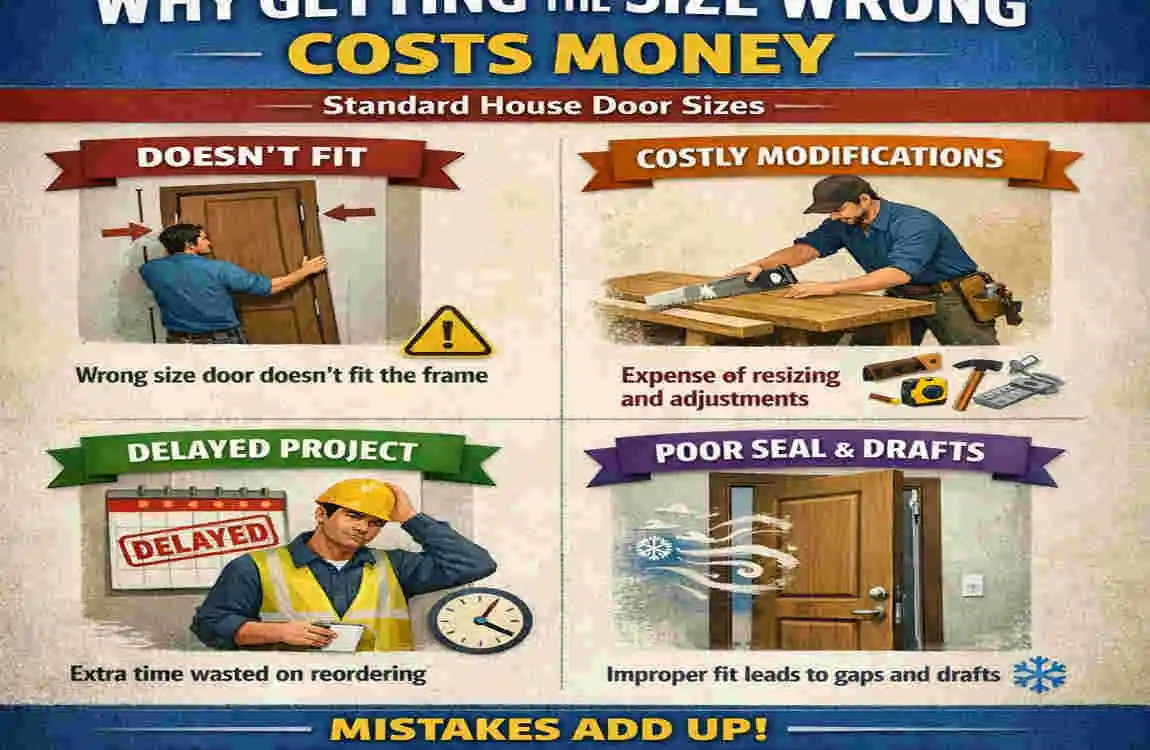
Security-rated and fire-rated doorsets are frequently built to order and non-returnable. A sizing error means writing off the cost entirely rather than reordering.
Even a door that can be trimmed has strict limits. Most manufacturers specify a maximum of 6-10mm per edge; cutting beyond that risks exposing the core, compromising a fire rating, or voiding the product warranty. Re-framing an undersized opening adds plasterer, painter, and threshold costs on top of the door itself.
In a renovation with a trade programme, a wrong-size door can hold up plasterers waiting to finish a reveal, floor layers working to a threshold height, and decorators waiting for reveals to be complete. A single ordering mistake can cost days on a project timeline.
A door fitted incorrectly (gaps, uncompressed seals, a frame that is not plumb) will not perform to specification. For external security doors in particular, an installation that does not meet the correct parameters can compromise the tested performance the product was certified to achieve.
Standard Size or Made-to-Measure?
Standard sizes work well for post-war and modern homes where the frame system is known and the opening was built to metric dimensions. A straightforward internal door swap in a 1990s or 2000s house is a good candidate.
Consider made-to-measure when working with pre-1940 masonry openings, walls over 200mm thick, extensions with different floor levels, or any situation where your three width measurements differ by more than about 10mm. For non-standard situations requiring security or fire-rated external doors, manufacturers like Latham’s offer custom-made steel doors built to your exact structural opening, which is a more reliable outcome than trimming a rated product into a frame it was not designed for.
Final Thought: Standard Helps, But Measuring Decides
Standard UK door sizes make buying easier, faster, and cheaper when they apply. The problem is treating them as a fit guarantee. Measure the opening (not the old door), understand the difference between leaf size, frame opening, and structural opening, account for fitting tolerances, and cross-check against a clear sizing reference before you commit to an order.
Before ordering, Latham’s guide to UK standard door sizes walks through common dimensions, metric-to-imperial conversions, and basic measuring steps, and is a useful reference for homeowners and trade buyers alike.
Frequently Asked Questions
What is the standard internal door size in the UK?
The most common internal door size in England and Wales is 1981 x 762mm (6ft 6in x 2ft 6in). In Scotland, 2040 x 726mm is more typical. These are manufacturing norms, not legally mandated dimensions. Many homes, particularly older or extended properties, will not match them without adjustment.
Is there a standard front door size in the UK?
No single universal size exists. Some external sizes are more commonly stocked (2032 x 813mm and 2032 x 914mm appear frequently), but front door sizes vary considerably by frame system, security specification, and manufacturer range. Always measure the frame opening before ordering an external replacement.
Why does my older house not match standard door sizes?
Older properties were often built to imperial dimensions that do not convert exactly to current metric sizes. Settlement shifts masonry openings over time, and door linings may have been replaced or modified. Any combination of these factors can produce an opening that sits between standard sizes.
Should I measure the door or the frame?
Measure the frame opening if you are replacing a leaf into an existing frame. Measure the structural opening if you are fitting a new doorset. The existing door leaf is not a reliable measurement to order against.
Can I trim a door to fit?
Most timber doors can be trimmed slightly, typically up to 6mm per edge as a general guide, though this varies by manufacturer and construction. Fire-rated and security-rated doors have strict limits on trimming without invalidating their certification. If a door requires significant trimming to fit, a different size or a made-to-measure product is usually the better option.