More than 26% of UK homeowners admit that they are more likely to remodel than relocate given the current financial climate. The same sentiment is echoed across the pond where homeowners are opting for renovation over relocation. As such, the US home improvement market is projected to reach $699 billion by 2029 according to the Home Improvement Research Institute (HIRI). However, while renovating an older home is incredibly rewarding, it also comes with some cold surprises. The primary reason is older homes were built using different building practices. Hence, there may be hidden dangers once parts of a house are torn open for renovation. The key is to test something first before restoring or fixing it up.
Asbestos and Lead
In older homes, plumbing may be an issue and hence, one of the upgrades to focus on is to redo the system. While it may be tempting to make it a do-it-yourself (DIY) project, hiring a company or individual to provide professional plumbing services is a safer bet. This is because older structures frequently contain piping materials that are hazardous or well past their natural lifespan. A professional plumber knows exactly how to spot and handle these materials safely. For example, lead pipes were common in homes constructed before 1986 in the US and before 1970 in the UK. Unfortunately, lead can leach into drinking water posing several health risks. Thus, if exposing, repairing, or altering an existing plumbing system during a renovation, it is vital that it is brought up to modern building codes. Public policy has also shifted heavily toward total eradication. In the US, the Environmental Protection Agency (EPA) mandates that public water utilities identify and completely replace all lead service lines.
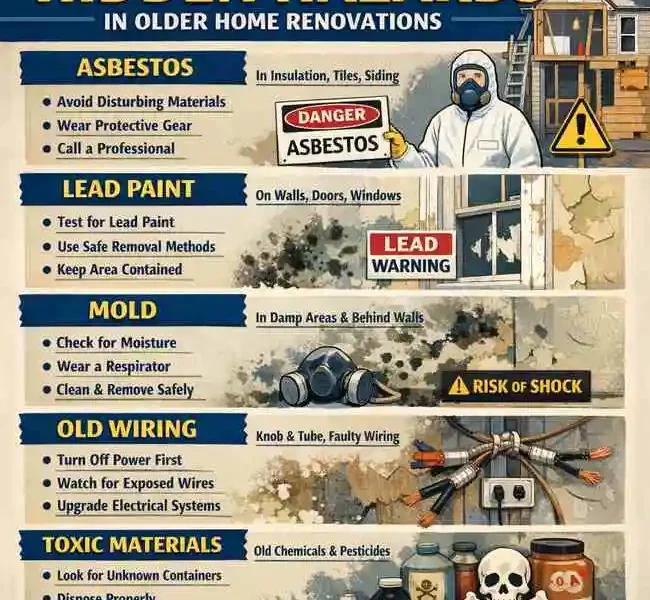
Another toxic substance that was predominantly used in older homes is asbestos. It is a naturally occurring silicate mineral that offers unique physical and chemical properties. Asbestos has highly durable fibers that make it a good construction material. It does not burn and its melting point is extraordinarily high. In addition, it offers excellent thermal and acoustic insulation while its tensile strength and durability make it highly resistant to weathering and warping. To top it all, asbestos is cheap to mine and process. Hence, asbestos was used in flooring, walls & ceilings, roofing & siding, and even heating, ventilation, and air conditioning (HVAC) systems. The good news is asbestos is perfectly safe if it is intact and untouched. Alas, when it is damaged or broken up, it releases microscopic fibers that can be inhaled causing permanent lung damage or mesothelioma. The golden rule of asbestos is to leave it completely alone. If a material needs to be removed as part of a renovation, it is best to hire a certified asbestos abatement specialist who can safely remove and dispose of the hazardous waste in accordance with local laws.
Mold and Electrical Systems
The presence of mold in homes has consequences on the structure of the building and on the health of its occupants. Mold reproduces by releasing minute spores in the air. In older structures with restricted airflow, these spores can accumulate to high concentrations. Inhalation of these spores can lead to coughing, wheezing, and throat irritation. Certain types of dark mold or toxic black mold is linked to severe neurological symptoms and may compromise immune systems. Its presence on the structure of a house is also negative. It is not only an ugly stain on walls, ceiling, furniture, or objects, mold can lead to structural wood rot, sagging floors, and warping door frames. If left unchecked, mold eventually leads to structural failure damaging plaster and drywall. Therefore, mold remediation, as part of renovation, involves replacing ductwork, checking the HVAC system, fixing plumbing systems, and sanitation and encapsulation.
On top of mold, electrical systems are also problems in older properties. Many houses have decaying wiring, ungrounded outlets, and overloaded circuits. These ancient systems were not designed to meet the capacity of modern appliances and gadgets. Thus, it is vital to update the entire electrical wiring system to meet capacity and building codes, and for safety. These measures include installing dedicated circuits and installing new boxes.
Renovating an older structure can be likened to opening a time capsule. The presence of lead, asbestos, and mold as well as an outdated electrical wiring system are risks that must be spotted early and handled safely for a successful remodel.