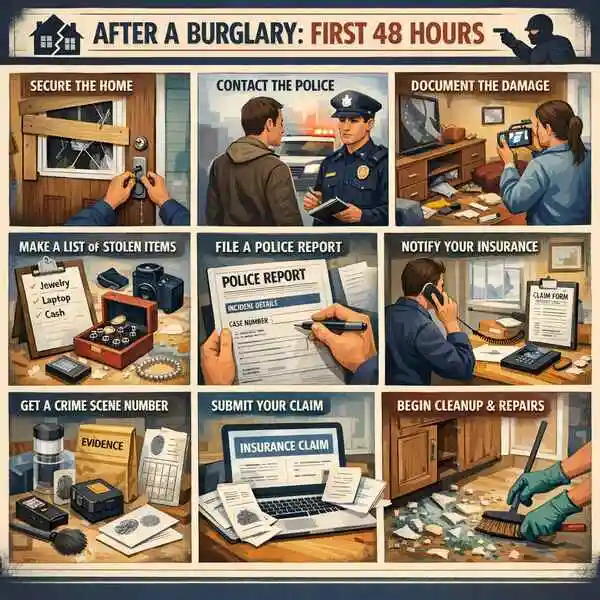
Coming home to find your front door forced open or a window smashed is a horrible experience. Your mind races, and it’s hard to think clearly about what to do next. But the steps you take in the first 48 hours after a burglary will make a big difference to your insurance claim, the police investigation and how quickly you get your home back to normal.
Don’t Touch Anything Before the Police Arrive
Your first instinct will be to walk through the house and check what’s missing. Try to resist that. Moving things around or cleaning up can destroy evidence that the police need to build a case. Fingerprints, footprints, DNA traces and tool marks on doors or windows are all useful to forensic teams, and they’re easy to contaminate without realising.
If it’s safe to enter, take a quick look from the doorway of each room but avoid touching surfaces, handles or broken items. If a door or window has been forced, don’t try to close it or prop it shut just yet. Call 999 if you believe the intruder might still be inside or has just left the scene, and call 101 or use your local force’s online reporting to report the burglary once you’re sure the property is empty and the offender is long gone.
The police will give you a crime reference number when they log the report. Write this down or save it on your phone straight away. You’ll need it for your insurance claim, and your insurer won’t process anything without it.
Photograph Everything Before You Clean Up
Once the police have attended and given you the go-ahead, grab your phone and photograph every bit of damage. Broken locks, smashed glass, forced door frames, ransacked drawers and any items left behind by the intruder. Get wide shots of each room and close-ups of specific damage.
These photos will support your insurance claim and give your insurer a clear picture of what happened. Take more than you think you need. It’ll be much easier to have too many photos than to realise later that you missed something important. If anything is missing, photograph the empty space where it was, especially if you have older photos showing the item in place.
Call Your Insurer as Soon as You Can
Most UK home insurers will expect you to report a burglary as soon as reasonably possible, so don’t put this off. Some policies do set a specific window like 24 or 48 hours, so check the wording, but the sooner you call, the smoother the claim will go. Have your crime reference number ready along with your policy details. Your insurer will walk you through the claims process and tell you what documentation they need.
They’ll likely ask for a list of stolen or damaged items with estimated values. If you have receipts, warranty cards or bank statements showing purchases, dig those out. For higher-value items like electronics or jewellery, your insurer may ask for proof of ownership before they’ll pay out.
Check your policy wording carefully too. Some policies cover emergency locksmith callouts and temporary boarding-up after a break-in, so ask your insurer whether you can claim those costs back.
Get Your Property Secured Fast
You can’t leave a broken door or smashed window open overnight. Most people call an emergency locksmith or boarding-up service within a few hours of the break-in. Getting new locks fitted to any entry points the burglar used will be a priority, and your insurer may even insist on it before they’ll continue covering the property.
But don’t forget the smaller things. If keys were stolen during the break-in, you’ll need to replace locks on internal doors, window locks and even cabinets or sheds that used the same keys. For those, an online key cutting service like Fast Keys will cut to code and post them out quickly, which will save you booking a second locksmith visit.
Change More Than Just the Front Door Lock
A common mistake is only replacing the lock on the entry point that was forced. If your house keys were taken, the burglar now has access to every lock those keys fit. That could include your back door, side gate, garage and any padlocked outbuildings.
Go through every lock in and around your home and replace anything that shared a key with what was stolen.
Keep a Written Record of Everything
In the days after a break-in, you’ll speak to the police, your insurer, locksmiths and possibly tradespeople for repairs. Keep a simple log of every call, email and visit. Note dates, times, names and what was agreed. This will protect you if there’s any dispute later and will make follow-up calls much easier.
Hold on to every receipt for emergency repairs too. Boarding-up, lock changes, glazing and any temporary security measures should all be documented. Your insurer will want to see these when they assess your claim.
After the Dust Settles: Make Your Home Harder to Hit Again
Once the immediate crisis is dealt with, take a step back and think about what made your home vulnerable. Was it a weak door lock? A hidden side window with no lock at all? Poor lighting around the entry point?
Simple upgrades will make a real difference. Fit BS3621 five-lever mortice deadlocks on wooden doors, or TS007 3-star cylinders on uPVC and composite doors, since these are the standards most UK insurers ask for. Add key-operated window locks, motion-sensor lights and a visible alarm box, and some insurers will drop your premium in return.
The first 48 hours after a burglary are stressful, but handling them properly will speed up your claim, help the police and get your home secure again. Take it one step at a time, keep records of everything and don’t rush through the process.