
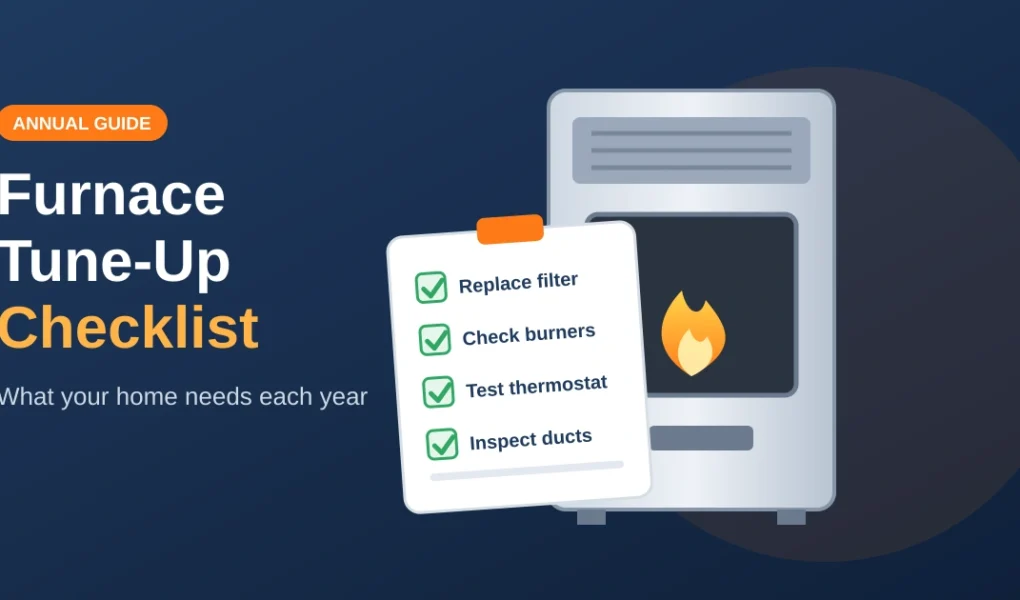
Annual Furnace Maintenance Checklist: What a Tune-Up Should Include
Quick Answer
A proper yearly service visit covers far more than a filter swap. A licensed technician inspects the heat exchanger, cleans and tests the burners, checks the blower and electrical connections, measures gas pressure, confirms safe venting, calibrates the thermostat, and tests every safety control. The visit should end with written readings and notes on anything worn. Expect roughly 60 to 90 minutes for a thorough job.
Introduction
The first truly cold night of the season has a way of exposing things. The thermostat clicks over, the furnace rumbles to life, and then goes quiet. No warm air at the vents, and nobody answering the phone at a heating company until morning. More often than not, the part that failed had been on its way out since spring.
That is why the yearly service visit earns its keep. Plenty of homeowners book it, pay the invoice, and never find out what the technician actually did down in the basement. A service breakdown like this furnace tune-up Calgary guide shows how many separate checks fit into one appointment, which makes it much easier to tell thorough work from a quick once-over.
Knowing the full list changes how you watch that visit. It also tells you which questions are worth asking while the technician is still standing there. Here is what belongs on the job.
What Proper Furnace Maintenance Actually Covers
A good visit runs in a set order: safety checks, then airflow, then controls, then a live test with everything working together. The order matters because a clogged blower will skew the readings taken at the burner, so a technician who tests performance before cleaning is measuring the dirt, not the equipment.
The Gas Side Gets Looked At First
This is where trouble turns dangerous rather than merely uncomfortable, so it leads the list.
- Heat exchanger inspected for cracks, rust, and soot, usually with a camera or mirror
- Burners pulled, brushed clean, and watched through a full light-off for an even blue flame
- Ignitor or pilot assembly tested
- Gas pressure measured at the manifold and adjusted to the rating plate
- Flue and vent piping checked for corrosion, blockages, and proper slope
Ask for the combustion analyzer readings. Carbon monoxide, oxygen, and flue temperature tell you whether the burn is clean, and no amount of looking at the flame will give you the same answer.
Airflow, Filters, and Honest Furnace Cleaning
Restricted air causes more comfort complaints than failing parts do. A real cleaning reaches the blower wheel, not just the filter slot.
- Blower wheel and housing vacuumed free of dust and lint
- Motor bearings checked, and lubricated where fittings exist
- Belt tension and pulley alignment confirmed on older units
- Return and supply registers checked for blockages
- Condensate drain and trap flushed on high-efficiency models
Temperature rise across the heat exchanger then gets measured against the range printed on the data plate. A reading above that range points at airflow, not at the appliance.
Controls, Wiring, and a Full Heating Cycle
A furnace tune up should finish with the system running while someone experienced stands there and watches it.
| Check | What it confirms |
| Thermostat calibration | Room temperature matches the setting on the wall |
| Limit and rollout switches | The unit shuts itself down if it overheats |
| Flame sensor | Burners hold steady instead of short-cycling |
| Electrical connections | No loose terminals or scorched wiring |
| Blower amp draw | The motor is not straining past its rated load |
| Complete cycle test | Ignition, heating, and shutdown happen in the right order |
Your carbon monoxide alarms deserve a look while the panel is still off, since a working detector is the backup for everything above it on this list.
The Paperwork You Should Walk Away With
Ask for numbers, not a verbal summary at the door. A proper record lists gas pressure, temperature rise, combustion readings, and amp draws, along with notes on any part showing wear. Next autumn, those figures become a comparison instead of a guess. A flue temperature creeping upward or a blower pulling more current than last year shows a problem forming while you still have months to deal with it, and the same figures give you a fair way to weigh one company’s quote against another.
Scheduling, Price, and the Months Between Visits
Book Before the First Cold Snap
Early autumn is the window to aim for, for three reasons:
- Shops are quieter, so you get a choice of appointment times
- Anything found becomes a scheduled repair rather than a 2 a.m. emergency in January
- Parts for older models can be ordered without paying to rush a courier
Once a year suits most gas units, while equipment past the fifteen-year mark often earns a mid-season look as well. Hang onto every invoice too. Many manufacturers want proof of service before they will honour a warranty claim on a major part.
What Drives Your Furnace Maintenance Cost
Quotes swing widely between companies, and the gap usually reflects scope rather than greed. Find out what each number actually buys before you compare them.
| Factor | Effect on the quote |
| Combustion analysis included | Raises the price, and is worth paying for |
| Time booked on site | A 30-minute slot cannot cover the full list |
| Equipment type | Condensing units have extra drains and sensors to service |
| Filter supplied | Some quotes include one, many bill it separately |
| Service plan membership | Lower per-visit rate, paid as a yearly fee |
| After-hours or weekend booking | Premium labour rates apply |
Be careful with a price far below everyone else in town. It typically covers a filter swap, a quick look, and a pitch for a new system.
Your Own Jobs Between Service Calls
A few habits keep the system healthy through the months nobody is checking on it:
- Look at the filter monthly and change it on schedule, meaning every one to three months for thin ones and every six to twelve for thick pleated ones
- Keep at least 60 cm clear around the unit, and store nothing against it
- Brush snow and ice away from exterior intake and exhaust pipes after every storm
- Replace smoke and carbon monoxide alarm batteries each autumn
- Listen for new rattles, banging on start-up, or a system that cycles on and off quickly
Catching a change early buys you the one thing a mid-winter breakdown never offers, which is time to decide how you want to handle it.
Why Annual Furnace Maintenance Pays Off in Records, Not Receipts
A heating system rarely quits without warning. It quits after a season or two of small signals that nobody was in a position to read.
Treat the checklist as your measure of a good visit. Ask whether the heat exchanger was inspected, whether combustion was measured, and whether the numbers were written down. Anyone doing careful work will be glad to walk you through them.
Then keep those records together, year after year. They turn into a history of your own equipment: how the readings have drifted, which parts have been replaced, and roughly how many winters the unit has left in it. That file is worth more than any single invoice sitting in it, and it costs you nothing but a folder.