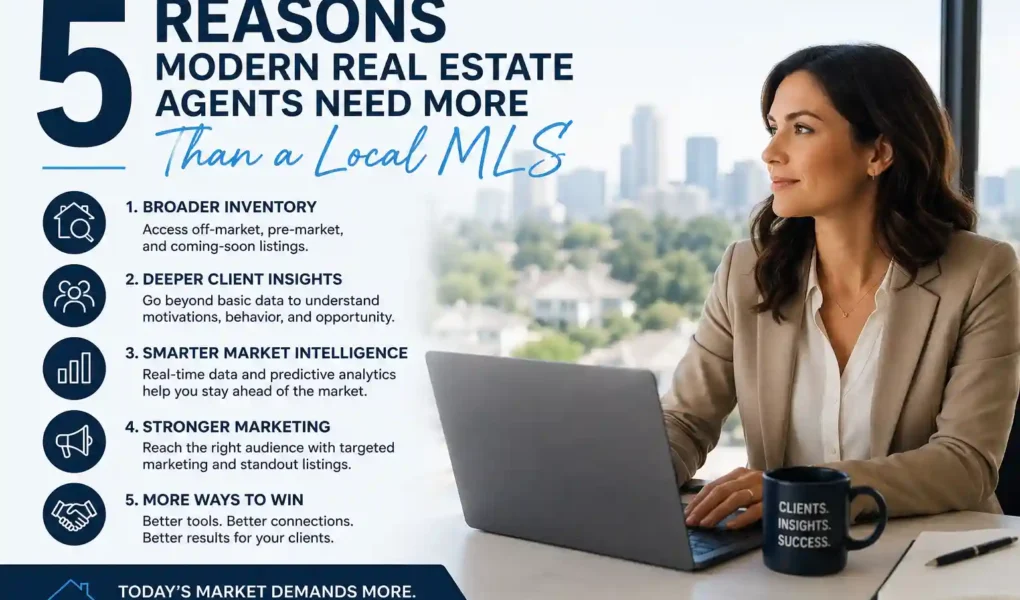
For many years, the real estate industry has used a set of local Multiple Listing Services (MLS) to share home information. This localized model worked well when most agents operated exclusively within their own counties. But things have changed; clients often move to new states. Some investors buy homes without even seeing them in person, sometimes from thousands of miles away. Top agents also grow their business in many places, not just in one area or state.
Depending just on local boards can hold back your growth. Today, agents need tools that keep up with the fast way buyers move and the large market out there.
Several major industry shifts are driving this change. Here are five reasons why modern agents are looking beyond traditional local MLS systems.
1. The Shift Toward Wider Exposure
These days, most people start looking for homes online. Limiting a listing to a single county MLS can significantly reduce a property’s exposure. The growth of google real estate listings reflects how buyers now search for properties online, often across multiple cities, states, and markets. Today, people looking to buy a home do not think about board borders. Their primary goal is to find the right property, regardless of geographic boundaries.
When an agent puts a property online using MyStateMLS, the information does not stay in just one area. It goes out to the top real estate websites all over the internet. Any buyer looking with a big search engine can see the listing. This is very important for special properties, commercial real estate, and land. The person who buys may not be someone who lives close by.
2. Why Local Boards Are Holding Modern Agents Back
Traditional local boards were important before there was the internet. They set up local rules, kept lists of homes on paper, and helped people in the area work together to sell houses. But now, because everything is digital, this kind of splitting things up has led to a few clear problems for real estate professionals.
- Compounding Fees: Agents who work in towns near the border or who help several different groups often need to pay the same fees to three or four different local boards just to get the market data they need.
- Data Silos: A local MLS does not usually share its data with the MLS of a neighboring county. This means agents may not know about properties for sale just a few miles away.
- Outdated Tech Barriers: A lot of local boards still use old software. This software may be slow to update, does not work well on mobile phones, and has hard-to-use screens that slow down daily work.
| Feature | Traditional Local Board | Nationwide MLS Platforms |
| Listing Boundary | Restricted to a specific county/city footprint | Nationwide coverage across all 50 states |
| Fee Structure | Often requires board membership + MLS fees | Flat rate options without forced board alignment |
| Cross-State Licensing | Difficult to manage under local rules | Designed to accommodate multi-state agents |
| Syndication Scope | Primarily local; limited national reach | Broad syndication to hundreds of property portals |
These limitations have become even more apparent as buyer behavior evolves in today’s changing housing market.
3. Buyer Behavior Is Reshaping Real Estate
The housing market has entered a highly calculated era. Current financial data points to national home prices stabilizing at a flat 0% growth rate, moving away from the chaotic hyper-inflation of the post-pandemic years. With fixed mortgage rates remaining steady at 6% or higher, buyers have become significantly more selective. They are no longer rushing into bidding wars over poorly exposed local properties; instead, they are taking their time and conducting cross-regional searches.
Because buyers are expanding their geographical search criteria to find affordability, a localized MLS leaves agents exposed to gaps in market visibility. When inventory sits longer on the market, relying solely on local circles restricts an agent’s ability to pull in out-of-market investors or cross-state buyers who have the capital to close deals.
4. Fragmented MLS Systems Increase Costs
Operating under the old system is rapidly becoming a major budgetary drain for independent brokerages. A standard real estate professional often pays hundreds of dollars per year for a single local board membership. However, as business boundaries blur, a growing percentage of modern agents find themselves forced to join three or more overlapping regional MLS platforms just to track listings in neighboring counties.
This compounding fee structure directly eats into marketing budgets at a time when operational efficiency is paramount. By utilizing a single, unified database instead of maintaining multiple fragmented accounts, real estate professionals can cut down on duplicate administrative costs while expanding their actual market listing footprint exponentially.
5. Modern Agents Need Borderless Technology
If you want to keep up, real estate pros need to be more than just “neighborhood experts.” They should start to act as real estate advisors for all needs. To do this, they need new tools that focus on being flexible and fast in today’s digital world.
Borderless Listing Power
Agents should be able to list a property in any place their license lets them. They should not need to join a new local board just for one sale. If a client asks you to sell some land two hours from you, your software should not stop you from doing your work in a good way.
Direct-to-Consumer Syndication
A modern listing platform needs to send information right away to big home-search websites, international portals, and special syndication feeds. This helps to make sure the listing gets seen by as many people as possible as soon as it is posted online.
Independence from Forced Affiliations
Many agents do not want to join local Realtor groups just to get the tools they need to buy and sell homes. If you want to work on your own, you should be able to use a strong listing site in a way that works best for you.
Conclusion: The Future of Property Syndication
The real estate world is moving to a more open and easy-to-see way of doing things. These days, using lots of small, local systems is not the best way for the digital market. A platform like MyStateMLS is helping lead the way. It gives brokers and agents a new choice that lets them take back the power in their work.
Frequently Asked Questions
Do I have to quit my local MLS to use a nationwide platform?
No. Many agents use a service that covers all states as well as their local MLS. This helps them share more listings, list out-of-market properties, and get tools their local board might not give.
Can independent brokers use these borderless tools?
Yes. These platforms are very good for small brokerages. They help brokerages use tools from around the country and reach more people. You don’t have to pay a lot for many local board memberships.
How do nationwide listing services handle syndication?
They send your property details to many real estate search sites, local websites, and networks around the world. This helps many people see your property online.
Is a nationwide MLS a good fit for commercial agents?
The commercial real estate, land, and other types of properties depend on buyers and investors from outside the area. A nationwide platform makes sure these listings get seen by people all over the country, not only by the local residential agents.
Do these platforms require a Realtor association membership?
No. One good thing about a nationwide service is that it works on its own. Licensed people can put their properties on it. They do not have to pay local group fees to do this.