Securing your home from HOA (Homeowners Association) access starts with understanding your property rights and the association’s rules. While an HOA may have limited access rights for emergencies, maintenance, or specific inspections, it does not automatically have unrestricted permission to enter your home. By reviewing your HOA documents, upgrading your door locks, installing security cameras, and keeping written records of access requests, you can protect your privacy and improve your home’s security while complying with applicable rules and lawsm.
| Topic | Key Information |
|---|---|
| HOA Access Rights | Depend on governing documents and local laws. |
| House Keys | An HOA does not automatically have a key to every home. |
| Change Door Locks | Check HOA rules and legal requirements first. |
| Smart Locks | Use keyless entry and access logs where permitted. |
| Security Cameras | Help document visits and attempted entry. |
| Emergency Access | May be allowed during urgent safety or property emergencies. |
| Written Notice | Ask for the reason, timing, and legal basis for entry. |
| Unauthorized Entry | Document the incident and seek legal advice if necessary. |
| Homeowner Protection | Review HOA rules, secure entrances, and keep written records. |
Understanding Whether an HOA Has a Key to Your House

What Is a Homeowners Association?
An HOA is a group of homeowners that manages shared amenities, enforces community rules, and maintains common areas such as pools, landscaping, and exterior building elements. Its authority generally covers common areas, not the interior of a privately owned home.
Does the HOA Have a Key to Your House?
- Most HOAs do not keep a master key for every unit.
- Keys may exist in special cases, such as a condominium where a property manager needs emergency access to plumbing or HVAC systems.
- Having a key is different from having legal permission to use it; the governing documents and local law define when entry is allowed.
Can an HOA Enter Your Home Without Permission?
Entry rights vary by state and by the HOA’s declaration, bylaws, and rules.
- Emergencies (burst pipe, gas leak, fire risk) often allow immediate entry.
- Routine inspections usually require notice and homeowner consent.
- If the HOA’s rules conflict with state law, the higher law prevails.
HOA Access Rules for Different Property Types
Property Type Typical Access Situation
Condominium Shared systems (plumbing, roofs) may require interior entry by authorized contractors.
Townhouse Exterior walls and roofs often under HOA control; interior entry less common.
Detached Home Homeowner controls interior; HOA may have limited rights for easements or emergencies.
Common Reasons an HOA May Request Access to Your Home
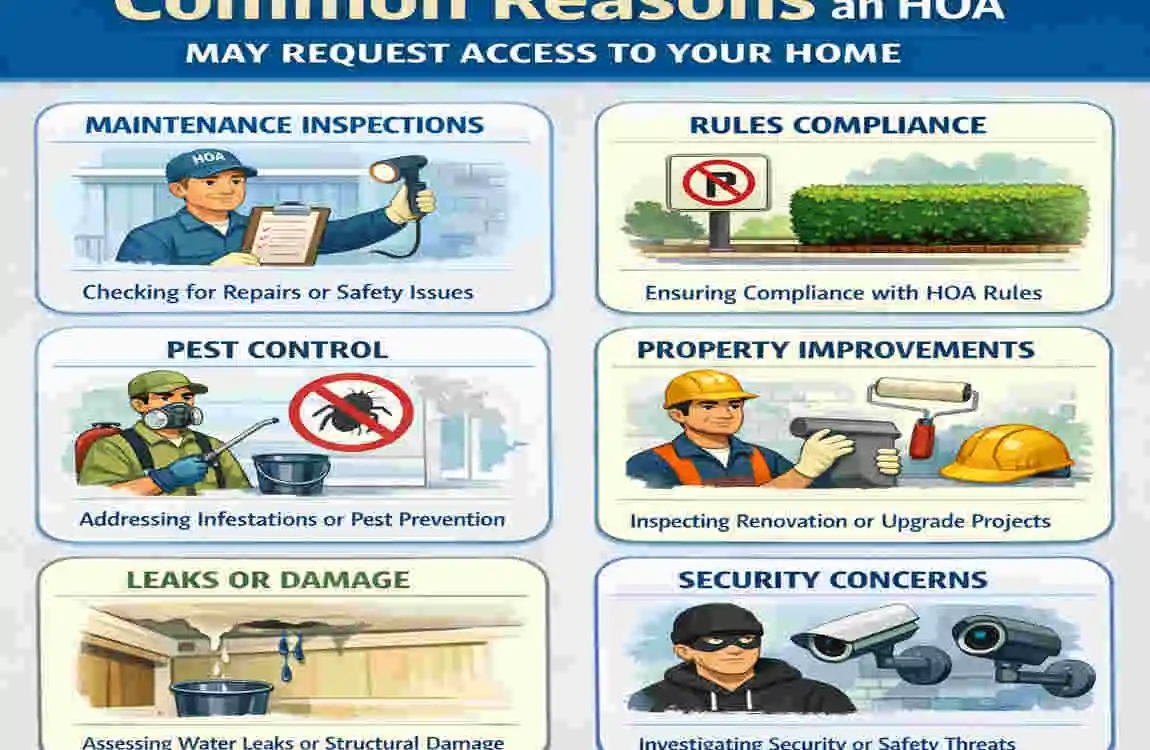
Emergency Repairs and Immediate Safety Concerns
Burst pipes, gas leaks, or fire hazards can damage multiple homes. In such cases, the HOA may need prompt entry to stop the problem and protect the community.
Routine Inspections and Property Maintenance
HOAs may schedule inspections to verify that homes meet community standards. They should provide written notice, explain the purpose, and agree on a convenient time.
Repairs to Shared Systems and Common Property
When plumbing, electrical, or roof work affects more than one unit, the HOA or its contractors may need to enter interior spaces where those components are located.
Suspected Violations of HOA Rules
A complaint about an exterior issue does not give the HOA the right to enter the interior. They can inspect visible areas, take photos, or request a scheduled interior check if the governing documents allow it.
Legal Rights and Privacy Protections for Homeowners
Review Your HOA Governing Documents
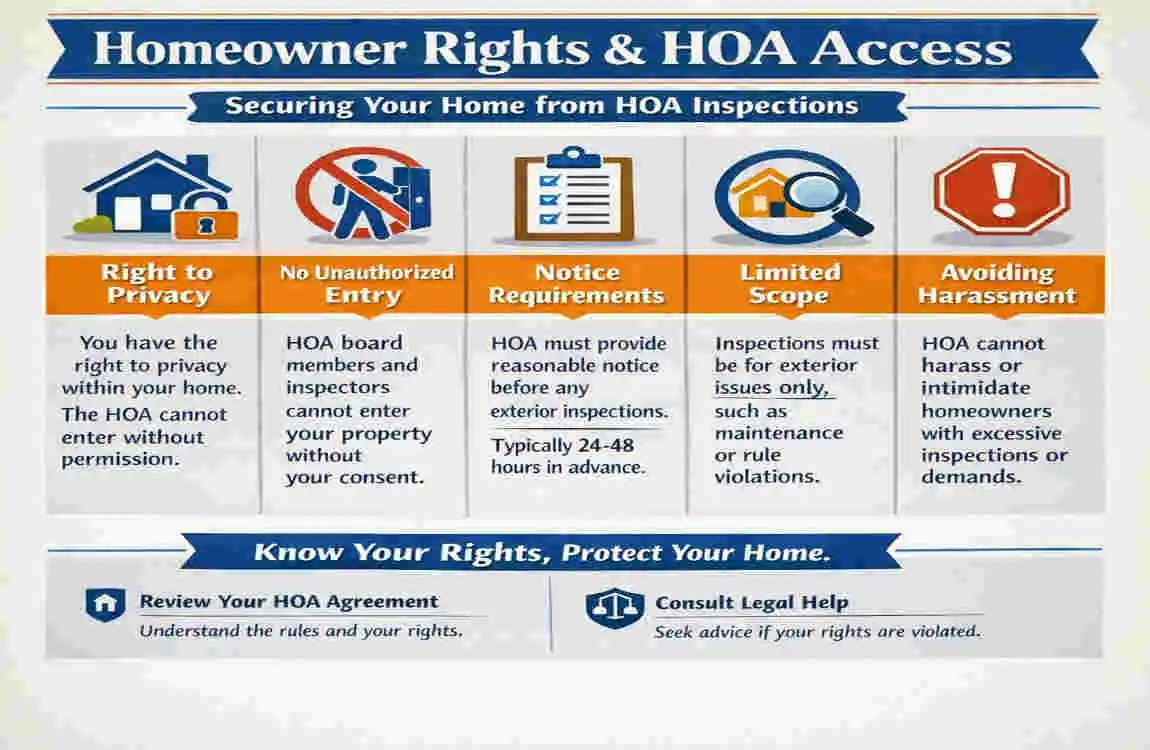
Look for sections titled “right of entry,” “emergency access,” or “inspection.” These clauses spell out when and how the HOA can enter.
Understand State and Local Laws
State statutes often set minimum notice periods and define what qualifies as an emergency. When in doubt, consult a local attorney.
Notice Requirements and Homeowner Consent
Proper notice usually includes the reason for entry, the date and time window, the names of the people entering, and the work to be performed.
What to Do if an HOA Enters Without Authorization
- Record the date, time, and who entered.
- Preserve any video or photos.
- Send a calm written request asking for the legal basis of the entry.
- Seek legal advice if the response is unsatisfactory.
Practical Ways to Secure Your Home From HOA Access
- Change or Upgrade Your Door Locks – Ensure any new lock complies with condo or townhouse rules.
- Install a Smart Lock or Keyless Entry – Provides temporary codes and logs of who entered.
- Add a Video Doorbell or Security Cameras – Documents visits and deters unauthorized entry.
- Secure Windows, Garage Doors, and secondary entrances; use deadbolts and reinforced strike plates.
- Establish a written access policy, ask the HOA to clarify who holds keys, how they’re stored, and what documentation is required after entry.
Handling HOA Disputes and Protecting Your Long‑Term Security

How to Communicate With the HOA Board
Write concise, factual letters requesting the specific provision that authorizes entry and propose reasonable appointment times.
What to Do If the HOA Refuses to Explain Its Access Rights
- Review the governing documents again.
- Request the association’s written access policy.
- Consider mediation or a local dispute‑resolution program.
Can You Take Legal Action Against Unauthorized HOA Entry?
Possible claims include trespass, privacy violation, or breach of contract, but each case depends on the facts and local law. Consult an attorney before proceeding.
Create a Home Security and HOA Access Checklist
- Review governing documents.
- Confirm who holds keys or codes.
- Verify local notice requirements.
- Upgrade locks and install security devices where allowed.
- Keep records of all entry notices and communications.
- Document any unauthorized entry.
- Update the list whenever management changes.
Frequently Asked Questions (FAQ)
Does the HOA have a key to your house?
Not automatically. Some HOAs may keep keys for emergencies or shared‑system maintenance, but the right to use them is governed by documents and law.
Can an HOA legally enter my home without permission?
Only in certain emergencies or when a specific contractual provision permits it. Routine entry generally requires notice and consent.
Can I change my locks if I live in an HOA community?
Usually, yes, but you must check condo or townhouse rules for approved lock types and any emergency‑access requirements.
Can an HOA force me to give it a house key?
It depends on the property’s legal structure and the association’s governing documents. Ask for the exact written provision supporting such a demand.
How much notice must an HOA give before entering?
Notice periods vary by state and by the HOA’s own rules; no single universal standard applies.
Can an HOA enter my home to inspect a violation?
A violation alone does not give unrestricted interior access. The HOA must follow the entry procedures outlined in the governing documents and applicable law.
What should I do if an HOA enters my house while I am away?
Document the event, preserve any evidence, request a written explanation, and seek legal advice if the entry appears unauthorized.
Can a smart lock prevent HOA access?
A smart lock improves control and logs entries, but it cannot override the HOA’s lawful right of entry.
Does an HOA have the right to enter during an emergency?
Yes, most jurisdictions allow entry when there is an immediate danger to life or property, subject to the specific emergency circumstances.
Who can help me resolve an HOA access dispute?
Start with the HOA board, then consult a qualified real estate attorney, and consider contacting local housing or consumer agencies if needed.