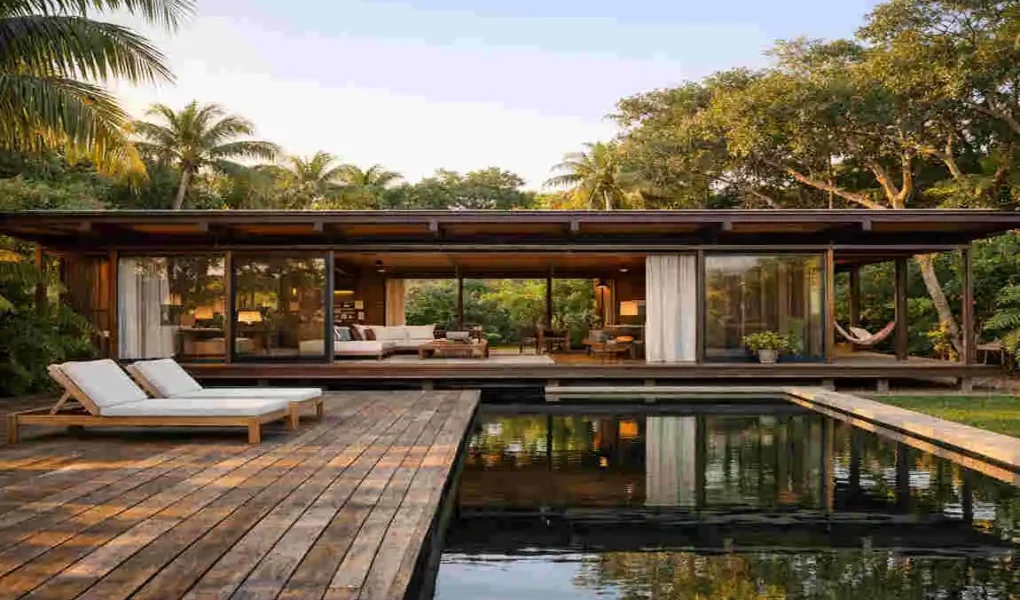
Have you ever walked through a space that felt like it was actually breathing? In the heart of Miami, where the humidity often dictates how we live, there is a home that doesn’t just fight the elements—it embraces them. The Brillhart Architecture House stands as a stunning testament to what happens when historical wisdom meets modern innovation.
Miami is famous for its glitzy high-rises and neon-lit Art Deco, but tucked away along the Miami River, this 1,500-square-foot gem offers a different kind of luxury Designed by the husband-and-wife duo Melissa and Jacob Brillhart, this residence is a masterclass in tropical modernism Miami style It isn’t just a house; it’s a “floating tropical refuge” that challenges our ideas about how much space and energy we really need to live well.
The Roots of the Design: Where History Meets the Future

To understand the Brillhart Architecture House, you first have to understand the history of Florida’s landscape. Long before air conditioning became a standard, architects had to be incredibly clever about keeping homes cool. The Brillharts didn’t just look at modern trends; they looked back at Florida Modernism and the pioneers who understood the local climate best. Drawing from the Dog Trot Typology, one of the most fascinating influences on the Brillhart House is the “Dog Trot” style. If you aren’t familiar with it, a Dog Trot is a traditional vernacular style featuring a central open breezeway between two enclosed living areas. This design was a survival tactic in the hot, humid South, allowing wind to whip through the center of the home and provide natural cooling.
The Brillharts took this concept and modernized it. Instead of a literal hole in the middle of the house, they used 50-foot sliding glass walls on both the front and back of the structure When these are open, the entire house essentially becomes a covered porch, allowing the Miami breeze to flow through every room The Influence of Postwar Florida Modernism The 1950s and 60s were a golden era for architecture in South Florida. Legends like Alfred Browning Parker and Paul Rudolph were experimenting with how to live in the tropics without being trapped in a concrete box. They prioritized local materials and passive cooling systems—ideas that the Brillhart Architecture House brings into the 21st century.
By studying these mid-century models, the Brillharts realized that a home could be both minimalist and incredibly functional. They moved away from the heavy, “fortress-like” construction common in modern Miami and opted for a lighter, more transparent approach that honors the glass pavilion typology. Merging Modern Materials with Traditional Wisdom. While the soul of the house is historical, the “bones” are modern. The architects used a steel superstructure combined with glass and wood. This allowed them to create a structure that feels light and airy but is strong enough to withstand the local environment. It’s a perfect example of how sustainable tropical architecture doesn’t have to look “rustic”—it can be sleek, sharp, and sophisticated.
Inspiration SourceKey Influence on Brillhart Architecture HouseModern Adaptation
Dog Trot Typology Breezeway for cross-ventilation 50-ft sliding glass walls
Glass Pavilion Indoor-outdoor flow Elevated 5-ft platform
Florida Modernism Local materials, passive cooling , Cedar shutters, steel frame
Architectural Features: A Pavilion in the Woods
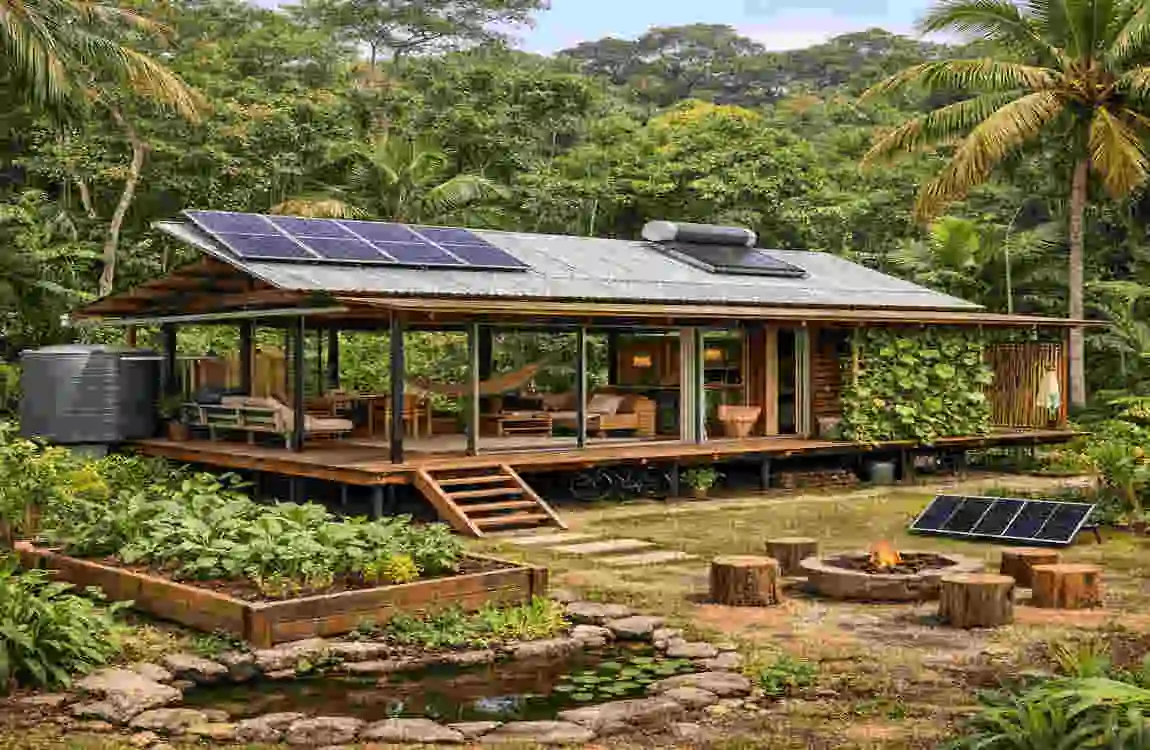
The Brillhart Architecture House is situated on a lush 330-foot-deep lot, and the way it sits on the land is just as important as the building itself. The architects chose to center the house on the lot, surrounded by dense native landscaping, to create a sense of total privacy despite being near downtown Miami.
The Magic of the 100-Foot Glass Facade
Imagine having a wall that disappears. The house features 100 feet of uninterrupted glass—50 feet on the front and 50 feet on the back. This isn’t just for the view; it’s about dissolving the boundaries between the indoors and the outdoors. When you are inside, you feel like you are sitting in the middle of a tropical forest.
To manage the intense Florida sun, the Brillharts added red cedar shutters. These aren’t just decorative; they are highly functional. You can slide them to block the sun at different times of the day or close them completely for privacy and security. They add a warm, organic texture that contrasts beautifully with the glass and steel.
Why the House “Floats”
One of the first things you’ll notice is that the Brillhart House is elevated five feet off the ground. This serves two primary purposes:
- Landscape Preservation: By lifting the house, the architects minimized the impact on the ground and the root systems of the surrounding trees. Flood Resilience: In a city like Miami, rising water is a genuine concern. Elevating the structure provides a layer of protection against potential flooding while also allowing air to circulate under the house, further cooling the floor. A Breakdown of Key Features.
- Elevated Foundation: 5 feet off the ground for flood resilience and air circulation. Operable Shutters: 50 feet of cedar shutters that provide shade and privacy. Open-Plan Interior: A layout that fuses the kitchen, dining, and living areas into one continuous space. Steel Superstructure: Chosen for its efficiency and ability to support large spans of glass. Sustainability Focus: Living Green in the Tropics
In a world where we are increasingly worried about our carbon footprint, the Brillhart Architecture House offers a blueprint for sustainable tropical architecture. It proves that you don’t need a massive solar farm or high-tech gadgets to be “green”—sometimes, you need good design.
Passive Design and Cross-Ventilation
The primary “technology” used in this house is passive cooling. By aligning the glass walls to catch the prevailing winds, the house stays cool naturally for much of the year. This drastically reduces the need for air conditioning, which is the biggest energy hog in Florida homes.
Furthermore, the architects intentionally reduced the use of concrete. Concrete has a high “embodied carbon” footprint, meaning it takes a lot of energy to produce. By using a steel frame and wood, the Brillharts created a lighter building that is much kinder to the planet. The “Self-Build” Philosophy. One of the most impressive parts of this story is that Melissa and Jacob Brillhart acted as their own general contractors. They didn’t just design the house; they managed the construction. This allowed them to ensure that every detail was executed perfectly and that the project remained cost-effective.
By analyzing 1950s construction models, they found ways to build a high-end architectural home on a budget that makes sense for a 1,500-square-foot space. This “rational” approach to building is something they hope other Miamians will adopt as the city continues to grow.
The Construction Story: A Labor of Love

The journey to complete the Brillhart Architecture House began long before the first shovel hit the dirt in 2014. It started with years of research. The Brillharts spent time documenting old Florida houses, sketching details, and figuring out why certain buildings survived the heat and hurricanes while others didn’t.
Experimentation and Optimism
The couple viewed this project as an experiment. They wanted to see if they could take the “glass box” concept—which is often criticized for being too hot in the tropics—and make it work through clever shading and ventilation. Their vision was to create a “floating tropical refuge” that felt both ancient and futuristic.
When the house was finished, it didn’t just satisfy their personal needs; it sparked a massive interest in the community. People were hungry for a home that felt connected to the environment rather than isolated from it. This demand has since influenced many of the projects in the Brillhart Architecture portfolio.
Interior Spaces: Minimalism with a View
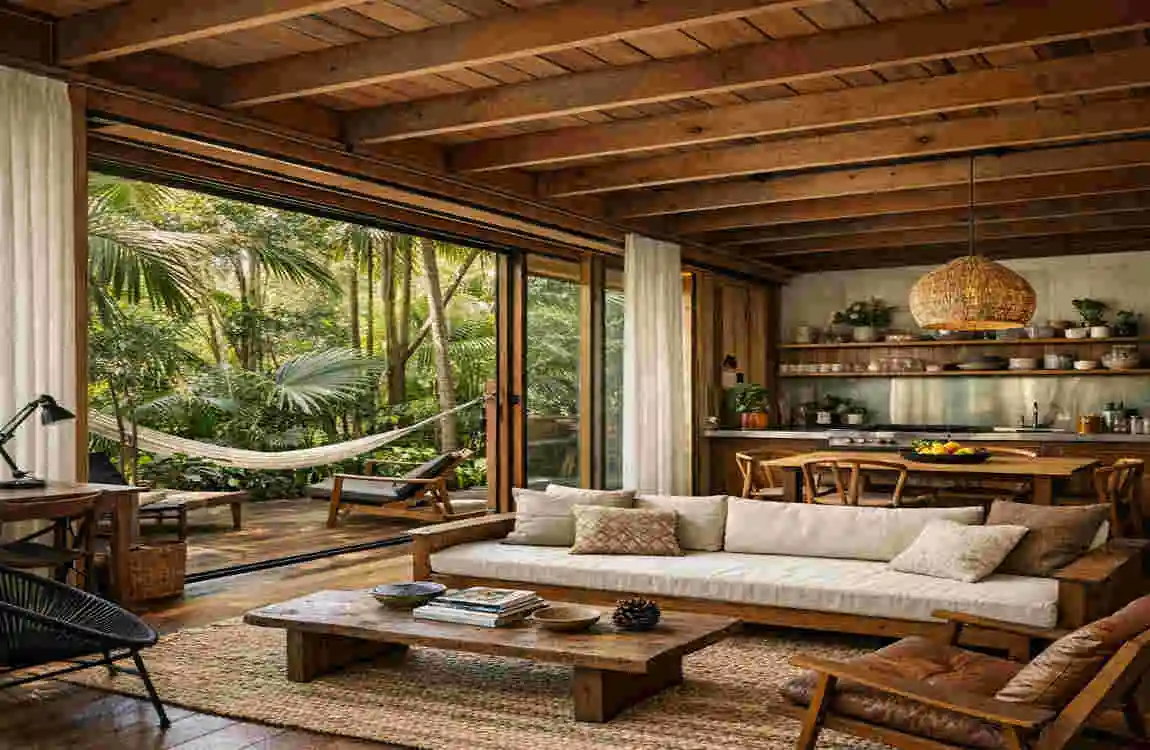
Stepping inside the Brillhart Architecture House is like taking a deep breath. The interior is defined by a “less is more” philosophy. Because the walls are mostly glass, the “decor” is actually the lush greenery outside The Heart of the Home: The Open Plan. The living, dining, and kitchen areas are all part of one ample, light-filled space. There are no heavy walls to block the light or the breeze. This makes the 1,500 square feet feel much larger than it actually is.
The materials inside are honest and straightforward. You’ll see wood, glass, and steel, all left in a relatively natural state. This celebrates the materiality of the home and keeps the focus on the surrounding landscape. The Porch as a Room. In many homes, the porch is an afterthought. In the Brillhart House, the porch is an essential living space. Because the cedar shutters can be opened or closed, the porch becomes an extension of the living room. It’s the perfect spot for a morning coffee or an evening glass of wine, fully immersed in the sounds of the Miami River.
Legacy and Impact: A Blueprint for the Future
Since its completion, the Brillhart Architecture House has been featured in major publications like Dwell and ArchDaily. It has won numerous awards and has become a “must-see” for anyone interested in modern design. But its real legacy is how it addresses the challenges of 2026 and beyond.
Resilience in a Changing Climate
As Miami faces rising sea levels and more intense storms, the Brillhart House offers a path forward. Its elevated design and use of durable materials like steel and cedar make it more resilient than many traditional homes. It shows that we can build homes that are beautiful, sustainable, and tough enough to handle the tropics.
A Greener Alternative to the “McMansion”
In a city where many new homes are massive, AC-dependent “McMansions,” the Brillhart House is a refreshing alternative. It prioritizes quality over quantity and connection over isolation.
Feature: Brillhart Architecture House, Typical Miami Modern
Size 1,500 sq ft 3,000+ sq ft
Materials : Steel/glass/cedar Concrete-heavy
Sustainability , Passive ventilation , AC-dependent
Brillhart Architecture House – FAQ
What is the Brillhart House?
A 1,500-square-foot residence in Miami designed and built by Jacob and Melissa Brillhart, completed in 2014 .
What inspired its design?
It follows a “back‑to‑basics” approach, drawing from older architectural models that emphasize good form and practical function.
What architectural traditions does it reference?
It nods to the American glass pavilion, the Dog Trot typology, and Florida Modernism/Florida Cracker architecture.
What materials are used?
The structure incorporates steel and glass with extensive use of woods like ipé, red cedar, white oak, and cypress .
What is its most distinctive feature?
A long front porch with folding louvered shutters that screen a 50‑foot glass wall.
How does the house address sustainability?
It uses sliding glass doors for cross‑ventilation, hidden solar panels, green roofs, and permeable hardscaping for heat and stormwater management.
Has it received any awards?
Yes. It won the AIA Florida Honor Award (2015) and AIA Miami Honor Award (2014).
Was it featured in media?
It appeared on the Netflix/BBC series The World’s Most Extraordinary Homes.