A wood-frame house can shift over time, and when it does, the home may start to feel uneven, strained, or uncomfortable. This is where house leveling comes in. In simple terms, leveling helps restore the structure to balance so it sits correctly on its foundation again.
You may first notice the problem through sloping floors, cracks in walls or ceilings, or doors and windows that stick. These warning signs can seem small at first, but they often point to a deeper foundation issue. If you ignore them, the damage can grow and become more expensive to fix later.
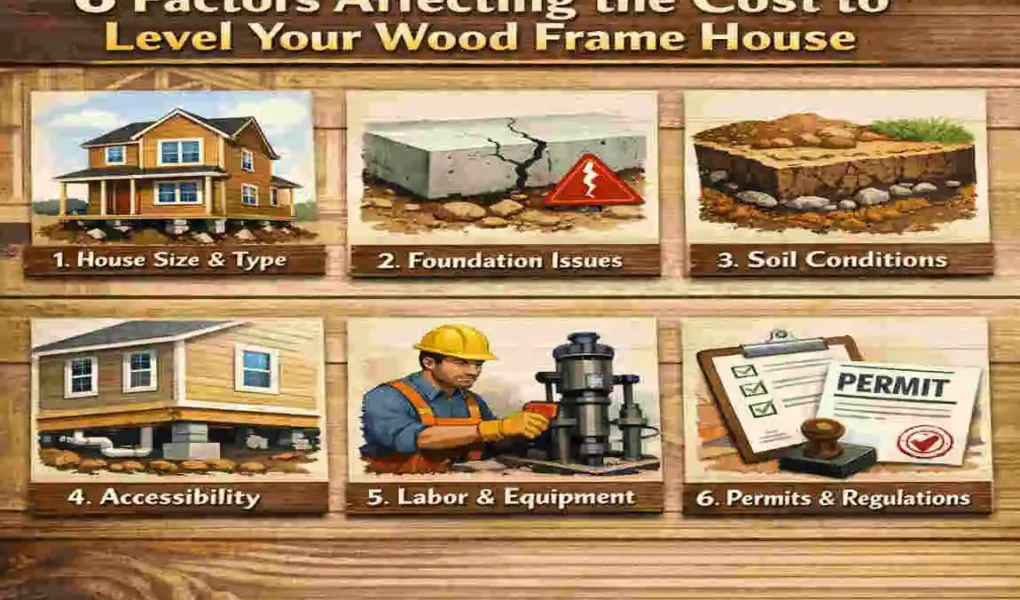
| Factor | How it affects cost |
|---|---|
| Foundation condition | More damage or settlement means more repair work and higher cost . |
| House size | Larger homes need more labor, materials, and time . |
| Soil stability | Weak or expansive soil makes leveling more difficult and expensive . |
| Accessibility | Hard-to-reach foundations usually increase labor cost . |
| Method used | Simple leveling is cheaper than major structural lifting or stabilization . |
| Location and permits | Local labor rates and permit requirements can raise the total price . |
If you are wondering how much it costs to level a wood-frame house, the answer depends on several key factors. There is no single price that fits every home. Some houses need only minor adjustments, while others need major structural work.
What Does It Mean to Level a Wood-Frame House?
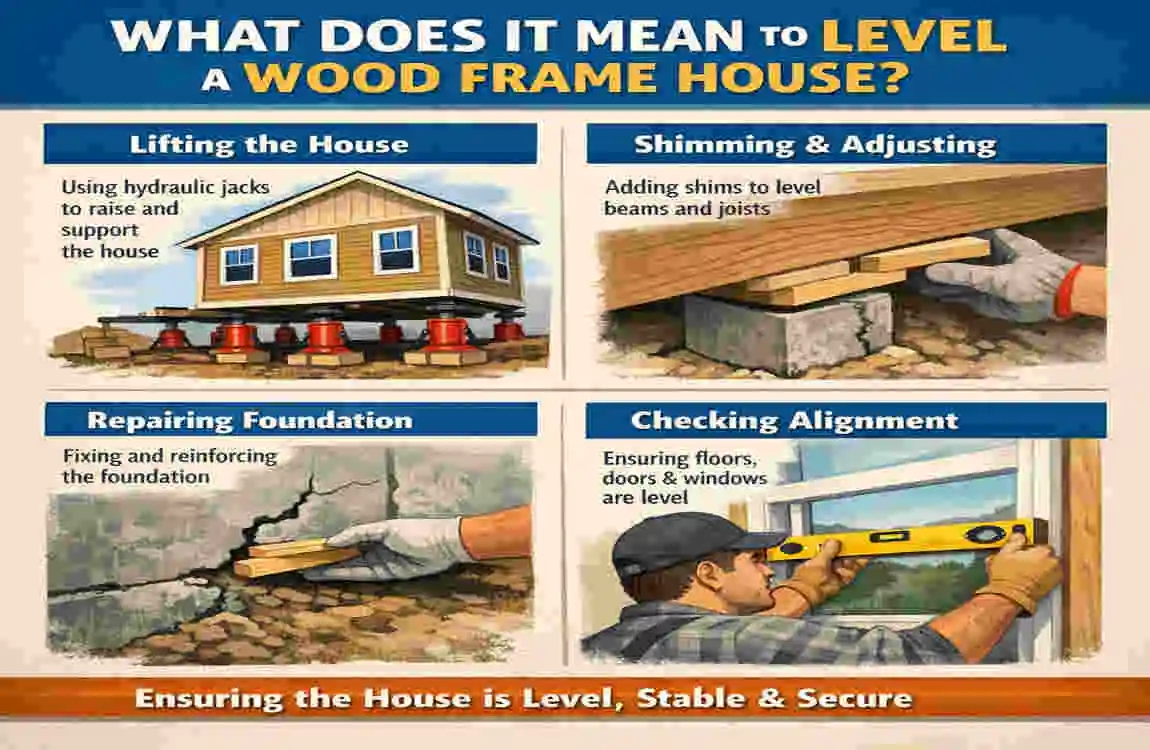
House leveling is the process of correcting a home that has settled unevenly. Over time, the ground under a house can move, weaken, or shift. When that happens, the structure above it may tilt or sink in certain areas.
Wood frame houses are especially sensitive to this kind of movement. They are built with materials that are somewhat flexible, which can be helpful in some cases. But that same flexibility also makes them more likely to show signs of movement when the foundation is no longer stable.
Why Wood Frame Houses Shift
Several things can cause a wood-frame house to become uneven:
- Soil movement under the foundation
- Moisture damage from leaks or poor drainage
- Foundation failure from age, wear, or poor construction
Even a small change in the ground can affect the home’s balance. Once the structure starts to move, the floors, walls, and openings above it often begin to show signs of stress.
Common Leveling Methods
Contractors may use different methods depending on the problem:
- Pier and beam adjustment
- Slab lifting, when the house sits on a slab
- Shimming and structural correction to restore balance
Each method works differently, but the goal is the same: bring the house back into a safer, more even position. Because wood-frame homes are lighter and more flexible than other types of homes, they can often be adjusted more easily. Still, they are also vulnerable to long-term damage if the problem is not fixed early.
Average Cost to Level a Wood-Frame House
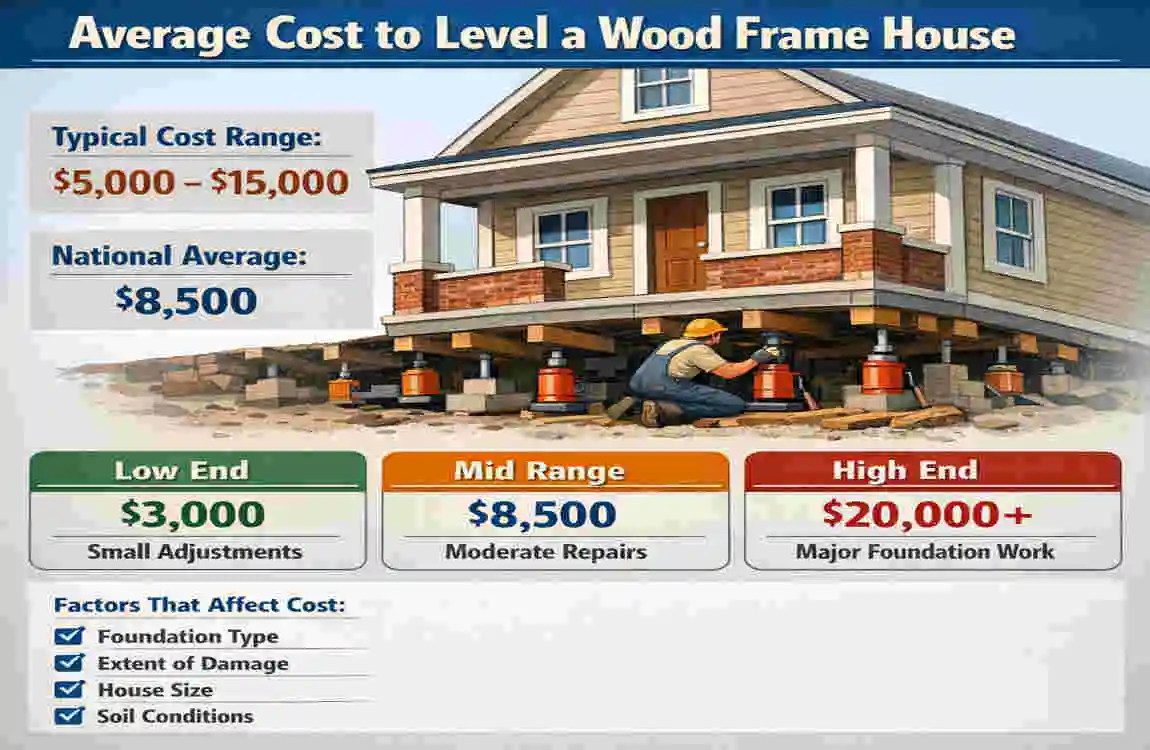
The cost to level a wood-frame house can vary a lot. A minor repair may cost only a few thousand dollars, while a major structural fix can climb much higher. In general, homeowners may see a wide range depending on the size of the house and the type of damage.
Typical Price Ranges
Here is a simple view of common cost levels:
Repair Level Typical Cost Range What It Usually Includes
Low-end repair $2,000–$5,000 Small adjustments, minor shimming, limited labor
Moderate repair $5,000–$15,000 Multiple supports, foundation correction, more labor
Major structural repair $15,000–$40,000+ Serious damage, soil correction, extensive foundation work
Cost Per Square Foot
Some contractors also estimate pricing by square footage. This can be useful, but it is only a general guide. Larger homes usually cost more because they need more support points, more labor, and more time.
Why There Is No Fixed Price
Understanding how much it does cost to level a wood-frame house requires breaking down the contributing factors. A home with minor settling in one corner is very different from a home with widespread foundation failure. That is why one homeowner may pay a modest amount while another pays much more.
Local labor rates, material prices, and permit fees also change from one area to another. In other words, the final price is always shaped by the condition of the house and the market where you live.
Severity of Foundation Damage
The biggest cost driver is often the severity of the damage. A small issue is usually quicker and cheaper to fix. A larger issue can require deeper repair, more equipment, and more labor.
Minor Damage
Minor damage usually means the house has only started to shift a little. You might see:
- Small floor slope
- Hairline wall cracks
- One or two sticking doors
In these cases, the repair may involve simple leveling adjustments, small shims, or minor support work. The cost is usually on the lower end because the damage has not spread very far.
Moderate Damage
Moderate damage is more serious. The home may have several visible warning signs, and the foundation may need more than just a basic adjustment. Contractors might need to reset supports, reinforce beams, or stabilize weak areas.
This level of repair takes more time and skill. The cost moves higher because the job is no longer just a quick correction. It becomes a more involved structural project.
Severe Damage
Severe damage is the most expensive case. This may include:
- Large foundation cracks
- Major floor sagging
- Strong separation in walls or ceilings
- Rot, moisture damage, or structural failure
In these situations, a simple leveling job may not be enough. The contractor may need to repair or replace major support parts. Sometimes, the underlying issue must be fixed before leveling can even begin.
Why Inspection Matters
A professional inspection helps reveal how serious the problem really is. Some damage is easy to see, but other damage stays hidden under the house or inside the frame. That hidden damage can significantly increase the total cost if it is not found early.
Simple Cost Breakdown by Severity
- Minor leveling: low cost
- Moderate repair: medium cost
- Severe structural repair: high cost
The more advanced the damage, the more expensive the repair becomes. This is why early action is so important.
Type of Foundation System
Not all wood-frame houses sit on the same kind of foundation. The foundation type affects both the difficulty of the repair and the cost.
Pier and Beam Foundation
A pier-and-beam foundation is often easier to access because there is usually space beneath the house. That access can make leveling simpler. Contractors can inspect supports, adjust beams, and replace damaged parts more easily.
Because the work is more accessible, labor costs may be lower than with other foundation types. However, if the supports have rotted or shifted badly, the price can still rise.
Slab Foundation
A slab foundation is much harder to work with. Since the home sits directly on a concrete slab, repairs may require specialized lifting equipment. In some cases, the slab may need to be raised or stabilized from below.
This type of repair often costs more because the process is more complex and less accessible. It may also involve more risk if the slab has cracked or settled unevenly.
Crawl Space Foundation
A crawl space foundation sits somewhere between the two. There is some access, but not always enough space to make the work easy. Contractors may need to crawl under the house to inspect and repair the structure.
If the crawl space is tight, wet, or damaged, the job becomes harder and more expensive. Better access usually means lower labor costs, while difficult access usually means higher labor costs.
Foundation Type and Repair Methods
Different foundation systems may require different repair styles:
- Pier and beam: support adjustment, beam repair, shimming
- Slab: lifting, stabilization, crack repair
- Crawl space: support replacement, moisture correction, leveling
The foundation type matters because it changes how the contractor gets to the problem and what tools are needed to fix it.
Soil Conditions and Ground Stability
The ground under your home plays a significant role in leveling your home. If the soil is weak or unstable, the foundation may continue to shift even after repairs.
Why Soil Matters
A house does not just sit on the ground. It depends on the ground to stay firm and steady. When soil moves, expands, shrinks, or washes away, the foundation above it can move too.
Expansive Clay vs Sandy Soil
Different soils behave in different ways:
- Expansive clay soil swells when wet and shrinks when dry. This repeated movement can push or pull on the foundation.
- Sandy soil drains more easily, but it may not hold weight as evenly if it is loose or poorly packed.
Clay soil is often more difficult and more costly to deal with because it moves significantly with changes in moisture.
Moisture and Drainage Problems
Poor drainage can worsen soil problems. Water may collect near the foundation, softening the ground. Over time, that can cause settling or erosion.
If a contractor has to address drainage problems while leveling the house, the cost will usually increase. That can include:
- Soil stabilization
- Drainage correction
- Regrading the yard
Seasonal Movement
Some homes move more during certain seasons. Heavy rain, drought, or frozen ground can all affect soil stability. A house may look fine in one season and then show signs of stress in another.
Long-Term Fix or Quick Patch?
It may be tempting only to fix the visible damage. But if the soil problem persists, the home may keep shifting. Spending more now on soil correction can sometimes save money later by reducing the need for future foundation repairs.
House Size and Structural Complexity
The home size and layout of the house also affect the final cost. Bigger homes usually require more work, labor, and materials.
Larger Homes Need More Support
A large home has more weight spread across a wider area. That means more points may need to be adjusted or reinforced. The work takes longer, and the equipment may need to be used more often.
Square footage matters because it often reflects the amount of structural support needed. The more area the contractor must level, the more expensive the job tends to be.
Single-Story vs Multi-Story Homes
A single-story wood-frame house is usually simpler to level than a multi-story home. A two-story house carries more weight and puts more pressure on the foundation. That makes the correction process more complex.
With multi-story homes, contractors must be extra careful, as a small shift can affect the entire structure above.
Complex Layouts Add Cost
Homes with extensions, add-ons, or unusual shapes can be harder to level. For example:
- Room additions may settle differently from the main house
- Irregular floor plans can create uneven pressure points
- Older remodels may have mixed framing styles
These design issues make the project more time-consuming. More complexity often means more labor hours and higher cost.
Weight Distribution Challenges
If one part of the house is heavier than another, the foundation may settle unevenly. This can happen when an addition was built later or when parts of the structure were remodeled without full support changes.
The more complicated the structure, the more detailed the leveling plan must be.
Repair Method and Technology Used
The chosen repair method can significantly change the price. Some techniques are more basic, while others require advanced equipment and specialized skills.
Hydraulic Jacks
Hydraulic jacks are commonly used to lift or adjust parts of a house. They help contractors slowly raise sections of the structure to a better level. This method can be effective, but it must be done carefully.
The cost depends on how much lifting is needed and how long the job takes.
Steel Piers
Steel piers are often used when the foundation needs strong, lasting support. They are driven deep into stable ground and can help hold the home in place.
This method is usually more expensive than a simple adjustment, but it may offer better long-term stability.
Concrete Underpinning
Concrete underpinning adds support beneath the existing foundation. It is a more traditional method, but it can still be effective for certain homes.
The cost can be high because it involves more home material and more labor. It may also take longer to complete.
Modern vs Traditional Methods
Newer methods often rely on stronger materials and more precise tools. Traditional methods may be cheaper in some cases, but they are not always the best fit for a serious problem.
The right method depends on the condition of the home, the soil, and the type of foundation.
Speed vs Cost
Sometimes homeowners want the fastest fix available. That can raise the price. Emergency repairs usually cost more than planned maintenance because the work must be done quickly, often after major damage has already set in.
If you can schedule the job early, you may avoid some of those extra costs.
Location, Labor, and Contractor Expertise
Where you live can have a big effect on the total price. Labor rates, permit costs, and contractor experience all vary by region.
Regional Pricing Differences
In some places, materials and labor are more expensive. In others, prices may be lower because demand is lower or the market is less busy.
Urban areas often have higher labor costs than rural areas. That does not always mean the work is better, but it does affect the final bill.
Experience Matters
You may see different price quotes from different contractors. Some will be general contractors, while others will be licensed structural engineers or foundation specialists.
An experienced professional may charge more, but they often bring better knowledge, better tools, and more reliable results. That can save money in the long run by reducing mistakes.
Permits and Inspections
Some leveling jobs require permits or inspections. These extra steps help ensure the repair meets local rules and safety standards. They also add to the total cost.
Why Cheap Labor Can Be Risky
A low price may look appealing at first. But if the contractor is not qualified, the repair may not last. In some cases, poor work can create bigger problems later.
Choosing a skilled professional is often the safer choice, especially when the foundation is involved. Foundation work is not the place to cut corners.
Additional Hidden Costs Homeowners Often Overlook
The leveling work itself is only part of the total cost. Many homeowners are surprised by the extra repairs that follow.
Common Extra Expenses
- Drywall cracks may need patching after the home is lifted
- Flooring replacement may be needed if the floor no longer lines up
- Plumbing and electrical adjustments may be required if the structure shifts
- Permit and inspection fees can add to the total
- Landscaping restoration may be needed after heavy equipment disturbs the yard
- Temporary relocation costs may come up if the home is unsafe during repair
These items are easy to miss when you first ask about leveling costs. Still, they can make a big difference in the final budget.
Why Hidden Costs Happen
When a house moves, many systems move with it. Walls, pipes, wires, cabinets, and floors may all require minor corrections after foundation work is complete. That is why it is smart to ask contractors what is included in the quote and what may cost extra.
Signs You Should Not Delay House Leveling
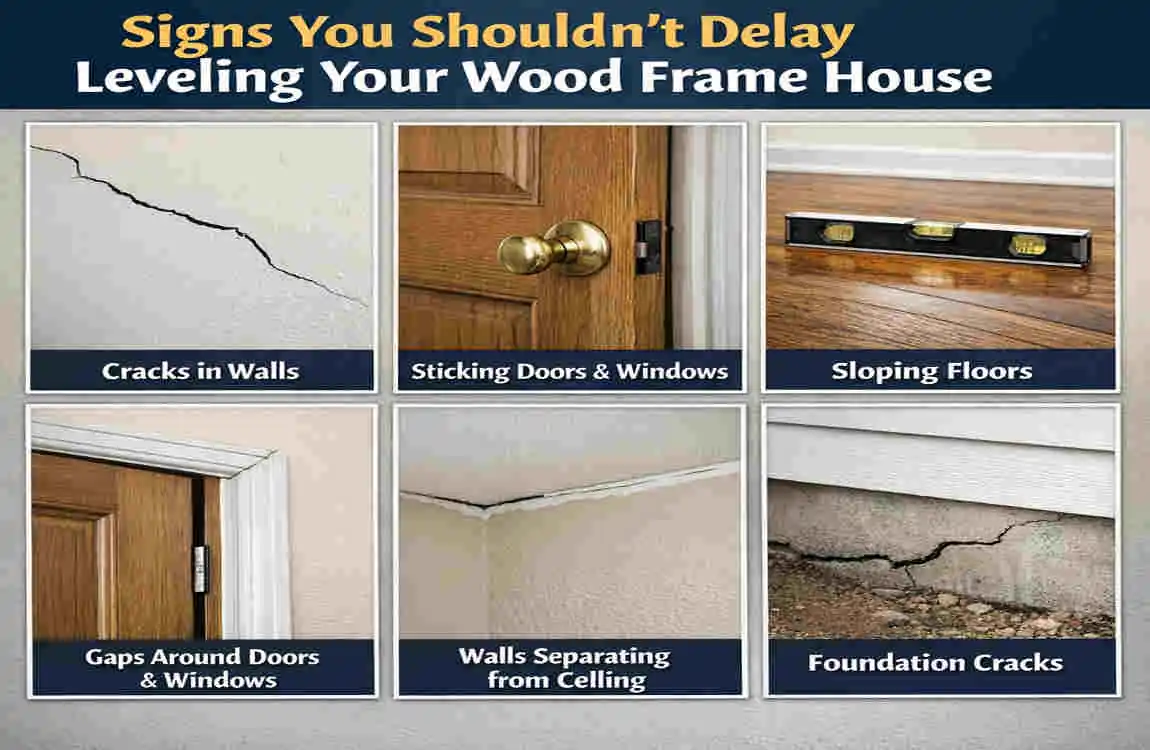
Some homeowners wait too long because the signs seem minor. But foundation problems usually do not fix themselves.
Warning Signs to Watch For
- Cracks that keep getting larger
- Doors and windows that no longer close properly
- New gaps between walls, ceilings, or floors
- Water intrusion or dampness near the foundation
- Floors that feel more uneven over time
Why Waiting Costs More
The longer you wait, the more damage can spread. A minor leveling issue can escalate into a larger structural repair if moisture, soil movement, or wood damage persists.
Delay can also create safety concerns. Uneven floors and weak supports can become dangerous, especially if the home keeps shifting.
If you notice the signs early, you have a better chance of keeping the repair smaller and more affordable.
How to Reduce the Cost of Leveling a Wood-Frame House
You may not be able to avoid every foundation problem, but you can take steps to lower repair costs.
Smart Ways to Save
- Schedule an early inspection as soon as you see warning signs
- Keep drainage working properly around the home
- Monitor the foundation regularly for new cracks or shifts
- Compare multiple contractor quotes before choosing a repair team
- Handle preventive maintenance before damage spreads
- Invest in soil stabilization early if the ground is a known problem
Prevention Helps More Than Reaction
A small repair today is usually cheaper than a major repair later. That is why regular checks matter so much. If you stay alert to changes in the home, you can often catch the issue before it becomes severe.
Also, make sure gutters, downspouts, and yard grading are moving water away from the house. Good drainage can protect the foundation and reduce future repair costs.
FAQ: How Much Does It Cost to Level a Wood Frame House?
Q: How much does it cost to level a wood frame house?
A wood frame house usually costs $2,000 to $15,000+ to level. Small repairs may be cheaper, while major foundation damage can cost much more.
Q: What affects the price the most?
The biggest factors are foundation damage, soil conditions, house size, repair method, and labor costs in your area.
Q: Is leveling a wood frame house worth it?
Yes, in most cases. Leveling can help prevent worsening cracks, stuck doors, water damage, and structural problems.
Q: Can a small slope in the floor be a serious issue?
Yes. Even a small slope can signal foundation movement. It is best to inspect it early before the damage gets worse.
Q: How can I lower the cost?
You can save money by getting an early inspection, fixing drainage problems, and comparing multiple contractor quotes.