Have you ever found yourself looking at a beautiful plot of vacant property and wondering exactly how much land is required for a mobile home? If you are planning to purchase a manufactured house, you are certainly not alone in asking this question. Most property placements require anywhere from 0.25 to 1 acre of space to properly accommodate local zoning laws, setback rules, and essential utilities.
Before we dive deep into the numbers, let us quickly define what we are talking about. Unlike traditional site-built houses that are constructed from the ground up right on your property, mobile or manufactured homes are built entirely inside climate-controlled factories. They are then transported to your land and securely anchored to a foundation. This efficient building method saves you incredible amounts of time and money, but it also brings up unique questions about property preparation.
Mobile Home Basics: Understanding Your Footprint
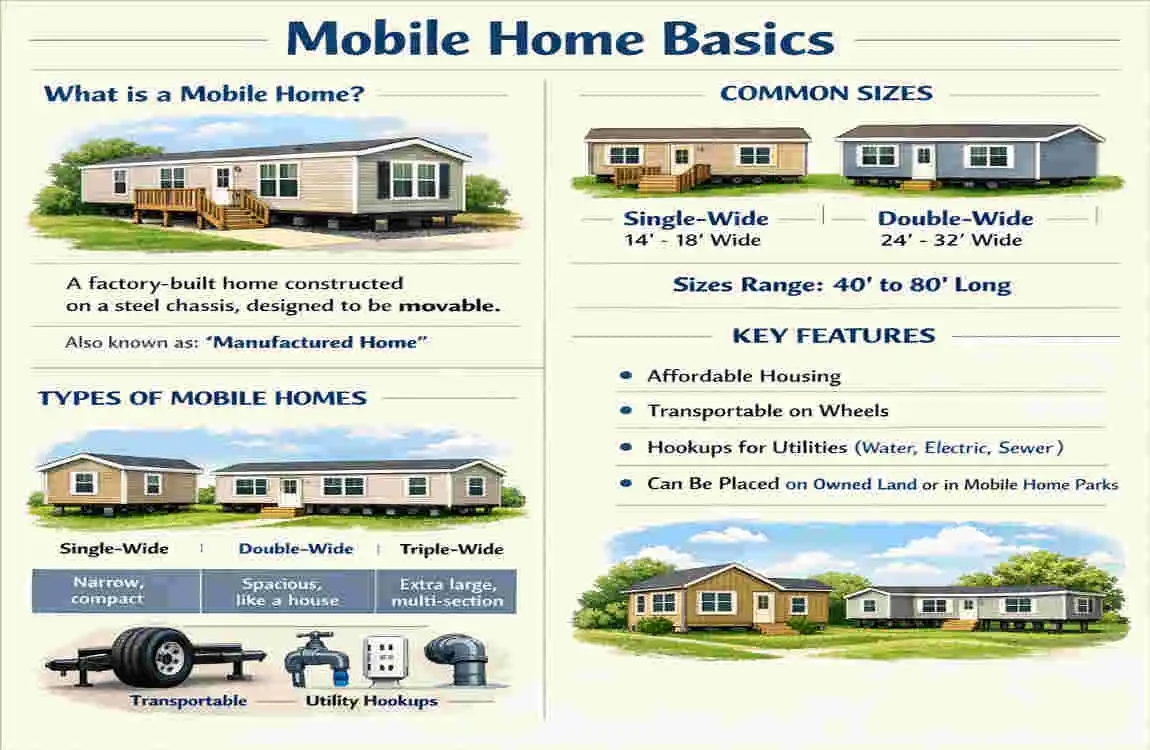
Before you can figure out your property requirements, you need to understand the physical size of the house you plan to buy. Manufactured homes generally fall into two primary categories: single-wides and double-wides. Each type demands a very different approach to property planning.
Single-wide homes are fantastic options for smaller, tighter lots. They typically offer between 980 and 1,120 square feet of interior living space. When you look at their exterior dimensions, you will find that the average single-wide measures about 14 feet wide by 70 feet long. Because of their streamlined, rectangular shape, you can easily slide them onto narrow parcels of land that traditional homes could never fit on.
Double-wide homes, on the other hand, provide a much more expansive living experience. These models generally offer 1,500 square feet or more of interior space. They are two separate single-wide units built in the factory, transported individually, and then seamlessly joined together at your property. The average double-wide measures around 24 feet wide by 60 feet long. Naturally, this wider footprint means you will need substantially more space just to fit the home itself.
But why does the raw land matter so much beyond just fitting the house? It comes down to everything else you need to live comfortably. You are not just dropping a rectangular box onto the dirt. You need to carve out space for a solid, code-compliant foundation. You need to pave a driveway and create a safe parking area for your family’s vehicles. You also want a decent yard for your children to play in, for your dog to run around, or for you to enjoy a weekend barbecue.
Imagine a visual footprint diagram in your mind. The house is just the center rectangle. Around that rectangle, you must draw a larger box for your driveway, an even larger box for your utility lines, and an outer boundary that represents your property lines.
Pro tip for investors: If you are looking at this from a business perspective, knowing these dimensions is crucial. When you utilize smaller single-wide homes, you can safely and legally fit 8 to 10 units per acre inside a specially zoned mobile home park. That high density is exactly what makes these parks such lucrative investments!
Minimum Lot Sizes Explained: How Much Space Do You Actually Need?
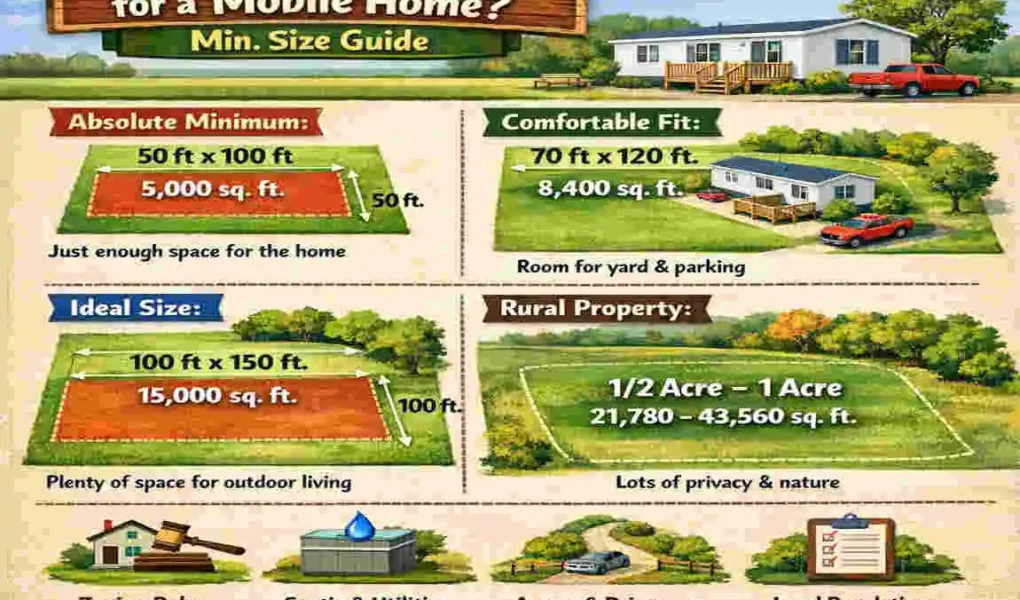
When you ask how much land is required for a mobile home, the answer heavily depends on where that land is located. The core ranges for minimum lot sizes span from as little as 2,000 square feet to 10,000 square feet (which equals about 0.05 to 0.25 acres) as a base requirement. However, if you are moving out to the country, rural areas often require a minimum of 0.25 to 1 full acre to accommodate private septic systems and water wells.
Let us look at dedicated mobile home parks. These communities are specifically engineered for high density. Because the park owner provides shared, centralized utilities like city sewer and water, the individual lots can be incredibly compact. Park lots typically range from 2,500 to 5,000 square feet per unit.
If you are buying a private parcel in a standard suburban neighborhood, the rules change again. Suburban plots usually require anywhere from 0.1 to 0.5 acres to blend in with surrounding traditional homes seamlessly and to meet municipal zoning codes.
To help you visualize these differences, here is a quick breakdown of how location changes your minimum size requirements:
Lot Size Comparison Guide
Location TypeMin. Size (sq ft) Acres Example States
Rural 10,890–43,560 0.25–1 GA, NC
Parks 2,500–5,000 0.06–0.11 MO (10+ acres parks)
Suburban 4,356–21,780 0.1–0.5 Varies Widely
So, what exactly pushes these minimum numbers up? Why can’t you just put a house on a tiny patch of grass in the country? The biggest factors are soil tests and utility requirements.
When you buy rural land, you usually do not have access to city sewer lines. This means you must install a private septic system. To do this, the county health department will mandate a “perc test” (percolation test) to see how quickly the soil absorbs water. If your soil contains a lot of heavy clay and drains slowly, you will be required by law to install a much larger septic drain field. That massive drain field instantly forces your minimum land requirement closer to the 1-acre mark, regardless of how small your actual house is.
Navigating Zoning and Setback Rules
If you are trying to figure out how much land is required for a mobile home, your very first stop should be the local zoning office. Zoning laws are the local government regulations that dictate exactly what you can and cannot do with a specific piece of real estate.
First, you must understand the zoning basics. Many counties have strict rules distinguishing between temporary Recreational Vehicles (RVs) and permanent manufactured residences. You cannot simply buy a piece of land zoned for temporary camping and place a permanent double-wide on it. You need to ensure the property is explicitly zoned for manufactured housing.
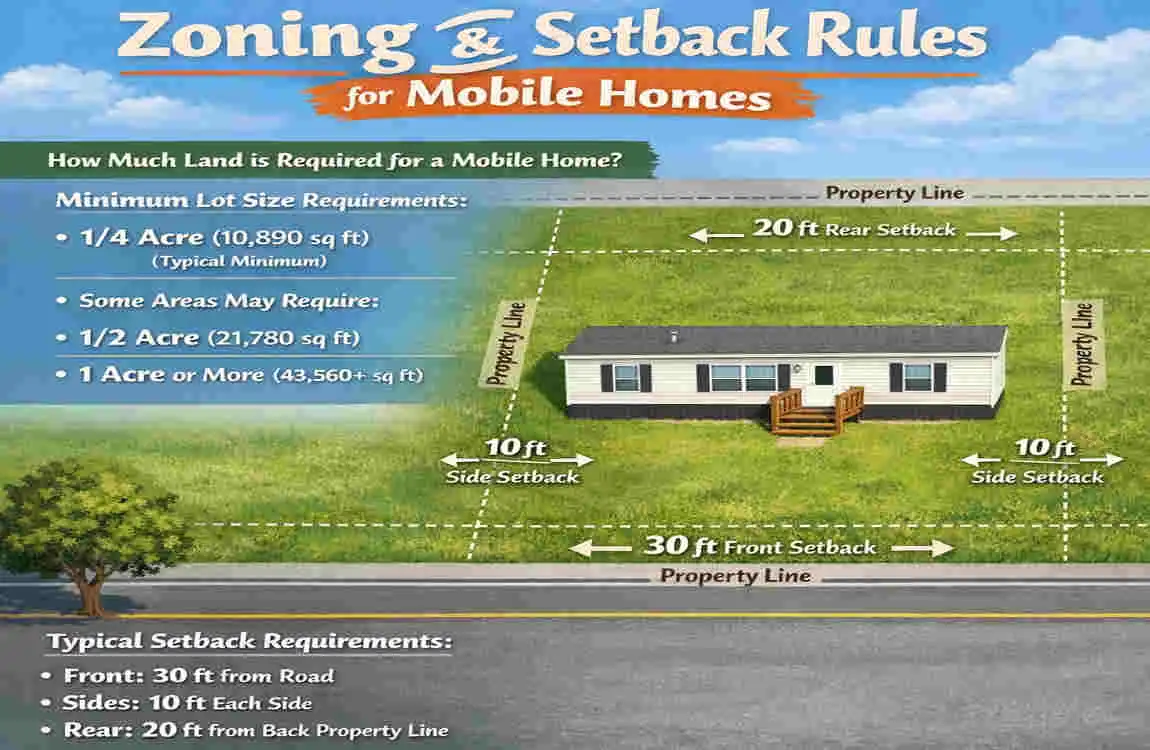
Next, we must talk about the invisible boundaries known as setbacks. Setbacks are mandatory buffer zones between your house and the edges of your property. Local governments enforce these rules to ensure fire safety, to keep neighborhoods looking spacious, and to allow room for utility workers to access power lines.
Common setback rules require you to leave 5 to 20 feet of empty space between neighboring homes. Furthermore, you almost always need to keep your house at least 20 feet away from public roads and side property lines. This means if you buy a tiny, narrow strip of land, the mandatory 20-foot setbacks on all four sides might completely eat up your buildable area, leaving you no room for the house!
These rules vary widely by state and county. For example, in Texas, it is incredibly common for rural counties to mandate a strict 1-acre minimum for any new manufactured residence due to septic and spacing rules. Meanwhile, in Minnesota, specific zoning codes for manufactured housing parks allow individual lots to be as small as 4,000 to 5,000 square feet.
If you are coming at this from a business angle and want to build a whole community, you have to look at cluster density laws. For commercial parks, municipalities generally cap the maximum cluster density at 8 to 10 units per acre to prevent overcrowding and utility strain.
Here is a simple checklist to keep you safe when navigating zoning:
- Research the county zoning office first: Never buy land without calling the local planning department and asking specifically about manufactured housing rules.
- Plan for a half-acre minimum: A half-acre is a highly common safe bet that ensures you have plenty of room to meet almost any setback requirement.
- Account for permitting space: Remember that county permits often require you to dedicate an extra 20% to 30% of your total space strictly for environmental buffers and drainage easements.
Imagine looking at a local zoning map. The map might show your property in a bright residential yellow, but when you overlay the setback lines, the actual “buildable envelope” in the center shrinks drastically. Always measure the buildable envelope, not just the total lot size.
Factoring in Utilities and Extra Space Needs
When answering the question of how much land is required for a mobile home, many first-time buyers completely forget to calculate the invisible infrastructure. Utilities are the silent space-eaters of the real estate world.
Let us start with the septic system. A septic system is not just a buried tank; it requires a sprawling underground leach field (or drain field) where filtered wastewater safely re-enters the soil. Depending on your local soil quality and the size of your house, a standard septic system can demand anywhere from 5,000 to 20,000 square feet (0.11 to 0.46 acres) of completely dedicated land. You cannot pave over a leach field, and you cannot park cars on it, which means that space is effectively off-limits for anything else.
If you are not on city water, you will also need to drill a private well. Health codes are incredibly strict about keeping your clean drinking water far away from your wastewater. Regulations typically require massive setbacks for your well, demanding an isolation radius that can eat up 2,500 to 5,000 square feet of space. Your well must be legally separated from your own septic tank, as well as your neighbor’s septic tank.
Then, you have to think about your daily logistics. You will need a driveway and a place to park. A standard two-car parking pad and a modest driveway will easily consume another 400 to 600 square feet of your lot.
Finally, you have to consider yard and landscaping requirements. Many local ordinances explicitly mandate that 50% of your total lot must remain uncovered by impervious surfaces (like concrete or roofs). This rule ensures that rain has a place to soak into the ground, preventing massive neighborhood floods during heavy storms.
When you add up the massive footprint of the septic field, the isolation radius of the water well, the driveway, and the mandatory green space, the total impact is staggering. These hidden utility factors consistently push the real-world answer for “how much land is required for a mobile home” to an average of 1/3 to 1/2 of an acre for a comfortable, legal setup.
Single-Wide vs. Double-Wide Land Guide
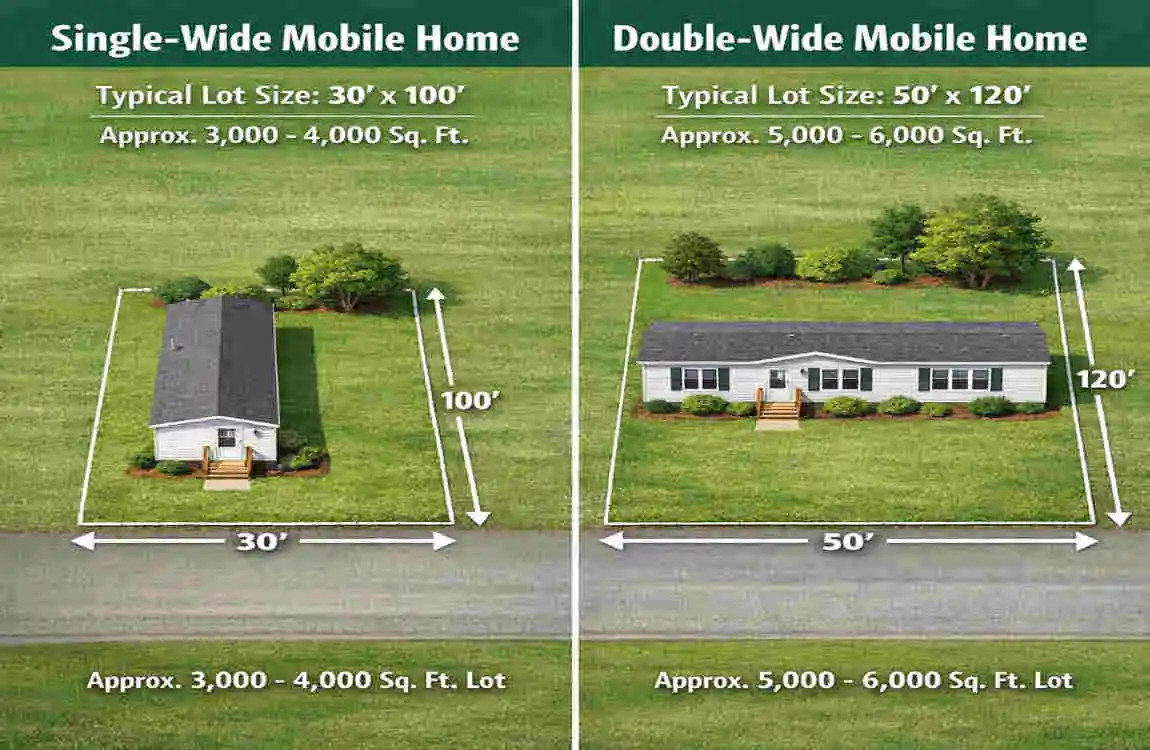
Now that we understand the hidden utility requirements, let us compare how your choice of home directly dictates your land shopping. The difference between placing a single-wide and a double-wide is like the difference between parking a compact car and a large commercial truck.
Home Type Breakdown and Land Needs
TypeSize (sq ft)Min. Land (sq ft)Per Acre Fit
Single-Wide 980–1,120 8,000–12,000 8–10
Double-Wide 1,500+ 14,000–21,000 4–6
If you choose a single-wide home, you are looking at the ideal solution for tight, restricted lots. Because they are narrow, they can easily slide onto parcels as small as 0.2 acres (around 8,000 to 12,000 square feet) while still leaving enough room to satisfy basic municipal setbacks. If you find a cheap, narrow strip of land nestled between two existing properties, a single-wide is likely your only viable option.
However, if you upgrade to a double-wide home, your land strategy must completely change. You are not just accounting for the final size of the home; you must account for the assembly process. A double-wide arrives on your property as two separate, massive halves pulled by two different heavy-duty transport trucks.
These trucks need a tremendous amount of swing room to maneuver, back up, and align the two halves perfectly along the “marriage line” where they join. Because of the heavy machinery and the wide turning radius required for delivery and assembly, a double-wide practically demands 0.33 to 0.5 acres (14,000 to 21,000 square feet) as an absolute minimum. If your property is too tight, the delivery drivers will not be able to get the home onto the foundation.
State-Specific Minimums You Should Know
Because real estate is inherently local, the answer to how much land is required for a mobile home varies widely depending on which side of a state line you stand on. Local geography, water tables, and political climates all shape these minimums.
In places like Texas, wide-open spaces are the norm, but so are strict environmental regulations regarding private septic systems. In many unincorporated Texas counties, health departments firmly enforce a 1-acre common minimum for any new residential placement that relies on a septic tank.
If we look at Missouri, the rules shift heavily toward community planning. While private land varies, commercial zoning codes often require developers to purchase a minimum of 10 acres total before they are legally allowed to break ground on a new manufactured housing park.
Down in the Rural South, including states like Alabama and Mississippi, the regulations are more relaxed, with 0.25 acres often serving as the baseline minimum for a rural residential placement.
Here is a quick look at the top 5 state environments to give you a clearer picture:
- Georgia: Often allows 1/4 acre minimums if you are connected to city water and sewer.
- North Carolina: Similar to Georgia, 1/4 acre is manageable for single-wides on municipal utilities.
- Texas: Prepare for 1 full acre if you are installing a private well and septic.
- Minnesota: Highly regulated parks beautifully maximize space, allowing 4,000 to 5,000 sq ft lots.
- Missouri: Strict total-acreage minimums (10+ acres) for new park developers.
Call to Action for Land Buyers: Do not guess when it comes to state rules! Use free digital tools to access your county’s GIS (Geographic Information System) maps online. These interactive maps allow you to click on any parcel of land, view the exact square footage, and instantly read the specific zoning codes assigned to that dirt before you spend a dime.
Cost and Business Tips for Investors
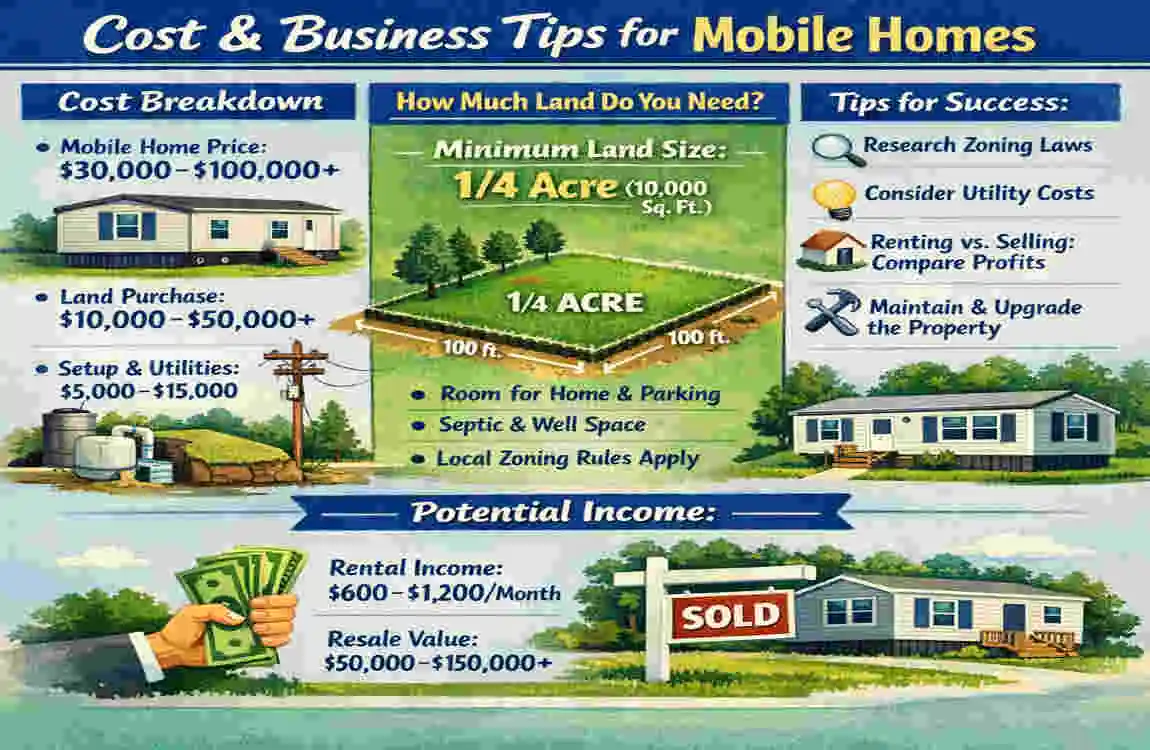
For the business owners, real estate developers, and ambitious investors reading this, understanding land requirements is the absolute foundation of your return on investment (ROI).
The land cost factor is your biggest variable. Depending on whether you are buying in the rural Midwest or the bustling Sun Belt, raw land can cost anywhere from $5,000 to $50,000 per acre. If you overpay for land that has highly restrictive zoning, your profit margins will vanish instantly.
For business blogs and commercial investors, here is the golden rule: Mobile home parks yield their highest profits when you can successfully achieve 8 to 10 units per acre. This high density is what makes the business model so incredibly resilient. You are spreading the cost of the raw land and the centralized utility infrastructure across multiple rent-paying tenants.
Let us do a quick investment calculation. If you buy 1 acre of appropriately zoned commercial land, utilizing smaller single-wide models will give you the highest density returns. Even if you factor in the required green spaces and paved access roads, efficiently arranging 8 single-wides on a single acre allows you to maximize your monthly lot rents without triggering municipal overcrowding violations. Always consult a civil engineer to draft your site plan to ensure you are maximizing every square inch of your investment.
Frequently Asked Questions (FAQ)
How much land is required for a mobile home? In most standard situations, you will find that 0.25 to 1 acre is the typical requirement for a private lot. However, if you are moving into a pre-existing community with shared utilities, the absolute minimum can start as low as 2,000 to 2,500 square feet.
What is the single-wide minimum lot size? For a standard private placement, you should aim for a minimum of 8,000 square feet (roughly 0.2 acres). This provides just enough room for the home, a modest driveway, and the mandatory boundary buffers required by local governments.
Do property setbacks count toward my total space? Yes, absolutely! Setbacks are a massive factor. They usually require an extra 5 to 20 feet of completely empty space around the entire perimeter of your home. You own this land, but you cannot build on it, meaning it eats into your usable square footage.
Can I put my house on a tiny 0.1-acre lot? Generally, placing a home on 0.1 acres is restricted to parks only. Because 0.1 acres equals roughly 4,350 square feet, you will not have enough room to install a private septic system or water well. You can only use a lot this small if you are tapping into a park’s centralized city sewer and water grid.