Want extra living space without the massive hassle of buying a brand-new house? You are certainly not alone. With housing markets tightening and families growing, more and more homeowners are looking right under their feet for a solution.
If you own a manufactured home, you may be stuck with the square footage you currently have. But that is not true. Adding a basement under your existing manufactured home is an incredible way to double your living space, add valuable storage, and significantly boost your property’s equity.
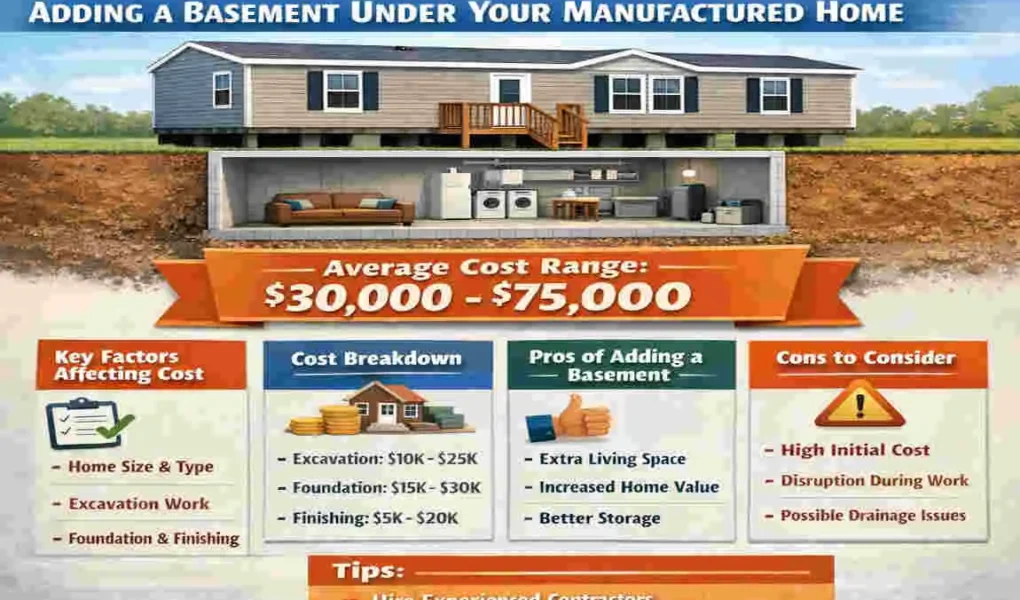
In 2026, the average cost ranges between $12,000 and $50,000, which breaks down to roughly $20 to $40 per square foot. While this might sound like a hefty investment, it is often far cheaper than buying a larger traditional home or funding a massive above-ground addition.
| Expense | Typical Cost Range |
|---|---|
| Design / engineering | $1,500–$5,000 |
| Permits / inspections | $500–$3,000 |
| Excavation / site prep | $5,000–$20,000 |
| Foundation / basement structure | $20,000–$60,000+ |
| Utilities / drainage / waterproofing | $5,000–$15,000 |
| Total estimated project cost | $35,000–$100,000+ |
Basement Basics for Manufactured Homes
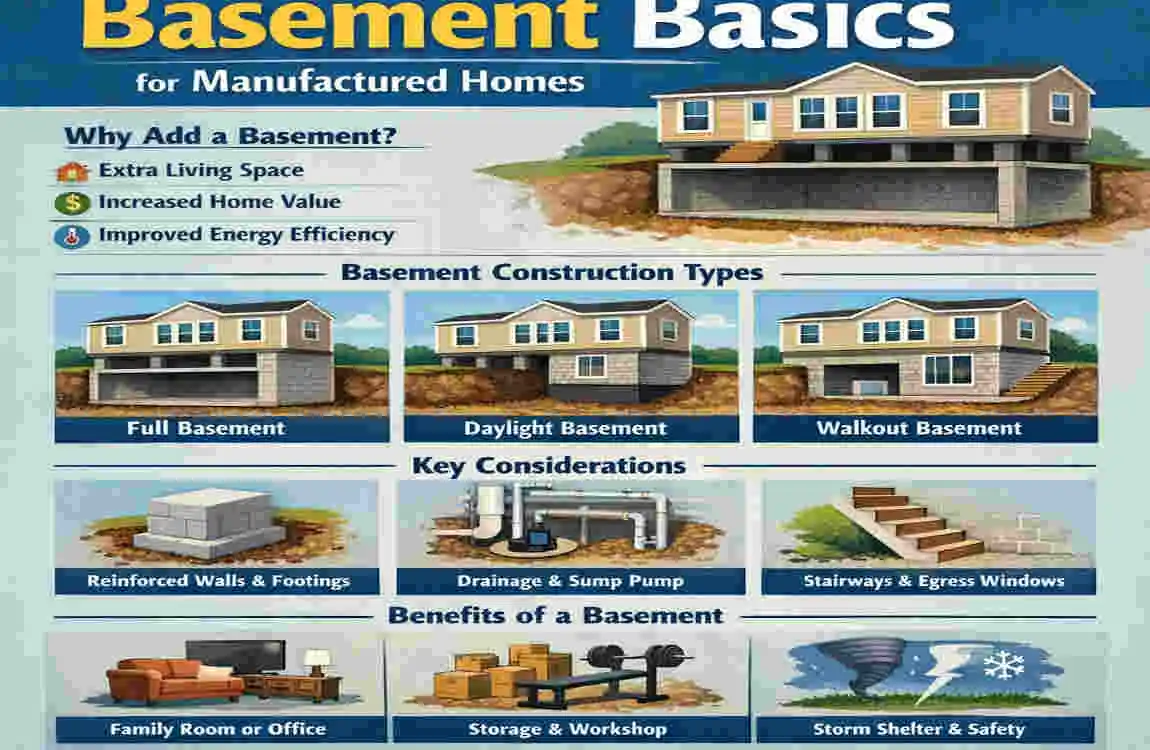
Before we dive into the numbers, let’s get on the same page about what putting a basement under a manufactured home actually entails. It may be the same process used for traditional, site-built homes. While there are similarities, manufactured homes require a highly specialized approach.
What Does the Process Look Like?
To add a basement to an existing manufactured home, heavy machinery experts must carefully lift your entire house into the air. Once your home is safely elevated and secured, excavation crews dig out the earth beneath it.
Next, contractors pour a heavy-duty concrete foundation and build the basement walls. Finally, they lower your home back down, anchor it securely to the new foundation, and finish the interior walls and flooring. It is a modern engineering marvel that completely transforms your property.
How It Differs From Site-Built Homes
Unlike traditional homes built directly on a foundation from day one, manufactured homes are built in factories. To legally place one in a basement, the foundation must meet strict guidelines set by the Department of Housing and Urban Development (HUD).
HUD requires the basement to act as a “permanent foundation.” This means the home must be permanently tied down and structurally integrated into the concrete to resist wind, gravity, and earthquake forces. You cannot just plop a mobile home on top of a basement and call it a day; it requires precise engineering.
Single-Wide vs. Double-Wide Considerations
The size of your home plays a massive role in the complexity of the project.
- Single-wide homes: These are generally simpler and boast a lower overall cost. Because they are narrow, supporting them during the lift is straightforward.
- Double-wide homes: These require significantly more engineering. Contractors must support the “marriage line” (the seam where the two halves of the home connect) to prevent the house from buckling or sustaining drywall damage during the lift.
Important Note: Not all manufactured homes qualify for a basement addition. Older models, particularly those built before HUD implemented strict structural codes in 1976, are often too fragile to survive the lifting process. Always have a structural engineer inspect your home first!
Average Costs Breakdown
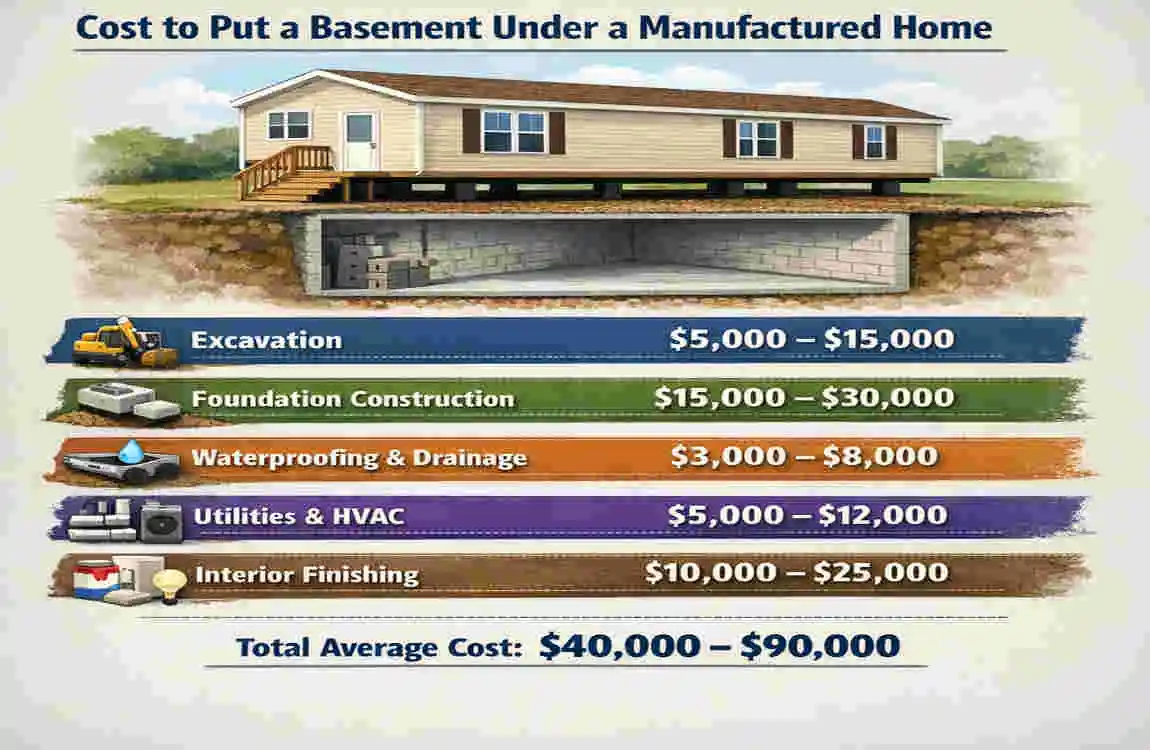
Let’s get into the core of why you are here: the numbers. The cost of putting a basement under a manufactured home can vary wildly depending on what you want. A bare-bones, unfinished concrete storage space will cost significantly less than a fully finished, livable family room with a bathroom.
To give you a clear picture, we have broken down the 2026 estimates into a handy table.
Estimated Cost Components
Cost Component: Low-End Estimate, High-End Estimate, Notes
Excavation $2,000 $8,000 The type of soil and the slope of your lot heavily affect this price.
Foundation & Pouring $5,000 $20,000 Includes concrete and steel rebar; averages around $33/sq ft.
Lifting & Jacking $3,000 $10,000 Requires specialized hydraulic jacks, especially for 1,000+ sq ft homes.
Waterproofing & Drainage $2,000 $10,000 Absolutely essential in wet climates or areas with high water tables.
Finishing (Walls, Stairs) $5,000 $25,000 Includes drywall, egress windows, basic flooring, and staircases.
Total Estimated Range $12,000 $50,000+ Based on 800-1,500 sq ft homes. Walkout basements add about 20% to the total.
Understanding the Numbers
When you break these totals down, you are looking at roughly $20 to $50 per square foot for the entire project. But why is the range so wide?
Let’s look at the Lifting and Jacking phase. If you have a small single-wide, a lifting crew can hoist it up in a day for around $3,000. But if you have a massive, custom double-wide, they need specialized hydraulic systems and more workforce, pushing the price toward $10,000.
Then, there is the Finishing phase. If you want a raw, concrete bunker for your hurricane supplies or winter gear, your finishing costs will be close to zero. But if you want a cozy media room with painted drywall, recessed lighting, and safety egress windows, you can easily spend $25,000 or more.
Regional Price Differences
Where you live dictates how much you will pay. If you live in a coastal area like California or a high-cost urban center in the Northeast, expect to pay about 30% more than the national average due to higher labor rates and strict building codes. Conversely, homeowners in the Midwest or rural Southern states often find their quotes leaning closer to the low-end estimates.
Factors Influencing Your Cost
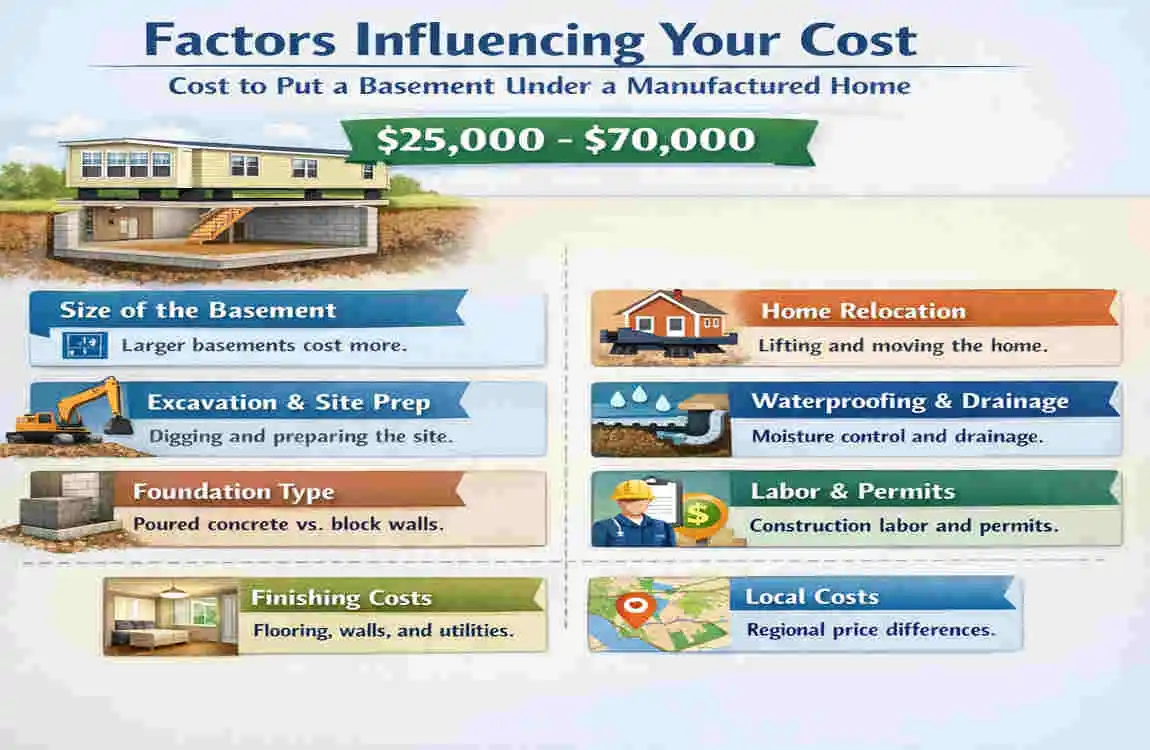
Look at the $12,000 to $50,000 range and wonder where exactly your home will fall. Several unique variables dictate your final bill. Understanding these factors can help you set realistic expectations before you ever call a contractor.
Your Home’s Size and Type
Naturally, the larger the footprint of your home, the larger the basement below it must be. A standard single-wide home usually incurs an average cost of around $15,000 for a basic basement. However, if you have a large modular home or a sprawling double-wide, your costs will easily exceed $30,000 because you need exponentially more concrete, steel, and excavation time.
Site Conditions and Terrain
What lies beneath the grass in your yard? If your property sits on soft, easy-to-dig dirt, excavation is quick and cheap. But if your contractor hits solid bedrock or massive boulders, excavation costs can spike by 50% or more.
Additionally, if your lot is heavily sloped, you cannot just dig a simple square hole. You will likely need expensive retaining walls to hold back the hillside and prevent mudslides from crushing your new foundation.
Location, Labor Rates, and Permits
Labor is one of the biggest line items on your invoice. Depending on your region, skilled construction crews charge anywhere from $50 to $150 per hour.
You also cannot forget the government. Local municipalities love to charge for building permits. Depending on how strict your local zoning laws are, permit fees and mandatory inspections can add anywhere from $500 to $2,000 to your budget.
The Level of Finish You Want
What is your vision for this space?
- Basic Storage: Leaving the concrete walls bare and the floor unfinished is the cheapest route.
- Livable Space: Adding framing, insulation, and drywall increases the cost.
- Full Apartment Setup: If you want to add a bathroom or a wet bar, you need to tie into your existing plumbing. Rerouting pipes and adding sewage pumps will instantly add at least $10,000 to your total.
Retrofit vs. New Build
Are you putting a basement under a home you already live in (a retrofit), or are you ordering a new home to be placed on a newly poured basement?
Retrofitting an existing home is notoriously more expensive. Contractors must carefully disconnect your electricity, plumbing, and HVAC systems before they lift the home. After the basement is finished, they have to reroute and reconnect all those utilities. This extra labor generally adds around $3,000 to the total project cost compared to placing a brand-new home on a waiting foundation.
Cost Comparison: Basements vs. Alternatives
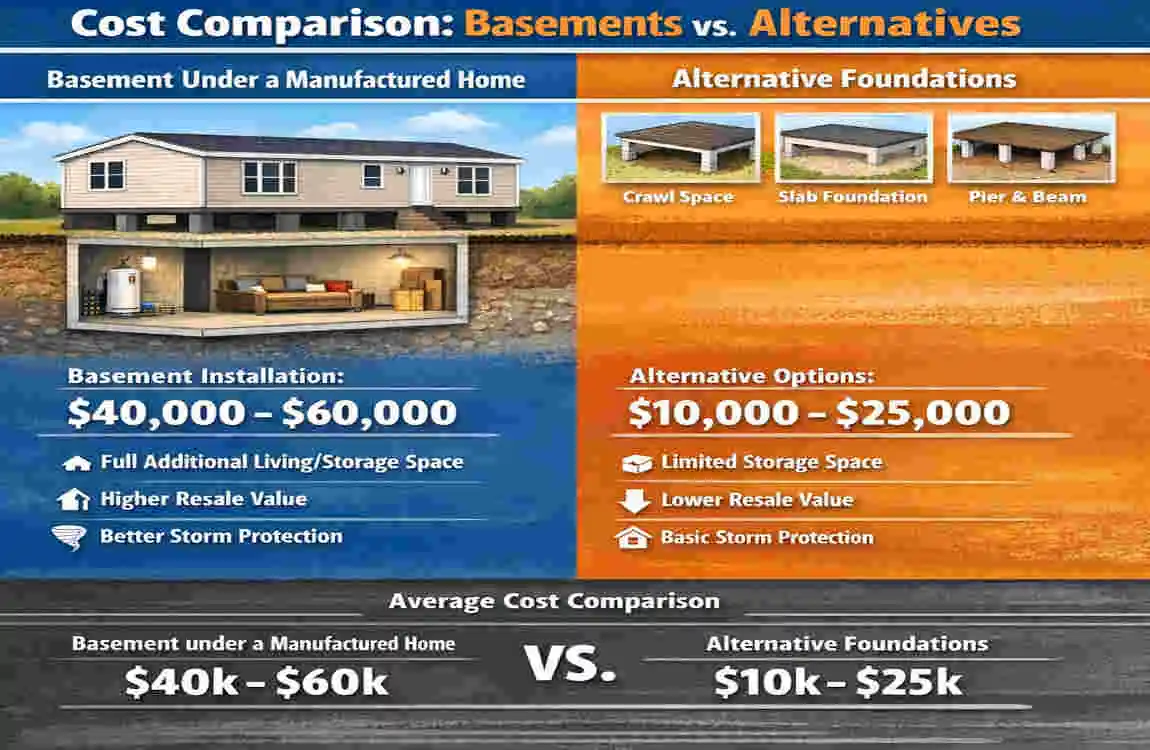
If the cost of a basement gives you sticker shock, you might be wondering about other foundation options. Let’s compare basements against the three most common alternatives for manufactured homes.
Foundation Types at a Glance
Foundation Type Cost Range Pros Cons
Piers / Blocks $3,000 – $12,000 Very cheap, incredibly fast to install. Zero storage space, vulnerable to pests.
Concrete Slab $5,000 – $15,000 Highly durable, low maintenance. No extra living space, hard-to-access plumbing.
Crawl Space $6,000 – $15,000 Well-ventilated, looks like a site-built home. Crawling access is difficult for repairs.
Full Basement $12,000 – $50,000 Massive livability, huge storage, adds high value. Highest upfront cost, longer build time.
Why Choose a Basement Over a Slab or Crawl Space?
If you want the cheapest option, concrete piers or a basic slab will win every time. However, those options do absolutely nothing to improve your day-to-day lifestyle.
When you choose a basement, you are not just buying a foundation; you are buying an extension of your home. You can turn that space into a home gym, a massive playroom for the kids, a dedicated home office, or simply a safe shelter during severe tornado weather.
Furthermore, a permanent basement foundation drastically changes how banks view your property. Once retrofitted to a permanent basement per HUD standards, your manufactured home can qualify for traditional mortgages. This upgrade alone typically adds 20% to 30% to your total home value!
Step-by-Step Installation Process
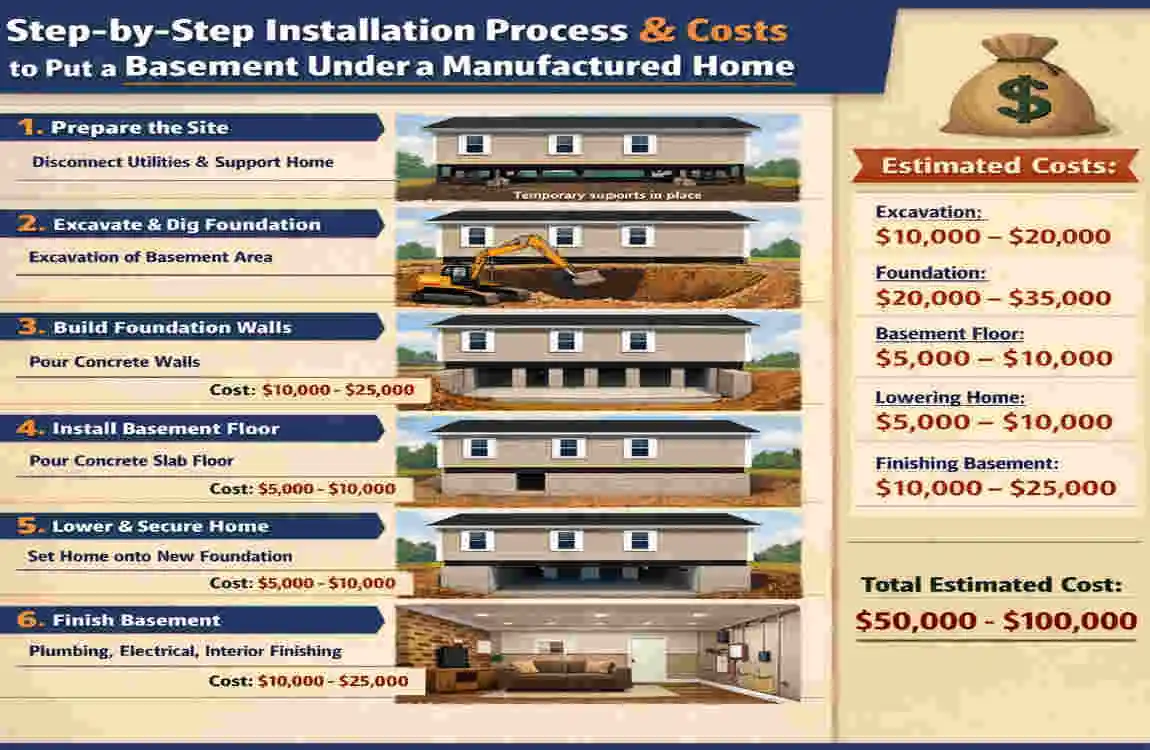
Are you curious about what actually happens once you sign the contract? Putting a basement under a manufactured home is a massive undertaking. Knowing the steps helps you prepare for the noise, the dirt, and the timeline.
Here is exactly what you can expect during this 2 to 6-week process.
Assessment and Engineering
Before anyone touches a shovel, professionals must evaluate your home and land. A structural engineer will inspect your home’s chassis to ensure it can survive the lift. They will also test your soil to see if it can support deep concrete walls. This initial planning phase usually costs between $1,500 and $3,500.
Permits and Zoning Check
Your contractor takes the engineer’s blueprints to the local building department. The city will review the plans to ensure they meet modern home safety codes. Once they approve the permits, the real work begins.
Lifting the Home
This is the most nerve-wracking but exciting part! Crews slide massive steel I-beams under your manufactured home. Using a network of synchronized hydraulic jacks, they slowly lift your home several feet into the air. As one veteran contractor notes:
Excavation and Digging
With your home hovering safely in the air, excavators and bulldozers move in. They dig a massive hole directly underneath your suspended house. They will carve out the exact dimensions needed for the basement, hauling away dozens of truckloads of dirt. Depending on the soil, this takes 3 to 7 days.
Foundation Pouring and Backfilling
Next, concrete crews arrive. They build wooden forms, lay down a grid of steel rebar for strength, and pour the concrete footings and walls. Once the concrete cures (hardens), they remove the wooden forms and push dirt back against the outside of the walls—a process called backfilling.
Lowering, Finishing, and Utilities
The hydraulic jacks slowly lower your home onto its brand-new foundation. Workers weld or bolt the home’s steel chassis securely to the concrete. Finally, plumbers and electricians hook your utilities back up. If you paid for a finished basement, crews will spend the next 1 to 2 weeks framing walls, hanging drywall, and installing flooring.
Call to Action: Ready to see if your home can handle the lift? Contact a local structural engineer today for a preliminary inspection!
Financing and Savings Tips
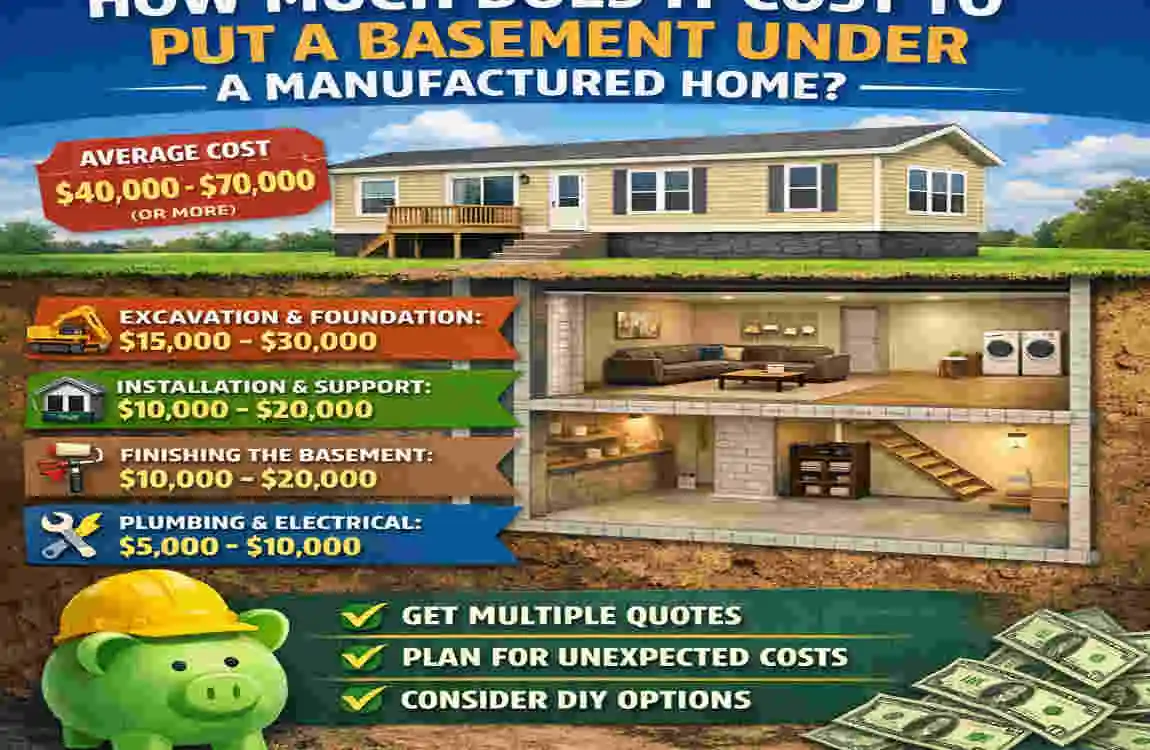
We know that spending up to $50,000 is not pocket change. Luckily, you do not have to drain your life savings to make this dream a reality. There are several smart ways to finance this project and clever tricks to lower the total cost.
Smart Financing Options
Because adding a basement turns your property into real estate (rather than personal property like a car), banks are much more willing to lend you money.
- FHA 203(k) Loans: This is a fantastic government-backed loan designed specifically for home rehabilitation. It allows you to borrow the money needed for the basement based on what the home will be worth once the basement is finished.
- Home Equity Lines of Credit (HELOC): If you already have significant equity in your property, you can borrow against it at a relatively low interest rate to fund the construction.
- Energy Tax Credits: If you use high-efficiency insulation or install energy-saving windows in your new basement, you might qualify for federal or state tax credits, putting cash back in your pocket come April.
How to Save Money on the Build
Do you want to trim a few thousand dollars off your quote? Try these strategies:
- Book in the Off-Season: Contractors are swamped in the spring and summer. If you schedule your excavation for late fall or winter (if your climate allows), you can often negotiate a 10% discount on labor.
- Do the Finishing Yourself: Pay the pros to do the heavy lifting, concrete pouring, and structural work. But once the concrete is dry, take over! You can save thousands by painting, hanging drywall, and laying laminate flooring yourself.
- Avoid DIY Excavation: You might think renting a backhoe will save you money. It will not. Excavating under a suspended house is incredibly dangerous. One wrong move and you could knock out a support beam, destroying your home. Leave the digging to the experts.
The ROI Factor: Keep in mind that a basement is an investment. Homeowners who add a basement typically recoup 70% to 90% of their costs when they eventually sell the home.
Legal and Practical Considerations
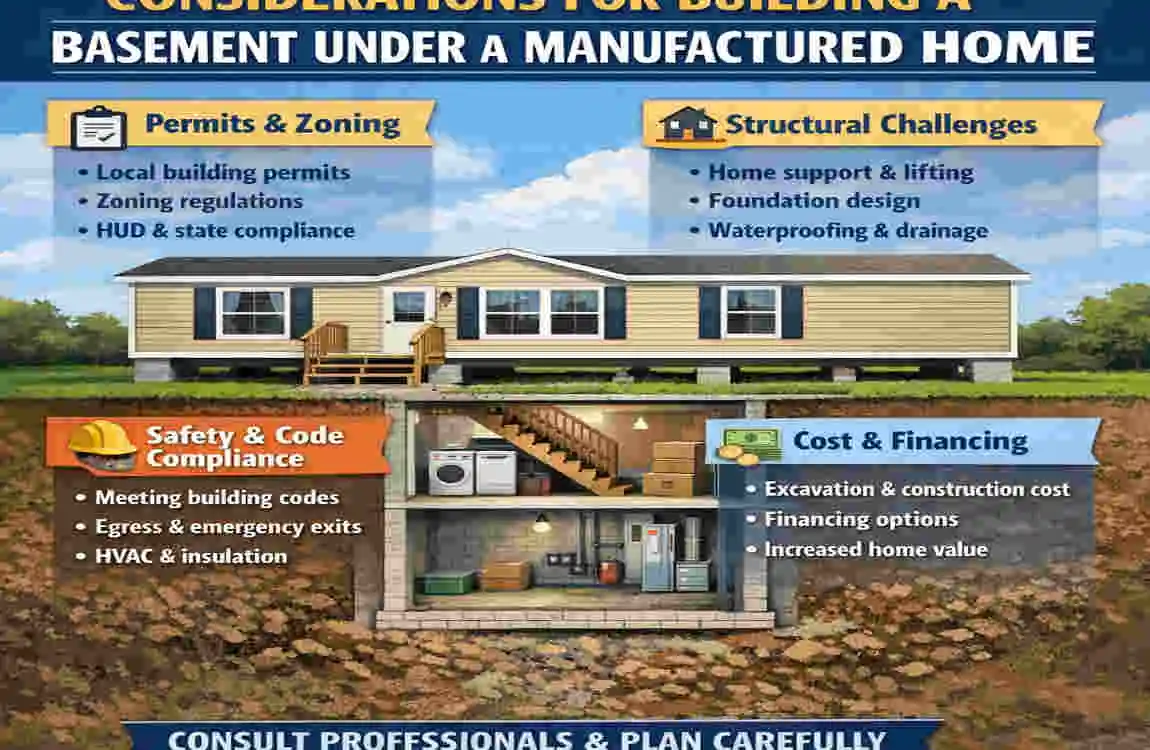
Before you sign any checks, you must navigate a few legal hurdles and practical realities. Ignoring these can result in heavy fines or a basement that constantly floods.
Strict HUD Compliance
We cannot stress this enough: your new basement must be completely compliant with HUD’s Permanent Foundations Guide for Manufactured Housing. If your contractor cuts corners and fails to meet these federal standards, you will not be able to finance or sell your home in the future legally. Always hire a contractor who specializes in manufactured homes, not just standard concrete work.
Soil Testing and Flood Zones
Do you live near a river, or is your home located in a designated flood zone? If so, your local zoning board might outright deny your request to build a basement. Even if they approve it, high water tables can cause hydrostatic pressure—meaning water will constantly push against your concrete walls, leading to cracks and severe flooding. Make sure your contractor includes aggressive waterproofing measures, like a high-end sump pump and exterior French drains.
Insurance Premiums Will Change
Adding 1,000 square feet of living space makes your home much more valuable. Consequently, your homeowner’s insurance Premium will rise, usually by 10% to 20%. However, this is actually good news! Your insurance goes up because your property equity has soared. You are protecting a much larger, more valuable asset.
Real Homeowner Case Studies
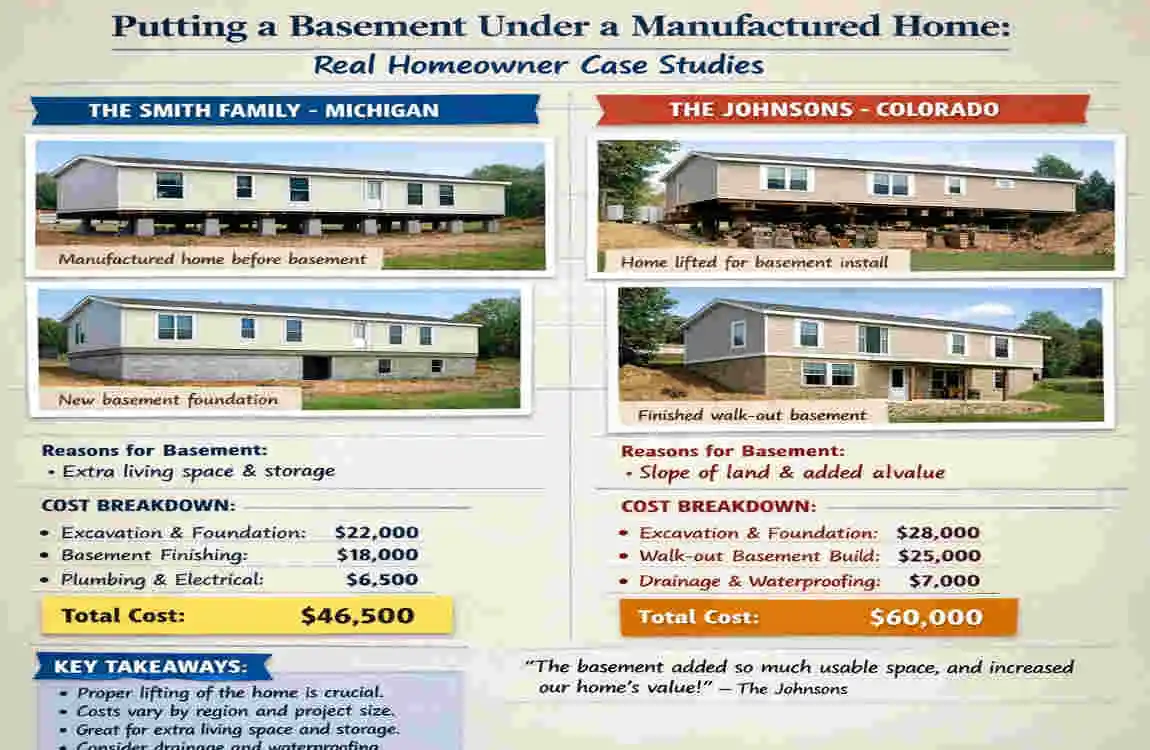
Sometimes, looking at abstract numbers is confusing. Let’s look at two real-world scenarios to see how different choices affect the final price tag.
The Texas Double-Wide Expansion
- The Home: A 1,200 square-foot double-wide manufactured home sitting on flat, sandy soil in rural Texas.
- The Goal: The homeowners wanted to add a 400 square-foot finished recreation room for their teenagers, leaving the rest of the basement as unfinished concrete storage.
- The Process: Because the soil was soft and flat, excavation was a breeze. Lifting the double-wide required careful marriage-line support, but the crew finished the lift in one day.
- The Final Bill: $28,000 total. This included $18,000 for the structural work and lifting, plus $10,000 to frame, drywall, and electrify the 400-square-foot rec room.
The Pennsylvania Sloped Lot
- The Home: A 900-square-foot single-wide manufactured home in Pennsylvania, perched on a heavily sloped, rocky hill.
- The Goal: The owners wanted a fully finished “walkout” basement—meaning one side of the basement is completely above ground with a door leading straight to the backyard.
- The Process: The rocky terrain meant the excavation crew had to bring in specialized rock-breaking equipment, doubling the digging time. However, the sloped lot made the walkout design possible, flooding the basement with natural sunlight.
- The Final Bill: $45,000 total. The rock excavation and the retaining walls needed for the sloped lot drove up the price, but the family essentially gained a beautiful, sunlit first-floor apartment.
Frequently Asked Questions (FAQs)
Still have a few lingering questions? Here are the most common questions homeowners ask when considering this massive upgrade.
How much does it cost to put a basement under a manufactured home?
On average, expect to pay between $12,000 and $50,000. The final price depends on the size of your home, the soil conditions on your property, local labor rates, and whether you want the space fully finished with drywall and plumbing or left as basic raw concrete.
Is it really possible to put a basement under a mobile home?
Yes, absolutely! As long as the home is structurally sound enough to be lifted by hydraulic jacks, you can add a basement. However, it must be installed on a HUD-approved permanent foundation system.
How long does the entire project take?
From the day the heavy machinery arrives to the day you can walk into your new basement, the project usually takes between 2 and 4 weeks for an unfinished space. If you are having contractors hang drywall, install flooring, and run plumbing, expect it to take closer to 6 weeks.
Does adding a basement increase my home’s value?
Yes, significantly. Moving a manufactured home from temporary piers to a permanent basement foundation typically increases the home’s resale value by 15% to 25%. It also allows future buyers to qualify for traditional, low-interest mortgages, making your home much easier to sell.
What are the cost differences between single-wide and double-wide homes?
Because double-wide homes are twice as large and have a vulnerable seam down the middle, lifting them requires more equipment and engineering. You can generally expect to pay 30% more to put a basement under a double-wide compared to a single-wide of similar length.