Planning your dream home is one of the most exciting journeys you will ever take. You’ve probably spent hours scrolling through Pinterest, looking at kitchen islands, and dreaming about the perfect main suite. But let’s pause for a second and talk about one of the most underrated parts of your home: the garage.
You might find yourself asking, “How many square feet are in a two-car garage?” It’s a question that sounds simple, but the answer can make or break how your home functions day to day. If the garage is too small, you’ll be doing a “sideways shuffle” every time you try to get into your car. If it’s designed just right, it becomes a sanctuary for your vehicles, your hobbies, and your storage needs.
How Many Square Feet Are in a Two-Car Garage? Here’s the Breakdown
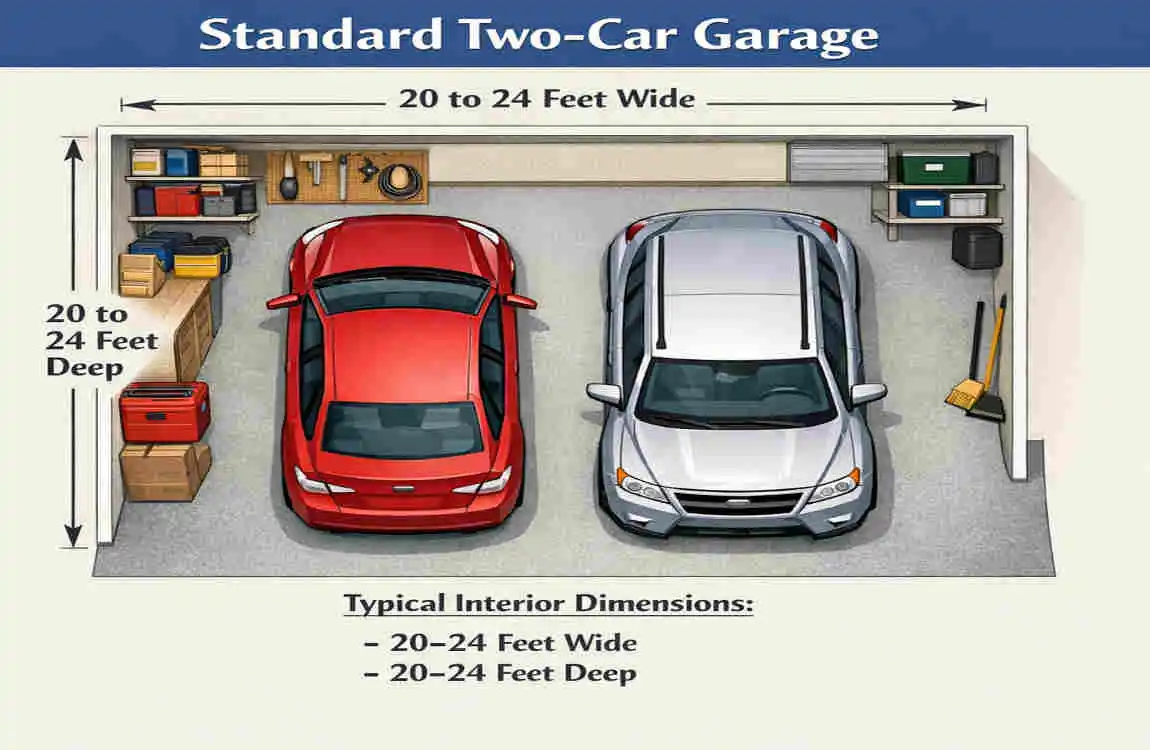
When you start looking at floor plans, you’ll notice that most builders have a “go-to” size for a standard two-car garage. However, “standard” can be a bit of a moving target depending on where you live and the type of cars you drive.
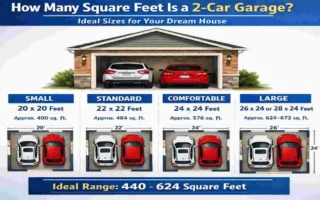
Generally speaking, a standard two-car garage typically measures between 400 and 600 square feet.
If you are looking for a quick reference to help you visualize these numbers, take a look at the table below. It breaks down the most common dimensions and the total square footage they provide.
Standard Two-Car Garage Dimensions Table
Dimensions (Width x Depth)Total Square FootageCommon Use Case
20 ft x 20 ft 400 sq ft Minimum standard; tight fit for two small cars.
22 ft x 22 ft 484 sq ft Comfortable for two sedans or small SUVs.
24 ft x 24 ft 576 sq ft The “Sweet Spot”; room for cars and some storage.
24 ft x 30 ft 720 sq ft Large garage; fits trucks and a small workshop.
30 ft x 30 ft 900 sq ft Triple-sized feel; massive storage or hobby space.
The “Minimum” vs. The “Functional” Standard
While a 400-square-foot garage (20×20) is technically a two-car garage, it’s often the bare minimum. Imagine trying to open your car doors when two vehicles are parked side-by-side in a 20-foot space. It’s tight!
Most modern homeowners are moving toward the 500- to 600-square-foot range. According to data from the National Association of Home Builders (NAHB), the average square footage of a two-car garage in a dream home is trending larger every year because our vehicles—and our lives—are getting bigger.
Factors Influencing Two-Car Garage Square Footage
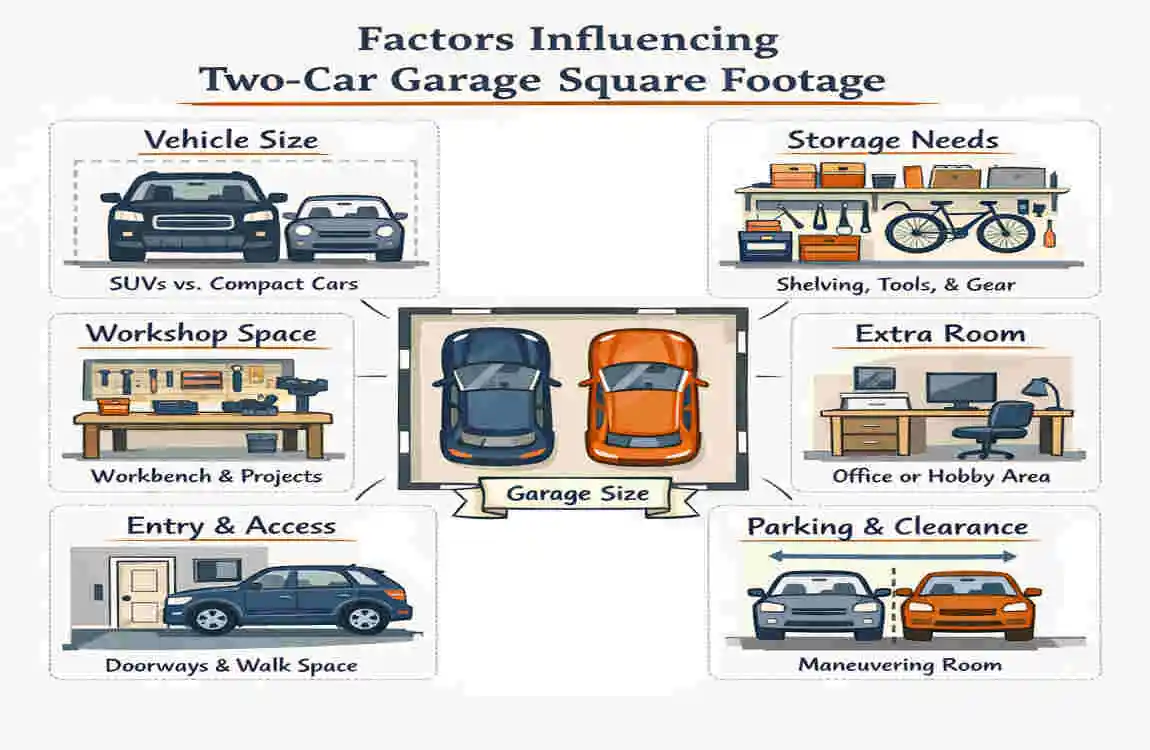
Why isn’t there just one single size for every home? Well, because every family has different needs. Several key factors will dictate whether you need a modest 400-square-foot space or a sprawling 700-square-foot workshop.
Vehicle Size and “Swing Space”
The most significant factor, obviously, is what you are parking inside. A Tesla Model 3 is much smaller than a Ford F-150.
- Small Cars: If you have two compact cars, you can get away with 400-450 square feet.
- SUVs and Trucks: Large vehicles need more width and depth. A full-size truck can be 19 to 22 feet long. If your garage is only 20 feet deep, your bumper will be touching the wall while your tailgate is hitting the garage door!
- The Door Factor: You also need to account for “swing space.” This is the room needed to fully open your car doors without hitting the wall or the car next to you. We recommend at least 30 to 36 inches of clearance between vehicles.
Door and Clearance Needs
The physical garage door itself takes up space. A standard double garage door is usually 16 feet wide. If your garage is only 18 feet wide, you have only 1 foot of wall space on either side of the door. This makes it incredibly difficult to park and even more challenging to walk around the car once it’s inside.
Storage and Multi-Use Requirements
Do you plan on keeping your lawnmower in the garage? What about the kids’ bikes, the holiday decorations, or a secondary refrigerator?
- Wall Storage: Shelving units usually protrude 12 to 24 inches from the wall.
- Workbenches: A functional workbench needs at least 2 to 3 feet of depth.
- Walkways: You should always leave a clear 3-foot path for walking so you aren’t tripping over gear in the dark.
Regional Building Codes
Depending on where you live, local laws may dictate the square footage of your attached garage. In some areas with high seismic activity or heavy snow loads, structural requirements limit how wide you can go without expensive reinforcements. Always check with your local planning department before finalizing your blueprints.
Ideal Two-Car Garage Sizes for Different Lifestyles
Not all garages are created equal because not all homeowners live the same way. Let’s look at three everyday “lifestyle” sizes to see which one fits your dream home vision.
The Everyday Family Garage (400–500 sq ft)
This is the most common size found in suburban developments. It’s designed for efficiency.
- Best for: Two mid-sized sedans or one SUV and one small car.
- Storage: Limited to some overhead racks or slim wall-mounted shelving.
- The Vibe: It gets the job done, but it’s not a place where you’ll be “hanging out.”
The “Oversized” Family Garage (550–700 sq ft)
If you have “toys” like a boat, a pair of large SUVs, or a collection of bikes, this is your zone.
- Best for: Families who drive large vehicles and need extra room for gear.
- Dimensions: Usually 24×24 or 24×26.
- The Vibe: Comfortable. You can open all the doors at once, and there is still room for the trash cans and a lawnmower.
The Workshop or Home Gym Conversion (700–800+ sq ft)
More people are using their garages for more than just cars. With the rise of remote work and home fitness, the garage has become a “flex space.”
- Best for: Hobbyists, woodworkers, or fitness enthusiasts.
- Features: Often includes extra electrical outlets for power tools, improved insulation, and, perhaps, plumbing for a utility sink.
- The Vibe: This is a valid extension of the home’s living space.
Garage Depth, Width, and Height: Beyond Just Square Feet
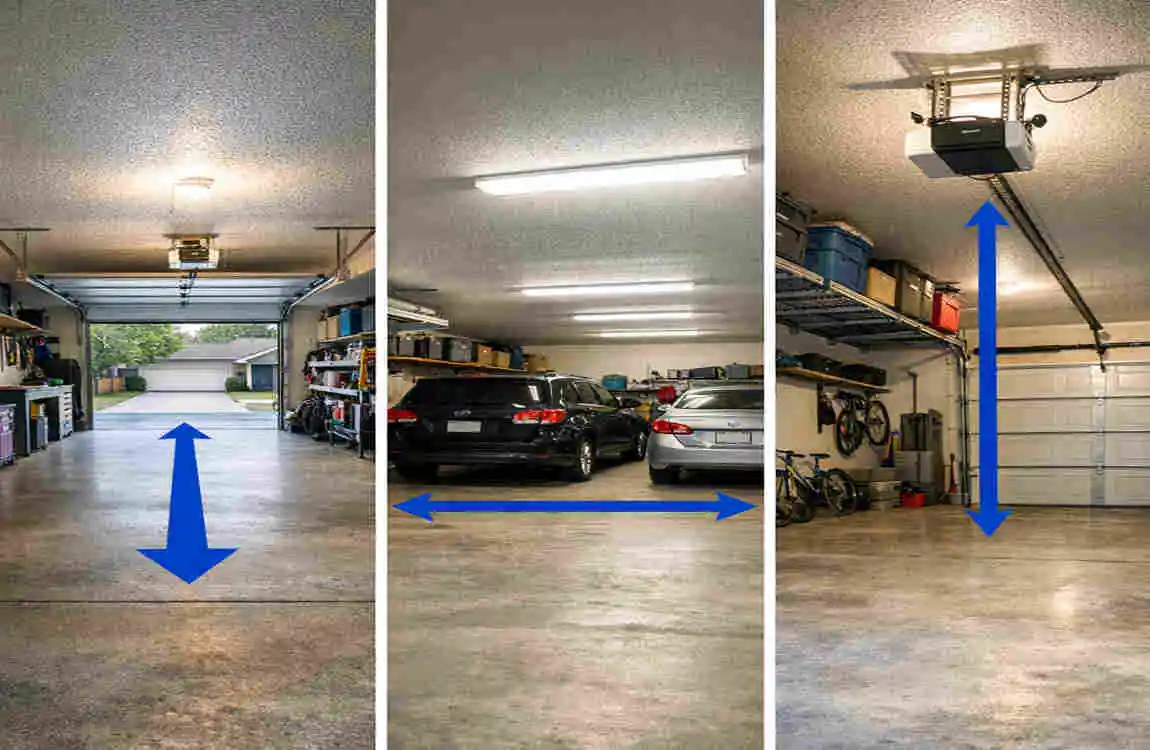
When someone asks “how many square feet are in a two-car garage,” they are looking at a flat number. But a garage is a three-dimensional box! You have to think about the “volume” as much as the “area.”
The Importance of Width
Width is what prevents “door dings.” If you have 24 feet of width, you have plenty of room for two 6-foot wide cars, a 3-foot gap between them, and 4.5 feet of space on the outer sides. That is luxury!
The Importance of Depth
Depth is often where people cut corners to save money, and they usually regret it. A 20-foot deep garage is barely enough for a modern minivan. If you go to 24 feet of depth, you suddenly have a 4-foot “buffer” at the front of the cars. That’s where you put your workbench, your extra freezer, or your tool chest.
Don’t Forget the Ceiling Height!
Standard garage ceilings are 8 feet high. However, if you want to install overhead storage racks or a car lift, you should aim for 10 or 12 feet.
- Pro Tip: If you drive a tall van or have a roof rack with a cargo carrier, measure that height before you build. There’s nothing worse than realizing your car won’t fit under the garage door header!
Cost to Build a Two-Car Garage by Square Footage
Building a garage is a significant investment. The cost is usually calculated per square foot, and while prices vary by location, we can look at some general averages.
Pricing Tiers
On average, building a garage costs between $50 and $100 per square foot.
- Basic (400 sq ft): $20,000 – $40,000. This usually includes a concrete slab, basic framing, and a standard door.
- Mid-Range (600 sq ft): $30,000 – $60,000. This might include better insulation, finished drywall, and windows.
- High-End (800+ sq ft): $50,000 – $100,000+. This is where you get custom flooring (epoxy), climate control, and high-end cabinetry.
The ROI (Return on Investment)
Is it worth spending the extra money for a larger garage? According to real estate experts like Zillow, a well-sized garage can boost your home’s value by 10-15%. Buyers love storage. If they see a spacious 600-square-foot garage, they see a home that can grow with them. It’s one of the few home improvements that almost always pays for itself.
Common Mistakes in Sizing Your Two-Car Garage
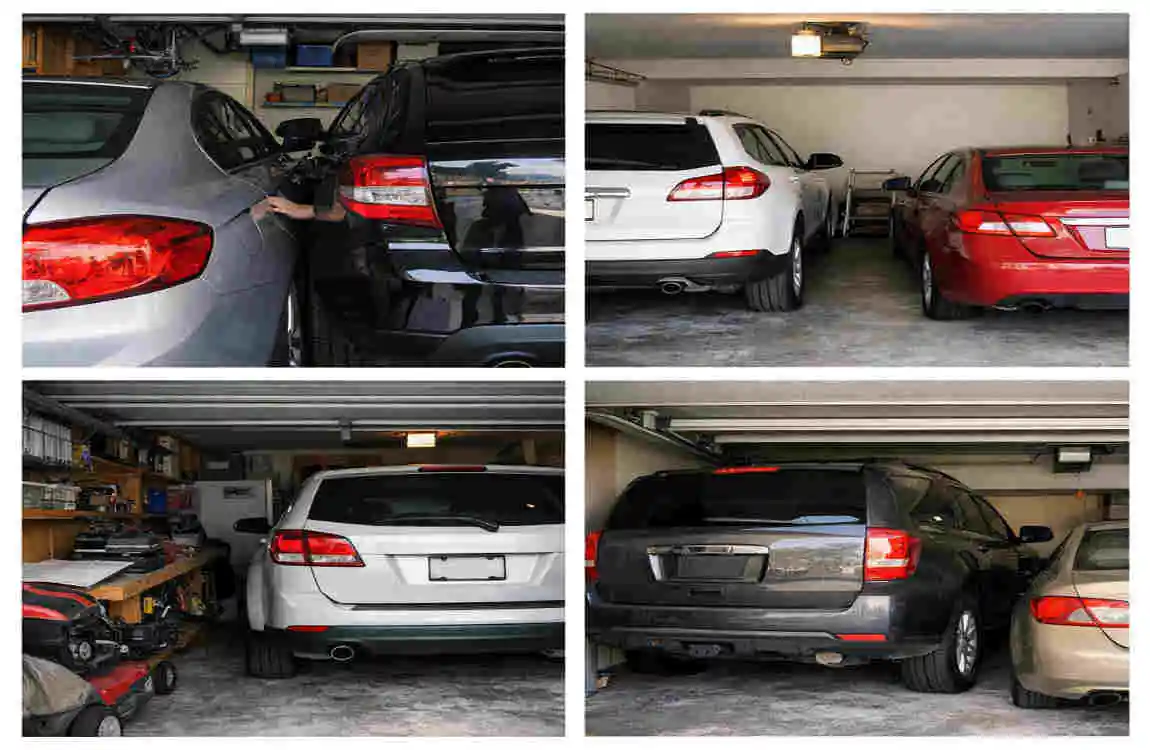
I’ve talked to many homeowners who said, “I wish I had made the garage just two feet wider.” To ensure you don’t have the same regret, avoid these common pitfalls:
- Ignoring the “Future” Car: You might drive a Prius now, but what if you buy a large electric truck in five years? Always size for the largest vehicle you might realistically own.
- Forgetting the EV Charger: Electric vehicles (EVs) are the future. Even if you don’t have one now, leave enough square footage and wall space for a charging station.
- Skimping on Insulation: If you live in a climate with extreme heat or cold, your garage will be miserable if it isn’t insulated. This takes up a tiny bit of interior space but adds massive comfort.
- Undersizing the Doors: A single 16-foot door is standard, but two 9-foot doors with a center pillar often look better and provide more structural integrity. However, this requires a wider garage overall.
FAQs About Two-Car Garage Square Footage
How many square feet are in a two car garage on average?
The average two-car garage is between 400 and 600 square feet. A 20×20 foot garage is the most common “minimum” size, while 24×24 is considered the modern ideal.
What is the minimum square footage for two cars?
Technically, you can fit two cars into 360 square feet (18×20), but it is extremely tight. We recommend a minimum of 400 square feet for basic functionality.
Will a 20×20 garage fit two SUVs?
It will be very tight. Most full-size SUVs are about 6.5 to 7 feet wide. In a 20-foot wide garage, that leaves very little room to open doors. For two SUVs, we recommend at least a 22×22 or 24×24 space.
Does a larger garage increase property taxes?
In most jurisdictions, yes. Property taxes are often based on the total square footage of the structure. However, the increase is usually minimal compared to the added home value and utility.
Can I turn a two-car garage into a living space later?
Yes, but it’s easier if you build it larger now. If you plan to convert it, ensure you have at least 500-600 square feet so the resulting room feels like a natural part of the house rather than a cramped closet.