Are you tired of opening your electricity bill only to find that prices have jumped once again? You are certainly not alone. Across the country, thousands of homeowners are looking up at their roofs, wondering whether it is time to switch to renewable energy. If you find yourself asking, “how much does it cost to install solar panel at home uk,“ you have landed in exactly the right place.
Leaping solar energy is a fantastic way to declare your independence from unpredictable grid prices while simultaneously doing your part for the environment. But, quite understandably, the upfront price tag is the first thing on every homeowner’s mind.
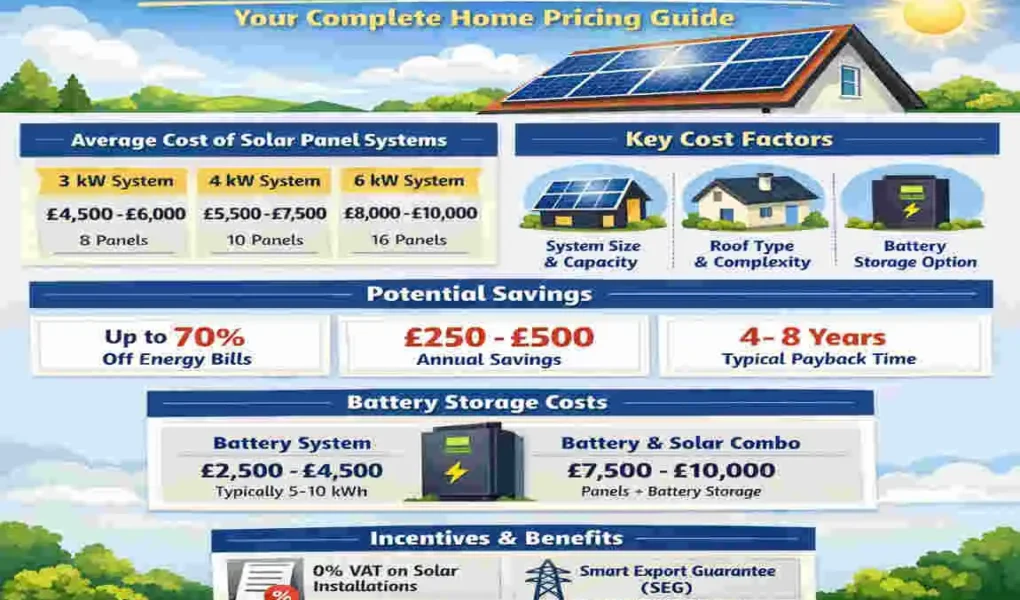
The even better news? The UK government has recently slashed VAT on solar panel installations to an incredible 0%. This policy alone instantly saves you anywhere from £1,000 to £3,000 on your final bill, making green energy more accessible than ever before. With modern solar technology boasting an average return on investment (ROI) payback period of just 6 to 7 years, your roof could be paying for itself much faster than you might think.
Average Solar Panel Installation Costs UK in 2026
When homeowners start their renewable energy journey, the primary question is always the same: how much does it cost to install solar panel at home uk?
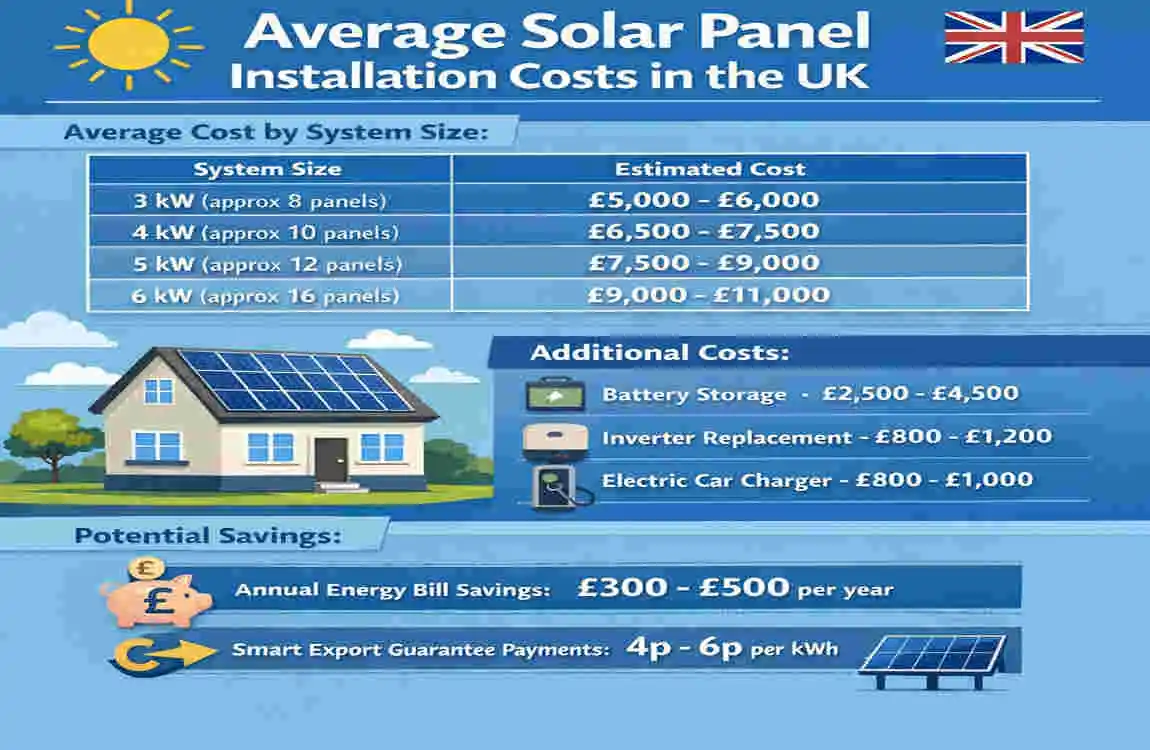
To give you the most accurate answer, we need to consider the system’s size. Solar systems are measured in kilowatts (kW), which indicate how much electricity the panels can generate under peak conditions. The larger your home and the higher your electricity usage, the more kWs you will need to keep your appliances running smoothly.
Below, we have broken down the average solar panel installation costs UK residents can expect to see in 2026.
2026 Solar Installation Cost Breakdown by System Size
System Size Cost Range (Installed)Ideal For Estimated Annual Savings
2kW £4,000 – £6,000 1-2 bed homes £300 – £500
3-4kW £5,000 – £9,000 2-3 bed homes £600 – £1,000
5kW+ £9,000 – £12,000+ 4+ bed homes £1,000+
+Battery Add-on +£2,500 – £7,500 All homes Up to 70% bill cut
Understanding the Price Drops
If you looked into solar panels a few years ago and got a bit of sticker shock, it is time to look again. UK solar panel prices: 2026 figures show a remarkable trend: prices have dropped by roughly 17% since 2023.
How did this happen? It all comes down to brilliant technological advances and improved manufacturing processes. The global production of photovoltaic (PV) cells has scaled up massively, making the raw materials cheaper to produce. Furthermore, modern panels are significantly more efficient. This means you need fewer panels on your roof today to generate the same amount of power that a massive, bulky system would have generated a decade ago.
When you combine these tech-driven price drops with the government’s 0% VAT initiative, it becomes clear why 2026 is being hailed as the perfect time to upgrade your home.
Cost Breakdown: What Makes Up Solar Panel Prices UK
It is one thing to know the final price tag, but if you really want to understand how much does it cost to install solar panel at home uk, you need to look beneath the surface. Where exactly is your hard-earned money going?
When a company hands you a quote, they are combining several different components, materials, and labor fees into one lump sum. Let’s peel back the curtain and look at the solar PV system cost breakdown.
The Solar Panels (£800 – £1,200 per kW)
The panels themselves are the stars of the show. Depending on the brand and underlying technology, you will generally pay between £800 and £1,200 per kilowatt.
There are two main types of solar panels you will encounter on the market:
- Monocrystalline Panels: These are the sleek, dark, Premium panels. Because they are made from a single, pure silicon crystal, they are highly efficient and perform brilliantly even on cloudy UK days. They sit at the higher end of the price spectrum, but their efficiency usually makes them worth the investment.
- Polycrystalline Panels: These have a slightly bluish, speckled appearance because they are made from melted silicon fragments. They are cheaper to manufacture and therefore cheaper to buy, but they are slightly less efficient. If you have a massive roof and plenty of space, these can be a budget-friendly option.
The Solar Inverter (£600 – £1,200)
If the panels are the heart of your solar system, the inverter is the brain. Your solar panels generate Direct Current (DC) electricity. Still, your home’s appliances (like your TV, fridge, and laptop) run on Alternating Current (AC).
The inverter is a clever box—usually installed in your loft or garage—that converts the DC power into usable AC power. Standard string inverters cost around £600-£800. However, if you plan to add a battery now or in the future, you will need a hybrid inverter, which can cost closer to £1,200.
Mounting, Wiring, and Labor (£400 – £6,000+)
You cannot just glue solar panels to your roof tiles! They require a specialized, weather-proof mounting system to keep them securely attached during heavy British storms.
This portion of the cost includes:
- The Mounting Hardware: The metal rails and brackets fitted to your roof joists.
- Wiring and Cabling: Heavy-duty electrical cables connecting the panels to the inverter and your main consumer unit.
- Scaffolding: To keep the installation team safe, scaffolding must be erected around your house. This usually costs between £400 and £900 depending on the size of your property.
- Labor Costs: Paying qualified roofers and electricians who perform the work.
Factors Affecting How Much Solar Panels Cost for Home UK
You might chat with a neighbor who paid £6,000 for their setup, while another friend paid £8,500 for the same 4kW solar system price. Why the discrepancy?
When asking how much does it cost to install solar panel at home uk, you have to factor in the unique quirks of your specific property. No two houses are identical, and several key variables will heavily influence your final quote.
Your Roof Type and Pitch
In an ideal world, you would have a south-facing roof tilted at a perfect 30 to 40-degree angle. This setup captures the most sunlight throughout the day. If your roof faces east or west, you can absolutely still get solar panels. Still, you might need to install one or two extra panels to generate the desired amount of electricity, which would increase the cost.
Furthermore, the material your roof is made of matters. Standard concrete tiles are easy to work with. However, if you have a slate roof, a flat roof, or a very steep and complex roof design, the installation becomes more labor-intensive. Complex roof layouts can add a 10% to 20% Premium onto your installation costs.
Your Geographical Location
Just like buying a pint of milk or hiring a plumber, labor costs vary wildly across the UK. If you live in London or the South East, you can expect the labor portion of your quote to be noticeably higher than if you live in the North of England or Wales.
Conversely, residents in Scotland sometimes have access to regional grants and interest-free loan schemes (like the Home Energy Scotland Loan) that can drastically reduce the upfront financial burden.
System Size and Your Energy Usage
This is a straightforward equation: the more electricity your family uses, the more panels you need. If you are constantly running a hot tub, charging two electric vehicles (EVs), and keeping a five-bedroom house warm, a standard 3kW system will not scratch the surface. You will likely need a 6kW+ system, which will push your baseline costs over £10,000.
Installer MCS Certification
Never cut corners on who installs your system. You absolutely must use an installer who is accredited by the Microgeneration Certification Scheme (MCS). While “chuck-in-a-truck” uncertified handymen might offer you a suspiciously cheap quote, using them will void your warranties, potentially invalidate your home insurance, and disqualify you from selling your extra energy back to the grid. Quality, certified labor costs a bit more, but it guarantees safety and performance.
Solar Panels Cost with Battery Storage UK
Let us talk about the absolute game-changer in the renewable energy world: solar batteries.
If you do not have a battery, you can only use your solar electricity when the sun is shining. If you are at work all day while your panels are working hard, most of the energy they generate is sent back to the national grid. Then, when you come home at 7 PM and turn on the oven and the television, you are forced to buy electricity back from your energy supplier at an expensive rate.
Adding a battery solves this problem. It stores your daytime sunshine so you can power your home for free all evening.
Battery Combo Cost Breakdown
Here is a look at what happens to the solar panels with battery cost when you bundle them together:
Solar System Size Battery Size Estimated Total Cost Potential Bill Savings
4kW 9-10kWh £14,900 – £16,400 Up to 70% reduction
Premium Brands vs. Budget Options
When researching how much does it cost to install solar panel at home uk with a battery, the brand of storage you choose plays a huge role.
Premium options, like the famous Tesla Powerwall or high-end GivEnergy equivalents, offer massive storage capacities (around 13.5kWh) and cutting-edge app integration. These luxury batteries alone can add £5,000 to £9,000 to your total bill.
However, if you are on a stricter budget, you can opt for smaller, modular battery systems starting around £2,500. These smaller units (around 3kWh to 5kWh) are perfect for simply covering your evening cooking and television habits without breaking the bank.
Government Incentives & Savings on Solar Installation
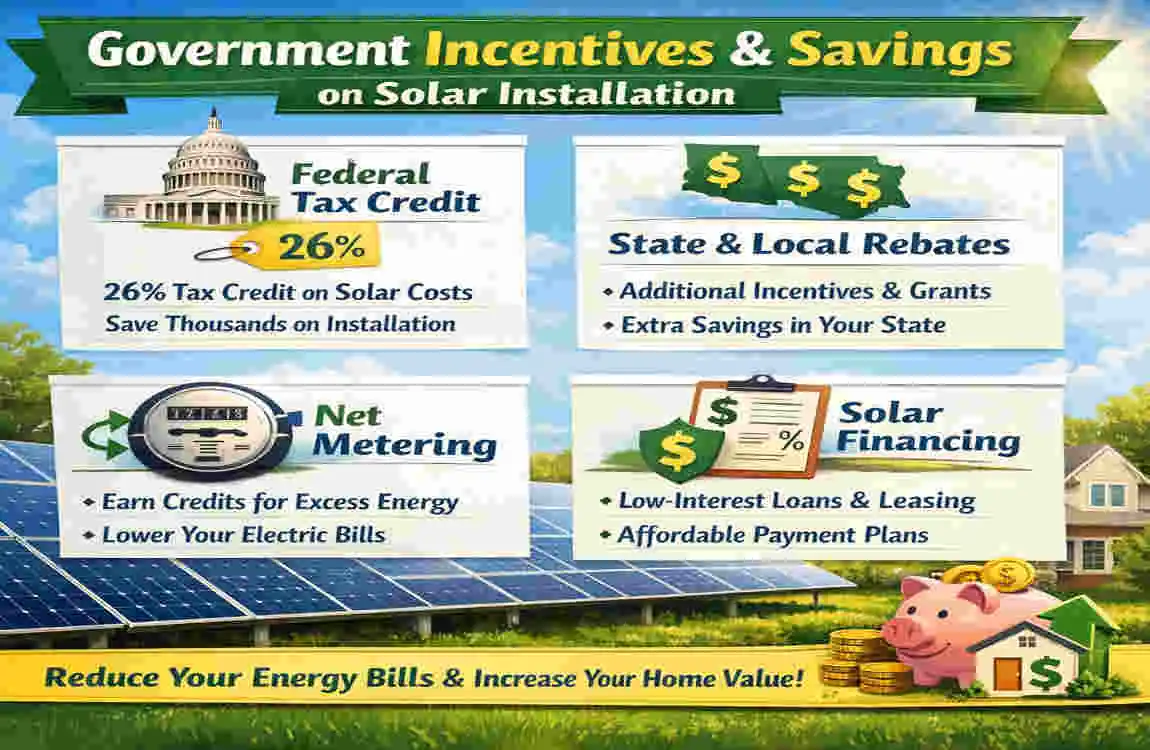
The upfront home solar panel prices seem daunting. Still, it is crucial to remember that the UK government wants you to install these systems to help meet the country’s net-zero carbon targets. Because of this, they offer several fantastic incentives that make answering “how much does it cost to install solar panel at home uk” much more pleasant.
The 0% VAT Scheme
We mentioned this briefly in the introduction, but it deserves its own spotlight. Until March 2027, the UK government has reduced the Value Added Tax (VAT) on energy-saving materials from 20% to 0%.
This is not a complicated rebate that you have to apply for; the 0% VAT solar panels discount is automatically applied to your quote by your installer. On a standard £10,000 system, this policy saves you £2,000 instantly. It is one of the most generous solar incentives in UK history.
The Smart Export Guarantee (SEG)
What happens if you generate more electricity than you can use or store? You sell it!
Through the Smart Export Guarantee (SEG) scheme, large energy suppliers are legally required to pay you for every unit of renewable electricity you export back to the national grid. In 2026, competitive energy providers are offering fantastic SEG rates, often around 15 p/kWh. This means your house becomes a miniature power station, earning you passive income all summer long.
Calculating Your Solar Payback Period
When you combine your drastically reduced monthly energy bills with your quarterly SEG payments, the savings stack up incredibly fast.
The average solar panel savings UK homeowners enjoy range from £783 to £1,567 per year, depending on the size of the system and whether they have a battery.
To calculate your personal solar panel payback period, you can use this simple formula: Total System Cost ÷ Total Annual Savings = Payback Period in Years
With current energy prices, most households achieve full payback in just 6 to 7 years. After that point, every watt of electricity you generate is pure, 100% financial profit.
Solar Panel Installation Process & Timeline UK
You have done the math, you know how much does it cost to install solar panel at home uk, and you are ready to take the plunge. But what actually happens next? Will your house be a chaotic building site for weeks on end?
Absolutely not. The modern solar installation process is incredibly streamlined. Here is the step-by-step timeline of what to expect:
Free Survey and Home Assessment (1-2 Weeks)
Once you request a quote, a reputable company will survey your property. They will assess your roof’s structural integrity, measure its dimensions, check your current fuse box (consumer unit), and analyze your typical energy consumption. Many companies now do this via a virtual survey using satellite imagery to save time.
Choosing Your MCS Installer and Signing the Contract
After reviewing your solar installation quotes UK, you will choose the proposal that best fits your budget. You will sign an agreement, pay a deposit, and the installer will order your specific panels and equipment.
The Installation Phase (1 to 3 Days)
This is the exciting part! The physical installation is surprisingly fast.
- Day 1: The scaffolding team arrives to erect safe access to your roof.
- Day 2: The roofers install the mounting brackets and secure the solar panels, while the electricians work inside to install the inverter, wire the battery, and connect the system to your consumer unit.
- Day 3: Testing, commissioning, and showing you how to use your shiny new monitoring app. Scaffolding is usually taken down shortly after.
Grid Connection and DNO Approval (4 to 12 Weeks)
If you are installing a large system (usually over 3.68kW per phase), your installer must notify your Distribution Network Operator (DNO). This company manages the power lines in your area. This is to ensure the local grid can handle the power you will be exporting. Your installer handles all this paperwork, though getting the final rubber stamp from the DNO can sometimes take a few weeks.
Once commissioned, your panels are guaranteed to perform for a long time, with most Premium brands offering 25-year performance warranties!
How to Get the Best Solar Panel Quotes UK
If there is one piece of advice you take away from this guide, let it be this: never accept the very first quote you are given.
The solar market is highly competitive, and prices can vary by thousands of pounds between different companies. To ensure you are getting the absolute best value when figuring out how much does it cost to install solar panel at home uk, you need to be a savvy shopper.
Here are our top tips for getting the best solar panel quotes in the UK:
- Compare at Least 3 Quotes: Always get a minimum of three detailed, written quotes from different companies. This gives you a clear baseline of the going rate in your specific postcode.
- Demand MCS Certification: As mentioned earlier, if the company is not MCS certified, politely decline their services and walk away.
- Use the Energy Saving Trust: Cross-reference the savings promised by the salesman with the independent calculators provided by the Energy Saving Trust to ensure they aren’t overpromising your ROI.
- Watch Out for Hidden Fees: Ask explicitly if the quote includes scaffolding, the DNO application, and the final electrical certification. A cheap quote might secretly exclude these necessary costs.
Is Installing Solar Panels Worth It in the UK?
It is the ultimate question. You know the costs, you know the process, but is it genuinely worth the hassle given the famously cloudy British weather?
The short answer is a resounding yes. Solar panels do not need direct, blazing heat to work; they need daylight. Even on an overcast Tuesday in November, your panels will be generating usable power.
Let’s weigh it up clearly:
The Pros and Cons of UK Solar
The ProsThe Cons
Massive Lifetime Savings: Save £20,000+ over the 25-year lifespan of the panels. High Upfront Cost: Even with 0% VAT, £5,000+ is a significant initial investment.
Increased Property Value: Homes with high EPC ratings and solar pre-installed sell faster and for more money. Aesthetic Changes: Not everyone loves the look of glass panels on their traditional roof.
Eco-Friendly Impact: Drastically reduce your household carbon footprint and fight climate change. Space Requirements: Inverters and batteries require wall space in a garage or loft.
Ultimately, installing solar panels is one of the safest financial investments you can make in your property right now. You lock in your energy costs, protect yourself from inflation, and do something genuinely good for the planet in the process.
Frequently Asked Questions (FAQ)
To help summarize everything we have covered, here are the most common questions homeowners ask when researching green energy upgrades.
How much does it cost to install solar panel at home uk? In 2026, the average cost for a standard 3-4kW solar panel system without a battery ranges from £5,000 to £9,000. If you wish to include a battery storage system, the total cost will typically range from £9,000 to £15,000, depending on the battery size and brand.
How much is a 4kW solar panel cost UK? A standalone 4kW solar system will cost roughly £6,000 to £8,000 to install. This size is ideal for a standard 3-bedroom home and can generate enough power to dent your annual energy bills significantly.
Do solar panels increase home value in the UK? Yes. Modern home buyers are highly motivated by energy efficiency. A house with a fully paid-off solar installation and a high Energy Performance Certificate (EPC) rating is highly attractive, often boosting property values by roughly 4% to 14%.
Is a solar battery necessary? It is not strictly necessary, but it is highly recommended. Without a battery, you can only use solar energy during the day. A battery allows you to store excess daytime energy to power your home during the expensive evening peak hours, dramatically reducing your bill.
Are there any government grants for solar panels in 2026? While direct cash grants are rare, the biggest government incentive is the current 0% VAT rate on energy-saving materials, which saves you thousands on the upfront cost. Additionally, the Smart Export Guarantee (SEG) legally ensures you are paid for exporting excess energy to the grid.