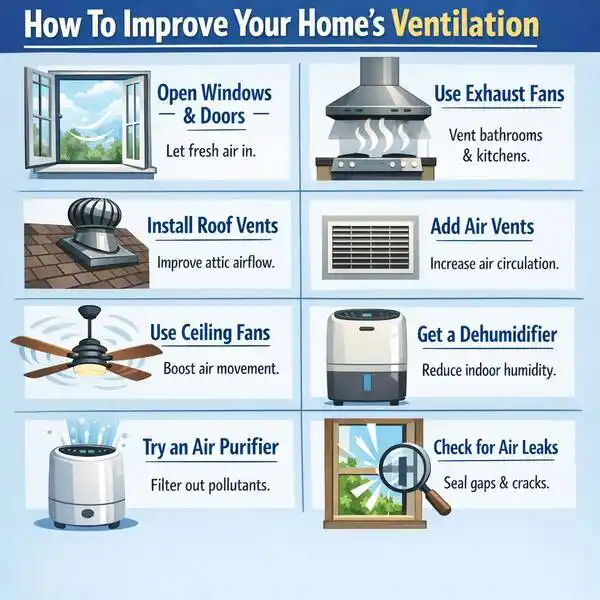
If there’s one thing we don’t talk about nearly enough when it comes to our homes, it’s the air inside them. We spend a fortune on new kitchens, dream about loft conversions, and obsess over the perfect shade of grey for the living room walls, but ventilation? It rarely gets a look in. Well, that’s all about to change, because good ventilation is one of the best things you can do for your home, your health, and your energy bills…
Why Ventilation Matters More Than You Think
Here’s a fun fact that might surprise you: the air inside your home can actually be more polluted than the air outside. Between cooking smells, moisture from showers, dust mites, volatile organic compounds from cleaning products and furniture, and the simple act of breathing, our homes can build up quite a cocktail of indoor pollutants if there’s no proper air flow. Poor ventilation leads to all sorts of problems. Condensation on windows, mould growing in corners, that musty smell you can never quite get rid of, and even long term health issues like respiratory problems and worsened allergies. In the UK, where we tend to build homes that are increasingly airtight (especially new builds), getting fresh air in and stale air out has never been more important. The good news? There are some genuinely brilliant solutions out there, and one of the best is something called MVHR, which stands for Mechanical Ventilation with Heat Recovery. Stay with us, because this technology is a game changer.
What Is MVHR and Why Is Everyone Talking About It?
MVHR, or Mechanical Ventilation with Heat Recovery, is a whole home ventilation system that continuously supplies fresh, filtered air throughout your property while simultaneously extracting stale, moist air. So far, so straightforward. But here is where it gets really clever: rather than letting all that warmth in the extracted air disappear outside, the system recovers up to 95% of it and uses it to pre-warm the incoming fresh air. In the UK climate, that is huge. Think about it. Every time you open a window in winter to air out a room, you are essentially throwing heat out along with the stale air. Your boiler then has to work harder to warm the space back up again. An MVHR system does the same job of refreshing your air without that energy loss. It is ventilation that actually works with your heating system rather than against it.
How Does a Heat Recovery Ventilation System Actually Work?
At the heart of an MVHR system is a heat exchanger unit, typically installed in a loft, utility room, or cupboard. From this central unit, a network of insulated ducts runs throughout the house, with supply vents delivering fresh air to living rooms and bedrooms, and extract vents pulling stale air from kitchens and bathrooms. The two airstreams (incoming fresh air and outgoing stale air) pass through the heat exchanger, where heat transfers from the warm outgoing air to the cool incoming air. Crucially, the two airstreams never actually mix, so you are not recirculating stale or polluted air. You are just capturing the heat from the air before it exits your home. Incoming air is filtered too, thus you get purified air as opposed to opening a window. MVHR systems operate continuously but on low settings. They are boosted either manually or automatically whenever you are cooking or taking showers, hence producing more humidity and smell. Modern systems are designed to make no noise and are controllable using mobile applications.
Is MVHR Right for Your Home?
MVHR is ideally suited to well insulated, airtight homes, and it works particularly brilliantly in new builds, which are often built to Passivhaus standards or similar. If you are renovating an older property, it can still work wonderfully, but you may want to ensure your home has reasonable levels of insulation and airtightness first to get the maximum benefit. It is also worth knowing that MVHR systems do require professional installation, as the ductwork needs to be carefully designed for your specific property. A reputable installer will carry out a site survey, calculate the air volumes needed for each room, and design a system that suits your home’s layout. It is not a DIY job, but it is absolutely worth the investment.
Costs in the UK currently range from around £3,000 to £8,000 or more for a full installation, depending on the size of the property and the complexity of the ductwork. Running costs are typically very low, as the fans use minimal electricity, and the heat recovery means your heating system can work less hard overall.
Other Ways to Improve Ventilation at Home
If MVHR is not quite right for your situation right now, there are plenty of other ways to get fresher air flowing through your home:
– Trickle vents are small, discreet openings built into window frames that allow a constant, controlled flow of fresh air without you needing to open the window. Many newer windows include them as standard, and they are a simple, affordable way to improve background ventilation.
– Extraction fans in kitchens and bathrooms are necessary and even legally required. If your fans are old and slow, getting yourself a better or moisture sensitive fan would help. Moisture sensitive fans activate themselves once there is high level of humidity in the air, and this is ideal for the times you take your bath without turning on the fan.
– The other solution is positive input ventilation (PIV). This technique works very well especially in the existing buildings. The PIV system works through introducing fresh filtered air into the building, starting from above, and making the stale air leave the building through the cracks and gaps that are there.
– Ventilating your building for about 10 to 15 minutes each day is also helpful. This is particularly the case after you have done cooking, taken a bath or dried clothes indoors. Through ventilation where you open windows on both sides of the house and create draught is the best way to do it.