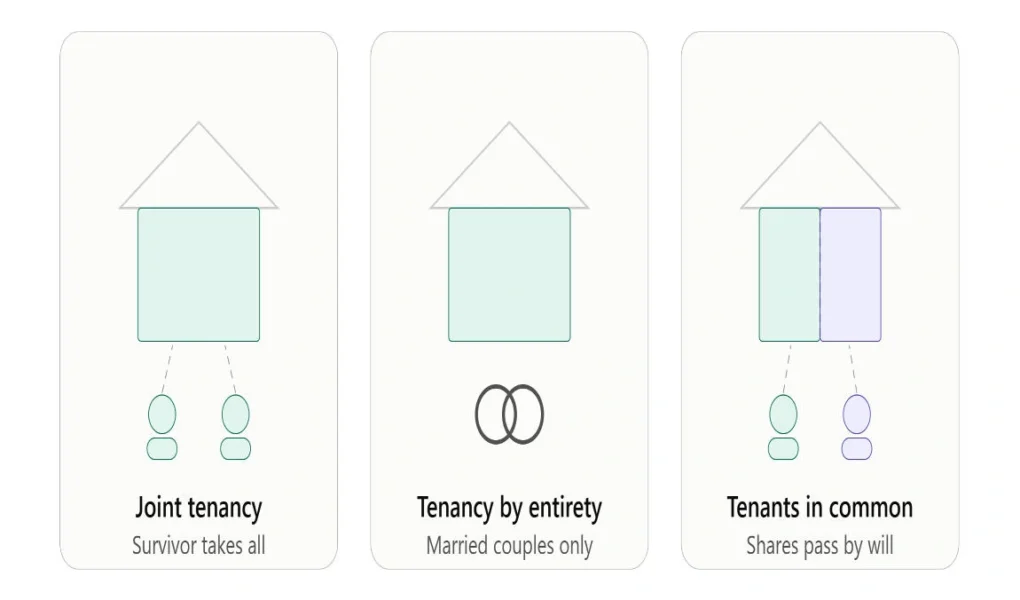
When someone dies while jointly owning a house, what happens to the property depends on how ownership was arranged, the terms of any will, and the laws that apply. In some cases, the surviving owner automatically receives the deceased person’s share, while in others, that share may pass to their heirs or beneficiaries. Understanding the type of joint ownership can help families know their rights, avoid disputes, and determine the next steps for the property. The rules can vary by country, so checking local inheritance laws is important.
Does a Jointly Owned House Go Through Probate?
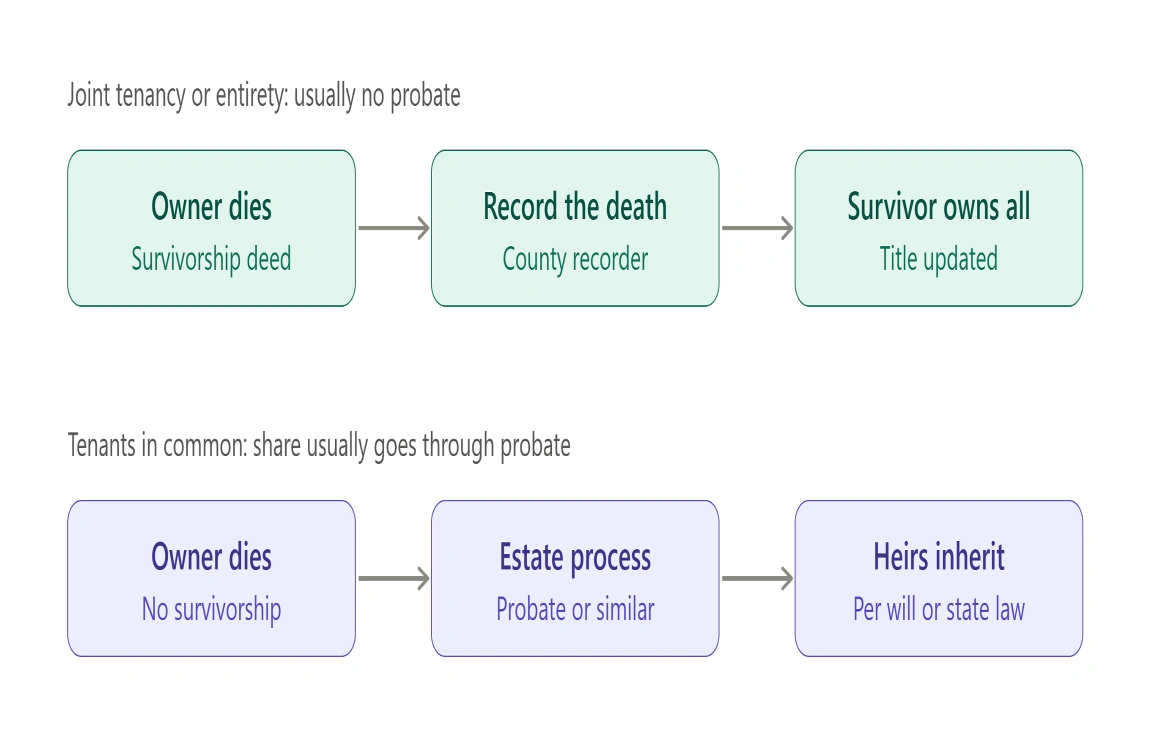
With joint tenancy or tenancy by the entirety, usually not. Joint tenancy property passes outside probate because ownership moves to the survivor by operation of law. But “no probate” does not mean “no paperwork.”
The public land records still show the deceased owner’s name. To fix that, survivors typically record proof of death with the county recorder. In some states that is a certified death certificate alone. In others it is a sworn statement as well. For example, one Minnesota law firm describes an affidavit of survivorship, recorded together with a certified death certificate and the prior deed, as the way to update the record. The property same source warns that this route only works for true joint tenancy and that county requirements, such as cover sheets and specific wording, vary.
A tenancy in common is different. The deceased owner’s share is part of their estate, so it usually runs through probate or a similar process, led by the executor named in the will or a court-appointed administrator.
Practical tip: order several certified copies of the death certificate early. Banks, the mortgage servicer, the insurance company, and the county recorder will each want one.
What Happens to the Mortgage?
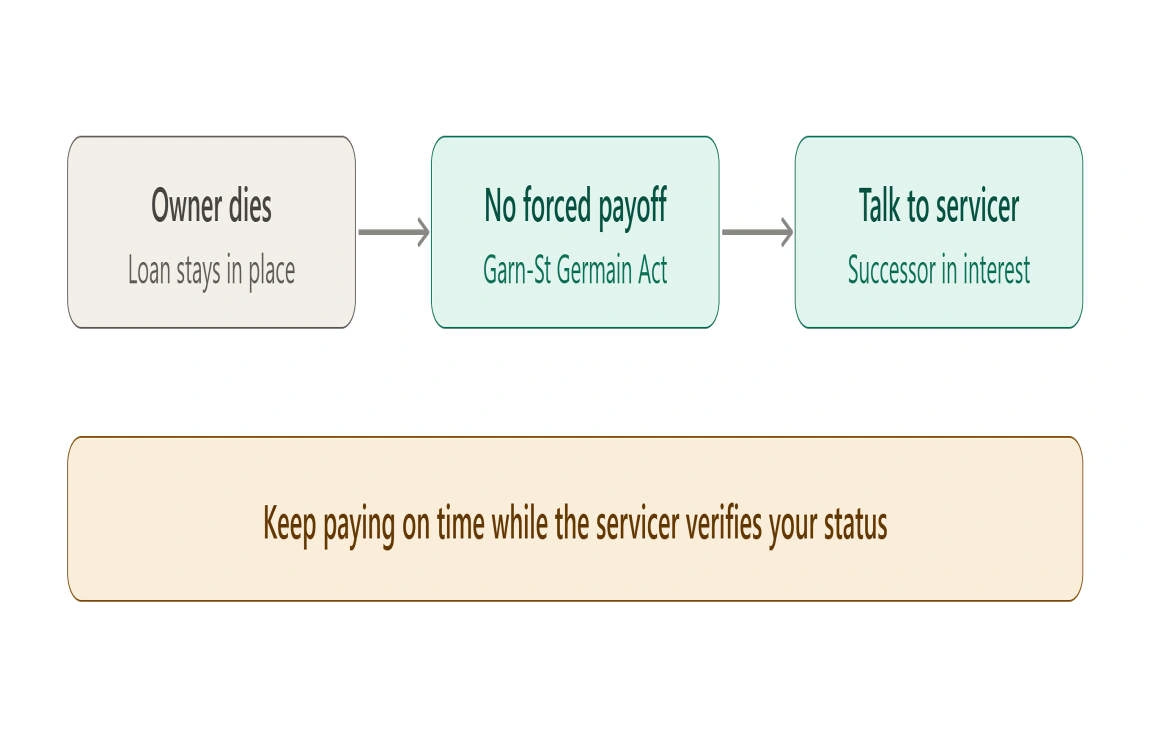
An owner’s death does not erase the loan. Payments are still due, and missed payments can lead to foreclosure no matter who owns the house on paper.
The good news is that federal law protects survivors from one common fear. Under the Garn-St Germain Act, a lender may not enforce a due-on-sale clause when title transfers by operation of law on the death of a joint tenant or tenant by the entirety, or when a relative receives the home because a borrower died. The protection applies to residential property with fewer than five dwelling units. In plain terms, the bank generally cannot demand full repayment just because the co-owner died.
Survivors who inherit a home also have rights as a “successor in interest.” The CFPB has said that adding an heir to the mortgage generally does not trigger the ability-to-repay rule. Since April 2018, servicers must treat confirmed successors in interest as borrowers for most servicing rules, which includes talking with them about options.
Keep two cautions in mind. First, the same Nolo guide notes that a foreclosure will not necessarily pause while the servicer verifies your status. Second, a mortgage company will still want documents. Contact the servicer early, ask for its successor-in-interest checklist, and keep paying on time while it is processed.
Tax Consequences: Why the Deed Can Affect Your Future Capital Gains
There is generally no special tax on a house simply passing to a surviving joint owner. The tax question comes later, when the survivor sells. It turns on “basis,” which the IRS defines in Publication 551, Basis of Assets as your investment in the property for tax purposes. Your gain is roughly the sale price minus your adjusted basis.
Property inherited from a decedent generally takes a basis equal to its fair market value at the date of death. How much of a jointly owned house gets that “step-up” depends on ownership:
- Married couples in most states: For a qualifying spousal joint tenancy, only the deceased spouse’s half is included in their estate and receives a basis adjustment. The survivor’s half keeps its original cost basis.
- Community property states: Both halves can receive a full basis adjustment when the first spouse dies.
- Unmarried co-owners: The rules are different and often turn on who paid for the property. Co-owners who cannot document their contributions can face a less favorable result.
A simple example (hypothetical numbers)
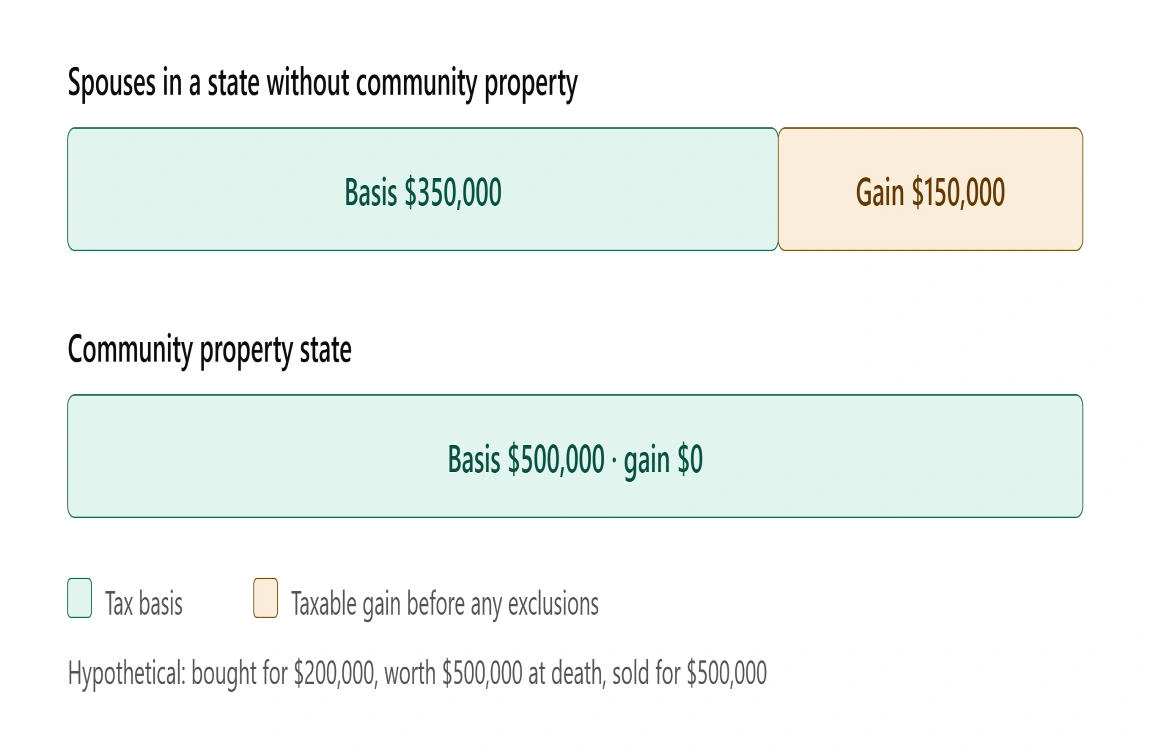
A married couple buys a home for $200,000 as joint tenants in a state without community property. It is worth $500,000 when one spouse dies.
- Survivor’s basis: $100,000 (half of original cost) plus $250,000 (half of value at death) = $350,000.
- If the survivor later sells for $500,000, the taxable gain before any exclusions is $150,000.
- In a community property state, the survivor’s basis could be the full $500,000, which would leave no gain on the same sale.
This example is simplified. It ignores selling costs, depreciation, and the federal home-sale exclusion, so ask a CPA how it applies to your sale.
Here is the home improvement connection: improvements you make to a property increase its basis. Keep receipts and contracts for roofing, kitchen remodels, additions, and similar work, because they can reduce taxable gain later.
Finally, be careful with deed changes made before a death. Adding a name to a deed is treated as a gift for tax purposes, and it can cost the new owner the step-up on the transferred share. Talk to an estate attorney before retitling a house.
What to Do Right After a Co-Owner Dies
There is no single national checklist, because deadlines and forms vary by state and county. This order works well in most situations:
- Order certified death certificates. Get more than you think you need. Many institutions will not accept photocopies.
- Confirm how title is held. Request a copy of the recorded deed from the county recorder’s office. Look for the words “joint tenants,” “tenants by the entirety,” or “tenants in common.”
- Look for a will, trust, or other estate documents. They matter most for tenants in common, and they may affect other assets even when the house passes by survivorship.
- Call the mortgage servicer. Report the death, keep payments current, and ask how it handles successors in interest.
- Update the public record. Ask the county recorder or a title company whether you need a death certificate alone or an affidavit as well.
- Tell the homeowners insurer. Update the named insured, and ask whether coverage changes if the house will sit empty.
- Keep property taxes, utilities, and HOA dues current. Missed bills can turn into liens or penalties.
- Start a basis file. Collect the original closing documents, improvement receipts, and an appraisal or other value estimate as of the date of death.
- Pause big decisions. Speak with an estate attorney and a CPA before you sell, refinance, retitle, or start a major renovation.
Protecting the House While Ownership Is Sorted Out
Paperwork can take weeks or months, and the house still needs care in the meantime. Handle the building in two tiers.
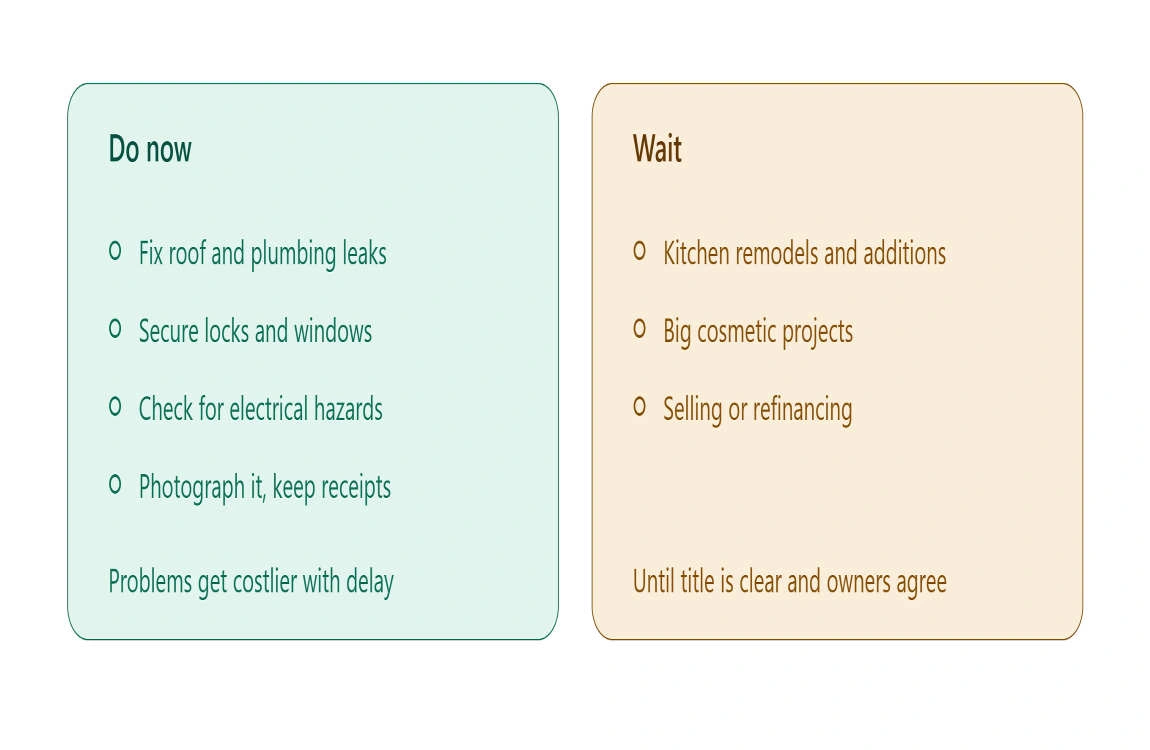
Do now: urgent maintenance
Fix problems that get worse or more expensive with time, such as roof leaks, plumbing leaks, broken locks and windows, and visible electrical hazards. If the home will be empty, have someone check it regularly for water damage, pests, and break-ins, and ask your insurer whether vacancy changes your coverage. Photograph the condition of the home and keep receipts for everything you pay for.
Wait: major renovations and sales
Kitchen remodels, additions, and big cosmetic projects can wait until title is clear and all owners or heirs agree. If you are a tenant in common or an heir, spending your own money on improvements before there is an agreement can lead to disputes. Whether you can be reimbursed varies by state, so ask an attorney and put any agreement in writing.
Safety notes for older or unoccupied homes
- Hire licensed professionals for electrical panels, gas lines, and structural work. Do not attempt these as DIY projects, even to “get the house ready.”
- Homes built before 1978 may contain lead-based paint. Use a certified contractor before sanding or demolishing painted surfaces.
- Do not discard papers during a cleanout. Deeds, tax bills, closing statements, and contractor invoices belong in your basis file.
Pros and Cons of Owning a Home Jointly
Joint ownership suits many families, but it is a trade-off, not a free upgrade.
Pros
- Simple transfer. With survivorship, the house passes without probate, which can save time and court involvement.
- Clarity for couples. Tenancy by the entirety also protects a spouse’s interest from the other spouse’s creditors.
- Fewer disputes over who gets the house, because the deed already answers the question.
Cons
- Less flexibility. Survivorship overrides a will, so you cannot leave your share to someone else unless the joint tenancy is ended first.
- Possible tax cost. Depending on who owns what, the surviving owner may get only a partial step-up in basis.
- Unintended results. Because one joint tenant can break the joint tenancy during life, the plan may not work the way the family expects.
Common mistakes to avoid
- Assuming the will controls the house without checking the deed.
- Waiting too long to contact the mortgage servicer.
- Skipping the recording step, which can surface as a problem property when you try to sell or refinance.
- Adding a child or friend to a deed without first asking about gift and basis consequences.
- Starting expensive renovations before ownership is settled.
Frequently Asked Questions
Does a jointly owned house automatically go to the surviving spouse?
Only if the deed creates survivorship (joint tenancy with right of survivorship or tenancy by the entirety) or community property rules in your state say so. If the spouses held title as tenants in common, the deceased spouse’s share passes under their will or state law.
Can a will override joint tenancy?
Generally no. Survivorship takes effect at death and takes priority over competing claims. The only way to change the result is to end the joint tenancy during life, usually by changing the deed.
Do I have to pay off the mortgage when a co-owner dies?
Not automatically. The loan stays in place, and you must keep making payments. Federal law generally prevents lenders from using a due-on-sale clause in these death-related transfers of qualifying residential property.
Does a jointly owned house go through probate?
Usually not when survivorship applies, although you still need to update the public record. A tenant in common’s share generally does go through the estate process.
What happens if the couple divorced but never changed the deed?
A tenancy by the entirety becomes a tenancy in common after divorce, which means survivorship is lost. If this applies to you, speak with an estate attorney promptly.
How soon can the surviving owner sell the house?
Usually after the death is recorded and the title is clear, because buyers and title companies want to see the owner’s name properly reflected in the public record. Your attorney or title company can tell you what your county requires.
Conclusion
What happens to a jointly owned house when someone dies comes down to the deed. With joint tenancy or tenancy by the entirety, the survivor usually takes the whole house without probate. With tenancy in common, the deceased owner’s share follows their will or state law, which can bring new co-owners into the picture.
In every case, the practical work is the same: confirm the deed, update the public record, stay current on the mortgage, protect the property, and keep good records for tax purposes. A short consultation with an estate attorney and a CPA, early, can prevent expensive problems later.