Renting a home in Texas can feel exciting, but it also comes with a few important steps. Landlords usually want to know that you can pay rent on time, take care of the property, and follow the lease rules. That means you will likely need documents, proof of income, and enough money for move-in costs.
If you are asking what you need to rent a house in Texas, the short answer is this: a valid ID, proof of income, a decent credit profile, rental history if you have it, and money for deposits and fees. Some landlords are stricter than others, but most follow a similar process.
What Do You Need to Rent a House in Texas?

Basic Eligibility Requirements
Most landlords want renters home who meet a few basic requirements. These are usually simple, but they matter a lot.
You will typically need to be at least 18 years old. You also need a valid government ID so the landlord can verify your identity. In many cases, you must also show that you have legal permission to live and rent in the United States.
Some landlords are more flexible than others, but these basics are usually expected for nearly every application.
Proof of Income
One of the biggest things landlords look at is income. They want to know you can afford the rent without falling behind.
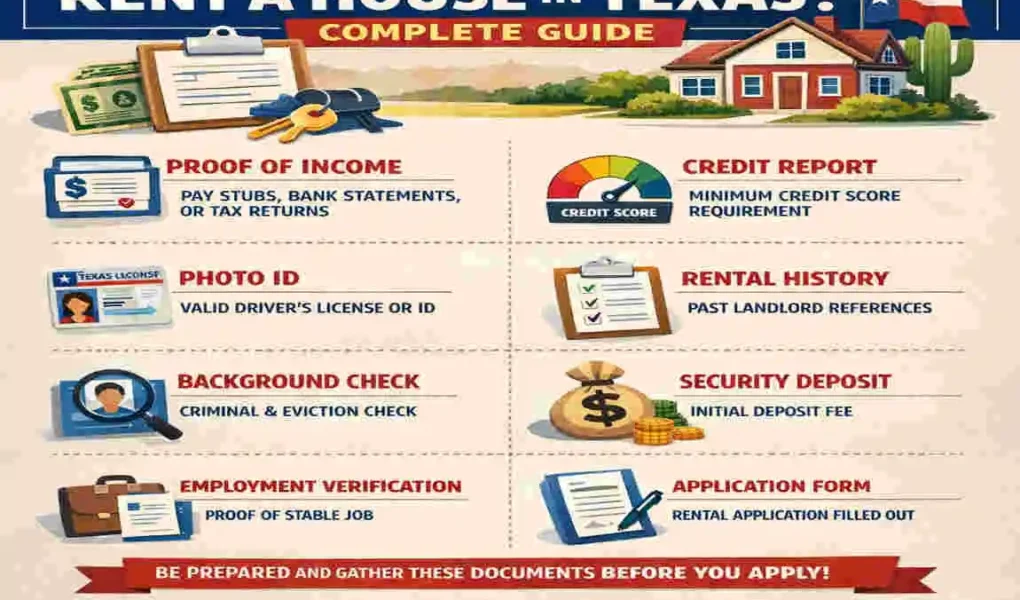
Common proof of income documents include:
- Recent pay stubs
- Employment verification
- Bank statements
- Tax returns or profit records for self-employed renters
If you work for an employer, pay stubs are often enough. If you are self-employed, you may need extra paperwork to show steady earnings.
Credit Score Requirements
Many landlords in Texas check your credit score. They use it to see how you manage money and bills.
Many landlords prefer a score of 620 or higher, but that is not a strict rule everywhere. Some properties are more flexible, especially if you have high income or a good rental history.
If your credit is low, you may still be able to rent. You might need a co-signer, a larger deposit, or extra proof that you can pay rent.
Rental History
Rental history can help a lot. If you have rented before and paid on time, that gives the landlord confidence.
Landlords may ask for:
- Previous landlord contact information
- Rental payment records
- Eviction history
A clean rental history can improve your chances. If you had problems in the past, be honest about them and explain the situation clearly.
Documents Required to Rent a House in Texas
You should gather your paperwork before applying. That way, you can move quickly when you find a home you like.
Government-Issued Photo ID
A driver’s license, state ID, or passport is usually required. This confirms your identity and helps the landlord verify your application.
Social Security Number or ITIN
Many rental applications ask for a Social Security number. If you do not have one, some landlords may accept an ITIN instead.
This information is often used for background and credit checks.
Employment Verification Letter
Some landlords ask for a letter from your employer. This may include your job title, pay rate, and how long you have worked there.
It helps prove that your income is stable.
Recent Pay Stubs
Recent pay stubs are among the most commonly requested documents. They show your current income and help the landlord see whether you can afford the rent.
Bank Statements
Bank statements can be useful if you are self-employed, paid irregularly, or want to show extra savings. They help prove that you have enough money to cover rent and move-in costs.
Personal References
Some landlords may ask for personal references. These are usually people who can speak to your character, reliability, or responsibility.
They are not always required, but they can help if your application needs extra support.
Previous Landlord Contact Information
If you have rented before, expect the landlord to ask for your old landlord’s contact details. They may call to ask if you paid on time and took care of the home.
How Much Money Do You Need Before Renting?

Moving in takes more than just first month’s rent. You should be ready for several upfront costs.
Security Deposit
A security deposit is one of the most common rental costs. It protects the landlord if there is damage or unpaid rent.
Many landlords ask for one month’s rent, but some charge less or more depending on the property and your application.
First Month’s Rent
Most rentals require the first month’s rent before you move in. This is usually due when you sign the lease.
Last Month’s Rent
Not every landlord requires this, but some do. It serves as an additional form of payment and may be used, depending on the lease terms.
Application Fees
You may need to pay an application fee when you apply. This helps cover screening costs, such as background and credit checks.
Pet Deposit and Pet Fees
If you have a pet, expect extra charges. These may include:
- Pet deposit
- Pet fee
- Monthly pet rent
The amount depends on the property and the landlord’s rules.
Income Requirements for Renting a House
The 3x Rent Rule
A common rule is that your monthly income should be at least three times the rent. For example, if the rent is $1,500, many landlords want to see monthly income of about $4,500.
This helps them feel confident that you can pay on time.
Stable Employment
Even if your income is high enough, landlords also want to see stability. A steady job makes your application stronger.
If you recently changed jobs, that may not be a problem, but be ready to explain your situation.
Using a Co-Signer or Guarantor
If you do not meet the income or credit requirements, a co-signer may help. A co-signer agrees to cover the rent if you cannot.
This can be helpful for students, first-time renters, or people with limited credit history.
Alternative Income Sources
Income does not always have to come from a traditional job. You may also be able to use:
- Child support
- Retirement income
- Disability benefits
- Self-employment income
- Investment income
The landlord may ask for proof, so keep records ready.
Credit Score and Background Checks
What Landlords Usually Check
Most landlords check more than just your credit score. They often review:
- Credit report
- Rental history
- Employment status
- Background record
This helps them decide whether you are likely to pay rent and follow the lease.
Criminal Background Screening
Many landlords run a background check. They may look for certain criminal history, though rules vary.
A record does not always mean automatic rejection, but it may affect approval depending on the property.
Credit Report Review
Landlords usually look for signs like late payments, debt problems, or unpaid accounts. A few old issues may not hurt too much, but serious recent problems can make approval harder.
How to Improve Your Approval Chances
You can make your application stronger by:
- Paying off small debts
- Saving more money
- Preparing documents early
- Giving accurate information
- Showing stable employment
- Getting good landlord references
A clean, organized application often helps a lot.
Texas Rental Application Process
Find the Right Rental Property
Start by choosing a house that fits your budget and needs. Make sure the rent is realistic based on your income.
Submit the Application
Once you find the home, complete the application fully. Be honest and fill in all required fields.
Pay the Application Fee
Most landlords charge a fee to process your application. This is usually paid upfront.
Complete Screening
The landlord may check your credit, background, employment, and rental history.
Receive Approval
If everything looks good, the landlord may approve your application and send the lease terms.
Sign the Lease Agreement
Read the lease carefully before signing. This step matters because the lease explains your rights and responsibilities.
Move Into Your New Home
After you pay the required move-in costs, you can get your keys and start moving in.
Understanding the Texas Lease Agreement
Lease Length
Your lease may be month-to-month or long-term, such as 6 or 12 months. Make sure you know how long the agreement lasts.
Monthly Rent
The lease should state the rent amount and when it is due each month.
Maintenance Responsibilities
The lease usually explains what you must do and what the landlord handles. Read this carefully so there are no surprises.
Utilities
Check whether utilities are included or if you must set them up yourself.
Renewal Terms
See how renewing works before your lease ends. Some leases renew automatically unless you give notice.
Early Termination Rules
If you need to move out early, the lease should explain the rules and possible penalties.
Tips to Increase Your Rental Approval Chances
Here are a few simple ways to improve your chances:
- Improve your credit score
- Save enough money for upfront costs
- Prepare documents in advance
- Provide accurate information
- Maintain stable employment
- Get strong landlord references
A well-prepared renter often looks much more reliable to a landlord.
Common Mistakes to Avoid
Applying Without Required Documents
Missing paperwork can slow down your application or even cause it to be rejected.
Hiding Financial Information
Be honest. Landlords often verify details, so hiding information can create problems.
Ignoring the Lease Terms
Never sign without reading. The lease controls many important parts of the rental.
Missing Application Deadlines
Some properties rent quickly. If you wait too long, someone else may get approved first.
Underestimating Moving Costs
Rent is only one part of the move. You may also need money for deposits, utilities, supplies, and transportation.
Estimated Upfront Rental Costs in Texas

Expense Estimated Cost
Application Fee $25–$100
Security Deposit One month’s rent
First Month’s Rent One month’s rent
Pet Deposit $200–$500
Utility Setup Fees $100–$300
Renters Insurance $10–$30/month
These are general estimates, but they show why it is important to save before applying.
FAQ
What do you need to rent a house in Texas?
Most landlords require a valid ID, proof of income, employment verification, a satisfactory credit history, rental references, and funds for the security deposit and first month’s rent.
What credit score is needed to rent a house in Texas?
Many landlords prefer a credit score of 620 or higher, though requirements vary by property and owner.
How much income do you need to rent a house in Texas?
Most landlords expect your monthly income to be at least three times the monthly rent.
Can I rent a house in Texas with bad credit?
Yes. Some landlords may approve your application if you provide a co-signer, pay a larger security deposit, or show strong proof of income.
| Requirement | Details |
|---|---|
| Valid Photo ID | A government-issued ID such as a driver’s license, passport, or state ID. |
| Rental Application | Complete the landlord’s application with your personal, employment, and rental history. |
| Proof of Income | Recent pay stubs, bank statements, tax returns, or an employment letter showing you can afford the rent. |
| Credit Check | Many landlords review your credit score and payment history before approving your application. |
| Background Check | A criminal background screening is commonly required by Texas landlords. |
| Rental History | Previous landlord references and a positive rental record can improve your chances of approval. |