Have you ever looked around your house and noticed flickering lights, outdated yellowish wall switches, or a severe lack of outlets for all your modern devices? You are definitely not alone. Many homeowners live with outdated electrical systems simply because they are intimidated by working with wires. But did you know that roughly 40,000 home electrical fires occur each year, often stemming from outdated or faulty wiring that could have been corrected with simple home electrical projects?
The good news is that you do not need to hire a professional for every minor fix. Tackling beginner-friendly home electrical projects offers a highly practical way to enhance your home’s overall safety, energy efficiency, and daily functionality. Better yet, stepping into the world of DIY electrical upgrades comes with massive cost savings. By doing the work yourself, you can easily save anywhere from $100 to $500 per project on labor costs alone, while simultaneously giving your property value a nice little boost.
Essential Safety Rules for Home Electrical Projects

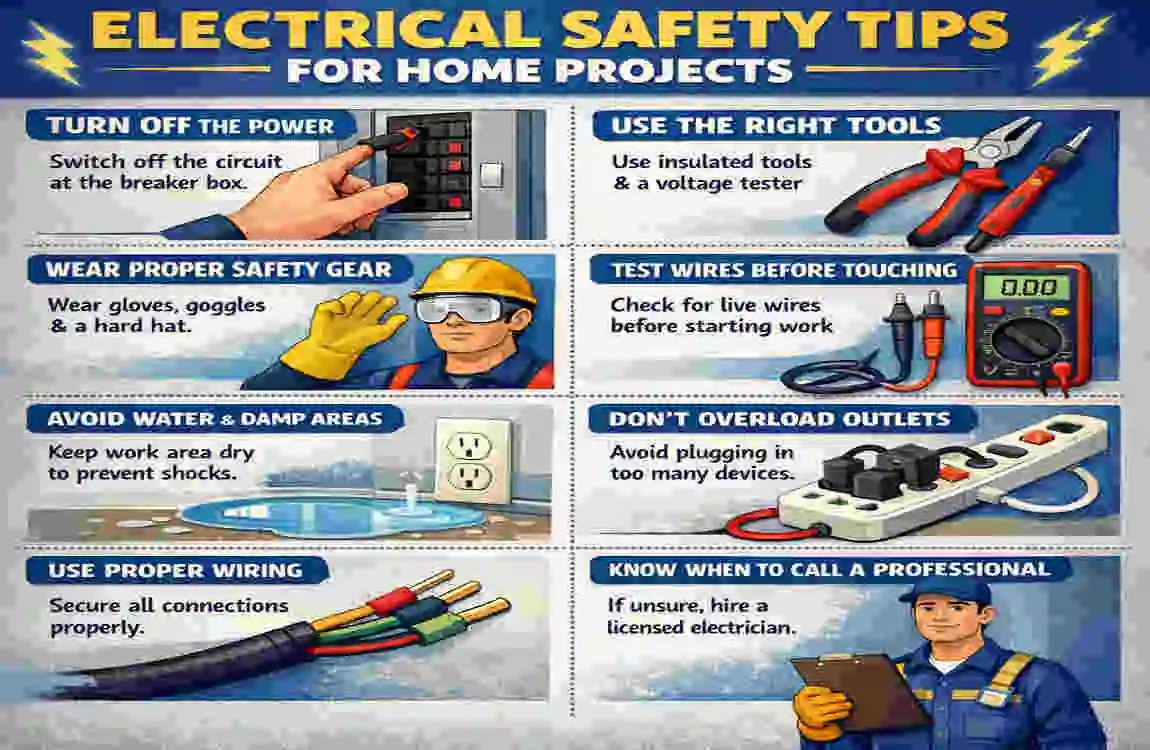
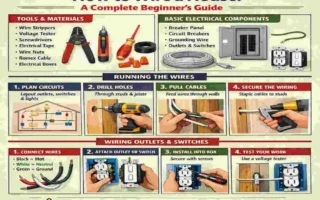
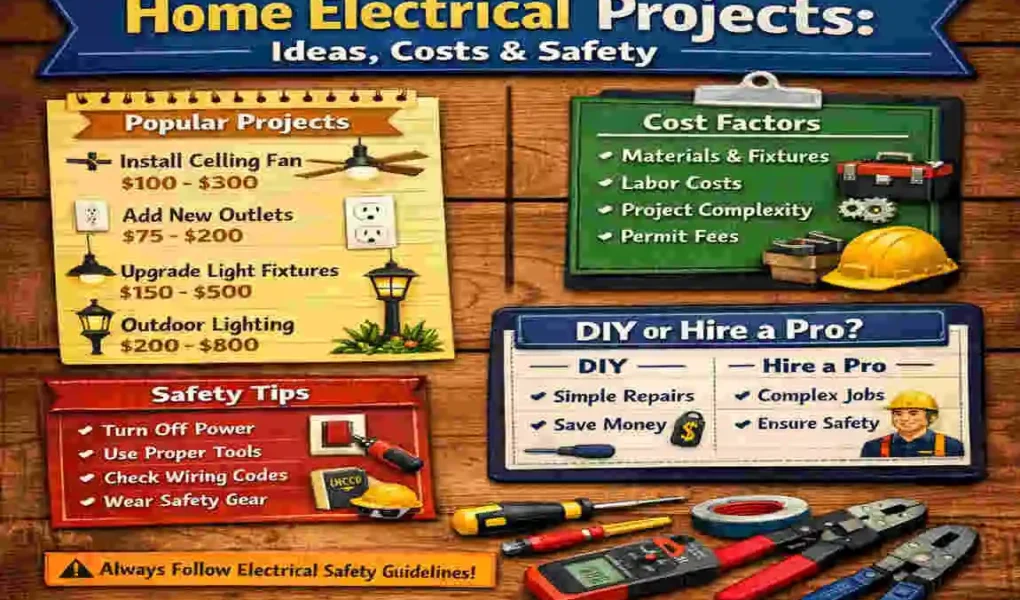
Before you even think about unscrewing a faceplate or touching a wire, we need to talk about safety. Electricity is incredibly useful, but it commands respect. When undertaking safe home wiring projects, strictly following these five must-know safety rules will keep you protected:
- Turn off the breaker and test. This is the golden rule. Never assume the power is off just because the wall switch is flipped down. Go to your main circuit breaker, turn off the breaker for the room you are working in, and always verify there is no power using a reliable non-contact voltage tester.
- Use modern connectors. While traditional wire nuts have been the standard for decades, modern WAGO lever connectors are much easier and safer for beginner electrical DIY enthusiasts. They lock wires securely in place without the hassle of twisting.
- Snap photos before disconnecting anything. Before you pull any wires apart, take a clear photo with your smartphone. Having a visual record of how the original wires were connected eliminates the guesswork from the reassembly process.
- Know your absolute limits. Simple swaps are fine, but you should never attempt to do heavy electrical panel work, install brand-new circuits from scratch, or work with heavy 240V appliance lines unless you are a licensed professional.
- Check your local building codes. Electrical codes vary wildly from one municipality to the next. Always check if your specific project requires a permit or a post-project inspection.
Safety Gear Checklist
Equipping yourself with the right safety gear is non-negotiable. Here is a quick breakdown of what you need before starting your home electrical projects:
Item Purpose Importance Level
Non-Contact Voltage Tester To safely confirm the power is 100% off before touching any wires. Critical
Wire Strippers To create clean cuts and strip insulation without damaging the copper wire inside. High
Needle-Nose Pliers For precision gripping and bending wires into loops for screw terminals. High
Rubber-Soled Shoes To provide grounding and prevent accidental electrical currents from passing through you. Moderate
Safety Goggles To protect your eyes from flying sparks, dust, or bits of clipped copper wire. High
Must-Have Tools for Beginner Electrical DIY
You do not need to spend a fortune to build a highly capable electrical toolkit. In fact, you can easily assemble a budget-friendly beginner kit for under $100 that will cover almost all the home electrical projects on this list.
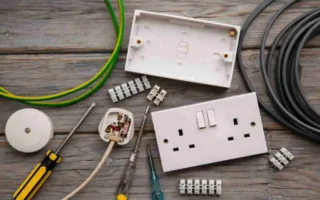
Having the proper tools not only speeds up your home electrical projects but also ensures professional, long-lasting results. Here is what you should consider picking up:
- Digital Multimeter: While a simple voltage tester tells you if power is present, a multimeter lets you test for specific voltage levels, continuity, and resistance. It is an invaluable troubleshooting tool.
- Assorted Insulated Screwdrivers: You will need both Phillips and flathead screwdrivers. Insulated handles provide an extra layer of shock protection.
- Fish Tape: If you ever plan on pulling new wires behind finished walls, a sturdy coil of fish tape is your best friend.
- Electrical Tape: Essential for wrapping wire connections and marking neutral wires when necessary.
- Utility Knife: Great for carefully scoring and slicing the outer sheathing off non-metallic (Romex) cables.
Investing in these basic tools will empower you to handle safe home wiring projects whenever they arise, saving you countless dollars in the long run.
15 Easy Home Electrical Projects Anyone Can Master
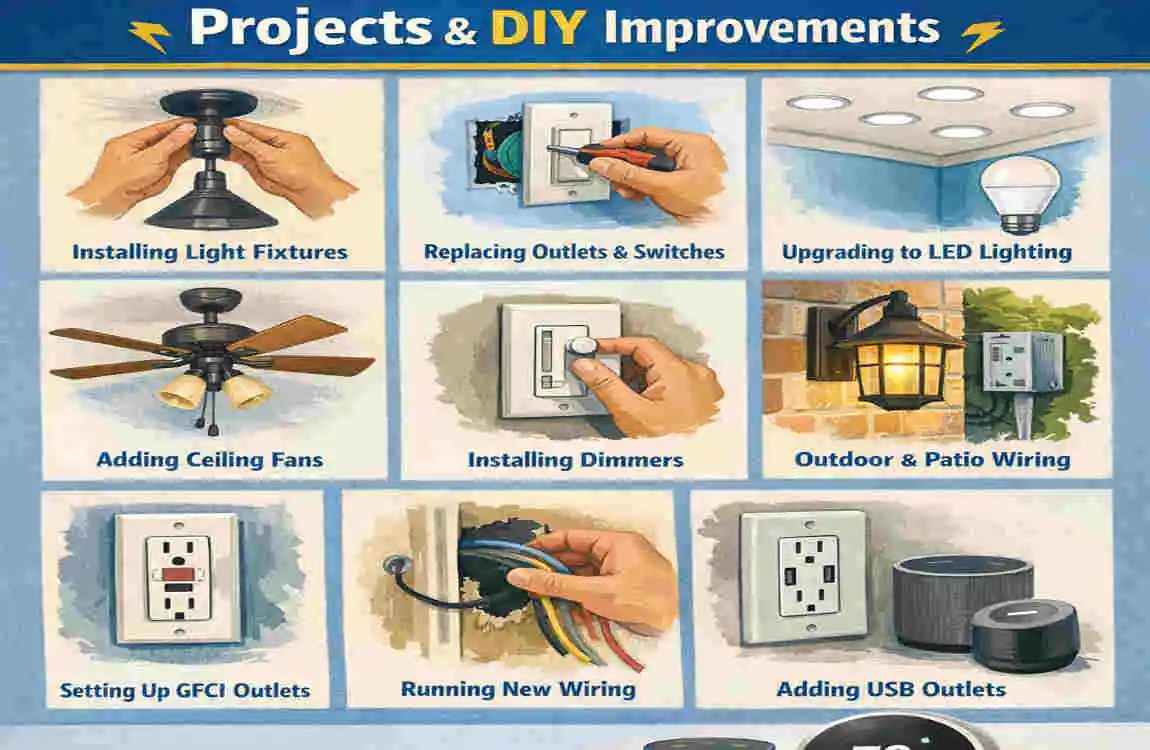
Ready to roll up your sleeves? Let us dive into the ultimate list of home electrical projects. Each of these upgrades is highly accessible for beginners, requires minimal tools, and delivers maximum impact.
Replace Standard Outlets with GFCIs
If you are looking for the absolute safest starter project, GFCI installation is where you should begin. GFCI stands for Ground Fault Circuit Interrupter. These outlets are designed to instantly shut off power if they detect a moisture-related short circuit, preventing potentially fatal shocks. They are legally required in wet areas like kitchens, bathrooms, basements, and garages.
Tools Needed: Voltage tester, screwdrivers, needle-nose pliers—estimated Cost: $20 – $25 per outlet.
Step-by-Step Instructions:
- Step 1: Head to your breaker box and turn off the power to the specific room.
- Step 2: Test the old outlet with your voltage tester to guarantee it is completely dead.
- Step 3: Unscrew the faceplate, then gently pull the old outlet from the wall box.
- Step 4: Take a clear photo of the wiring. You will notice “Line” (incoming power) and “Load” (power feeding other outlets) terminals on the back of the new GFCI.
- Step 5: Disconnect the old wires and carefully attach them to the correct terminals on the new GFCI outlet. Always wrap the wire clockwise around the screw.
- Step 6: Push the wires neatly back into the box, screw the GFCI into place, and attach the new faceplate.
- Step 7: Turn the breaker back on and press the “Test” and “Reset” buttons on the GFCI to ensure it functions correctly.
Warning: Reversing the Line and Load wires is the most common beginner mistake and will prevent the outlet from working!
install Convenient USB Outlets
Are you tired of constantly hunting for those little charging blocks? One of the most popular modern home electrical projects is swapping out standard bedroom or kitchen receptacles for outlets with built-in USB-A or USB-C ports. It provides ultimate modern convenience and instantly declutters your countertops.
Tools Needed: Voltage tester, screwdrivers, wire strippers—estimated Cost: $25 – $35 per outlet.
Step-by-Step Instructions:
- Step 1: Turn off the power at the main breaker panel.
- Step 2: Verify there is zero voltage present at the outlet.
- Step 3: Remove the cover plate and extract the existing receptacle.
- Step 4: Note the wire placement. You will typically see a black (hot), white (neutral), and bare copper (ground) wire.
- Step 5: Disconnect the wires and attach them to the corresponding terminals on your new USB outlet. No special rewiring is needed; it wires up exactly like a standard plug.
- Step 6: Because USB outlets have bulkier internal components, carefully fold the wires accordion-style to fit everything snugly into the electrical box.
- Step 7: Secure the outlet, attach the faceplate, and restore power.
Swap Out Basic Light Switches for Dimmers
Lighting sets the entire mood of a room. Upgrading from a harsh, single-pole toggle switch to a smooth, sliding dimmer switch is an incredibly rewarding beginner electrical DIY task. Dimmers let you customise your room’s ambience for movie nights, dinner parties, or relaxing evenings while saving energy.
Tools Needed: Voltage tester, screwdrivers, WAGO connectors—estimated Cost: $20 – $40 per switch.
Step-by-Step Instructions:
- Step 1: Cut the power at the breaker box and test the switch.
- Step 2: Remove the existing switch plate and pull the switch housing out of the wall.
- Step 3: Disconnect the two black (or black-and-red) wires and the bare ground wire.
- Step 4: Your new dimmer will likely have its own pre-attached wires (called pigtails). Use your wire strippers to expose a bit of fresh copper if necessary.
- Step 5: Connect the ground wire first. Then, connect the two black house wires to the dimmer’s hot wires using secure WAGO connectors or wire nuts.
- Step 6: Gently tuck the bulky wiring back into the box.
- Step 7: Mount the switch, making sure the “UP” orientation is correct, and screw on the cover plate.
Warning: Ensure you purchase a dimmer specifically rated for LED bulbs if you use LED lighting; older incandescent dimmers will cause modern LEDs to buzz and flicker violently.
Add a Breezy Ceiling Fan
Installing a ceiling fan is a fantastic way to improve your home’s airflow, keeping you cooler in the summer and pushing warm air down during the winter. This project boosts both comfort and energy efficiency. While it is slightly more involved than an electrical outlet replacement, it is highly doable for a beginner patient.
Tools Needed: Voltage tester, screwdrivers, ladder, wire strippers. Estimated Cost: $100-$300 (depending on the fan).
Step-by-Step Instructions:
- Step 1: Turn off the power at the breaker.
- Step 2: Remove the existing light fixture.
- Step 3: Crucial Step: Inspect the ceiling box. Standard light boxes cannot support the heavy, dynamic weight of a spinning fan. You must ensure the box is stamped with “Acceptable for Fan Support.” If not, you must install a retrofit fan brace between the ceiling joists.
- Step 4: Once the proper box is secured, attach the fan’s mounting bracket to the box.
- Step 5: Assemble the fan motor on the floor, then lift it and hang it onto the bracket’s temporary hook (this saves your arms while wiring).
- Step 6: Connect the wires: usually black/blue to black (hot), white to white (neutral), and green to bare copper (ground).
- Step 7: Tuck the wires into the canopy, secure the housing, and attach the fan blades one by one.
Replace Outdated Light Fixtures
Nothing dates a home faster than a dusty, brass 1990s chandelier or a generic “boob light” flush mount. Upgrading your light fixtures completely transforms your interior design. Plus, integrating modern LED fixtures can save you up to 75% on lighting energy consumption!
Tools Needed: Voltage tester, screwdrivers, wire nuts, a helpful friend—estimated Cost: $50 – $200.
Step-by-Step Instructions:
- Step 1: Shut off the power at the panel and double-check with your tester.
- Step 2: Have a friend hold the old fixture to support its weight while you unscrew the mounting canopy from the ceiling.
- Step 3: Untwist the wire connectors to detach the old black, white, and ground wires.
- Step 4: install the new fixture’s metal mounting strap onto your ceiling box.
- Step 5: Lift the new fixture (again, a helper is invaluable here) and connect the corresponding wires securely.
- Step 6: Carefully arrange the wires inside the ceiling box so nothing gets pinched.
- Step 7: Push the fixture’s canopy flush against the drywall and secure it with the provided decorative nuts.
install Ultra-Slim Recessed Lights
Old-school recessed “can” lights required massive holes and complicated housing brackets. Today’s modern, ultra-slim LED “canless” recessed lights have revolutionized DIY electrical upgrades. They snap right into the drywall and take up less than an inch of depth, giving your room a seamless, professional look.
Tools Needed: Hole saw attachment, drywall saw, voltage tester, fish tape—estimated Cost: $100 – $150 per room.
Step-by-Step Instructions:
- Step 1: plan your lighting layout. Ensure your desired locations do not intersect with hidden ceiling joists by using a stud finder.
- Step 2: Use the paper template provided with the lights to trace perfect circles on the ceiling.
- Step 3: Cut the holes using a hole saw or a manual drywall jab saw.
- Step 4: Run your non-metallic (Romex) cable from your switch box to the first hole, and then daisy-chain the wire from hole to hole.
- Step 5: Strip the wires and connect them inside the small, provided junction boxes for each light.
- Step 6: Snap the junction boxes closed and shove them up into the ceiling void.
- Step 7: Connect the low-voltage wire to the light disc, pinch the spring-loaded metal clips upward, and pop the light perfectly flush into the drywall hole.
Upgrade to Smart Switches
Welcome to the future! Smart switches let you control your home’s lighting via smartphone apps, set automated vacation schedules, and use voice commands with Alexa and the Google Assistant. It is one of the most rewarding home electrical projects for tech enthusiasts.
Tools Needed: Voltage tester, screwdrivers, needle-nose pliers—estimated Cost: $30 – $60 per switch.
Step-by-Step Instructions:
- Step 1: Turn off the power and remove the old wall switch.
- Step 2: Check for a neutral wire. Most smart switches require a constant power source to stay connected to your Wi-Fi. Look into the back of the box for a bundle of white wires tucked away. If you don’t have them, you will need to buy a specific “no-neutral-required” smart switch.
- Step 3: Connect the ground, line (hot), load (light fixture), and the white neutral wire to the smart switch.
- Step 4: Ensure all connections are incredibly tight, as these boxes can get crowded.
- Step 5: Mount the switch and restore power at the breaker.
- Step 6: Follow the manufacturer’s app instructions to connect the switch to your home’s 2.4GHz Wi-Fi network.
- Step 7: Assign the switch a fun name like “Living Room Main” and test your new voice controls.
Add Weatherproof Outdoor Outlets
Stringing Christmas lights or running a power washer usually means snaking a hazardous extension cord out of a cracked window. Adding a dedicated outdoor outlet solves this safely. Because it is exposed to the elements, this requires specific weatherproof gear and a strict GFCI installation.
Tools Needed: Drill, voltage tester, screwdrivers, exterior sealant—estimated Cost: $40 – $70.
Step-by-Step Instructions:
- Step 1: Identify an indoor outlet that shares an exterior wall where you want your new outdoor plug.
- Step 2: Turn off the power. Remove the indoor outlet to access the back of the box.
- Step 3: Drill a hole directly straight through the back of the indoor box, passing entirely through the exterior siding of your house.
- Step 4: Run a short piece of Romex cable through the hole from the inside to the outside.
- Step 5: Wire the indoor outlet so it feeds the new outdoor line.
- Step 6: On the exterior, wire a weather-resistant (WR) GFCI outlet into a weatherproof exterior box.
- Step 7: Mount an “in-use” bubble cover to protect the outlet from rain, even when a cord is plugged in, and seal the edges with high-quality exterior silicone caulk.
install Hardwired Smoke and Carbon Monoxide Alarms
Old, yellowed smoke detectors with dying batteries are a severe safety hazard. Modern building codes require hardwired alarms with built-in battery backups, and they must be interconnected—meaning if one detects smoke in the basement, every alarm in the house goes off simultaneously.
Tools Needed: Voltage tester, screwdrivers, wire strippers—estimated Cost: $35 – $50 per detector.
Step-by-Step Instructions:
- Step 1: Turn off the specific breaker controlling your current alarm circuit.
- Step 2: Twist off the old detector body and unscrew the mounting plate.
- Step 3: Disconnect the old wiring harness.
- Step 4: Wire in the new detector’s harness. You will connect black to black, white to white, and—most importantly—the red “traveler” wire to the other red wire. This traveller wire allows the alarms to communicate with each other.
- Step 5: Attach the new mounting bracket to the ceiling box.
- Step 6: Plug the wire harness into the back of the new combination smoke/carbon monoxide detector.
- Step 7: Twist the detector onto the base until it clicks, turn the power on, and press the test button to hear that deafening, life-saving chirp.
Replace Your Old Doorbell
Is your current doorbell barely emitting a faint, sad “ding”? Swapping it out for a fresh traditional chime or upgrading to a modern video doorbell is one of the quickest safe home wiring projects you can tackle this weekend.
Tools Needed: Screwdrivers, wire strippers. Estimated Cost: $20-$150.
Step-by-Step Instructions:
- Step 1: Locate your doorbell transformer (usually near your main electrical panel or in the attic) and turn off the power. Doorbells run on very low voltage, but safety always comes first.
- Step 2: Unscrew the old doorbell button from your exterior trim.
- Step 3: You will see two tiny wires. Detach them from the old button. Wrap them around a pencil temporarily so they do not slip back into the wall cavity!
- Step 4: If installing a video doorbell, check whether you need to upgrade the transformer (most require at least 16V-24V to power the camera).
- Step 5: Attach the two tiny wires to the screw terminals on the back of the new button or camera. (For doorbells, it usually does not matter which wire goes to which screw).
- Step 6: Screw the new doorbell securely into the trim.
- Step 7: Restore the power and give it a test ring.
Add Gorgeous Under-Cabinet Lighting
Under-cabinet lighting eliminates dark kitchen shadows, making food prep much safer and highlighting your beautiful backsplash. It adds a luxurious, high-end feel to any kitchen for a fraction of the cost of a full remodel.
Tools Needed: Drill, screwdrivers, measuring tape—estimated Cost: $50 – $150.
Step-by-Step Instructions:
- Step 1: Choose your system. For beginners, a plug-in LED strip system or puck lights are the easiest route, bypassing the need for complex in-wall wiring.
- Step 2: Thoroughly clean the underside of your cabinets with rubbing alcohol so the adhesive strips will stick properly.
- Step 3: Measure the length of your cabinets and plan where the lights and connecting wires will go.
- Step 4: Peel the backing off the LED light strips and press them firmly onto the cabinet’s bottom edge, ideally hiding them behind the front lip to reduce glare.
- Step 5: Connect the strips using the provided jumper cables, drilling tiny holes through cabinet lips if necessary to route the wires invisibly.
- Step 6: Secure loose wires with small adhesive cable clips.
- Step 7: Plug the main power adapter into a nearby countertop outlet or hide it in a microwave cabinet above.
Complete a Surge Protector Installation
We plug incredibly expensive televisions, computers, and smart appliances directly into our walls. A sudden power surge from a lightning strike or a grid fluctuation can fry thousands of dollars’ worth of electronics instantly. Adding surge protection is a vital defensive home electrical project.
Tools Needed: Screwdrivers, voltage tester. Estimated Cost: $30-$250.
Step-by-Step Instructions:
- Step 1: Assess your needs. You can choose to install individual surge-protecting wall receptacles, or go for a whole-home surge protector installed directly at the breaker panel.
- Step 2: For Wall Outlets: Turn off the power, remove the old outlet, and wire in a specialised surge-suppression receptacle, exactly as you would for a standard electrical outlet replacement.
- Step 3: For Whole-Home Units: We strongly recommend hiring a pro for the actual panel installation. However, you can safely purchase the exact unit compatible with your specific panel brand (e.g., Square D, Siemens) beforehand to save on parts markups.
- Step 4: Ensure your expensive electronics are plugged into these protected zones only.
- Step 5: Regularly check the small LED indicator light on the surge receptacles. If the light goes out, the unit has absorbed a massive surge and sacrificed itself to save your TV. It must then be replaced.
Systematically Label Your Circuit Breaker Panel
Have you ever experienced a tripped breaker, only to find yourself standing in the dark with a flashlight in your mouth, frantically flipping unlabelled switches? Properly mapping and labelling your circuit panel removes the panic from future outages and is essential for safely isolating power during your home electrical projects.
Tools Needed: A helper, a lamp, a sharpie, and panel labels—estimated Cost: $5.
Step-by-Step Instructions:
- Step 1: Plug a bright lamp or turn on a radio in the room you want to test.
- Step 2: Have a friend stand in that room while you stand at the main breaker box.
- Step 3: Turn off a single, unlabelled breaker switch.
- Step 4: Have your friend yell out if the lamp or radio turned off.
- Step 5: If it did, you have successfully identified the circuit. Write down the room and specific application (e.g., “Master Bedroom Outlets” or “Kitchen Overhead Lights”) on the sticker next to the breaker.
- Step 6: Turn the breaker back on and move to the next switch.
- Step 7: Continue this methodical process until every single switch in the panel is clearly and accurately documented.
Fix Annoying, Loose Outlets
When you plug a heavy charger into a wall and it immediately droops or falls out, you have a loose outlet. Not only is this highly irritating, but it is also a massive fire hazard! Loose connections can cause electrical arcing, generating intense heat and melting the plastic faceplate.
Tools Needed: Voltage tester, screwdrivers, outlet shims/spacers—estimated Cost: $5 – $20.
Step-by-Step Instructions:
- Step 1: Identify if the problem is a worn-out receptacle (plugs fall out easily) or an outlet that is physically pushed too far back into the wall box.
- Step 2: Turn off the power and remove the cover plate to inspect the situation.
- Step 3: If the plug is loose: The internal metal contacts are worn out. You need to replace all electrical outlets following the basic steps outlined in Project #2.
- Step 4: If the outlet is sunken: The electrical box is set too deep in the drywall. Purchase plastic outlet spacers (often called “caterpillars”).
- Step 5: Loosen the top and bottom mounting screws of the outlet.
- Step 6: Slide the plastic shims over the screws behind the outlet’s metal yoke.
- Step 7: Tighten the screws. The shims will pull the outlet forward, making it perfectly flush and rigidly secure against the faceplate.
install Motion-Sensor security Lights
Boosting your home’s exterior security is incredibly easy with motion-sensor lighting. Walking up your driveway at night shouldn’t feel like a horror movie. These fixtures automatically flood the area with light when they detect movement, deterring unwanted guests and guiding you safely to the front door.
Tools Needed: Voltage tester, screwdrivers, ladder, wire nuts—estimated Cost: $40 – $100.
Step-by-Step Instructions:
- Step Turn off the power at the breaker that controls your existing exterior porch or garage light.
- Step : Remove the old fixture to expose the exterior round junction box.
- Step : install the new motion light’s mounting strap to the box. Ensure a rubber weatherproofing gasket is in place.
- Step : Support the new fixture and connect the wiring: ground to ground, white to white, and black to black.
- Step : Bolt the fixture tightly to the mounting bracket and apply a bead of exterior caulk around the top and sides of the base (leaving the bottom open to allow condensation to drain).
- Step : Restore power.
- Step : Wait for dusk, then adjust the small dials on the bottom of the motion sensor. You can customise both the detection distance (sensitivity) and the duration of light after movement stops.
Advanced Tips for Tackling Home Electrical Projects

Once you have mastered the basics, you may be tempted to take on larger challenges. However, knowing exactly when to draw the line and step back is the hallmark of a smart DIYer.
When to Call a Professional Electrician: While swapping a fixture is simple, you should immediately call a licensed professional for any project involving your main breaker panel. Do not attempt to upgrade your home’s total amperage service, wire a brand-new 240-volt circuit for a hot tub or electric vehicle, or run totally new circuits through walls (rough-in wiring). These tasks carry immense safety risks and strict code compliance requirements that require professional expertise and municipal permits.
Maximizing Your Energy Savings: Many of these home electrical projects offer fantastic returns on investment. By simply transitioning your entire home to LED lighting, installing dimmer switches, and using smart timers to ensure lights turn off automatically when rooms are vacant, you can confidently save up to 20% on your monthly electrical bill.
To help you decide which project to tackle next weekend, refer to this handy SEO-optimized project comparison table:
Project Difficulty Level Estimated Cost Time to Complete Safety Risk
GFCI Swap Easy $20 30 minutes Low
Install Smart Switch Easy $40 45 minutes Low
Ceiling Fan Installation Medium $150 2 hours Medium
Recessed Lighting Medium $120 3 – 4 hours Medium
Surge Protector (Panel) Expert / Pro $250+ 1.5 hours High
Common Mistakes to Avoid During Home Electrical Projects
Even with the best intentions, beginner enthusiasm can sometimes lead to dangerous errors. Ensure your safe home wiring projects go smoothly by actively avoiding these prevalent pitfalls:
- Skipping the Tester: Never trust a wall switch. Relying solely on the position of a switch rather than physically checking the wires with a non-contact voltage tester is how painful—and potentially lethal—shocks happen. Always test twice!
- Overloading Circuits: It might be tempting to daisy-chain five new outlets onto a single bedroom circuit. However, doing so draws too many amps, causing your breaker to trip constantly and the wires behind the walls to overheat.
- Ignoring Local Codes: Building codes exist purely to keep you and your family safe. Ignoring them to save a buck on wire gauge or failing to use GFCI outlets near water sources will not only create a massive hazard but also likely fail inspection when you try to sell your home later.
Wrapping Up Your Home Electrical Projects
Taking charge of your home’s functionality does not require a master electrician’s license. By carefully following safety rules, investing in a basic toolkit, and taking your time with the step-by-step instructions provided above, you can master these 15 home electrical projects with total confidence.
From executing a flawless electrical outlet replacement to bathing your kitchen in bright, energy-efficient LED lighting, these DIY electrical upgrades genuinely empower you to create a safer, smarter, and more comfortable living environment.
So, what are you waiting for? Cut the power, grab your voltage tester, and try tackling just one of these upgrades this coming weekend. Be sure to share your amazing before-and-after results with us!
Frequently Asked Questions (FAQ)
Are home electrical projects safe for absolute beginners? Yes, as long as you stick to straightforward swap-outs like light fixtures, faceplates, and simple switches. The most critical factor is ensuring the main breaker is fully off and verifying it with a reliable voltage tester before starting.
Do I need an official permit to change a light fixture or outlet? Generally, no. Simple one-for-one swaps and minor DIY electrical upgrades, such as changing a wall outlet or hanging a ceiling fan, do not require a permit. However, adding completely new wiring, installing a new circuit, or modifying the electrical panel almost always requires local permitting and inspection.
Why does my new smart switch require a “neutral” wire? Standard switches break the hot connection to turn off a light. However, smart switches have built-in Wi-Fi radios that require constant, uninterrupted power to communicate with your phone or router, which is why the white neutral wire is necessary to complete that continuous circuit.
What is the difference between a GFCI and an AFCI outlet? A GFCI (Ground Fault Circuit Interrupter) is designed to protect people from severe electrical shocks in wet areas by monitoring current imbalances. An AFCI (Arc Fault Circuit Interrupter) is designed to detect dangerous electrical arcing (sparking) behind walls, which prevents house fires. Modern codes often require both.
How tight should wire connections be? Electrical connections should be incredibly snug. If you gently tug on a wire after securing it with a wire nut or a screw terminal, it should not budge or slip out. Loose wires are the number one cause of dangerous electrical arcing and heat buildup.