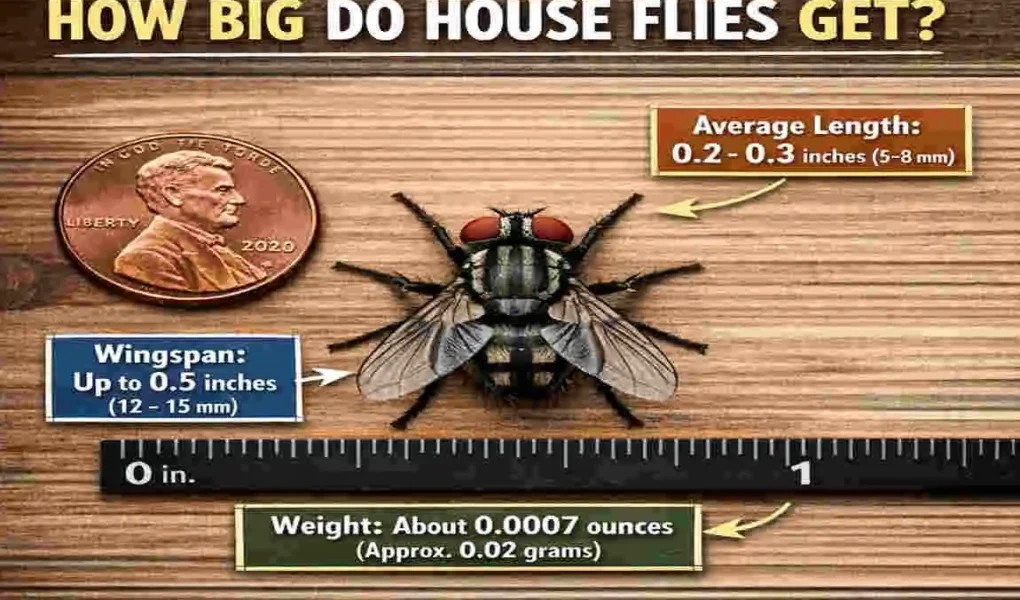
House flies are one of the most common insects people notice indoors. They are small, quick, and easy to recognize, which is why many people ask how big house flies get.
| House Fly Feature | Typical Size / Information |
|---|---|
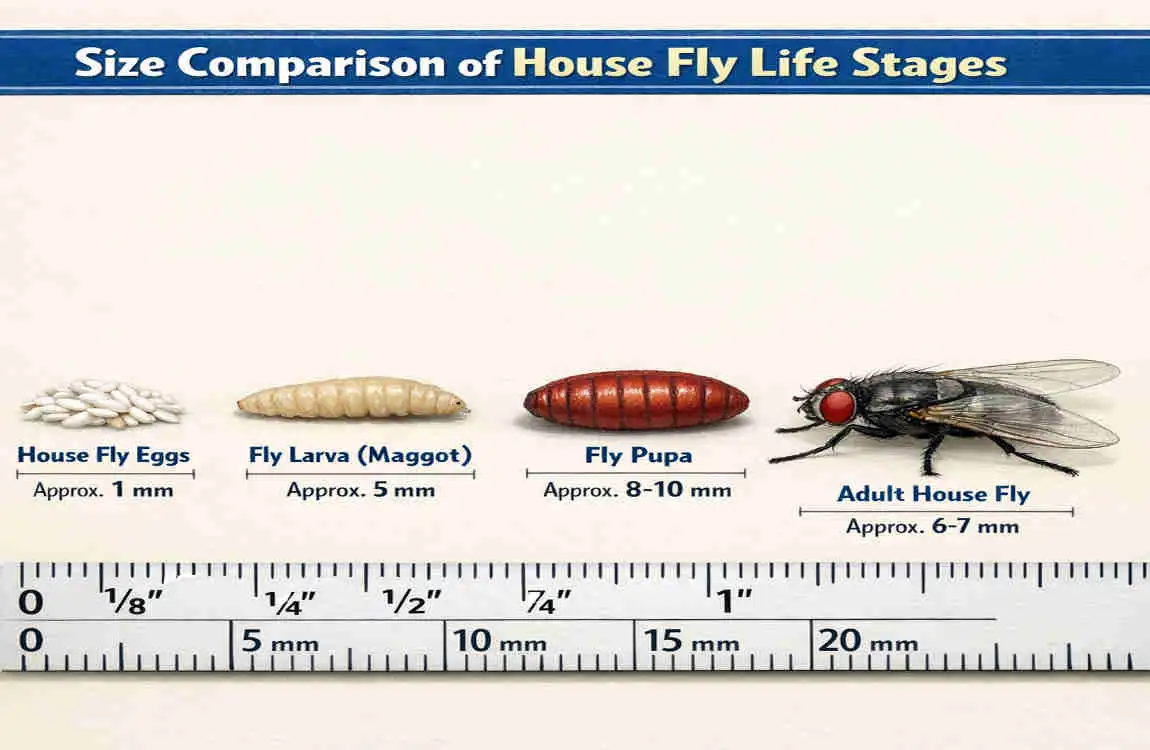
| Adult body length | About 6–7 mm (0.24–0.28 inches) |
| Wingspan | Approximately 13–15 mm (0.5–0.6 inches) |
| Body color | Usually gray with darker markings |
| Head size | Small, with large compound eyes |
| Larvae size | Tiny when hatched and can grow to around 7–12 mm |
| Egg size | Approximately 1–1.2 mm long |
| Adult weight | Generally only a few milligrams |
| Male vs. female | Females can sometimes appear slightly larger |
| Growth | House flies develop through egg, larva, pupa, and adult stages |
| Large-looking flies | A noticeably larger fly may be another species rather than a typical house fly |
In simple terms, an adult house fly is usually only a few millimeters long. It may look larger when it is close to you, but it is still a small fly overall.
How Big Do House Flies Get?
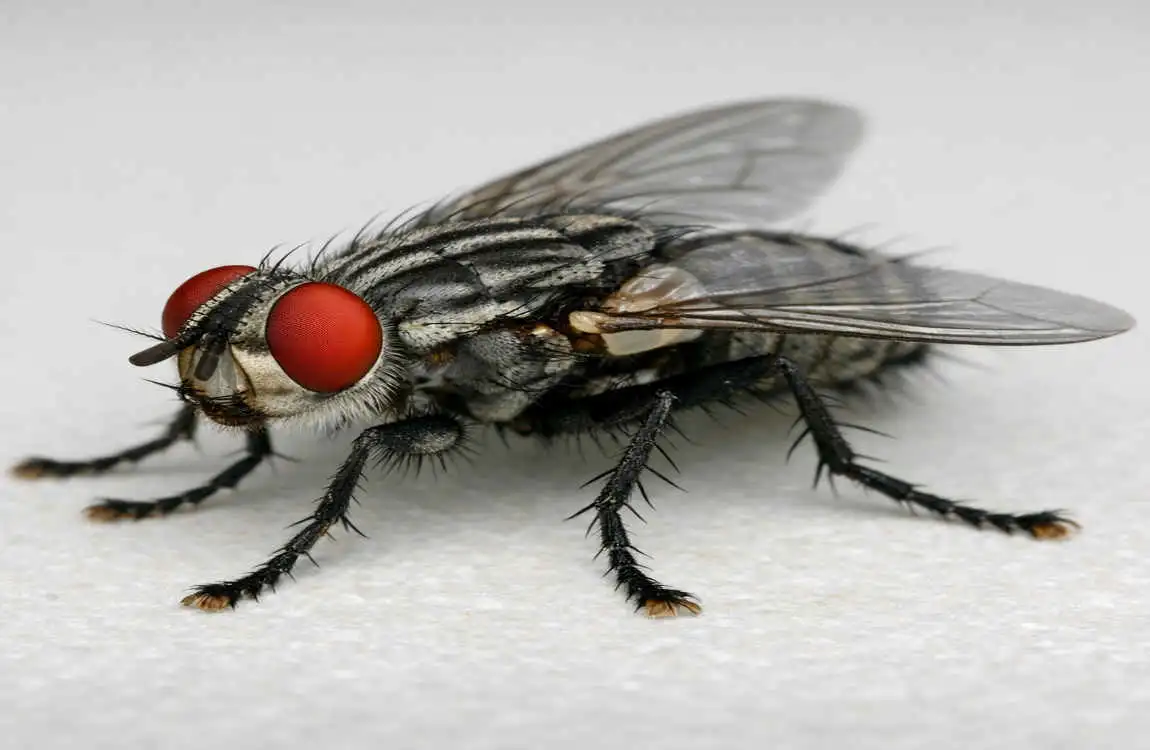
A typical adult house fly is about 6 to 7 millimeters long, which is roughly the size of a small seed. Its wings can stretch a little wider than its body, but the fly still stays compact and light.
House clean flies have a gray body, dark lines on the chest, and clear wings. They look small, but they move fast, so they often seem bigger than they really are.
Compared with fruit flies, house flies are much larger. They are also usually smaller than blow flies and some cluster flies. Their size can vary a little depending on the species, the environment, and how well they developed as larvae.
What Does a House Fly Look Like?
Body Size and Shape
A clean house fly has a short, rounded body that looks compact from head to tail. It is built for quick movement, so it does not have a long or narrow shape like some other flies.
Its body is small, but it still has a clear head, thorax, and abdomen. This makes it easy to spot once you know what to look for.
Color and Markings
Most house flies have a gray body with dark stripes on the thorax. The abdomen may look a little darker or slightly shiny.
These markings help you tell them apart from other small flies. Even when the fly is still, the striped chest is one of the easiest things to notice.
Wings and Legs
House clean flies have two transparent wings and six legs. Their wings help them fly quickly, while their legs help them land, climb, and stay on walls, windows, and food surfaces.
Their wings often look larger than expected because they are thin and spread wide when the fly is active.
How Big Are House Flies at Different Life Stages?
Eggs
House fly eggs are tiny and hard to see without close inspection. They are usually laid in moist places with food or waste.
At this stage, they are much smaller than the tip of a pin, so most people never notice them.
Larvae or Maggots
After the eggs hatch, the larvae, also called maggots, begin to grow quickly. They start small, then grow thicker and longer as they feed.
This clean stage is when most of the fly’s growth happens. The larva can look very different from the adult fly, since it does not yet have wings or the same body shape.
Adult House Flies
When the fly becomes an adult, it reaches its full size. This is the stage people usually notice indoors, especially when the fly lands on windows, counters, or walls.
At this point, the fly has its full body shape, wings, and legs, and it looks much more recognizable than the earlier stages.
What Factors Affect House Fly Size?
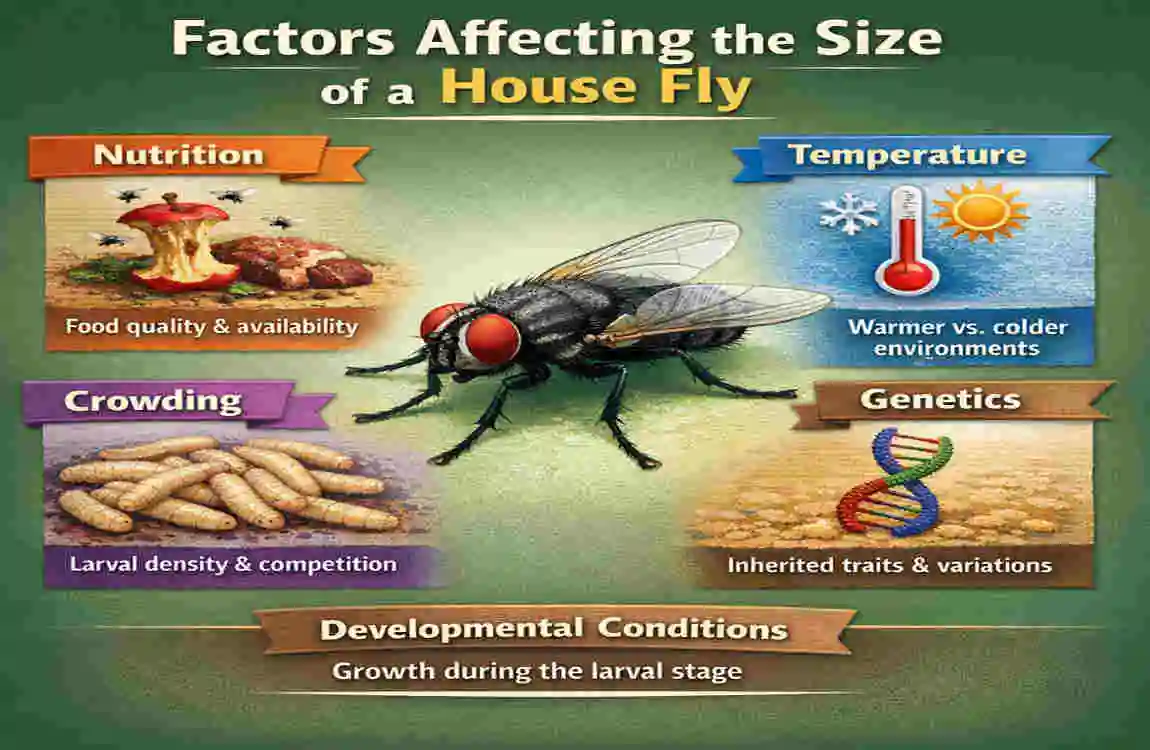
A house fly does not always grow to the same size. A few things can affect how large it becomes.
- Food and nutrition: A larva that has enough food may grow more strongly than one that does not.
- Temperature: Warm conditions can speed up development, while cooler conditions may slow it down.
- Genetics: Like many living things, some flies are naturally a little larger or smaller.
- Species differences: Not every fly that looks like a clean house fly is one. Similar flies may be bigger or smaller.
These changes are usually small, but they can make one fly look different from another.
House Fly Size Compared With Other Flies
Different flies can be easy to mix up, especially if you only see them for a second. This table gives a simple size comparison.
Type of Fly Usual Size General Look
House fly Small, around 6 to 7 mm Gray body, striped chest, clear wings
Fruit fly Much smaller Tiny body, often seen near fruit or drains
Blow fly Usually larger Shiny body, often metallic-looking
Cluster fly Similar or slightly larger Darker body, slower movement
If a fly looks much bigger than a clean house fly, it may actually be a blow fly or cluster fly. This is one reason people sometimes misjudge how big house flies get.
Why Do Some House Flies Look Bigger?
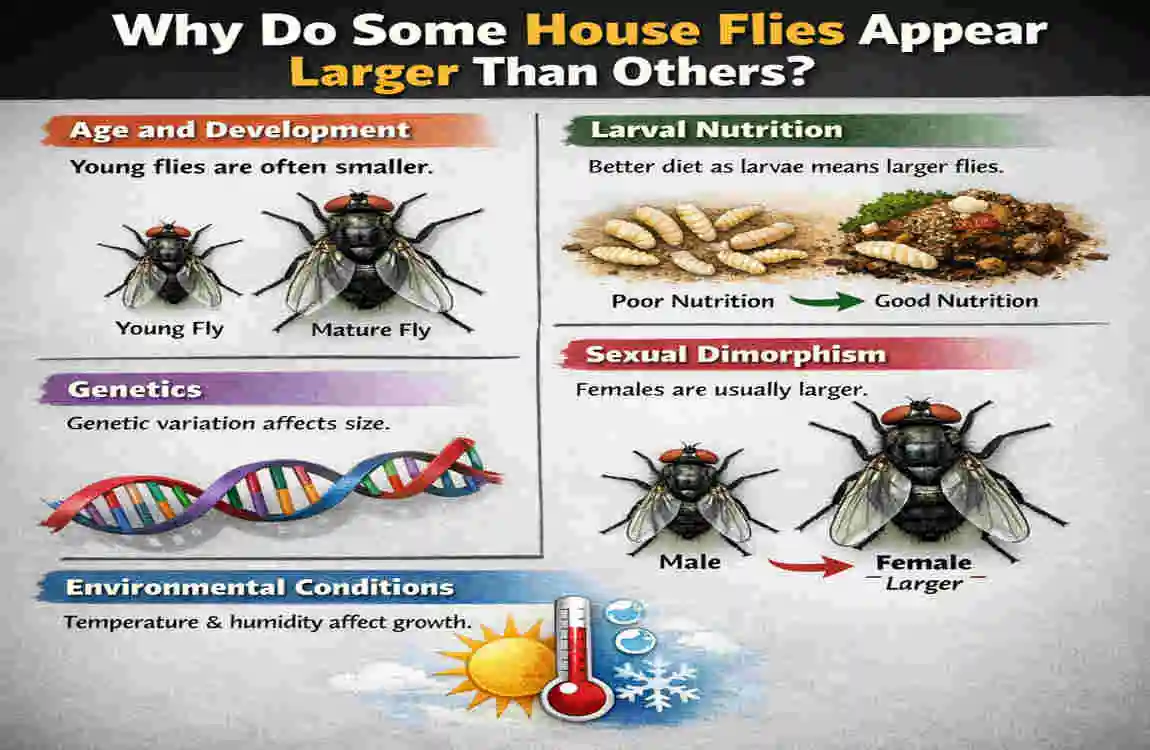
Sometimes a house fly seems larger than expected even when it is a normal size. This can happen for a few simple reasons.
First, distance matters. A fly closer to your eyes can look much bigger than one farther away. Second, wing position can change how large the fly appears, especially when the wings are spread out.
A fly may also look bigger if it is fully grown and well-fed. In some cases, people may also compare a clean house fly to a smaller insect and assume it is huge, even when it is just average size.
Frequently Asked Questions About House Fly Size
How big do house flies get?
Most adult house flies grow to about 6 to 7 millimeters long. They are small insects, but they can look larger because they move fast and have wide wings.
What is the average size of a house fly?
The average house fly is roughly the size of a small grain or seed. Its body is compact, and its wings make it look wider when it flies.
Can house flies grow bigger inside a home?
A house fly does not grow larger just because it is inside a home. Its size depends more on development, larval diet, and species.
How big are house fly larvae?
House fly larvae are tiny when they first hatch, then grow longer and thicker as they feed. They are much different in shape from the adult fly.
Why do some flies look much bigger than house flies?
Some flies are simply different species, like blow flies or cluster flies. They may have larger bodies, broader wings, or a darker appearance.
What is the difference between a house fly and a large fly?
A house fly is usually smaller and gray with dark stripes. A large fly may belong to another species and can have a stronger body shape or a shinier look.