Have you ever pulled into your driveway, stared at your exterior, and asked yourself, “What style is my house?” You are definitely not alone. Many homeowners fall in love with a property without ever knowing its architectural style.
Understanding your home’s unique design is like finding out its personality type. It tells the story of when it was built, why they used certain materials, and how it fits into your local neighbourhood. Plus, knowing your exact architecture makes renovating, decorating, and landscaping so much easier.
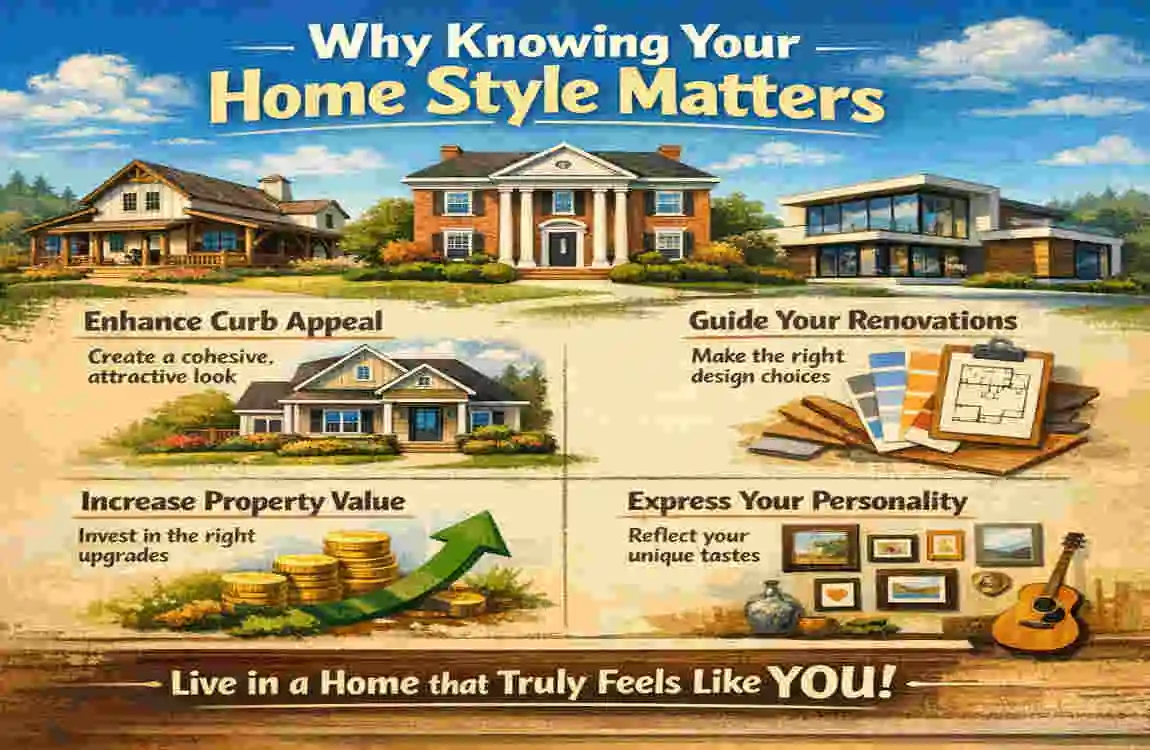
Why Knowing Your House Style Matters for Homeowners

Knowing your home’s architectural style is just fun trivia to share at dinner parties. However, identifying your home’s architecture offers significant practical benefits for everyday homeowners.
First, it heavily influences your renovation planning. When you know your home’s true style, you can make design choices that honour its original character. Imagine putting sleek, ultra-modern windows on a historic Victorian home. The result usually looks confusing and out of place. By matching your upgrades to your architecture, you create a cohesive, beautiful flow that boosts your property’s curb appeal.
Second, understanding your style helps you maximise your resale value. Buyers love homes that feel authentic. If you want to sell your home in the future, marketing it accurately—like highlighting its “authentic Mid-Century Modern charm”—attracts highly motivated buyers who are looking for exactly that aesthetic.
Finally, knowing the answer to “what style is my house?” helps you with historic preservation. Many older homes feature incredible craftsmanship that cannot be replicated today. When you know what makes your home special, you know exactly which original features you need to protect, preserve, and show off to the world.
Take the Quiz: Discover What Style Is My House in 60 Seconds
Do you want a quick answer? Grab a piece of paper and take our architectural styles quiz! Answer these ten simple questions by looking at the front of your home.
Write down your answers, and then match your most common responses to the style hints provided. This fast, interactive house style quiz is the perfect way to kickstart your journey.
Quiz Question Options Style Hints
Roof Shape A) Tall and pointed (Gable) B) Sloped on all sides (Hip) C) Totally flat A = Colonial, Tudor, Cape Cod B = Ranch, Federal C = Mid-Century Modern
Home Height A) One single story B) Two very symmetrical stories C) Two stories with a towering feel A = Ranch, Bungalow B = Colonial, Federal C = Victorian, Tudor
Siding Material A) Mostly brick or stone B) Wood clapboard or shingles C) Stucco and smooth finishes A = Tudor, Colonial B = Cape Cod, Craftsman C = Mediterranean, Modern
Window Types A) Multi-pane grids (Double-hung) B) Tall, narrow, or arched C) Massive floor-to-ceiling glass A = Colonial, Cape Cod B = Victorian, Mediterranean C = Mid-Century, Contemporary
Front Porch A) Small, unroofed stoop B) Thick columns, cozy seating area C) Wraparound covering multiple sides A = Colonial, Ranch B = Craftsman, Bungalow C = Farmhouse, Victorian
Front Door A) Dead centre, perfectly balanced B) Off to one side (Asymmetrical) C) Heavy wood with iron details A = Colonial, Federal B = Ranch, Contemporary C = Tudor, Mediterranean
Decorative Trim A) Very little, clean and simple B) Elaborate, lace-like “gingerbread” C) Exposed wooden beams/rafters A = Ranch, Modern B = Victorian C = Craftsman
Colour Palette A) Bright whites, muted blues/greys B) Earthy browns, greens, deep reds C) Wild, vibrant, multi-colour combinations A = Cape Cod, Farmhouse B = Craftsman, Tudor C = Victorian
Garage Setup A) Attached and very visible B) Detached and hidden in back C) Built deep into the basement level A = Ranch, Contemporary B = Craftsman, Victorian C = Mid-Century Modern
Special Features A) A round tower (Turret) B) Small windows popping out of the roof (Dormers) C) Large white columns holding a triangle roof A = Victorian B = Cape Cod C = Greek Revival
Did you tally up your answers? Keep your results handy! Now, let’s dive into our detailed visual guide so you can match your quiz results with real-world examples.
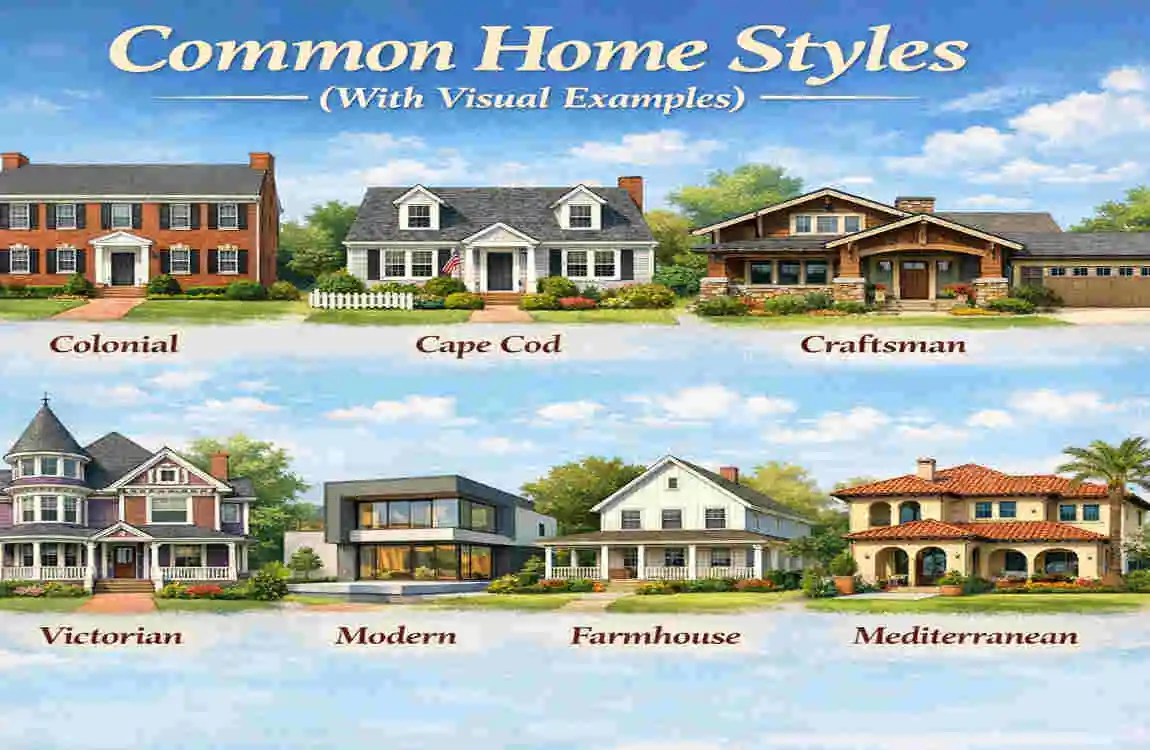
Visual Guide: 12 Most Common House Styles With Photos & ID Tips

If you are still wondering, “What style is my house?” the easiest way to figure it out is by looking at visual examples. Builders have constructed millions of homes across the country, but most fall into one of these twelve classic categories.
Let’s break down the defining traits, the rich history, and the visual cues of the most popular American house styles.
Colonial House Style
The Colonial style is the absolute classic American home. Originating in the 1600s as European settlers arrived on the East Coast, this style emphasises strict symmetry and formal elegance. If you draw a line down the exact middle of a Colonial house, both sides will look almost identical.
Builders traditionally constructed Colonial homes using brick or wood siding. They always feature a central front door, flanked by an equal number of windows on either side. These homes usually have two full stories, making them incredibly spacious for large families. Today, modern builders still use this style because it feels timeless and stately.
Visual Cues to Look For:
- Perfect symmetry across the entire front facade.
- Multi-pane, double-hung windows are perfectly aligned.
- A medium-pitched gable roof (a simple triangle shape).
- A decorative crown or small roof sitting directly over the front door.
Victorian House Style
If you ever ask, “What style is my house if it has a turret and feels like a dollhouse?” the answer is almost certainly Victorian. Popular during the reign of Queen Victoria (1837–1901), these homes reject the strict rules of the Colonial style. Instead, they embrace complex, asymmetrical, and highly decorative designs.
Victorian architecture wants to show off. Builders used new mass-production techniques during the Industrial Revolution to create elaborate wooden trims, often called “gingerbread” detailing. These homes boast steep, complex roofs, wraparound porches, and vibrant, multicoloured paint jobs.
Visual Cues to Look For:
- Steep, intersecting rooflines with multiple peaks.
- A round or octagonal turret (tower) on one corner.
- Intricate wooden trim along the roof and porches.
- Tall, narrow windows that sometimes feature stained glass.
Craftsman/Bungalow House Style
The Craftsman style exploded in popularity during the early 20th century as a direct rebellion against the overly decorated Victorian style. Instead of factory-made frills, the Craftsman movement celebrated hand-crafted artistry, natural materials, and cozy, functional living spaces.
When identifying a Craftsman, you will notice a strong connection to nature. These homes sit lower to the ground and feature low-pitched roofs with wide, overhanging eaves. Builders intentionally left the wooden roof rafters exposed to show off the home’s construction. Inside, you will usually find gorgeous built-in shelving, window seats, and thick wooden window casings.
Visual Cues to Look For:
- Low-pitched gabled roofs with wide overhangs.
- Exposed wooden rafters under the roofline.
- A deep, inviting front porch supported by thick, tapered columns.
- Earthy colour palettes featuring greens, browns, and warm yellows.
Ranch House Style
If you live in the American suburbs, there is a very high chance you live in a Ranch. Booming in popularity after World War II, the Ranch style reflects a shift toward casual, relaxed, and car-centric family living. Families wanted sprawling yards and easy, stair-free living.
The most defining feature of a Ranch home is its single-story, long, and horizontal profile. Builders designed these homes to hug the ground. They almost always feature an attached garage, large picture windows in the living room, and sliding glass doors that open directly onto a backyard patio. They are the ultimate expression of mid-century suburban life.
Visual Cues to Look For:
- A single-story, sprawling layout that is wider than it is deep.
- A low-pitched roof, often in a hip style (sloping on all sides).
- An attached garage that sits prominently on the front.
- Large picture windows or asymmetric window placements.
Cape Cod House Style
Do you want a home that feels like a cozy retreat? The Cape Cod style is the answer. Originally built by English colonists in New England in the 1600s, these homes were designed to withstand brutal, snowy winters. That is exactly why they have such steep roofs—to stop heavy snow from piling up!
Cape Cods are generally symmetrical, a story-and-a-half tall, and charmingly simple. The most recognisable feature is the presence of dormer windows—those adorable little window boxes that pop out directly from the slanted roof. They traditionally feature wood shingle siding that weathers beautifully over time.
Visual Cues to Look For:
- A very steep gable roof designed to shed snow.
- Dormer windows projecting from the roofline.
- Wood shingle siding (often cedar).
- A central chimney to heat the entire compact home.
Tudor House Style
When you ask yourself, “What style is my house?” does your mind immediately jump to medieval England or a fairytale storybook? If so, you likely own a Tudor home. Popular in wealthy American suburbs during the 1920s and 1930s, this style mimics the romantic look of old English manors.
The absolute giveaway of a Tudor home is the decorative half-timbering. This means you will see a light-colored stucco exterior crisscrossed with dark, heavy wooden boards. Tudors also feature incredibly steep, multi-gabled roofs, massive brick or stone chimneys, and narrow windows grouped.
Visual Cues to Look For:
- Decorative half-timbering (dark wood over light stucco).
- Extremely steep cross-gabled roofs.
- Massive, elaborate chimneys often topped with decorative clay pots.
- Tall, narrow casement windows with leaded glass.
Mid-Century Modern House Style
Mid-Century Modern (MCM) is having a massive resurgence right now. Spanning roughly from 1945 to 1969, this architecture tossed out all the traditional rules. Architects wanted to integrate nature directly into the living space, blurring the lines between indoors and outdoors.
MCM homes are famous for their flat or slightly angled roofs, clean geometric lines, and massive walls of glass. They rarely feature any decorative trim. Instead, the beauty comes from the structural materials themselves, like exposed steel, concrete block, and rich wood panelling. They feel open, airy, and incredibly cool.
Visual Cues to Look For:
- Flat or asymmetrical slanted roofs.
- Floor-to-ceiling glass windows and sliding doors.
- Clean, sharp, geometric lines with zero decorative trim.
- An emphasis on integrating the house into the natural landscape.
Contemporary House Style
People often confuse “Modern” and “Contemporary,” but they are actually different. While Mid-Century Modern refers to a specific era, Contemporary refers to architecture being built right now. It is constantly evolving in line with current trends and technologies.
Today’s Contemporary homes prioritise sustainability, energy efficiency, and bold, unique shapes. You will see a mix of contrasting materials, like corrugated metal siding paired with warm wood accents. They almost always feature wide-open floor plans, oversized, asymmetrical windows, and eco-friendly features such as solar panels or green roofs.
Visual Cues to Look For:
- Asymmetrical facades with bold, unconventional shapes.
- A mixture of industrial materials (metal, concrete, glass, wood).
- Large, unadorned windows meant to capture as much natural light as possible.
- Eco-friendly design elements and sustainable building materials.
Farmhouse House Style
If you love watching home renovation shows, you are already intimately familiar with the Farmhouse style. Originally built by early American farmers out of pure necessity, these homes were designed to house large families and provide shelter from the harsh elements of rural life.
The traditional Farmhouse is tall, simple, and practical. It almost always features a massive, welcoming wraparound porch where workers could kick off their muddy boots. Today, the “Modern Farmhouse” trend has taken the country by storm, combining these historic, rustic shapes with sleek black windows, crisp white board-and-batten siding, and modern fixtures.
Visual Cues to Look For:
- A large, deep wraparound front porch.
- Simple, tall, and rectangular main structures.
- Board-and-batten siding (vertical wood strips).
- Metal roofs or simple gable rooflines.
Mediterranean House Style
If you ask, “What style is my house?” and you live in California, Florida, or the Southwest, you might be looking at a Mediterranean. Designed to capture the breezy, romantic feel of coastal Spain, Italy, and Greece, this style thrives in warm, sunny climates.
You can spot a Mediterranean home instantly by looking at the roof. Builders almost exclusively use red clay tiles. The exterior walls are coated in thick, protective stucco, usually painted in warm whites, earthy pinks, or sunny yellows. You will also see beautiful arches over the doors and windows, as well as heavily carved wooden doors.
Visual Cues to Look For:
- Red clay barrel-tile roofs.
- Smooth or textured stucco walls.
- Prominent arches over windows, doors, and walkways.
- Wrought-iron balconies and window grilles.
Federal House Style
Following the American Revolution, the newly formed United States wanted an architectural style that felt distinctly different from the British Colonial look. The result was the Federal style. It is similar to Colonial in its strict symmetry, but it is much more delicate, refined, and Roman-inspired.
Federal homes are typically flat-faced brick structures. The easiest way to tell a Federal home from a Colonial home is by looking at the front door. Federal homes almost always feature a beautiful, half-circle window (called an elliptical fanlight) sitting directly above the front door. They also feature elegant, tooth-like moulding along the roofline called dentil moulding.
Visual Cues to Look For:
- An elliptical fanlight window directly over the front door.
- Narrow windows flanking the door (sidelights).
- Dentil moulding (small, square blocks) along the roof cornice.
- A very flat, unadorned brick facade that relies on perfect proportions.
Greek Revival House Style
Do you want a home that looks like an ancient temple? That is the essence of the Greek Revival style. Extremely popular in the mid-1800s, this style drew inspiration from ancient Greece, the birthplace of democracy. It was meant to project power, wealth, and civic pride.
The defining feature of a Greek Revival home is the columns. These homes feature massive, two-story columns painted bright white. The roof is usually turned so the triangular gable faces the street, mimicking the pediment of a Greek temple. You will often see this grand, imposing style on historic southern estates or old civic buildings.
Visual Cues to Look For:
- Massive, towering columns (often round and fluted).
- A front-facing triangular gable (pediment) over the porch.
- Bold, simple mouldings and heavy cornices.
- A front door surrounded by narrow windows on the top and sides.
Quick Comparison Table: Match Your House Instantly
To make things even easier, we have organised the key identifying features into this handy cheat sheet. Use this table to cross-reference the traits you see in your own home.
Style Roof Type Exterior Siding Window Style Defining Era
Colonial Medium Gable Brick or Wood Multi-pane, double-hung 1600s – 1800s
Victorian Steep, Complex Wood (Scalloped) Tall, arched, stained glass 1837 – 1901
Craftsman Low, Exposed Rafters Wood, Stone, Stucco Grouped, thick casings 1905 – 1930s
Ranch Low Hip or Gable Brick, Wood, Stucco Large picture, asymmetric 1945 – 1980s
Cape Cod Very Steep Gable Wood Shingles Multi-pane with dormers 1600s – 1950s
Tudor Steep Cross-Gable Stucco with Wood Trim , Tall, narrow casement , 1890s – 1940s
Mid-Century Flat or Slanted Wood, Stone, Glass Floor-to-ceiling glass 1945 – 1969
Contemporary Asymmetrical Mixed Metals, Wood , Massive, geometric 1970s – Present
Farmhouse Simple Gable, Metal Board-and-batten Tall, simple frames 1800s – Present
Mediterranean Red Clay Tile Stucco Arched, recessed 1920s – Present
Federal Low-pitch or Flat Brick Multi-pane, fanlights 1780 – 1840
Greek Revival Front-facing Pediment Wood or Brick Tall, simple 1825 – 1860
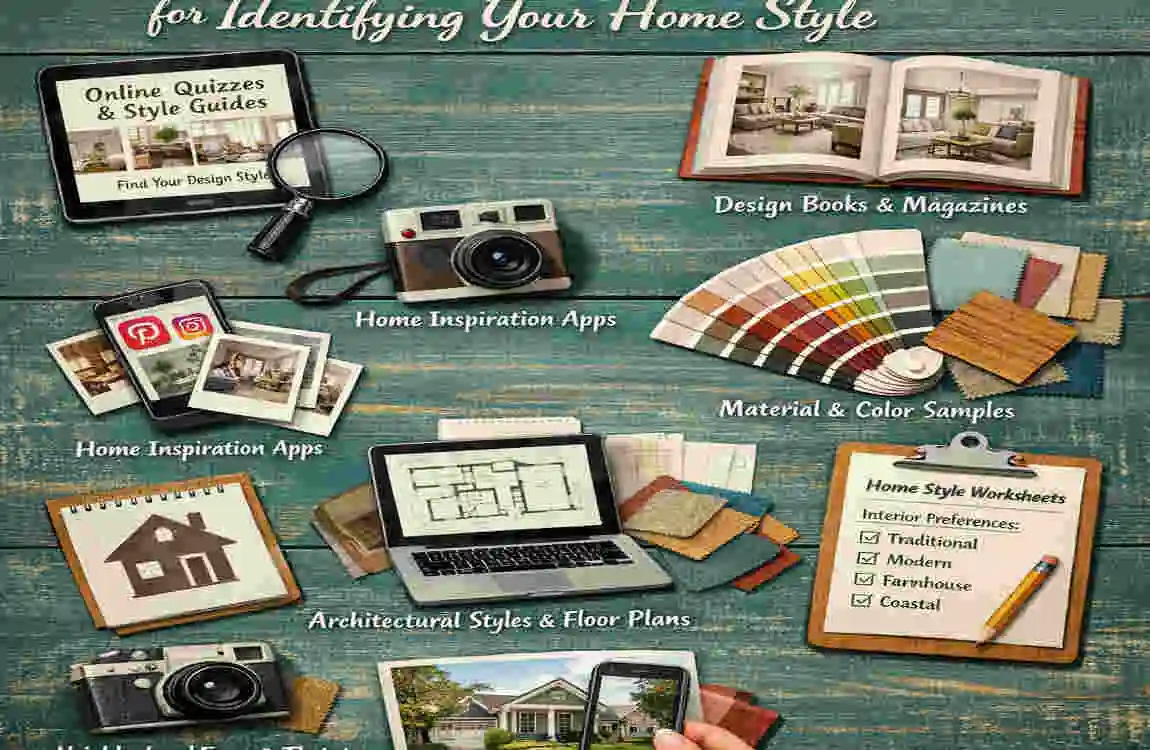
How to Confirm What Style Is My House (Expert Steps)

Sometimes, simply looking at photos isn’t enough to confidently identify your home’s architecture. Homes are often renovated over decades, blending multiple styles. If your house feels like a confusing mashup, you need to dig a little deeper.
Analyse with Google Street View. Take a virtual walk down your street. Builders rarely build one house in a vacuum. Usually, they build entire neighbourhoods during the same era. If all the houses around you are 1950s Ranches, chances are your home started as a Ranch, too, even if a previous owner added a Farmhouse porch to it later.
Hunt Down the Blueprints or Deeds Look through your closing documents, or visit your local county clerk’s office. Finding the original building permits or blueprints will tell you exactly when the home was built. Once you know the exact year of construction, you can easily match it to the dominant architectural trend of that specific decade.
Visit Your Local Historical Society. If you live in an older home, your local historical society is a goldmine. They often keep archives of old neighbourhood photographs. Seeing a picture of your home from 80 years ago, before decades of modern renovations stripped away its original charm, is the fastest way to see its true architectural style.
Utilise Smart Home Design Apps. Technology makes everything easier! There are dozens of brilliant architecture apps available on your smartphone. You snap a picture of your exterior, and the artificial intelligence analyses your rooflines, windows, and materials to identify your exact architectural style.
Consult with a Local Architect. When in absolute doubt, call in the professionals. A local architect or experienced real estate agent can look at the bones of your house—the foundation, the load-bearing walls, and the roof trusses—and tell you definitively what the original builder intended. They know exactly how to see past bad paint jobs and confusing renovations.
Common Mix-Ups: What Style Is My House Really?

Because builders love to borrow ideas from the past, many homeowners get stuck between two very similar styles. Let’s clear up a few of the most common architectural mix-ups so you can identify your home architecture accurately.
Farmhouse vs. Craftsman People mix these up all the time because both feature large, inviting front porches. How do you tell them apart? Look at the roof and the columns. A Farmhouse will have a taller, steeper roof and simple, skinny porch posts. A Craftsman sits lower to the ground, features exposed roof rafters, and has incredibly thick, heavily tapered columns that often sit on stone bases.
Colonial vs. Federal: These two styles look like siblings. Both are symmetrical, brick, and boxy. The trick is to look at the front door and the roofline. If the home has a delicate, half-moon window sitting directly over the front door, it is a Federal. If the roofline features small, square, tooth-like dentil blocks, you are definitely looking at a Federal home, not a standard Colonial.
Mid-Century Modern vs. Contemporary. This mix-up happens because people use the words “modern” and “contemporary” interchangeably in everyday conversation. However, in architecture, they are vastly different. Mid-Century Modern implies a very specific, vintage look from the 1950s and 60s, featuring flat roofs and wood panelling. Contemporary means the home was built recently and features today’s cutting-edge trends, like asymmetrical metal siding and smart-home technology.
FAQ: Quick Answers to “What Style Is My House?”
Do you still have a few lingering questions? We hear these specific queries from curious homeowners all the time. Let’s answer them quickly!
What style is my house if it has a wraparound porch? If your home features a deep porch that wraps around the front and sides of the house, you are most likely looking at a Farmhouse or a Victorian. If the home is simple and painted white, it is a Farmhouse. If it has a turret, elaborate gingerbread trim, and bright colours, it is a Victorian.
What style is my house if it is only one story? Single-story homes are overwhelmingly Ranch-style, especially if they are long and wide and feature an attached garage. However, if your single-story home is compact, has a deep front porch, and features earthy colours, it could be a small Bungalow or Craftsman.
What style is my house if it has a flat roof? Flat roofs are a massive giveaway for modern architecture. If your home has a flat roof, large glass windows, and a retro vibe, it is Mid-Century Modern. If it has a flat roof with stark white stucco and curves, it might be Art Deco.
Can my house be more than one style? Absolutely! We call these “Transitional” or “Eclectic” homes. As the decades pass, successive owners renovate the home to reflect current trends. It is very common to find a classic Colonial home that suddenly sports a trendy Modern Farmhouse kitchen and a Craftsman-style front door.