Have you ever pulled into a driveway, hit the button for the garage door, and felt that slight twinge of anxiety, wondering if you’re going to scrape the side mirror? You aren’t alone. For many of us, the garage is the unsung hero of the home—it’s the workshop, the storage unit, the home gym, and occasionally, the place where we actually park our cars.
But here is the million-dollar question that plagues homeowners and dream-home builders alike: how many square feet is a 2-car garage really supposed to be?
However, if you are planning your “forever home” or even just looking to upgrade your current setup, simply settling for the bare minimum might be a decision you regret later. The difference between a “standard” size and an “ideal” size can mean the difference between dinging your car doors every day and having ample room for a workbench, holiday decorations, and your SUV.
Standard 2-Car Garage Dimensions: The Basics
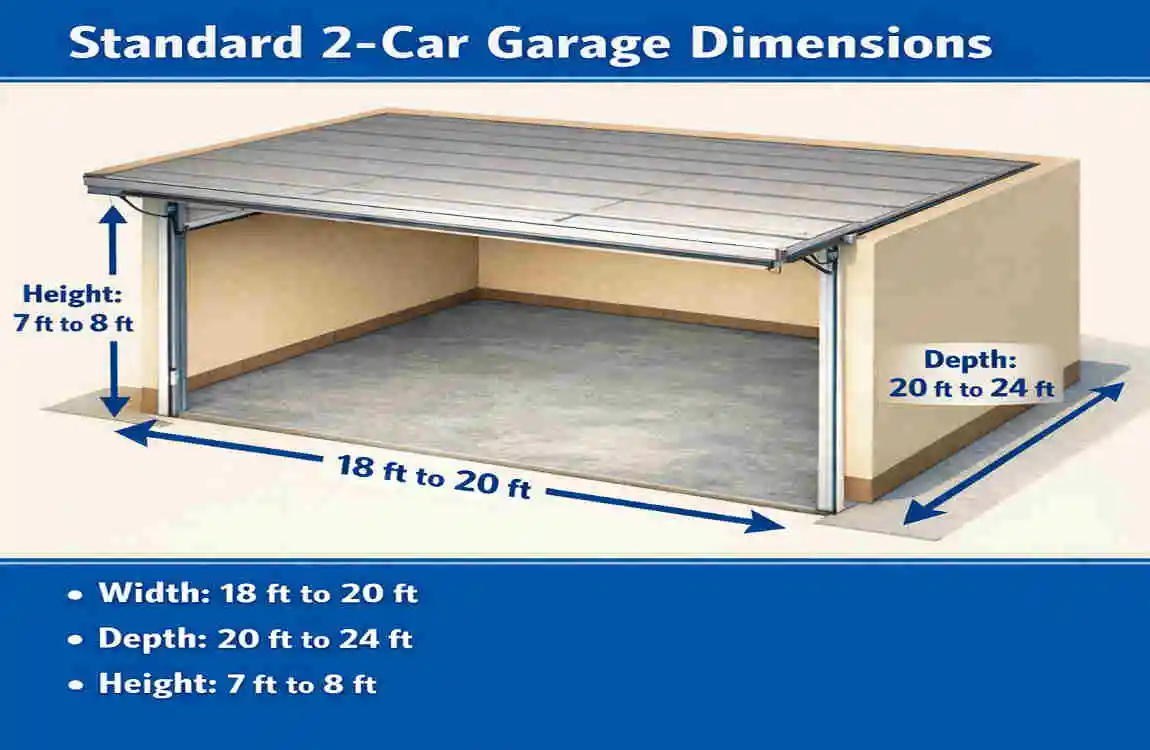
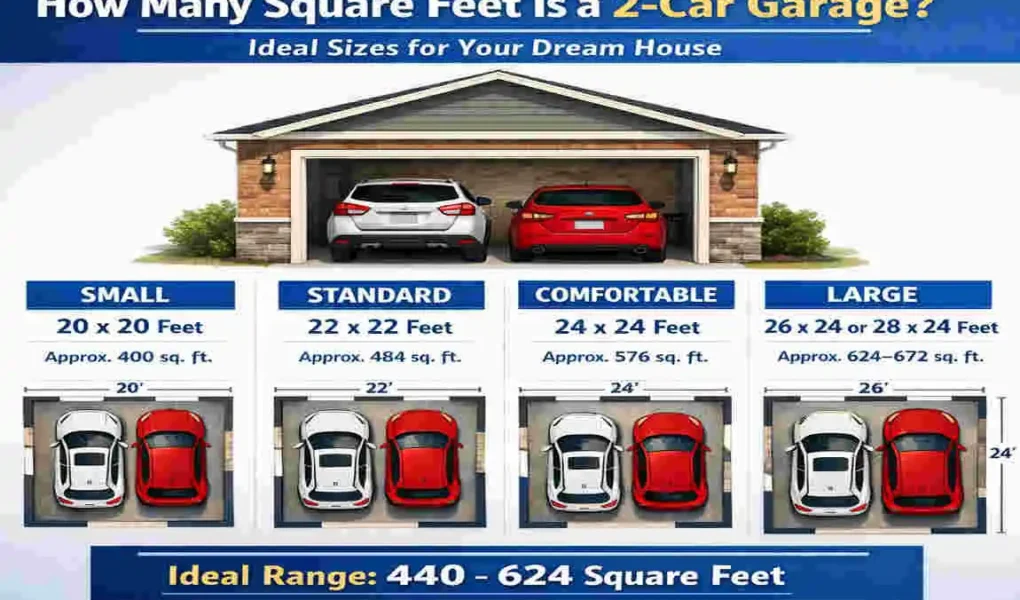
When we talk about the standard 2-car garage size, we are usually working with a square or slightly rectangular shape. The most common dimensions you will see in suburban developments range from 20 to 24 feet in width and 20 to 24 feet in depth.
Mathematically, this gives you the 400-576 sq ft range. But numbers on a blueprint look very different than real life.
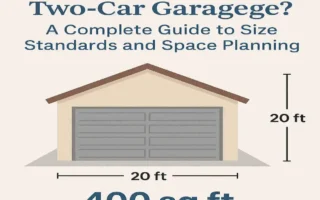
The 20×20 Garage (400 Sq Ft)
A 20×20 garage is often considered the absolute minimum. While it technically fits two cars, it doesn’t account for “human factors.”
- The Squeeze: If you park two compact sedans side-by-side, you have very little room to open the doors.
- No Storage: In a 400 sq ft setup, you effectively have zero floor space for shelving, lawnmowers, or bicycles if both cars are parked inside.
The 24×24 Garage (576 Sq Ft)
This is widely considered the ideal size for a standard 2-car garage.
- Breathing Room: That extra 4 feet of width lets you open car doors fully without hitting the adjacent vehicle or the wall.
- Depth: The extra depth accommodates longer vehicles, such as pickup trucks or large SUVs, while still leaving room for a workbench or shelving unit at the back.
Here is a quick breakdown of how these sizes translate to real-world usage:
Size Type Dimensions (ft) Sq Ft Best For
Minimum 20×20 400 Compact cars, tight lots, minimal storage needs.
Average 20×22 to 20×24 440-480 Mid-sized sedans, some wall storage.
Standard / Ideal 24×24 576 SUVs, Trucks, Workbenches, Freezers.
Why Width Matters More Than You Think
Think about the modern vehicle. A standard sedan is roughly 6 to 7 feet wide. Two of them, side by side, take up 14 feet. If you have a 20-foot-wide garage, you are left with only 6 feet of total clearance. That means you have just 2 feet of space on the exterior sides and 2 feet between the cars.
That is a tight squeeze, especially if you are carrying groceries, managing a baby car seat, or trying to navigate around a wet vehicle on a rainy day. This is why 2-car garage dimensions are often pushed to 24 feet wide by custom builders—it creates a comfortable 3-4 foot buffer zone that makes daily use significantly less stressful.
Minimum vs. Oversized Sizes: Finding Your Fit
Not every homeowner has the luxury of unlimited land, and conversely, some have space to spare. Understanding the spectrum from “minimum viable product” to “oversized luxury” helps you set realistic expectations.
The Minimum: 18×20 (360 Sq Ft)
Believe it or not, some older homes or ultra-compact urban builds feature garages as small as 18×20 feet (360 sq ft).
- The Reality: This is extremely tight. It requires you to park perfectly straight every single time. It is often better suited to one car and some storage than to two actual cars.
- Truck Trouble: If you own a full-size pickup truck (which averages 19-20 feet long), a minimum-depth garage is a no-go. You won’t be able to close the garage door.
The Oversized: 24×30 and Beyond (720+ Sq Ft)
If you are designing a custom home, you might hear the term oversized 2-car garage. This usually starts around 24×30 feet, giving you 720 square feet or more.
- The Workshop Dream: That extra 6 feet of depth (going from 24 to 30) creates a massive area at the back of the garage. This is perfect for a permanent workbench, a dedicated area for a riding lawnmower, or even a home gym.
- Resale Value: An oversized garage is a huge selling point. Buyers love seeing that they don’t have to rent an off-site storage unit because their garage can handle the overflow.
Here is how the square footage stacks up in terms of utility:
Comparison Minimum (360 Sq Ft)Standard (576 Sq Ft)Oversized (720+ Sq Ft)
Vehicle Capacity 2 Compacts (barely) 2 SUVs/Trucks 2 Large Vehicles + Toys
Storage Space , Wall hooks only , Shelves + Cabinets, dedicated Workshop/Gym Area
Comfort Level High Stress Comfortable Luxurious
Cost Estimate Lowest Balanced Investment Higher Initial Cost
Regional Differences
It is also worth noting that geography plays a role. In dense urban areas or older East Coast suburbs, the 20×20 standard is common. However, in suburban areas with larger lots, or regions where large trucks are popular (like the Midwest or Texas), 24×24 is often the baseline expectation for new construction.
Factors Influencing Your Ideal Garage Size
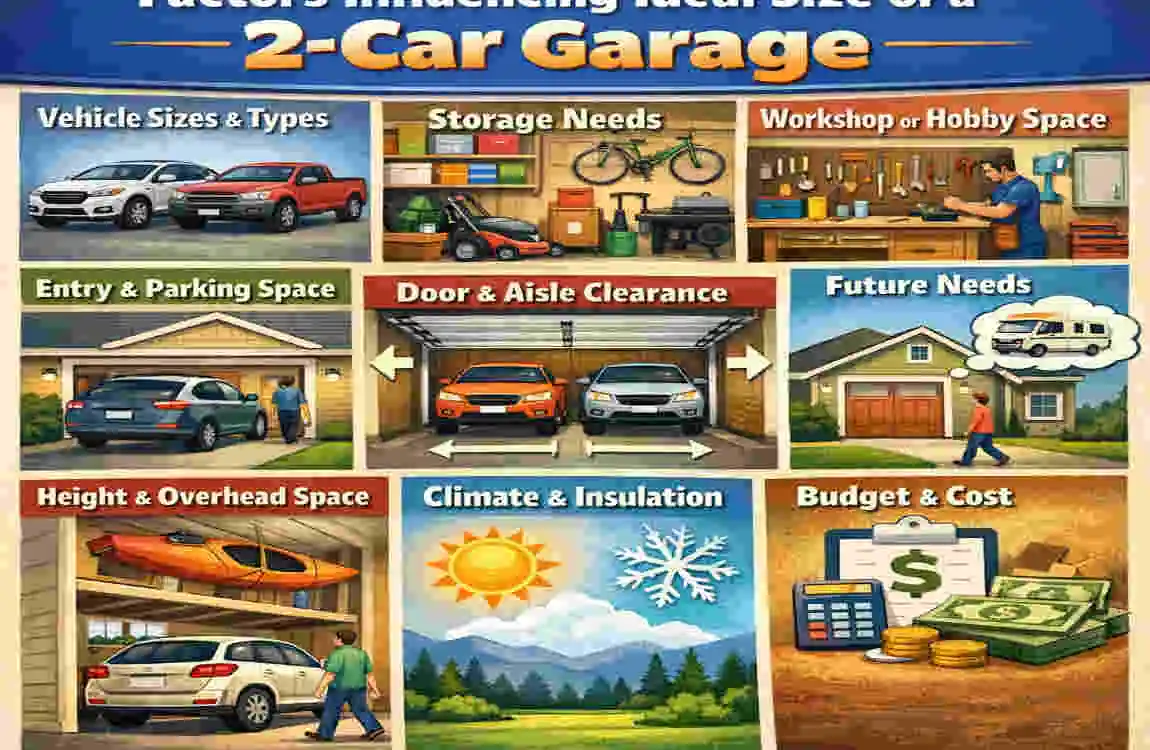
Deciding how many sq ft a 2-car garage is isn’t just about picking a number off a chart. It’s about your lifestyle. Here are the five critical factors you need to weigh before pouring concrete.
Vehicle Type and Size
This is the most obvious but often overlooked factor. Cars are getting bigger.
- SUVs and Trucks: A Ford F-150 or a Chevy Tahoe is significantly longer and wider than a Honda Civic. If you drive a large SUV, you need a minimum depth of 24 feet—anything less, and you might find yourself walking sideways to get around the bumper.
- Door Swing: Coupes (2-door cars) often have longer doors than sedans. They require more width to open comfortably.
The “Stuff” Factor (Storage Needs)
Be honest with yourself: are you really only going to park cars in there?
- Lawn Equipment: A push mower takes up about 10 sq ft. A riding mower takes up 20-30 sq ft.
- Recreational Gear: Kayaks, mountain bikes, golf clubs, and camping gear eat up square footage fast.
- The Rule of Thumb: If you plan to store anything substantial, add 100-200 sq ft to your base requirement. This pushes a 400 sq ft need up to that 600 sq ft range immediately.
Ceiling Height and Vertical Space
While we are focused on square footage (floor area), don’t forget cubic footage.
- Standard Height: Most garage ceilings are 8 or 9 feet high.
- Lift Potential: If you are a car enthusiast who wants to install a hydraulic lift, you will need a ceiling height of at least 12 feet. This doesn’t change the floor square footage, but it drastically changes the space’s volume and utility.
Workspace Requirements
Do you do your own oil changes? Do you enjoy woodworking?
- A functional workbench needs about 2-3 feet of depth off the wall, plus 3-4 feet of standing room behind it. That is a 6-foot slice of your garage gone in a 20-foot deep garage, that leaves only 14 feet for the car, which is not enough. This is why the oversized 2-car garage is crucial for hobbyists.
Building Codes and HOA Restrictions
Before you dream too big, check the rules.
- Setbacks: Local zoning laws require your garage to be a certain distance from the property line.
- HOA Limits: Some Homeowners Associations limit the size of detached structures or the width of driveways, which effectively caps your garage width.
Cost Breakdown by Size
Money matters. Expanding your garage from a “standard” to a “dream” size comes with a price tag, but it might be more affordable than you think, given the value it adds.
The basic build cost for a detached garage generally ranges from $50 to $100 per square foot, depending on materials, electricity, and insulation.
The Cost of Going Bigger
Let’s look at rough estimates for the shell and basic finishing (slab, frame, roof, siding, door):
- 400 Sq Ft (20×20):
- Material Est: $20,000 – $30,000
- Total w/ Labor: $40,000 – $60,000
- Verdict: Most affordable, but offers the least utility.
- 576 Sq Ft (24×24):
- Material Est: $30,000 – $45,000
- Total w/ Labor: $60,000 – $90,000
- Verdict: The “Sweet Spot.” You get nearly 50% more space for roughly a 30-40% increase in cost.
- 720 Sq Ft (24×30):
- Material Est: $40,000 – $60,000
- Total w/ Labor: $80,000 – $120,000
- Verdict: Higher upfront cost, but significant ROI (Return on Investment) for resale value and lifestyle functionality.
ROI Tip: A larger garage is one of the few home improvements that consistently offers a high return. Buyers perceive a 24×24 garage as a “luxury” feature compared to a cramped 20×20, which can increase your home’s value by an estimated 10-15% in car-dependent areas.
Design Ideas for Dream House Garages

If you have established that 576 sq ft (24×24) is your target, how do you make it amazing? A garage shouldn’t just be a concrete box.
The “Lofted” Layout
If you are building a detached garage, consider a high-pitch roof to create a loft.
- Bonus Space: A 24×24 footprint offers enough structural integrity to support a second-story studio, office, or “man cave.”
- Storage: Even a partial loft provides a massive area for seasonal decorations, freeing up the main floor for your cars.
The “Tandem” Garage
If your lot is narrow but deep, consider a tandem layout. This is where one car parks in front of the other.
- Dimensions: Typically 12-15 feet wide but 36-40 feet deep.
- Pros: Fits on narrow city lots.
- Cons: You have to move the back car to get the front car out.
Future-Proofing
- EV Charging: install a 240-volt outlet (NEMA 14-50) even if you don’t have an electric car yet. It is a huge selling point.
- Insulation: Don’t skimp on insulated garage doors. They keep the space cooler in summer and warmer in winter, making the garage usable as a workspace year-round.
FAQ Section
How many square feet is a 2-car garage exactly? There is no single “exact” number, but the industry standard range is 400 to 576 square feet. A 20×20-foot garage (400 sq ft) is the minimum, while a 24×24-foot garage (576 sq ft) is considered the ideal standard.
What’s the ideal 2-car garage size for a dream house? For a dream home, you should aim for at least 24×24 feet (576 sq ft). If you have the space, stretching the depth to 30 feet (making it 720 sq ft) creates a luxury experience with room for workshops and storage without cramping your vehicles.
Can a 20×20 garage actually fit two SUVs? Technically, yes, but it will be a miserable experience. A large SUV is roughly 6.5 to 7 feet wide. Two of them take up 14 feet. In a 20-foot-wide garage, you are left with inches to spare on either side. You likely won’t be able to fully open the doors. For SUVs, a 24-foot width is highly recommended.
What is the minimum legal size for a 2-car garage? This varies by local municipality, but many building codes recognize 20×20 feet as the minimum functional size for a two-car structure. However, some developers push this down to 18×20 in high-density areas, though this is often functionally obsolete for modern vehicles.
How many square feet is a 3-car garage? If you are considering upgrading, a standard 3-car garage typically measures 800 to 1,000 square feet. The most common dimension is roughly 32 feet wide by 24 feet deep.