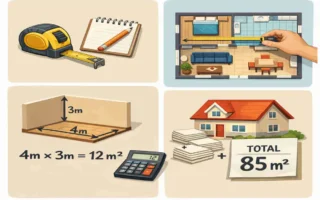
If you are wondering how to calculate the square meters of a house, you are already doing something smart. Knowing the size of a home is important for many reasons, and it helps you make better decisions as a buyer, seller, renter, homeowner, or builder.
| What to do | How to do it (practically) | |
|---|---|---|
| 1 | Draw a simple floor sketch | Roughly draw each room/area of the house from above, including hallways and closets that you want counted. |
| 2 | Break into simple shapes | Split irregular areas into rectangles (and simple shapes) on your sketch so each piece is easy to measure. |
| 3 | Measure length and width | Use a tape measure to record each rectangle’s length and width in meters; note them directly on the sketch. |
| 4 | Calculate area per room | For each rectangle: area = length × width (in square meters); write the result in the sketch for that piece. |
| 5 | Add all areas together | Add the square meters of all rooms/rectangles to get the total interior house area in m². |
House square meters tell you the total area of a home. This helps you understand how much space you really have, how much material you need for renovation, and how a property compares with others on the market. It is also useful for flooring, painting, furniture planning, and even construction permits.
What Does “House Square Meters” Mean?
Definition of Square Meters
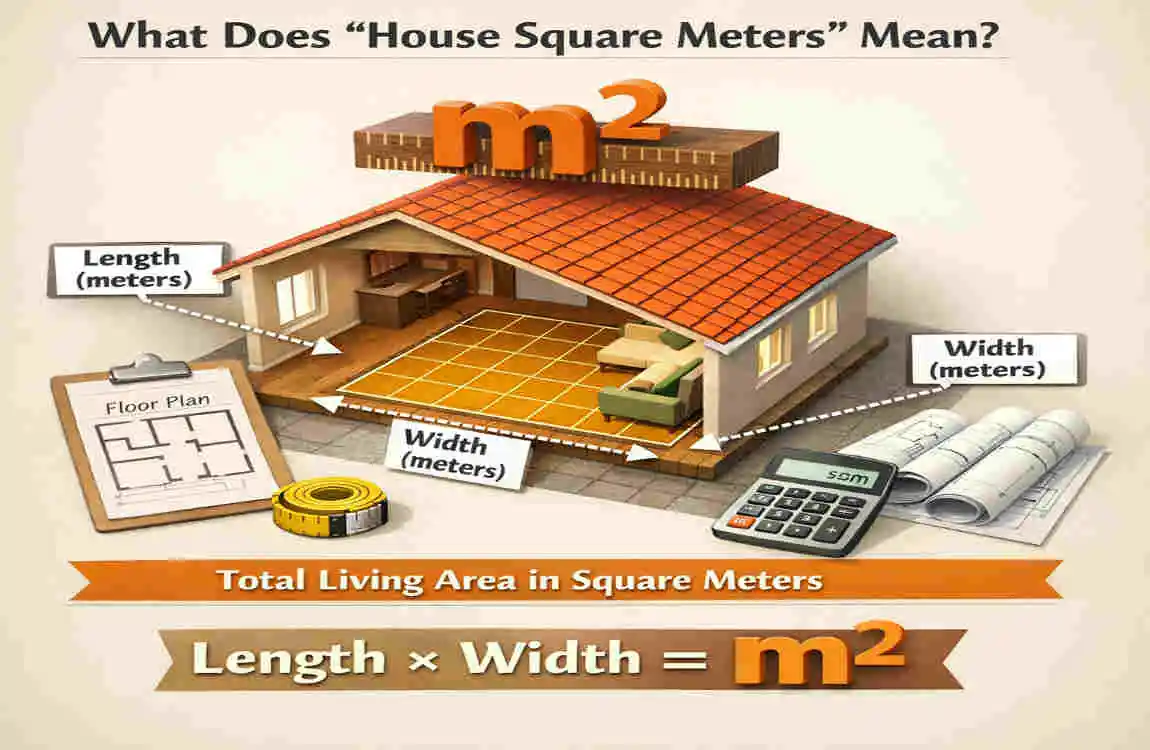
A square meter is a unit of area. It tells you how much flat space something covers. The basic formula is simple:
Length × Width = Area
So, if a room is 5 meters long and 4 meters wide, the area is:
5 × 4 = 20 m²
That means the room covers 20 square meters.
When you calculate home area in meters, you are measuring the surface space of rooms, floors, or the whole house.
Difference Between Square Meters and Linear Meters
People often mix these up.
- Linear meters measure length only
- Square meters measure area
For example, a wall that is 6 meters long is measured in linear meters. But a room that is 6 meters long and 4 meters wide is measured in square meters.
Why Real Estate Uses Square Meters
Most property listings use square meters because it provides a clearer idea of property size. It is a standard way to compare homes.
In some places, square feet are used instead. That is why it helps to understand both.
Tools You Need Before Measuring a House
If you want to learn how to calculate house square meters, you should start with the right tools.
Basic Measuring Tools
You only need a few simple items:
- Tape measure
- Laser distance meter
- Calculator
- Notebook
- Graph paper
These tools help you measure each room and record the numbers clearly.
Optional Advanced Tools
If you want faster or more detailed results, you can also use:
- Floor plan software
- Digital measuring apps
- Drone mapping for very large homes
For most homes, a tape measure or laser tool is enough.
Step-by-Step Process: How to Calculate House Square Meters
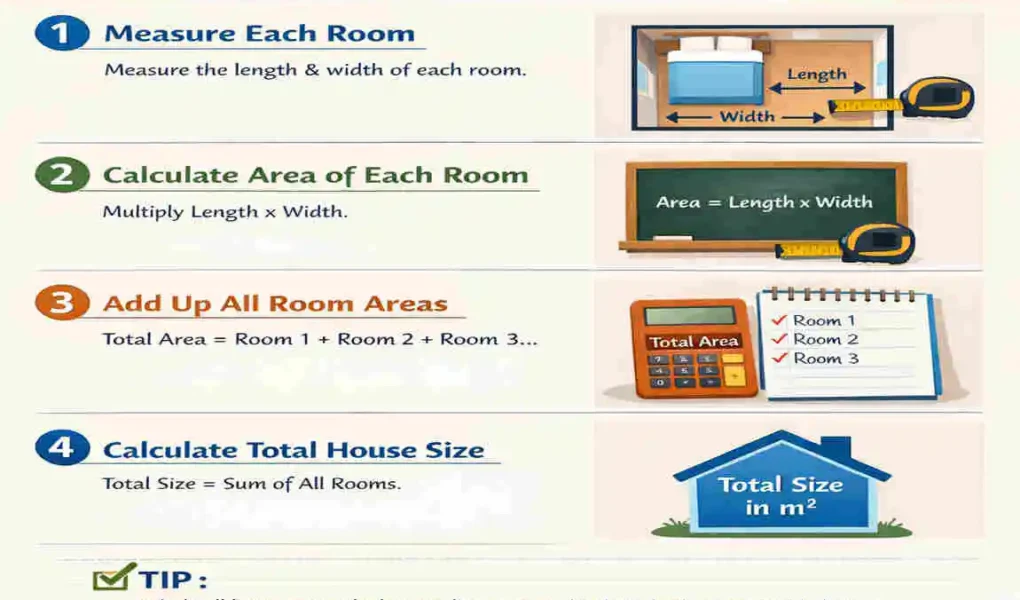
Measure Each Room’s Length and Width
Start with one room at a time—measure from wall to wall, not from baseboard to baseboard. Write the numbers in meters.
Be careful and take your time. If the room is not a perfect rectangle, measure the main sections separately.
Apply the Formula
Now use this formula:
Length × Width = Area in Square Meters
For example:
- Length = 5 meters
- Width = 4 meters
So:
5 × 4 = 20 m²
That room is 20 square meters.
This is the core idea behind calculating house square meters. Once you understand this, the rest becomes easier.
Repeat for Every Room
Do the same for all rooms in the house:
- Bedrooms
- Kitchen
- Bathrooms
- Living room
- Hallways
- Closets
Each room may have a different shape and size. Measure them one by one and write everything down.
Add All Room Areas
After measuring each room, add the areas together.
For example:
Room Size Area
Bedroom 4 m × 3 m 12 m²
Kitchen 5 m × 2 m 10 m²
Living room 6 m × 4 m 24 m²
Bathroom 2 m × 2 m 4 m²
Total = 50 m²
That gives you the total living area.
Exclude Non-Livable Spaces if Needed
Some spaces may not count toward the total house size, depending on local rules or the reason you are measuring.
These may include:
- Garages
- Open balconies
- Storage sheds
- Outdoor patios
Always check what should be included before making final calculations.
Double Check Accuracy
Before you finish, measure again.
This is important because small mistakes can change the final number. Check corners, odd angles, and any walls that are not straight. If you want to be extra careful, repeat the full how to calculate house square meters process once more.
How to Calculate Square Meters for Irregular-Shaped Rooms
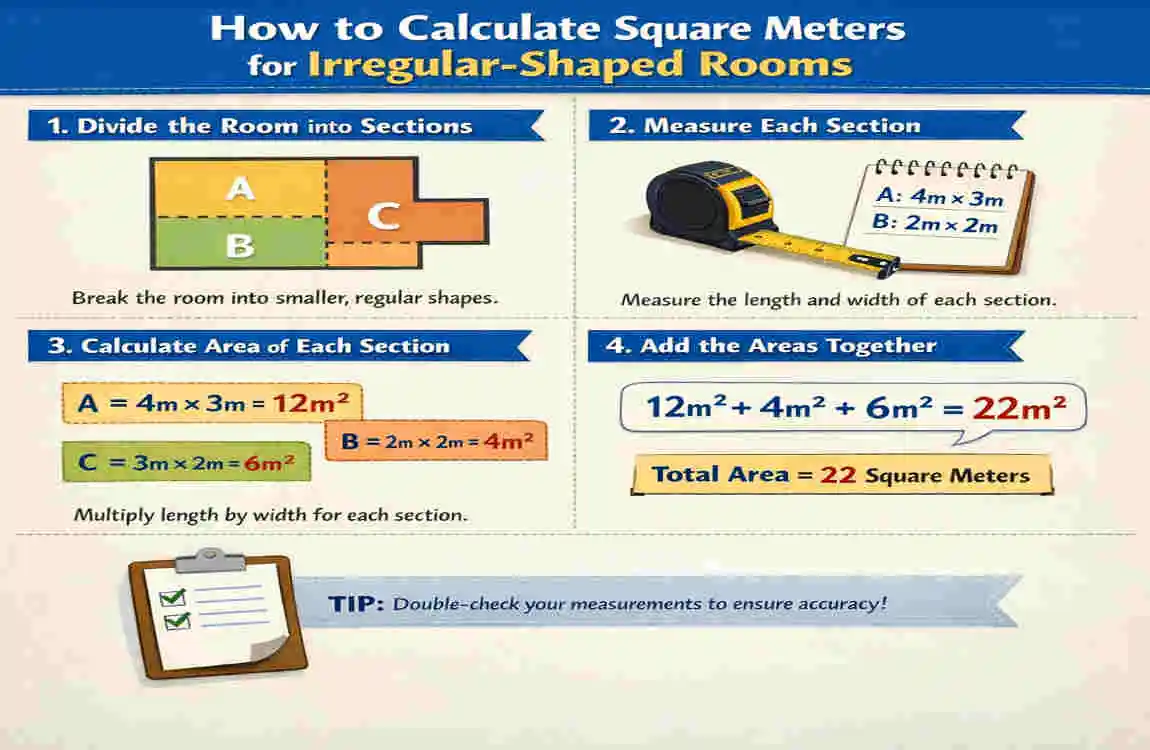
Not every room is a simple box. Some rooms have corners, cut-outs, or L-shapes. That does not make the job hard. You need to split the room into smaller shapes.
Divide the Room into Shapes
Break the room into:
- Rectangles
- Squares
- Triangles
Calculate Each Section Separately
Measure each part separately, then add the results together.
For example, if an L-shaped room can be split into two rectangles, calculate both areas and combine them.
Example Walkthrough
Let’s say one part is 4 m × 3 m = 12 m²
The second part is 2 m × 3 m = 6 m²
Total area:
12 + 6 = 18 m²
This method makes irregular room measurement much easier.
How to Measure Multi-Story Houses Correctly
If your home has more than one floor, you need to measure each level separately.
Calculate Each Floor Separately
Measure:
- Ground floor
- First floor
- Basement, if it is livable
- Attic, if it is used as living space
Combine All Levels
After measuring each floor, add them together for the total house area.
Staircases and Shared Spaces
Stairs may or may not be included, depending on the measurement standard used. Shared spaces can also be counted differently. If you are measuring for legal or sale purposes, it is best to check local rules.
Square Meters vs Square Feet: Understanding the Difference
Why Some Countries Use Square Feet
Different countries use different systems. Some real estate markets prefer square feet, while others use square meters.
Conversion Formula
Here is the simple conversion:
1 square meter = 10.764 square feet
Quick Example
If a home is 100 m², then:
100 × 10.764 = 1,076.4 sq ft
Square MetersSquare Feet
50 m² 538.2 sq ft
100 m² 1,076.4 sq ft
150 m² 1,614.6 sq ft
Knowing this helps with the square meters-to-square feet conversion and makes house-size conversions easier.
Common Mistakes When Calculating House Square Meters
Even simple measuring can go wrong. Here are some mistakes to avoid:
- Measuring from baseboards instead of walls
- Forgetting closets or hallways
- Including non-livable space by mistake
- Ignoring odd corners or angled walls
- Mixing feet and meters
These errors can significantly change your final number. Stay organized and write everything down clearly.
Benefits of Knowing Accurate House Square Meters
Measuring your home correctly gives you real value.
Better Property Valuation
If you know the exact size, you can price or compare the home more fairly.
Easier Renovation Budgeting
You can estimate materials and labor more accurately.
Accurate Flooring Orders
Knowing the area helps you buy the right amount of flooring, tiles, or carpet.
Furniture Planning
It is easier to choose furniture that fits well in each room.
Insurance and Legal Documentation
Accurate measurements can help with records, insurance, and legal property documents.
When to Hire a Professional for House Measurement
Sometimes, it is better to call an expert.
Large Luxury Homes
Big homes often have many rooms and complex layouts.
Complex Floor Plans
If the design is unusual, a professional can measure it more accurately.
Commercial or Mixed-Use Property
These properties often need special measurement rules.
Legal Property Verification
If the measurement is for sale, tax, or legal use, a surveyor or architect is a smart choice.
Helpful Digital Tools to Calculate House Square Meters
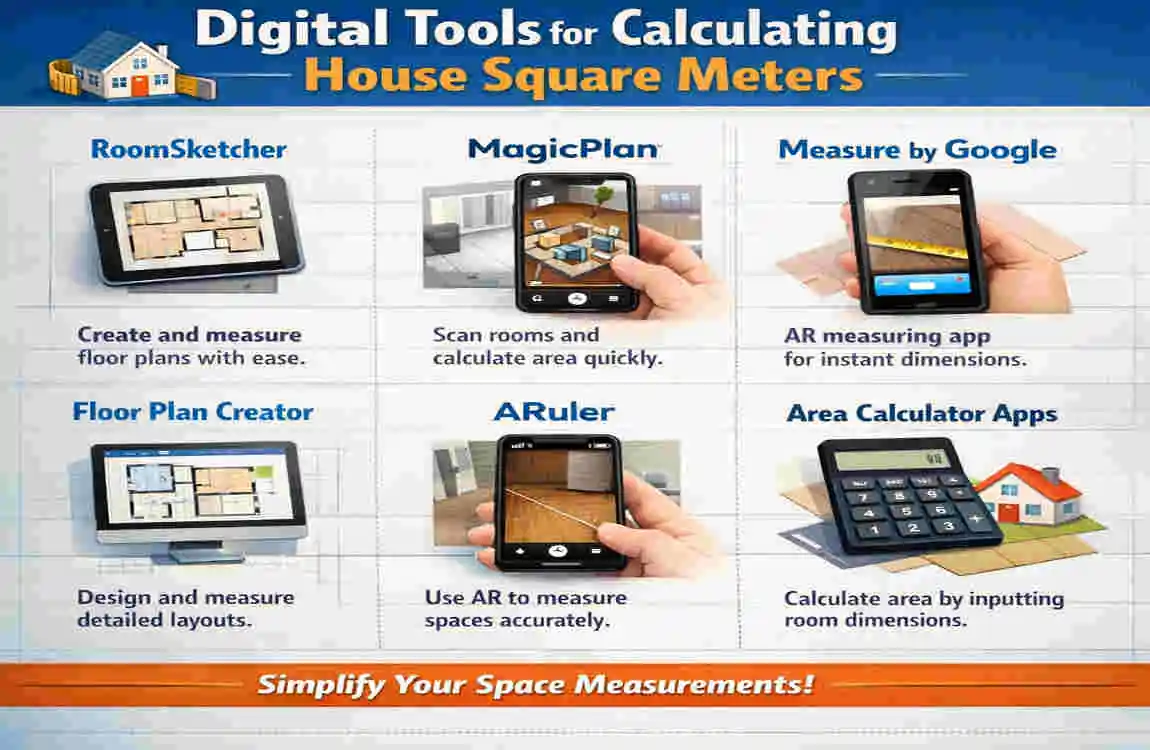
Today, many tools make measuring easier.
Useful Options
- Laser measuring devices
- Floor planner apps
- Property measurement software
- Smart home mapping apps
Pros and Cons
Digital tools are fast and convenient. But they can still make mistakes if the room is unusual or the app is not used correctly. That is why it is good to double-check by hand.
FAQs
How do I manually calculate the square meters of a house?
Measure each room’s length and width in meters, multiply them, then add all the room areas together.
Do closets count in total square meters?
Usually, yes, if they are inside the livable part of the house. But rules can vary.
Is balcony space included in house square meters?
Sometimes no, especially if the balcony is open. It depends on the local measurement standard.
How accurate are mobile measuring apps?
They can be helpful, but they are not perfect. Always verify important numbers with a tape measure or laser tool.
What is the easiest way to measure a house?
The easiest way is to measure one room at a time, write the results clearly, and use the formula length × width.
Can I convert square feet into square meters?
Yes. Divide square feet by 10.764 to get square meters.