Are you dreaming of transforming your outdated home into a modern masterpiece, but you are worried about completely breaking the bank? You are definitely not alone. When you decide to renovate a house, it can easily feel like a massive mountain to climb. The good news is that home renovations absolutely do not have to be overwhelming or shockingly expensive.
With a little bit of creativity and some strategic planning, you can create a beautiful living space on a realistic budget. Smart home renovations can boost your overall property value by up to 70 percent. It is true! You can dramatically improve your living space and build lasting wealth at the exact same time.
Why Renovate a House on a Budget? Key Benefits and Common Pitfalls

Before we dive into the juicy tips, let us take a moment to talk about the “why” behind your project. Why do so many people look for an affordable house renovation instead of just buying a brand-new home?
The Amazing Benefits of Budget Renovations
First and foremost, renovating your current home is almost always cheaper than moving. When you factor in closing costs, real estate agent fees, and moving expenses, staying put and updating your space makes a lot of financial sense.
Additionally, an affordable house renovation allows you to completely customize your living environment. You get to choose the exact paint colors, the specific flooring, and the layout that perfectly matches your family’s unique lifestyle. For those who love DIY house flips, budget renovations are the ultimate way to force appreciation and build massive equity in a property.
Watch Out for These Common Pitfalls
However, renovating on a budget is not without its challenges. The biggest pitfall that homeowners face is simple overspending. It is incredibly easy to get caught up in the excitement and start adding Premium upgrades that you do not really need.
Another major trap is poor planning. If you start swinging a sledgehammer before you have a clear blueprint, you will likely end up paying for costly mistakes. You might tear down a wall that hides important plumbing, or you might order the wrong size cabinets.
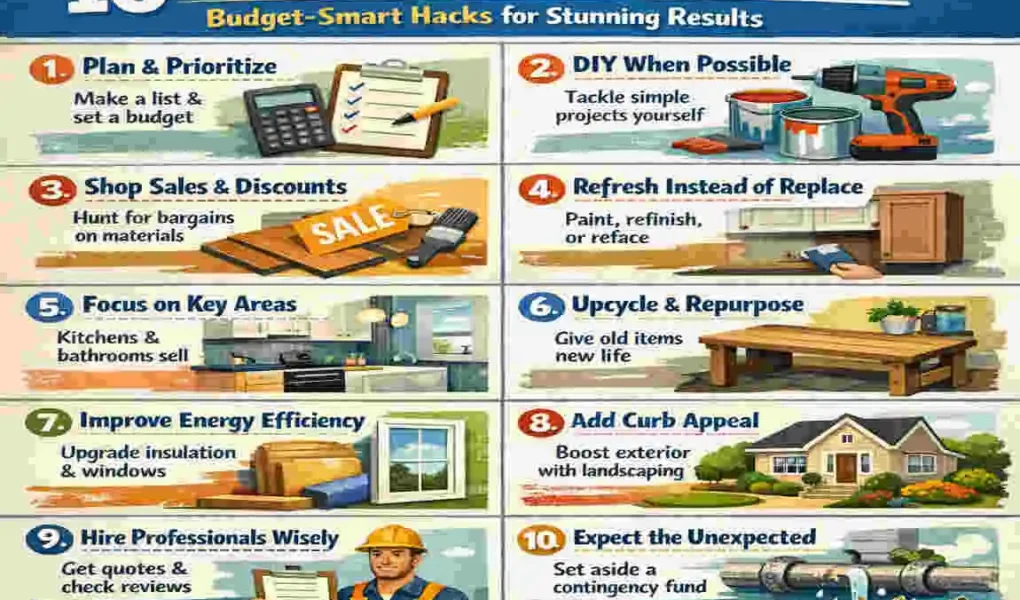
Do not worry, though! These 10 tips will ensure your plan to renovate a house shines brilliantly while keeping your wallet happy and full.
plan Your House Renovation Like a Pro – Start with a Realistic Budget
If you want to succeed, you must plan your house renovation with the precision of a professional project manager. Everything begins and ends with your budget. If you do not know how much money you have to spend, you will inevitably spend too much.
Step-by-Step Budgeting Guide
Start by sitting down and figuring out exactly how much cash you have readily available for this project. Once you have a firm number, you need to track every single projected cost. You can use simple digital tools, spreadsheets, or home management apps to keep your numbers organized.
Write down every single item you will need. This includes materials, tools, permit fees, and labor costs. Be as detailed as humanly possible.
The Ultimate Budget Hack: The Contingency Fund
Here is a massive hack that will save your sanity: always allocate a 10 to 20 percent contingency fund.
When you renovate a house, surprises will always pop up. You might pull up old carpet and find rotting wood underneath. You might open a wall and discover faulty electrical wiring. Your contingency fund acts as a financial safety net so these surprises do not derail your entire project.
Sample Budget Table for a $20,000 Kitchen Reno
To help you visualize this, let us look at a sample budget breakdown for a $20,000 kitchen renovation.
Renovation Category Percentage of Budget Estimated Cost
Cabinets and Hardware 30% $6,000
Installation and Labor 20% $4,000
Appliances and Ventilation 15% $3,000
Countertops 10% $2,000
Flooring 7% $1,400
Lighting and Electrical 5% $1,000
Unexpected Contingency 13% $2,600
As you can see in this table, the contingency fund is built right into the initial plan. If you follow this structure, you will stay in total control of your finances.
Prioritize High-Impact, Low-Cost Updates to Renovate a House

When you are working with limited funds, you need to focus on updates that give you the biggest bang for your buck. You want to look for quick house renovation ideas that completely change the feel of a room without draining your bank account.
Focus on True ROI Areas
Your return on investment (ROI) should guide your decisions. Paint is arguably the most powerful tool in your renovation arsenal. A fresh coat of crisp, bright paint can make a dark, dingy room look brand new. It instantly makes spaces feel larger and cleaner.
Do not forget about your lighting! Swapping out old, dusty ceiling fans or builder-grade dome lights for modern fixtures will completely modernize your home.
Similarly, updating the hardware on your doors and cabinets is incredibly cheap but highly effective. Swapping out shiny brass doorknobs for sleek, matte black levers takes just a few minutes but modernizes your home instantly.
The Peel-and-Stick Hack
Want a brilliant hack for your kitchen or bathroom? Try using DIY peel-and-stick backsplashes. Traditional tile requires messy thin-set mortar, specialized wet saws, and sticky grout.
Peel-and-stick tiles, on the other hand, require a pair of scissors and a little bit of patience. You can easily save hundreds of dollars on labor and materials, and modern vinyl tiles look remarkably like the real thing. Take a “before” photo, apply your new backsplash, and snap an “after” photo. You will be amazed by the dramatic transformation!
Master DIY Skills for Budget-Friendly House Renovation Wins
If you truly want to save money, you need to be willing to get your hands a little dirty. Mastering basic do-it-yourself (DIY) skills is the fastest way to slash your renovation bill. When you DIY to renovate a house, you are paying for materials, but you get to keep the labor costs right in your own pocket.
Start with Beginner Tutorials
You do not need to be a master carpenter to make a difference. Start with beginner-friendly tasks.
For example, doing your own demolition is a fantastic way to save cash. Tearing down non-load-bearing walls, ripping up old carpet, and hauling away trash are tasks that require zero technical skill. You need a little bit of elbow grease and a good pair of safety glasses.
Installing click-lock luxury vinyl plank flooring is another incredibly easy DIY project. The planks snap together, and you can transform an entire living room in a single weekend.
The Free Education Hack
Here is a money-saving hack: skip the expensive contracting classes and utilize free video tutorials. There are thousands of professional contractors who share their secrets online for absolutely free. By learning from these visual guides, you can save up to 40 percent on your total project costs simply by not hiring outside professionals.
The Essential DIY Tool List Under $200
You do not need a garage full of expensive power tools to get started. Here is a list of essential tools you can buy for under $200 total:
- A high-quality tape measure (Accuracy is everything).
- A sturdy claw hammer (For demolition and driving nails).
- A reliable utility knife (For cutting drywall and opening boxes).
- An entry-level cordless drill (Your best friend for assembling anything).
- A heavy-duty pry bar (Essential for removing baseboards safely).
- Safety gear (Goggles, thick gloves, and dust masks).
Source Affordable Materials Without Sacrificing Quality
One of the biggest expenses when you renovate a house is the cost of building materials. However, you do not have to buy everything brand new from an expensive retail store. With a little bit of hunting, you can find high-quality items for a fraction of the original price.
Where to Shop for Bargains
Step away from the shiny big-box hardware stores and start looking at local alternatives. Places like architectural salvage yards and charity-run home improvement stores are absolute goldmines. People donate perfectly good cabinets, doors, and light fixtures that you can buy for pennies on the dollar.
You should also become a daily checker of online community marketplaces. Homeowners frequently order too much tile or flooring for their own projects and sell the excess online at steep discounts to get it out of their garages.
The Countertop Remnant Hack
If you are updating a small kitchen island or a bathroom vanity, never buy a full slab of quartz or granite! Instead, ask local stone fabricators if you can buy their “remnants.”
Remnants are the leftover pieces from larger kitchen jobs. Fabricators want to get rid of these pieces, so they will often sell them to you for 50 percent off the standard retail price. It is the exact same luxury stone, just beautifully discounted.
Big-Box Retail vs. Salvage Prices
Let us look at a quick comparison table to show you just how much money you can save by shopping smart.
Material Type Average Big-Box Price Average Salvage Price Estimated Savings
Solid Wood Interior Door $150 – $250 $30 – $50 80% Savings
Chandelier/Light Fixture $100 – $300 $15 – $40 85% Savings
Box of Subway Tile $45 – $60 $10 – $20 70% Savings
Kitchen Sink (Stainless) $150 – $400 $25 – $75 80% Savings
By sourcing your materials creatively, you can stretch your renovation budget further than you ever thought possible!
Refresh Your Kitchen on a Shoestring – Core of Any House Renovation
Real estate experts will always tell you that kitchens sell houses. The kitchen is the beating heart of your home, and it is usually the core focus of any plan to renovate a house. However, completely gutting a kitchen and starting from scratch can easily cost tens of thousands of dollars. Luckily, there are highly effective budget ways to renovate a house’s kitchen.
Cabinet Refacing Over Complete Replacement
Brand-new kitchen cabinets are absurdly expensive. If your current cabinet boxes are structurally sound, do not throw them in the dumpster! Instead, consider refacing them or simply painting them.
Refacing involves keeping the cabinet frames but ordering brand-new doors and drawer fronts. This gives you a completely fresh, modern look for about half the cost of new cabinets.
If you want an even cheaper option, clean your existing wooden cabinets thoroughly, sand them down, and apply a high-quality primer and cabinet-grade paint. A fresh coat of navy blue or crisp white paint will completely revolutionize your kitchen space over a single weekend.
The Open Shelving Illusion Hack
Do you have a small, cramped kitchen? Upper cabinets can make a small space feel completely claustrophobic.
Here is a fantastic, cheap hack: remove one or two of your upper cabinet doors to create an open shelving illusion. You can paint the inside of the cabinet a fun accent color to make your dishes pop.
Alternatively, you can take the upper cabinets down entirely and install heavy-duty, rustic wooden planks on metal wall brackets. You can buy beautiful, sturdy brackets for around $30. Open shelving makes your kitchen feel larger, airier, and significantly more modern—all for just a few dollars.
Transform Bathrooms Efficiently During Your House Project
Next to the kitchen, the bathroom is the most important room to update. When you tackle your renovation project, you want to approach bathrooms with extreme caution. Moving plumbing pipes or rewiring electrical fixtures behind tiled walls will drain your budget in the blink of an eye.
Focus on Quick, Surface-Level Fixes
The secret to an affordable bathroom renovation is to leave the layout exactly as it is. Focus your energy and your budget on surface-level quick fixes that make the room feel clean and inviting.
Start by replacing the main fixtures. A shiny new bathroom faucet, a modern showerhead, and a matching towel ring can make a surprisingly big difference.
Never underestimate the power of fresh caulking! Over time, the caulk around your bathtub and sink turns yellow and cracked. Scraping out the old, gross caulk and running a crisp, bright white line of new silicone caulk instantly makes the entire bathroom feel much more sanitary.
The Acrylic Tub Overlay Hack
What if your bathtub is an ugly shade of 1970s avocado green or deeply stained? Replacing a bathtub is a massive headache that involves ripping up floor tiles and wall tiles.
Instead of replacing the tub, use the acrylic overlay hack. You can hire a specialized company to come in and install a custom-fitted acrylic liner right over your existing bathtub.
Alternatively, you can buy a DIY tub and tile refinishing kit for well under $100. These epoxy paints allow you to roll a brilliant white finish directly over your old, ugly tub. It takes a weekend to cure, and the results are incredibly smooth and glossy!
Boost Curb Appeal Cheaply – First Impressions for House Renovation
You can have the most beautiful interior in the world, but if the outside of your house looks terrible, nobody will want to step inside. Curb appeal is all about creating a stunning first impression. Luckily, boosting your home’s exterior is one of the cheapest parts of any house renovation.
Simple Landscaping Hacks
You do not need to hire a professional landscape architect to make your yard look amazing. Start by cleaning up what you already have. Trim back overgrown bushes that are blocking your windows. Pull the pesky weeds out of your flower beds.
The most cost-effective landscaping hack is laying down fresh mulch. A few bags of dark, rich wood mulch will instantly make your garden beds look manicured and professionally maintained.
Next, add some exterior lighting. You do not need to wire expensive electrical lamps. Buy a multi-pack of solar-powered pathway lights and stick them into the ground leading up to your front porch. They charge during the day and provide a warm, welcoming glow every single night.
The Front Door Value Hack
Here is a secret that real estate agents swear by: painting your front door is the highest ROI task you can do.
Choose a bold, inviting color that contrasts beautifully with your home’s siding. Think about a rich navy blue, a vibrant classic red, or a cheerful yellow. A single can of exterior paint costs very little, but studies show that a freshly painted, visually striking front door can increase a buyer’s perceived value of your home by up to 200 percent!
Energy-Efficient Upgrades That Pay Off in Your House Renovation
When you renovate a house, you should not just think about how the home looks. You also need to think about how the home functions. Sustainable, energy-efficient upgrades are brilliant because they actually put money back into your pocket every single month by lowering your utility bills.
Easy LED Swaps and Insulation Upgrades
One of the easiest sustainable house renovation tips is to walk through your entire home and swap out every single old incandescent lightbulb. Replace them with energy-efficient LED bulbs. LEDs use a fraction of the electricity and last for years, meaning you will not be climbing on a ladder to change them anytime soon.
Another highly impactful area is your attic insulation. Heat naturally rises, which means in the winter, your expensive heating is escaping right through your roof. Renting a machine to blow in some extra fiberglass or cellulose insulation into your attic is a moderately cheap DIY project that pays for itself in just one or two cold seasons.
The Weather stripping Hack
Do you ever feel a cold breeze blowing in, even when your windows and doors are firmly shut? That is your hard-earned money blowing right out the door.
Here is a $20 hack with massive returns: buy a few rolls of foam weatherstripping. Take a weekend afternoon to carefully seal the gaps around your doors and your older window frames.
By simply blocking these drafts, you force your heating and air conditioning units to work much less. This tiny investment provides an incredible ROI, often paying for itself in lower energy bills within just a couple of months.
Smart Staging Tricks Post-Renovation for Maximum Impact
Once you have finished the hard work of your renovation, the project is still not completely over. How you present your newly updated home matters immensely, especially if you are planning to sell it or if you want to show it off to your jealous friends! Smart staging highlights all the hard work you just completed.
The Power of Decluttering and Neutral Tones
The golden rule of staging is to declutter aggressively. When a room is packed with personal knick-knacks, oversized furniture, and messy piles, people cannot see the beautiful renovation you just did. They only see the mess. Clear off your newly installed kitchen counters completely. Remove half the clothes from your closets to make them look spacious.
Additionally, stick to neutral tones for your decor. While you might love neon green pillows, a neutral palette of soft whites, grays, and warm beiges helps spaces feel much more open, calm, and universally appealing.
The Furniture Rental Hack
If you are a house flipper trying to sell an empty, newly renovated home, here is a brilliant hack: do not sell it empty. Empty rooms actually look much smaller than furnished rooms because the human eye has no point of reference.
Instead of buying expensive furniture just for photos, rent it! You can rent a stylish sofa, a modern rug, and a glass coffee table for a very reasonable monthly fee. Taking listing photos with rented furniture makes the home look lived-in and luxurious, helping you sell the house significantly faster.
Hire Wisely and Avoid Costly Mistakes When You Renovate a House
While we have talked a lot about DIY projects, the reality is that some jobs require professional help. You should never mess with your main electrical panel or attempt complex plumbing reroutes unless you are licensed. When you do need to hire contractors to help renovate a house, you must do it wisely.
How to Vet Contractors Properly
Never hire the first person you find in the phone book. You need to vet your contractors thoroughly.
Always ask for references and take the time actually to call those past clients. Ask them if the contractor showed up on time, if they stayed on budget, and if the final work held up well.
The golden rule of hiring is to get at least three written quotes from three different companies. This gives you a clear understanding of the true market rate for your specific project. If one quote is shockingly lower than the others, that is usually a major red flag that they cut corners or use terrible materials.
The Fixed-Price Contract Hack
Here is a hack to protect your wallet: always insist on a fixed-price contract.
Some contractors prefer to work on a “time and materials” basis. This means if they work slowly, you pay them more! With a fixed-price contract, the contractor agrees to complete the specific job for one set amount of money. If they take three days longer than expected, that is their problem, not your financial burden.
Always put everything in writing, including the payment schedule, and never pay the full amount upfront before the work is actually completed to your satisfaction.
Common Mistakes to Avoid in Budget House Renovations

Even with the best intentions, things can easily go wrong. To keep your project running smoothly, make sure you avoid these common, expensive pitfalls:
- Skipping the necessary permits: It might seem like a hassle, but if the city catches you renovating without a permit, they can force you to tear down your beautiful new work and hit you with massive fines.
- Buying cheap, low-quality paint: Budget renovations are great, but cheap paint requires four coats to cover a wall and chips easily. Spend a few extra dollars on high-quality paint; it saves you time and looks vastly better.
- Changing your mind mid-project: Every time you change your mind after the work has started (known as scope creep), you add massive delays and high change-order fees to your bill. Stick to your original plan!
- Ignoring the home’s original style: If you put an ultra-modern, glossy kitchen inside a historic, 1920s craftsman home, it will look completely out of place and hurt your resale value.
- Ordering materials too late: Supply chain delays happen constantly. If your tile does not arrive on time, your contractor cannot work, but they might still charge you for the delay. Order everything before demolition begins!
Renovate a House: Your Next Steps and Tools Checklist

You are now armed with the knowledge to pull off an incredible, budget-friendly home transformation! It is time to stop dreaming and start doing.
To help you get started right away, here is an actionable checklist for your next steps:
- Define your absolute maximum budget (and set aside that 20% contingency).
- Make a list of priorities (focusing on high-ROI items like paint and curb appeal).
- Audit your current tools and buy the basic essentials.
- Start scouting local salvage yards and online marketplaces for material deals.
- Watch three DIY tutorial videos for your first simple project.
Do you want to keep this information handy? Make sure to bookmark this page and start drafting your master plan today. With a little bit of sweat equity and these smart hacks, your dream home is well within your reach!
Frequently Asked Questions (FAQs) About How to Renovate a House on a Budget
How much does it really cost to renovate a house? The total cost depends entirely on the size of your home and the scope of your projects. A light cosmetic update (paint, new fixtures, landscaping) can cost as little as $5,000 to $10,000. A full gut renovation can easily exceed $100,000. By using the budget hacks mentioned above, like DIY labor and salvaged materials, you can often cut traditional contracting estimates completely in half.
Can I renovate a house myself? Yes, you absolutely can! Most cosmetic renovations, such as painting, laying vinyl flooring, installing baseboards, and upgrading cabinet hardware, are incredibly beginner-friendly. However, you should always hire licensed professionals for structural changes, major plumbing, and complex electrical work to ensure your home remains safe and up to code.
Which room should I renovate first to get the best return? The kitchen almost always provides the highest return on investment. Buyers care deeply about kitchens and bathrooms. If you are on a strict budget, start by giving your kitchen a facelift with painted cabinets, new hardware, and a peel-and-stick backsplash.
How can I finance a house renovation if I do not have cash? If you do not have liquid cash, you can explore options like a Home Equity Line of Credit (HELOC), a home equity loan, or a specialized renovation mortgage. However, borrowing money adds interest to your total cost, so it is highly recommended to save up cash and tackle your renovation one room at a time as you can afford it.
Is it actually cheaper to renovate a house or buy a new one? In almost all real estate markets, renovating your current home is significantly cheaper than buying a new one. When you buy a new house, you lose thousands of dollars to real estate commissions, closing costs, loan origination fees, and moving trucks. Putting that same money directly into your current home builds your personal equity instead of giving it to someone else.