Have you ever stood in your driveway, looked up at your roof, and wondered, “How tall is a standard 2-story house, actually?”
Maybe you are planning to paint the exterior yourself and need to know what size ladder to buy. You may be an aspiring homeowner in Lahore looking to build your dream villa in DHA and need to understand the local building codes. Or you may be curious about how your home stacks up against the neighbours.
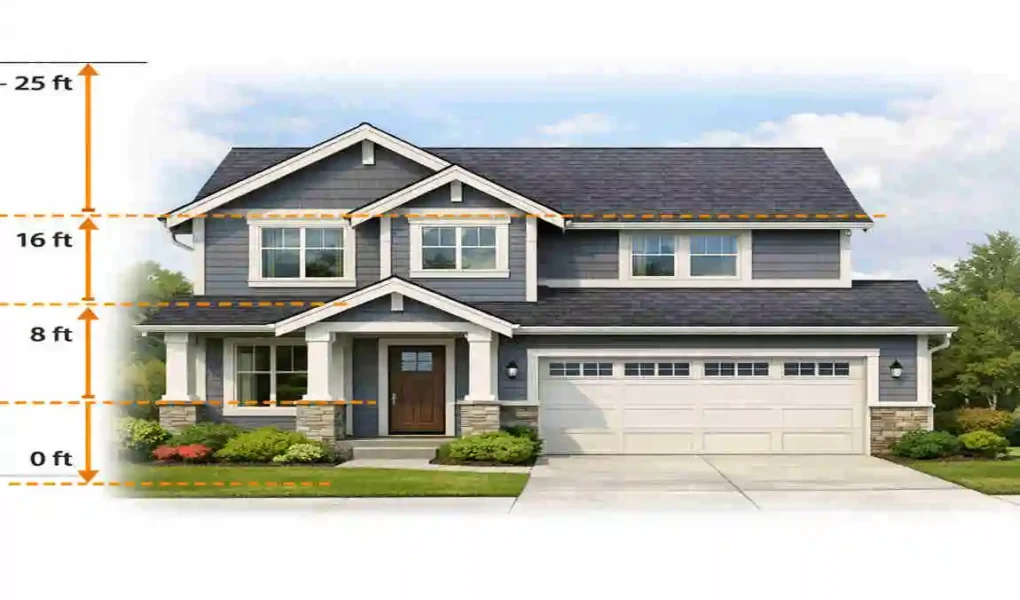
Here is the quick answer to satisfy your curiosity right now: A standard 2-story house is typically between 20 and 25 feet tall at the eaves (where the gutters are) and can reach 30 to 35 feet at the peak of the roof. In metric terms, that is roughly 6 to 10.5 meters high.
However, if you are planning a renovation, installing solar panels, or dealing with property laws in places like Pakistan, “roughly” isn’t good enough. You need specifics.
How Tall Is a Standard 2-Story House? Core Dimensions Explained
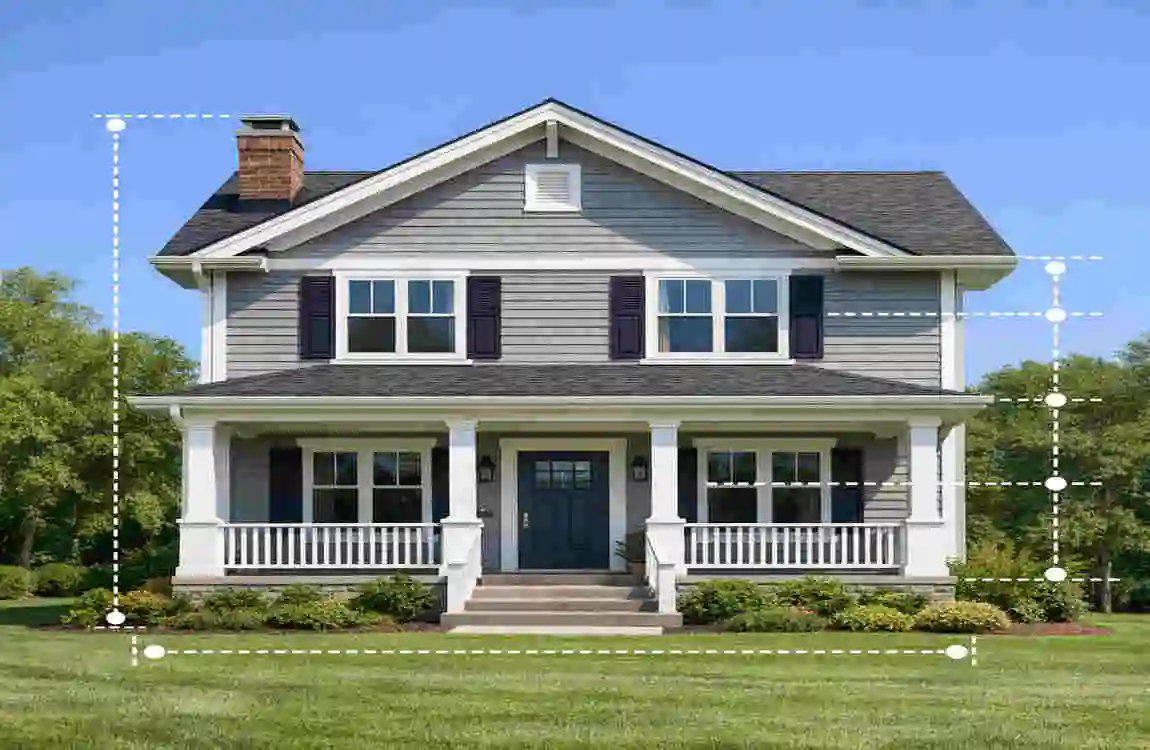
When we ask how tall a standard 2-story house is, we have to define what we mean by ‘tall.’ Are we talking about the height of the window on the second floor? The height to the gutter? Or the very tip of the roof?
To understand the total height, think of a house as a layer cake. Each layer adds to the total. Generally, modern homes are getting taller as high ceilings have become a symbol of luxury.
The Breakdown of Height
Let’s dissect the vertical anatomy of a typical home.
- The Foundation: This is the base. Depending on where you live, this could be a flat slab on the ground (adding only 6 inches) or a raised crawlspace (adding 2 to 3 feet).
- First Floor Ceiling Height: In older homes, this was standard at 8 feet. In newer constructions, especially in upscale areas, 9 or 10 feet is becoming the new normal.
- The Floor Structure (Joists): Between the ceiling of the first floor and the carpet of the second floor, there is a structural layer. This includes pipes, wires, and wood or concrete beams. This usually adds about 1 to 2 feet.
- Second Floor Ceiling Height: Usually, this matches the first floor, standing at 8 to 9 feet.
- The Roof System: This is the wildcard. A flat roof might only add 1 foot, while a steep, cathedral-style roof can add 10 to 15 feet or more.
Height Comparison Table
To make this easier to visualise, here is a breakdown comparing a standard US home, a Metric standard, and a typical home in Pakistan.
Measurement PointUS/Standard (ft)Metric (m)Pakistan Avg (ft)
Foundation/Plinth 1 – 2 ft 0.3 – 0.6 m 2 – 3 ft
First Floor Height 8 – 10 ft 2.4 – 3.0 m 10 – 11 ft
Floor Structure 1 – 1.5 ft 0.3 – 0.5 m 0.5 – 1 ft (RCC Slab)
Second Floor Height 8 – 9 ft 2.4 – 2.7 m 10 – 11 ft
Total Eave Height 20 – 25 ft 6.0 – 7.6 m 22 – 26 ft
Roof Peak Total 25 – 35 ft 7.6 – 10.7 m 28 – 32 ft
As you can see, the eave height (the height of the walls before the roof starts) is relatively consistent. The significant variation usually comes from the roof’s style.
Factors Affecting 2-Story House Height: What Changes the Numbers?
You might look at two houses on the same street that are both “two stories,” yet one towers over the other. Why is that? The answer to how tall a standard 2-story house is depends on four main variables.
Roof Pitch and Style
This is the biggest factor. The “pitch” refers to the slope of the roof.
- Flat Roofs: Common in modern architecture and very common in Pakistan for utilising roof space. These homes are shorter, usually topping out around 22-25 feet.
- Gable Roofs: These are the classic triangular roofs. A steep pitch helps shed snow and rain but adds significant height. A high-pitched gable roof can easily make a house 30 to 35 feet tall.
- Hip Roofs: These slope on all four sides and are generally aerodynamic, but can still add 6-8 feet to the total height.
Ceiling Height Preferences
Decades ago, an 8-foot ceiling was standard to save on heating costs. Today, open-plan living dictates higher ceilings. If a builder decides to put 10-foot ceilings on both the first and second floors, that house is instantly 4 feet taller than a standard older home, even before you look at the roof. In luxury villas in Lahore’s DHA Phase 6 or 7, 11-foot ceilings are quite common to keep the home cool during summer.
Foundation Type
A house built on a concrete slab sits almost level with the grass. A house built over a basement or a crawlspace needs to be raised. In flood-prone areas, you might see houses raised on stilts or on high foundations, which add to the overall measurement but not to the living space.
The “Attic” Factor
Does the house have a usable attic? If the roof is designed to house a third living space or storage area (a loft), the roof pitch must be steeper to allow a person to stand up inside. This raises the roof’s peak.
Regional Variations: How Tall Is a Standard 2-Story House Worldwide?
Construction practices vary across cultures, climates, and available materials. Let’s take a trip around the world to see how height standards differ.
The United States Standard
In the US, wood framing is king. The International Residential Code (IRC) dictates safety, but style dictates height. The average suburban American 2-story home usually falls in the 26 to 30-foot range. Because snow is a factor in many states, roofs tend to be pitched (sloped) rather than flat.
UK and Europe
In the UK, homes are often older or built to blend in with historical architecture. You will find that standard 2-story semi-detached houses are slightly more compact vertically, often sitting around 24 to 28 feet. They measure strictly in meters, aiming for roughly 5 meters to the eaves and 8 meters to the ridge.
Pakistan and Lahore Context
If you are reading this from Pakistan, the construction style is totally different. Here, we use Brick and RCC (Reinforced Cement Concrete).
- The Climate Factor: In Punjab, the heat is intense. High ceilings (10-12 feet) are preferred because they allow hot air to rise, keeping the living level cooler.
- The Roof Factor: Flat roofs are the norm. We use our roofs for evening walks, drying clothes, or storing water. Therefore, a typical 2-story house in Lahore might have taller walls (eaves) but a shorter total height because there is no triangular attic on top.
- The Mumty: However, we do have the “Mumty” (the stair tower leading to the roof). This small room often pushes the structure’s maximum height to 30+ feet.
Regional Height Comparison Table:
RegionAvg Total Height (ft)Dominant Feature
Lahore (DHA/Bahria) 28 – 32 ft High ceilings + Mumty
Karachi 26 – 30 ft Coastal wind considerations
US Suburbs 28 – 32 ft Steep-pitched roofs
UK / EU 24 – 28 ft Compact design
Lahore-Specific Guide: Standard 2-Story Heights Under Local Rules
For our readers in Lahore, understanding how tall a standard 2-story house is isn’t just about curiosity—it is about the law. The Lahore Development Authority (LDA) and private societies, such as DHA (Defence Housing Authority), have strict bylaws.
The 30-35 Foot Rule
Generally, for residential plots (such as 10 Marla or 1 Kanal), there is a height restriction to ensure privacy between neighbours. You cannot build a skyscraper next to a bungalow.
- Standard Limit: The permissible height for a residential building is typically capped at around 30 to 35 feet above the road level.
- Structure Breakdown:
- Plinth Level: Usually 2 to 3 feet above the road.
- Ground Floor: 10 to 11 feet clear height.
- First Floor: 10 to 11 feet clear height.
- Parapet Wall: The safety wall on the roof is usually 3 feet.
- Mumty: The stair cabin is allowed to go higher, but only covers a small area.
Why This Matters in Lahore
If you build higher than the approved plan, the authorities can demolish the unauthorised portion. When buying a house in Model Town or Johar Town, always check if the height complies with the completion certificate. A house that looks “too tall” might be legally compromised.
Measuring Your 2-Story House Height Accurately
Okay, you want to know the exact number for your house. Maybe you need to rent a scaffold or buy a ladder to clean the windows. How do you measure something that tall without falling off?
Here are three methods, ranging from easy to pro.
The Tape Measure & Window Trick (Easiest)
You likely have a 25-foot tape measure.
- Open a second-story window.
- Lower the tape measure until it touches the ground (or have a friend hold it there).
- Read the measurement at the window sill.
- Measure from the window sill up to the gutter/eave.
- Add the two numbers together. Result: This gives you the Eave Height.
The Brick Count (No Tools Needed)
If you have a brick house (common in Pakistan), this is surprisingly accurate.
- Measure the height of one brick plus the mortar gap (usually about 3 to 4 inches total).
- Go outside and count the number of bricks from the ground to the roof.
- Multiply the brick count by the height of one brick. Result: A very close estimate of your wall height.
The Shadow Math (High School Geometry)
On a sunny day, this works perfectly.
- Measure your own height (e.g., 6 feet).
- Measure the length of your shadow.
- Measure the length of the house’s shadow.
- Formula: (House Shadow ÷ Your Shadow) × Your Height = House Height.
Modern Apps
There are several apps like “Measure” on iPhone or “Google Earth Pro” on desktop. In Google Earth, you can use the 3D building tool to see the estimated elevation of the roof peak versus the ground level.
Why Height Matters for Homeowners: Practical Impacts
Why should you care how tall a standard 2-story house is? Aside from trivia, the height of your home impacts your wallet and your lifestyle in ways you might not expect.
Maintenance and Safety
If your eaves are 22 feet high, a standard 20-foot extension ladder will not reach them. You need a 28-foot extension ladder to safely reach the gutters, as the ladder must be angled. Knowing the height prevents you from buying useless equipment or, worse, falling because you tried to stretch too far.
Heating and Cooling Efficiency
Taller houses are more affected by the “Stack Effect.” Hot air rises. In a 30-foot-tall house, the second floor will be significantly hotter than the ground floor in the summer.
- In Lahore: This is why the top floors in June are ovens. Knowing your height helps you calculate the right tonnage for your Air Conditioner. A standard AC might struggle to push cool air down from a 12-foot ceiling.
Insurance Premiums
Believe it or not, some insurance companies factor in the roof’s height and complexity. A steep, 35-foot peak is harder to replace than a flat, 20-foot roof.
Solar Panel Efficiency
If you are installing solar, the installer needs to know the height. Taller houses often have better access to sunlight, free from the shade of trees or neighbouring fences. However, the installation cost might be higher because the crew needs safety harnesses and lifts to get the panels up 30 feet.
Customising Height: Building or Modifying a 2-Story House
If you are in the planning phase of building a home, you have choices to make. Should you go for a towering look or keep it low-profile?
The Cost of Height
Every vertical foot costs money.
- Materials: More bricks, more cement, more paint.
- Labour: scaffolding takes time to set up. Working at 25 feet is slower than working at 10 feet.
- Estimate: In the current market, adding an extra foot of ceiling height to a 10 Marla house can add Rs. 50,000 to Rs. 100,000 to your grey structure cost due to the extra steel and concrete required.
Aesthetics vs. Function
A taller house looks grander. It has “curb appeal.” A house with high ceilings feels spacious and luxurious. However, a lower-profile house is easier to heat in the winter and easier to maintain. You have to balance the “wow factor” with the “bill factor.”
Adding Height to an Existing Home
Can you make a house taller? Yes, but it is expensive. “Raising the roof” involves literally cutting the roof off, building new walls (knee walls), and putting the roof back on. This is common in loft conversions where homeowners want to turn an attic into a bedroom.
Story House Height Facts
Let’s clear up some common misconceptions about how tall a standard 2-story house is.
- Myth: All 2-story houses are exactly 20 feet tall.
- Fact: 20 feet is the bare minimum. Most are significantly taller due to the roof and foundation.
- Myth: You can build as high as you want as long as you own the land.
- Fact: Absolutely not. Zoning laws and “Right to Light” laws restrict height to protect neighbours’ views and sunlight.
- Myth: A 2-story house is exactly double the height of a 1-story house.
- Fact: Not usually. A 1-story house has a foundation, walls, and a roof. A 2-story house has a foundation, walls, floor, and a roof. The roof doesn’t double, but the walls do.
FAQs: How Tall Is a Standard 2-Story House? Quick Answers
Here are the most frequently asked questions to give you fast facts.
1. How tall is a standard 2-story house in feet? A standard 2-story house is generally 20 to 25 feet to the eaves and 25 to 35 feet to the roof peak.
2. What is the height of a 2-story house in meters? In metric terms, this translates to roughly 6 to 7.6 meters to the eaves and 7.6 to 10.7 meters to the peak.
3. How tall is a standard 2-story house in Pakistan? In Pakistan, specifically areas like Lahore, standard 2-story homes are often 28 to 32 feet tall. This accounts for higher ceilings (10-11 ft per floor), a raised plinth level, and the rooftop Mumty (stair cabin).
4. What is the average ceiling height per story? Historically, 8 feet was the standard. In modern construction, 9 feet is the new standard, with luxury homes often featuring ceilings 10 to 12 feet high.
5. Does the roof type affect the height of a 2-story house? Yes, significantly. A flat roof keeps the house shorter (around 22-25 ft), while a steep gable or hip roof can add 10+ feet, making the total height over 30 feet.
6. How to measure a 2-story house height accurately? The most accurate DIY method is to measure the height of one brick and count the total number of bricks vertically. Alternatively, measure from the window sill to the ground and from the window sill to the roof, then add them together.
7. What is the maximum height for a 2-story house in Lahore? Under standard residential bylaws in Lahore (LDA/DHA), the height is usually capped at 30 to 35 feet for a 2-story structure to ensure neighbourhood uniformity and privacy. Always check your specific society’s transfer letter or bylaws.