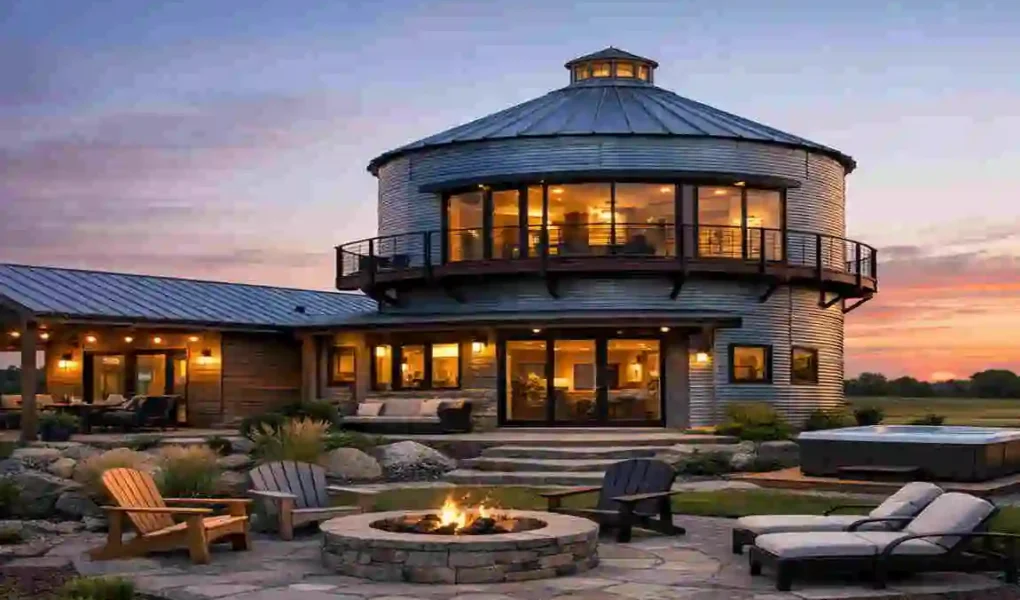
Imagine, for a second, that you are waking up in a home with no sharp corners. You look up, and instead of a flat white ceiling, you see a towering, majestic dome of shimmering steel. You walk to your window, and because your house is a cylinder, you have a panoramic view of the sunrise that a traditional rectangular house could never offer.
This isn’t just a dream from a sci-fi movie. This is the reality of living in a silo house. Whether you call them grain bin homes, silo barndominiums, or cylindrical retreats, these structures are taking the housing world by storm in 2026. Why? They are incredibly cool, surprisingly durable, and often much cheaper than a standard custom-built home.
What Exactly Is a Silo House?
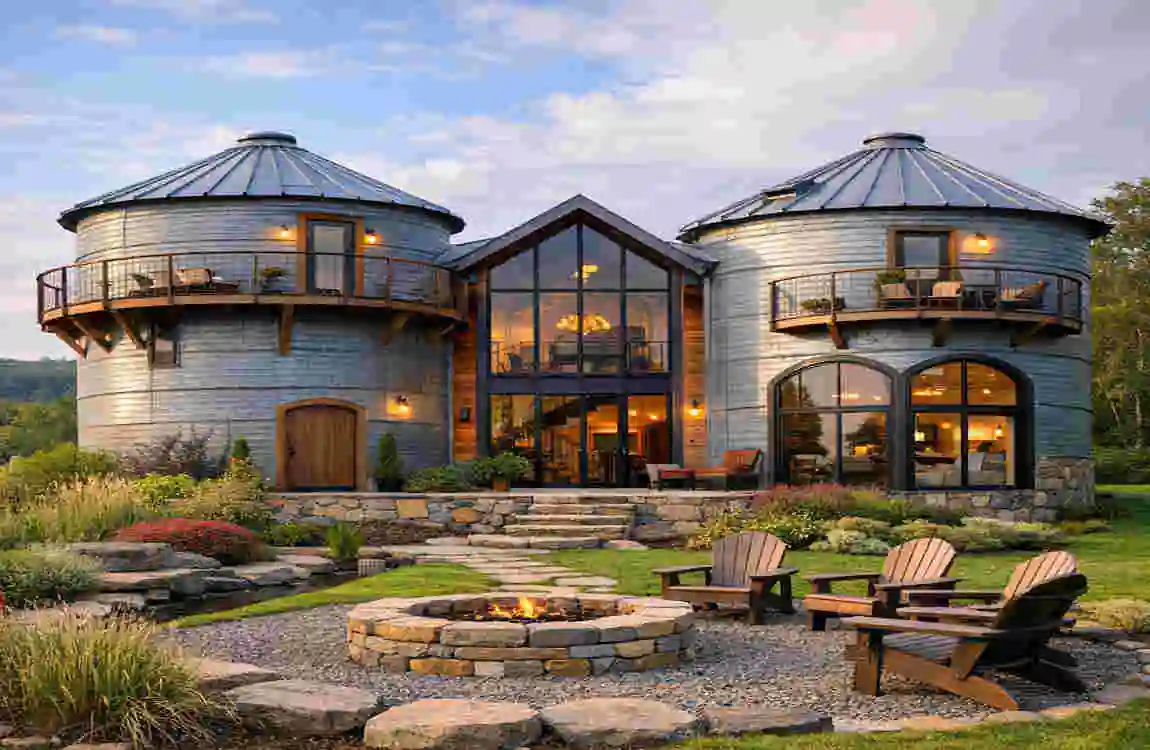
Before we talk about the money, let’s make sure we are on the same page about what these homes actually are. A silo house is a residential structure created from a grain storage bin. These are the large, galvanized steel cylinders you see on farms across the American Midwest.
While they were originally designed to hold thousands of pounds of corn or wheat, architects and DIY enthusiasts realized they make excellent “shells” for homes. They are strong, weather-resistant, and offer a massive amount of vertical space.
The Two Main Types of Silo Homes
When you start planning your build, you’ll generally choose between two paths:
- The Full Conversion: This is where the entire living space is contained within one or more silos. You might have a three-story home where the kitchen is on the bottom, the living room is in the middle, and the main suite is at the very top.
- The Hybrid (Silo Barndominium): This is the most popular choice in 2026. You build a traditional rectangular “barndominium” (a metal barn-style home) and attach a silo to it. The silo usually serves as a dramatic entryway, a spiral staircase tower, or a unique round kitchen.
A Bit of History
The trend really took off in rural areas, where old, abandoned silos sat empty. Farmers started turning them into guest houses or “man caves.” As the “tiny home” movement grew, people realized that a 24-foot to 30-foot diameter silo provides plenty of room for a full-sized, multi-level residence. Today, it’s a high-end architectural statement that combines industrial chic with eco-friendly living.
The Pros and Cons: Is a Round House Right for You?
Every type of home has its ups and downs. Before you commit your life savings to a giant metal cylinder, you should weigh the benefits against the “quirks.”
The Major Benefits The Pros
- Incredible Durability: These bins are made of heavy-duty galvanized steel. They are designed to withstand massive internal pressure and extreme outdoor weather. They are naturally resistant to fire, termites, and rotting. A well-maintained silo can easily last 50 to 100 years.
- Cost Savings: On average, building a silo house can be 30% to 50% cheaper than building a traditional custom stick-built home. You are essentially buying the “roof and walls” of your house for a fraction of the cost of lumber and siding.
- Energy Efficiency: When you use modern spray foam insulation, these homes become incredibly airtight. Because heat rises and the shape promotes natural airflow, many owners report energy bills that are significantly lower than their neighbors’.
- Speed of Build: Since the “shell” of the house is often delivered as a kit or is already standing, you can get the exterior finished in weeks rather than months.
The Challenges The Cons
- The “Curve” Problem: This is the biggest hurdle. Most furniture—couches, cabinets, beds—is designed for flat walls. You will likely need custom cabinetry and creative furniture placement, which can drive up your interior costs.
- Financing and Codes: Because silo houses are “non-traditional,” some big banks might be hesitant to give you a standard mortgage. You may need to work with specialty lenders or agricultural banks. Similarly, some city zoning boards might give you a hard time if they’ve never seen a grain bin home before.
- Acoustics: Metal cylinders can be echoey. Without proper soundproofing and soft finishes (like rugs and curtains), your home might sound like a giant drum when it rains.
Quick Comparison Table: Silo vs. Traditional
FeatureSilo HouseTraditional Home
Average Cost (Sq Ft) $124 – $301 $150 – $450+
Build Time 3 – 6 Months 10 – 14 Months
Lifespan 50+ Years 40 – 70 Years
Maintenance Low (Steel is tough) Moderate (Siding/Paint)
Resale Value Niche (Harder to sell) High (Standard market)
Complete Cost Breakdown: Where Does the Money Go?
Now, let’s get into the nitty-gritty of the “how much does it cost to build a silo house” question. To make this easy to understand, we’ve broken the costs down into categories.
The Size and Approach
The total price depends heavily on whether you choose a “Hybrid” model or a “Full Conversion.”
- Hybrid Builds ($124 – $240 per sq ft): These are generally more affordable because most of the home uses standard construction methods. You only pay the “Premium” for the silo on a small portion of the luxury house.
- Full Silo Conversions ($147 – $301 per sq ft): These are more expensive per square foot because every wall is curved. This requires custom labor for framing, drywall, and finishes.
Average Total Estimates
Total Square Footage, Hybrid Build Cost, Full Conversion Cost
800 sq ft (Tiny Home) $99,200 – $192,000 $117,600 – $240,800
1,200 sq ft (Standard) $148,800 – $288,000 $176,400 – $361,200
2,000 sq ft (Family Size) $248,000 – $480,000 $294,000 – $602,000
Material Costs 40% – 50% of your Budget
Materials are your biggest upfront expense. In 2026, steel prices have stabilized but remain higher than they were a decade ago.
- The Steel Shell: A new grain bin kit can cost between $15,000 and $40,000, depending on the diameter and height. If you find a used one to repurpose, you might get it for as little as $30 per square foot, but you’ll have to pay to move it.
- The Foundation: You can’t just set a silo on the dirt. You need a heavy-duty reinforced concrete slab. Because of the weight and the circular shape, expect to pay $10,000 to $50,000 for the foundation and site prep.
- Insulation: This is non-negotiable. Metal is a terrible insulator on its own. You must use closed-cell spray foam. It sticks to the curved walls and provides a vapor barrier. This will cost you between $12,000 and $25,000.
- Windows and Doors: Putting a flat window into a curved wall is tricky. You often need custom frames or specialized flashing to prevent leaks. Set aside $15,000 to $40,000 for high-quality, energy-efficient openings.
Labor and Installation 20% – 30% of your Budget
Building a silo house isn’t like putting together an IKEA bookshelf. You need professionals.
- Site Preparation: Clearing land, digging trenches for utilities, and leveling the ground can cost between $5,000 and $50,000, depending on your lot.
- Erection and Assembly: If you are building a tall silo, you will need to rent a crane. This is a major expense. The labor to bolt the rings together and seal the seams can run between $20,000 and $100,000.
- Interior Finishing: This is where the “simple” silo becomes a “home.” Framing the interior walls, running plumbing, and installing electricity in a round space is slow work. Expect to pay $30 to $100 per square foot for interior finishes.
Key Factors That Will Swing Your Budget
When you see a price range of $124 to $301, that’s a big gap! Why the difference? Here are the factors that will push you toward the high or low end of that range.
Your Location
If you are building in the rural Midwest, labor and land are cheaper. You might even find a local contractor who has worked on silos before. However, if you are building in a high-seismic zone (like California) or a hurricane-prone area (like Florida), you will need extra steel reinforcement and specialized engineering. This can add 20% to your total cost.
New vs. Repurposed Bins
Buying a used bin sounds like a great way to save money, and it can be! You might find a used bin for $5,000. But wait! You have to take it apart, transport it, and put it back together. Often, the cost of labor and transport for a used bin is the same as buying a brand-new kit delivered to your door.
The Level of Finish
Do you want a “rustic” look with plywood floors and exposed metal? Or do you want a “luxury” look with quartz countertops, spiral oak staircases, and custom-curved shiplap?
- Budget Finish: ~$60/sq ft for interiors.
- Luxury Finish: ~$160+/sq ft for interiors.
Economic Trends
2026 As of 2026, we are seeing a slight increase in the cost of specialized labor. There are fewer “general” contractors and more “specialty” builders. While the steel itself has leveled off, the cost of the skilled trades (plumbers and electricians who can work with metal structures) has risen by about 10-15%.
Real-World Examples: What People Are Actually Paying
Sometimes, looking at a spreadsheet isn’t enough. Let’s look at two common scenarios to see how these numbers play out in real life.
The “Silo Entry” Hybrid
Total Square Footage: 1,200 sq ft The Build: A 900 sq ft rectangular barndominium with a 300 sq ft silo attached to the front. The silo serves as a high-ceiling dining room. Total Cost: $149,000. Why it worked: By keeping the bedrooms and bathrooms in the “flat” part of the house, the owner used standard furniture and standard plumbing. They got the “wow factor” of the silo without the headache of custom-curved everything.
The Two-Story Full Conversion
Total Square Footage: 2,425 sq ft. The Build: Two large silos connected by a glass walkway. One silo is the “public” space (kitchen/living) and the other is the “private” space (bedrooms). Total Cost: $388,000. Why it worked: This was a high-end build. It included a custom spiral staircase in the center of the main silo and Premium spray foam insulation. While it was expensive, it was still nearly $150,000 cheaper than a traditional custom home of the same size in that area.
Financing and Saving Tips: How to Keep Costs Down
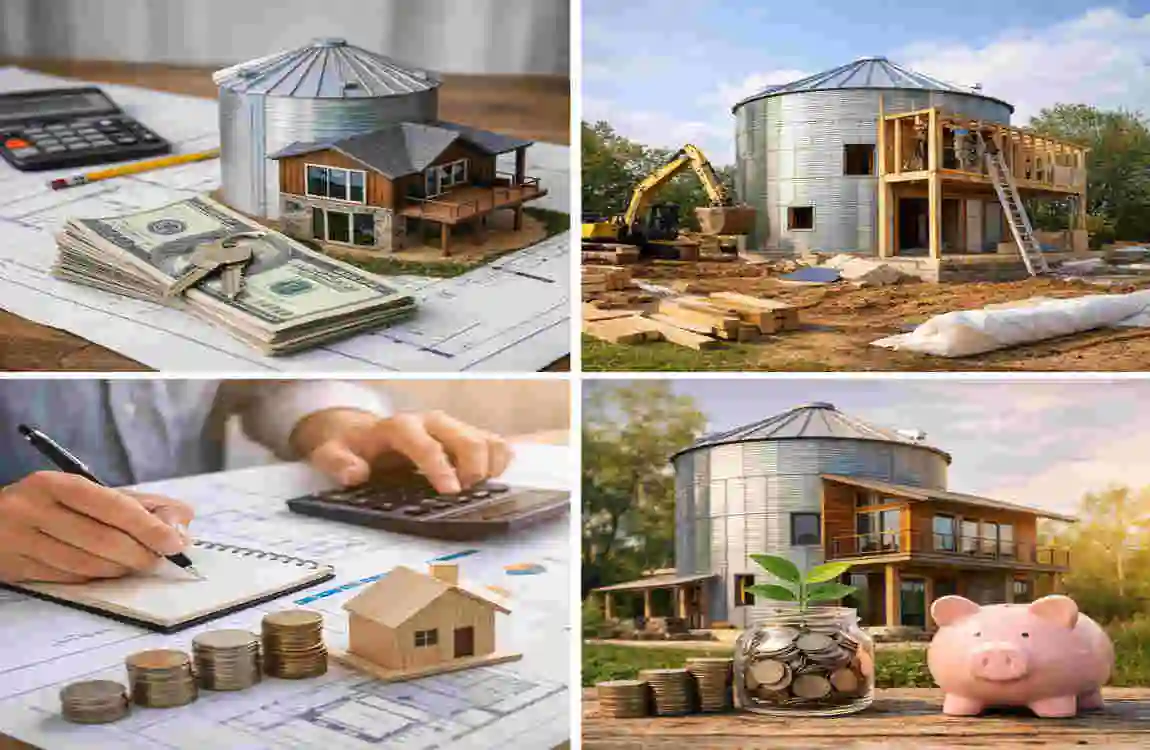
Let’s be honest: financing a silo house can be a bit of a headache. Most traditional lenders use “comparables” to value a home. If there are no other silo houses in your zip code, the bank might not know how much your house is worth.
Financing Strategies
- Construction Loans: Look for lenders who offer “construction-to-permanent” loans. These cover the cost of the build and then turn into a standard mortgage once you move in.
- Farm Credit Banks: If you are building on rural land, agricultural lenders are much more familiar with silos and are often more willing to finance these projects.
- Cash is King: Many silo house owners build in stages. They buy the land and the shell with cash, then finish the interior as they save up more money.
Pro-Tips for Saving Money
- Go DIY on the Interior: If you are handy, doing your own flooring, painting, and trim can save you 20% on your total budget.
- Buy a Standard Bin Size: Don’t order a custom-sized silo. Stick to the standard 24-foot or 30-foot diameters. The kits are mass-produced and much cheaper.
- Use “Flat” Internal Walls: Even in a round house, you can build internal partition walls that are straight. This allows you to use standard doors and cabinets on those specific walls.
- Look for Rural Grants: Some states offer “eco-build” or “rural revitalization” grants for people building energy-efficient or unique homes in underpopulated areas.
Frequently Asked Questions FAQs
How much does it cost to build a silo house on average?
In 2026, most homeowners spend between $124 and $301 per square foot. For a standard home, this usually ranges from $150,000 to $360,000.
Are silo houses actually cheaper than traditional homes?
Yes! Generally, you can save 30% to 50% compared to a custom stick-built home. The savings come from the fact that the exterior “shell” is a mass-produced industrial product.
How long does it take to build one?
A silo house can be built in 3 to 6 months. This is much faster than the 12+ months required for most traditional homes because the exterior structure goes up so quickly.
Can I build a silo house in a city?
It depends on the local zoning laws. Rural areas are much easier. If you want to build in a city, you will likely need an architect’s seal and a lot of patience to get through the building permit process.
Is it hard to keep the house warm in the winter?
Not if you insulate it correctly! With closed-cell spray foam, a silo house can actually be more energy-efficient than a standard house. The metal reflects heat in the summer, and the foam keeps it cozy in the winter.