Imagine locking your door at night and turning off the lights. As you settle into bed, do you feel completely secure? Do you feel safer nestled in a standalone house at the end of a quiet street, or high up in a bustling apartment complex surrounded by neighbours?
When we talk about apartment safety vs house safety, we are looking at two very different lifestyles. On one hand, apartment safety involves multi-unit buildings, shared hallways, and property management rules. On the other hand, house safety is all about single-family homes, private yards, and personal responsibility. Both have their unique charms, but both hide surprising vulnerabilities.
Today, we are going to bypass the rumours and look straight at the facts. We will uncover 7 shocking stats drawn from reliable sources such as the FBI, NFPA, and CDC. Our goal is simple: to finally settle the question of whether apartments are safer than modern houses.
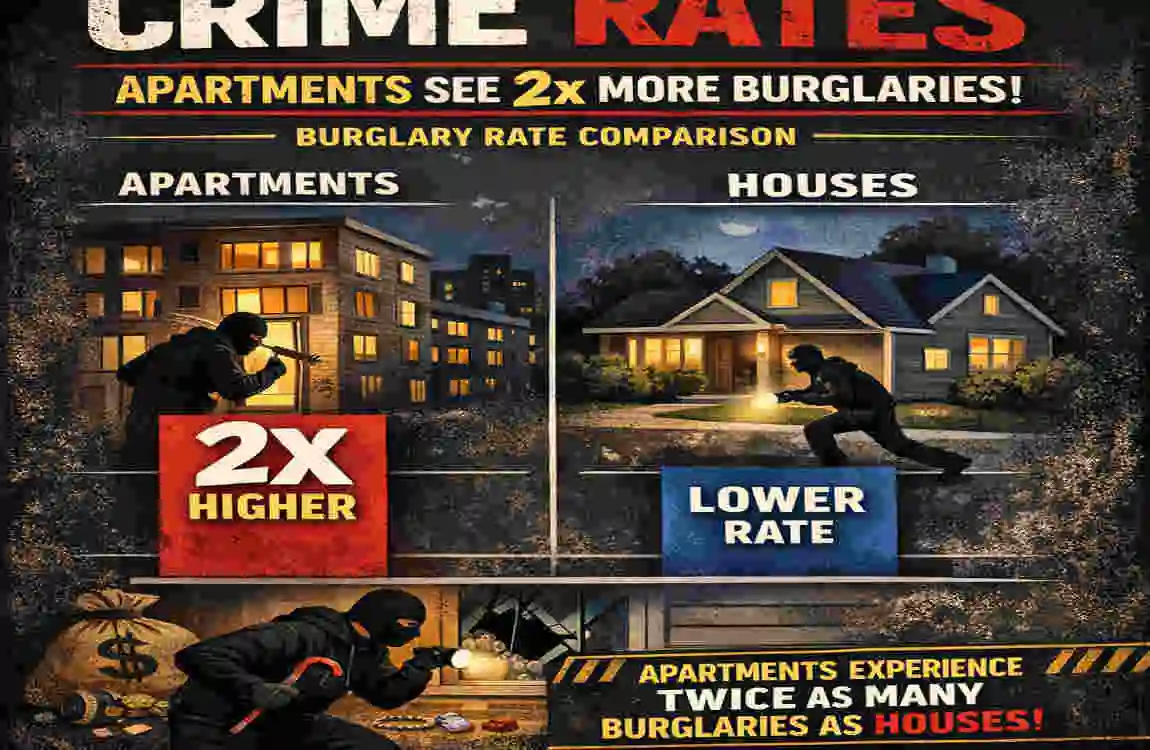
Apartments Face Double the Burglary Risk of Houses
When you think of a burglary, you might picture a masked intruder sneaking through the backyard of a quiet suburban house. However, the data paints a very different picture.
According to the 2024 crime reports based on FBI data, apartments experience significantly higher break-ins. In fact, the numbers show that apartments have a burglary rate per unit that is 2.1 times higher than that of standalone houses.
Understanding the Numbers Behind the Crime
Let us break this down. If you were to look at a bar chart comparing these incidents, you would see a striking difference. The data reveals roughly 15.2 burglaries per 1,000 apartment units, compared to just 7.1 per 1,000 single-family houses.
Why is the burglary risk of houses vs apartments so skewed? It largely comes down to access and opportunity. Apartment buildings see a massive amount of foot traffic. Delivery drivers, guests, maintenance workers, and strangers constantly move through shared lobbies. This makes it incredibly easy for a bad actor to slip in unnoticed.
The Local Reality in Busy Cities
Take, for example, the urban trends in bustling cities like Lahore, Pakistan. As the city grows upward with new apartment high-rises, residents’ anonymity increases. In a standalone house in a close-knit neighbourhood, a stranger lingering at the front gate is noticed immediately. In a massive apartment block, a stranger in the hallway is just another face in the crowd. More units mean more targets in one convenient location for thieves.
Actionable security Tips for Your Home
You do not have to become a statistic. Whether you rent a flat or own a home, you can take control of your security today.
- For Apartment Dwellers: Upgrade your front door. Ask your landlord to install smart locks and a deadbolt. Always use your peephole, and never prop open the main building doors for strangers.
- For House Owners: Leverage your outdoor space. Install motion-sensor floodlights around your perimeter. Plant thorny bushes under your ground-floor windows to deter sneaky intruders.
Houses Have 3x Deadlier Fires Than Apartments
The thought of fire is terrifying for any homeowner. But when we look at home fire statistics, a massive misconception is shattered. Many people assume that a fire in a crowded apartment building would be an absolute catastrophe.
Yet the National Fire Protection Association (NFPA) reports, based on its 2025 data sets, that single-family homes are actually far more dangerous. Standalone houses account for a staggering 73% of all residential fire deaths, despite having fewer overall fire incidents than massive multi-unit complexes.
The Hidden Danger in Standalone Homes
Why do houses burn faster and more dangerously without neighbours’ help? It comes down to isolation and building codes. If a fire starts in the kitchen of a large, isolated house in the middle of the night, it can spread for a long time before anyone notices.
On the flip side, commercial apartment buildings are usually constructed under incredibly strict commercial fire codes. They feature heavy fire-retardant doors, concrete walls that stop flames from spreading, and most importantly, automated sprinkler systems.
If you look at a pie chart of fire fatalities by dwelling type, the massive slice dedicated to standalone homes is shocking. Data shows that apartment sprinkler systems contain fires to the room of origin nearly 85% of the time.
Real-World Lessons and Local Safety
When we look at local safety records, such as Rescue 1122’s rescue statistics in Pakistan, we see similar trends. Emergency responders frequently face the challenge of reaching deeply recessed suburban homes in time. In apartments, alarms trigger building-wide alerts instantly, prompting faster evacuations and quicker emergency calls.
Fire Prevention for Everyone
When comparing fire safety houses vs apartments, preparation is your best friend.
- Check Your Alarms: Ensure you have working smoke detectors in every single bedroom, regardless of where you live.
- Plan an Escape: Map out two ways to escape your home. In an apartment, never use the elevator during a fire. In a house, ensure second-story windows can be easily opened.
Apartments Survive Quakes 40% Better Than Houses
When the ground starts shaking, panic sets in instantly. A common fear is being trapped inside a tall building during an earthquake. It feels unnatural to be suspended high in the air when the Earth is moving.
However, geological data tells a comforting story for city dwellers. According to structural data from geological surveys, multi-story apartments actually collapse 40% less frequently in severe seismic zones compared to traditional single-family houses.
The Science Behind Seismic Safety
This shocking stat comes down to the science of modern engineering. When comparing earthquake safety apartments vs houses, you have to look at how they are built.
Large apartment buildings undergo rigorous structural engineering tests. They are built on deep reinforced concrete foundations, with flexible steel frames that sway with tremors, and conform to strict commercial building codes. Older standalone houses, however, are often built on shallow foundations with rigid wooden or brick frames that snap under pressure.
Looking at Recent Tremors
We can see this play out in real life. During the 2023 earthquakes that rattled parts of Punjab and Lahore, modern high-rise apartments swayed but largely held their ground. Meanwhile, older, independently built houses suffered severe structural cracking and partial roof collapses. The reinforced structures of modern flats handled the kinetic energy much better.
Preparing Your Home for Shocks
You cannot predict an earthquake, but you can definitely prepare your living space to withstand one.
- Secure Heavy Furniture: In an apartment, use L-brackets to bolt heavy bookshelves and wardrobes to the wall. This prevents crushing injuries during a sway.
- Retrofit Your House: If you live in an older standalone home, hire a structural engineer. Ask them about retrofitting your house with seismic braces and bolting the frame securely to the foundation.
Houses Account for 60% of CO Deaths
Carbon monoxide (CO) is known as the silent killer. It is a colourless, odourless gas that can quickly become deadly if not detected in time. When examining CO poisoning risks in houses, the numbers are incredibly grim.
Health reports from the CDC reveal that a massive 60% of all carbon monoxide fatalities occur in single-family homes. This means standalone houses are hit significantly harder by this invisible threat than apartment complexes.
The Silent Threat in Large Homes
How does this happen? Standalone houses typically have more personal combustion appliances. Think about gas furnaces, large water heaters, wood-burning fireplaces, and attached garages where cars are parked.
Furthermore, in areas that experience frequent power outages—such as the load-shedding schedules commonly seen in Pakistan—homeowners often rely on personal gas generators. When these generators are placed too close to house windows or in poorly ventilated garages, the toxic gas easily seeps inside.
Why Apartments Hold an Edge
Apartments hold a distinct edge when it comes to carbon monoxide safety. Why? They usually rely on shared, commercial-grade HVAC systems that are located on the roof or in dedicated exterior utility rooms.
Additionally, modern apartment buildings are legally required by property managers to have hard-wired carbon monoxide detectors in every single unit. If you look at a line graph tracking CO incidents over the winter months, the spike in standalone houses is terrifyingly steep compared to the flat line of apartment buildings.
Simple Solutions for Better Air
You must take proactive steps to protect your lungs and your life from carbon monoxide.
- Install Dedicated Alarms: Do not rely solely on smoke detectors. Buy dual-sensor alarms or dedicated CO detectors and place them near every sleeping area.
- Generator Safety: If you use a backup generator at your house, keep it at least 20 feet away from your home. Never run it inside a garage or under a covered patio.
Apartment Falls Outnumber House Falls by 25%
While we often focus on dramatic events like fires and burglaries, everyday accidents are far more likely to send you to the hospital. When it comes to injury statistics, apartments vs houses, the danger is literally right beneath your feet.
CDC injury reports highlight a hidden danger of vertical living: apartment-related falls outnumber house-related falls by 25%.
The Hidden Dangers of Vertical Living
It is easy to see why this happens when you break down the daily routine of an apartment dweller. Unless you live in a luxury high-rise with a perfectly functioning elevator, you are likely dealing with stairs.
Carrying heavy groceries, wrestling with a stroller, or hauling a bicycle up three flights of concrete stairs dramatically increases your risk of tripping. Furthermore, shared apartment stairwells can suffer from poor lighting, spills from other neighbours, or worn-out anti-slip treads.
The Contrast with Single-Family Homes
Houses certainly have their own hazards, like uneven backyard terrain or a slippery front porch. But overall, they present far fewer multi-level risks.
A single-story ranch house eliminates the daily stair-climbing marathon. Even in a two-story house, the stairs are private, allowing the homeowner to control the lighting, the carpet quality, and the removal of tripping hazards. If you were to look at a medical table of injury types by housing, stair-related sprains and fractures heavily dominate the apartment column.
Navigating Stairs and Spaces Safely
Do not let a simple misstep ruin your month. You can easily modify your environment to prevent nasty falls.
- Apartment Safety Hacks: Request that your landlord fix broken hallway lights immediately. If you have interior stairs inside your unit, add grip tape or non-slip treads to the edges.
- House Upgrades: Keep your private stairs completely clear of clutter. Never use the stairs as a temporary storage spot for laundry baskets or shoes.
Apartment Theft Rates Spike 50% Higher
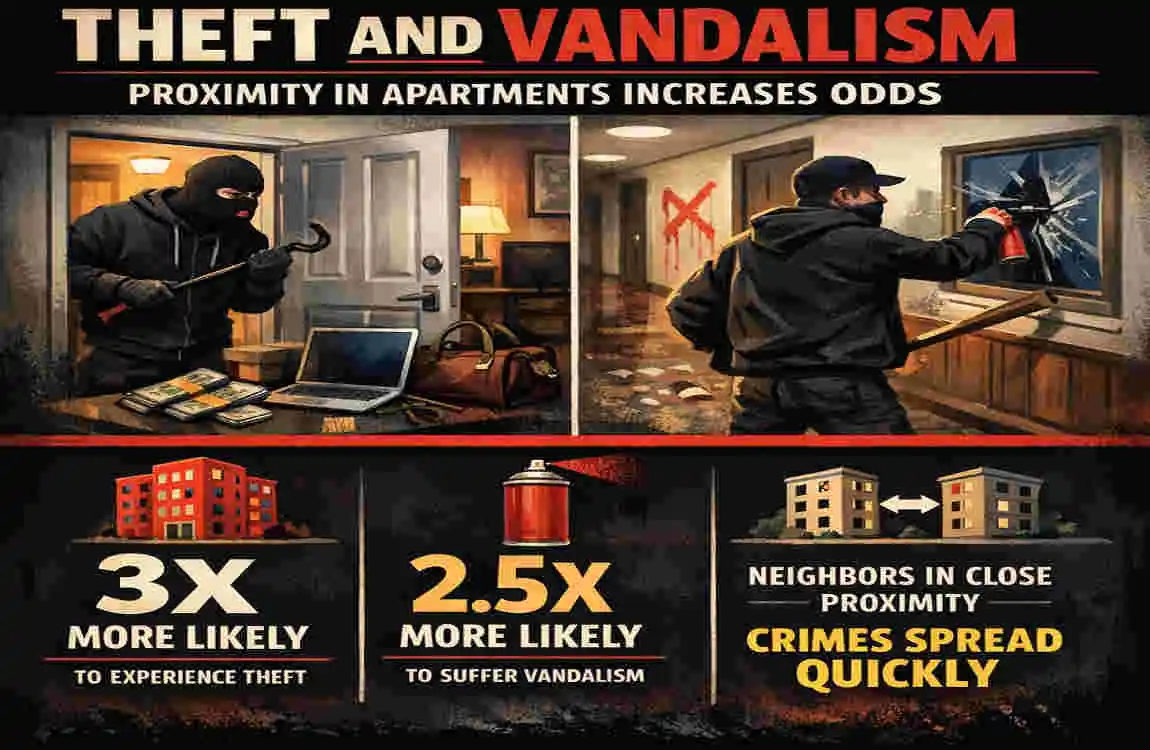
We have already discussed burglaries, which involve someone breaking into your actual living space. But what about general property theft and vandalism? This includes stolen packages, slashed tyres, and stolen bicycles.
When looking at general theft risks between apartments and houses, the Bureau of Justice Statistics reveals a frustrating truth. Property crime and theft rates are 50% higher in multi-unit dwellings than in private houses.
Proximity Brings Unique Risks
The very nature of an apartment complex forces people to share space. You share a mailroom, a lobby, a parking garage, and bicycle racks. This extreme proximity increases your odds of becoming a victim of a crime of opportunity.
“Porch pirates” absolutely love apartment buildings. Why steal one package from a house when you can walk into a bustling apartment lobby and swipe five packages at once? A visual map overlay of urban crime hotspots almost always glows bright red over dense apartment complexes because the volume of unattended property is simply higher.
The Beauty of House Isolation
In this specific category, houses win solely based on isolation. A single-family home allows you to park your car in a private, locked garage. Your packages are delivered right to your personal door, which is often monitored by a private doorbell camera.
Thieves are far less likely to walk up a long private driveway, exposing themselves to the street and private security cameras, to check if a car door is unlocked.
Building a Safe Community
Protecting your belongings requires a mix of technology and community effort.
- For Apartment Residents: Never leave valuables in your car, even in a “secure” underground garage. Pick up your packages immediately upon delivery, or use a secure locker system. Form a casual community watch with your hallmates to report suspicious loitering.
- For Homeowners: Do not let your isolation make you a target. Use smart delivery boxes for your porch and ensure your private driveway is brightly illuminated at night.
COVID Spread 2.5x Faster in Apartments
The global pandemic fundamentally changed how we view our living spaces. Our homes became our offices, our gyms, and our absolute safe havens. But they also became potential vectors for illness.
When analysing health and safety, apartments vs. houses, the statistics are sobering. A recent 2024 retrospective health study by the WHO revealed that COVID-19 and similar airborne viruses spread 2.5 times faster in dense apartment buildings than in sprawling suburban neighbourhoods.
The Reality of Dense Housing
This staggering infection rate stems from the spread through shared air and surfaces. In an apartment building, hundreds of people touch the same elevator buttons, door handles, and mailboxes every single day.
Furthermore, many older apartment buildings utilise shared central ventilation systems. If someone coughing on the third floor shares a poorly filtered air duct with your apartment on the fourth floor, your risk of infection skyrockets. The visual heatmap of infection rates during the pandemic’s peak showed dense apartment blocks lighting up with cases at an incredible rate.
The Benefit of Suburban Isolation
Houses provide an incredibly effective natural barrier to airborne illnesses: physical distance.
In a standalone house, you control who crosses your threshold. You control the cleanliness of your doorknobs. Most importantly, your HVAC system is completely private. The air circulating in your living room is yours alone, significantly lowering the risk of catching a neighbour’s seasonal flu.
Post-Pandemic Health Upgrades
We have learned vital lessons over the last few years. Maintaining a healthy home environment is now more important than ever.
- Upgrading Apartment Airflow: Open your windows daily to create a cross-breeze and flush out stagnant air. Invest in a high-quality HEPA air purifier for your living room to filter out particles from shared building systems.
- House Hygiene: Just because you are isolated doesn’t mean you can slack off. Change your home’s HVAC filters every three months to ensure your family is breathing the cleanest air possible.
Apartments Safer Than Houses? The Ultimate Pros-Cons Table
We have dug deep into the data, exploring everything from crime rates to health hazards. So, are apartments safer than houses?
To give you the clearest picture possible, let us put the data head-to-head in this ultimate safety breakdown.
Safety Factor: Where Apartments Win, Where Houses Win, The Ultimate Verdict
Crime & Burglaries: Close neighbours can report suspicious noises. Extreme isolation makes homes harder to approach unnoticed. Houses Win. (Apartments suffer 2.1x more break-ins).
Fires & Fatalities Commercial sprinklers and strict fire codes contain flames. Private space means fewer accidental fires caused by others. Apartments Win. (Houses account for 73% of fatal fires).
Natural Disasters Deep foundations and steel frames resist earthquakes. You completely control maintenance and structural upgrades. Apartments Win. (40% fewer structural collapses in quakes).
Every day, elevators remove the daily need to climb dangerous stairs—no shared, slippery, or poorly lit public walkways. Houses Win. (Apartments see 25% more stair-related ER visits).
Theft & Vandalism Secured entry gates and hired lobby guards deter some thieves. Private locked garages protect vehicles perfectly. Houses Win. (Apartment lobbies see 50% more property theft).
Airborne Health Professional management handles pest control. Private HVAC systems prevent the spread of airborne viruses. Houses Win. (Infections spread 2.5x faster in apartments).
Carbon Monoxide Commercial utility rooms keep gas appliances far from beds. You have complete control over your home’s air quality monitors. Apartments Win. (60% of CO deaths happen in standalone homes).
Analysing the Final Score
Look closely at the table above. If we tally up the statistics, the score is incredibly close. Houses win out on preventing property crime, burglary, health transmissions, and everyday fall injuries. Apartments, on the other hand, take the crown for surviving massive, life-threatening events like raging fires, earthquakes, and carbon monoxide leaks.
Ultimately, the answer to “Are apartments safer than houses?” is nuanced. It is a 50/50 split.
Urban apartments hold the edge when it comes to structural disasters and severe fire safety. Single-family houses provide unparalleled peace of mind when it comes to avoiding violent crime, theft, and protecting your family’s privacy. Your final choice depends heavily on your geographic location, your lifestyle, and how proactive you are about home maintenance.
Are Apartments Safer Than Houses? FAQs
You likely still have a few specific questions on your mind. Here are the most common questions people ask when debating between renting a flat and buying a home.
Are apartments safer than houses for families? It depends entirely on your children’s age and your location. For toddlers, the lack of private stairs in a single-story apartment is very safe. However, houses offer secure, fenced-in backyards where children can play away from busy streets and strangers, making them generally preferred for growing families.
What stats prove house burglary risks? While apartments face double the burglary rates per unit, standalone houses are still targeted, usually during the day when families are at work. The FBI notes that houses without basic security systems are 300% more likely to be burglarised than homes with visible cameras.
Are ground-floor apartments dangerous? Statistically, yes. Ground-floor apartments experience higher break-in rates than upper-level units because windows and patios are easily accessible from the street. If you live on the ground floor, window locks and security bars are highly recommended.
What are the best apartment fire safety tips? Never turn off your smoke detector, even if it goes off while you are cooking. Learn exactly where the building’s emergency stairwells are located, and never attempt to use the elevator if the fire alarm is sounding.
Is carbon monoxide really a risk in electric homes? If your house relies 100% on electricity (no gas stove, no gas furnace) and you do not park a gas-powered car in an attached garage, your CO risk is virtually zero. However, if you ever use a portable gas generator during a power outage, the risk immediately returns.