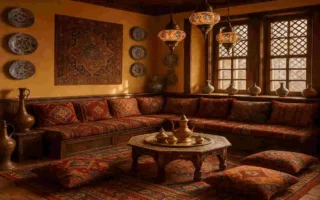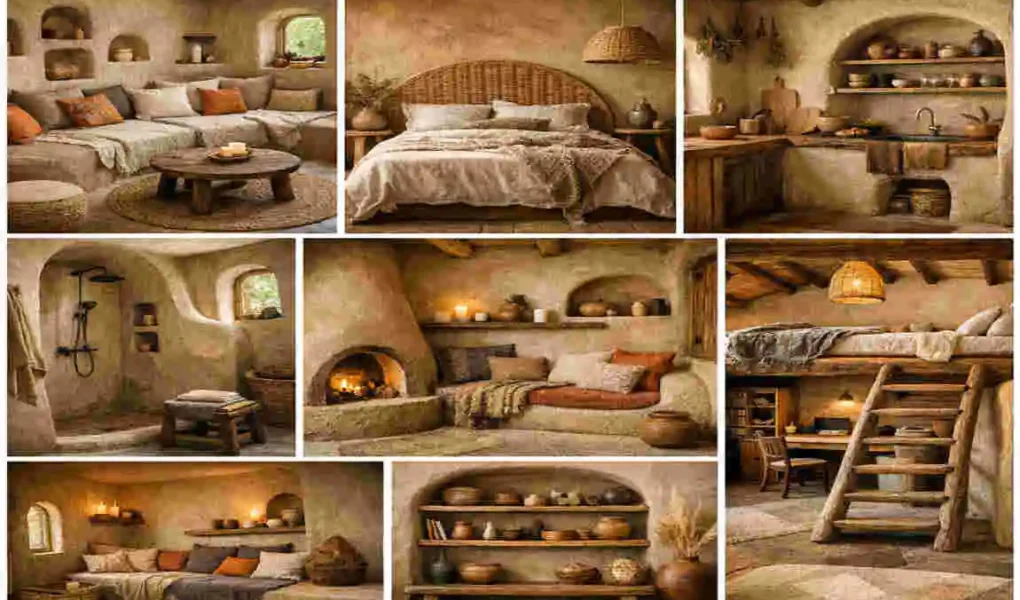
the world of interior design took a surprising turn. While high-tech gadgets and “smart homes” are still everywhere, a massive shift toward the earth has occurred. Believe it or not, mud house searches surged 40% on Pinterest recently. People are moving away from the “concrete jungle” vibe and looking for something that feels more grounded, literally. If you have ever wondered how mud house interior spaces manage to look so chic and feel so cosy without costing a fortune, you are in the right place.
What Are Mud Houses and How Do Mud House Interiors Actually Work?
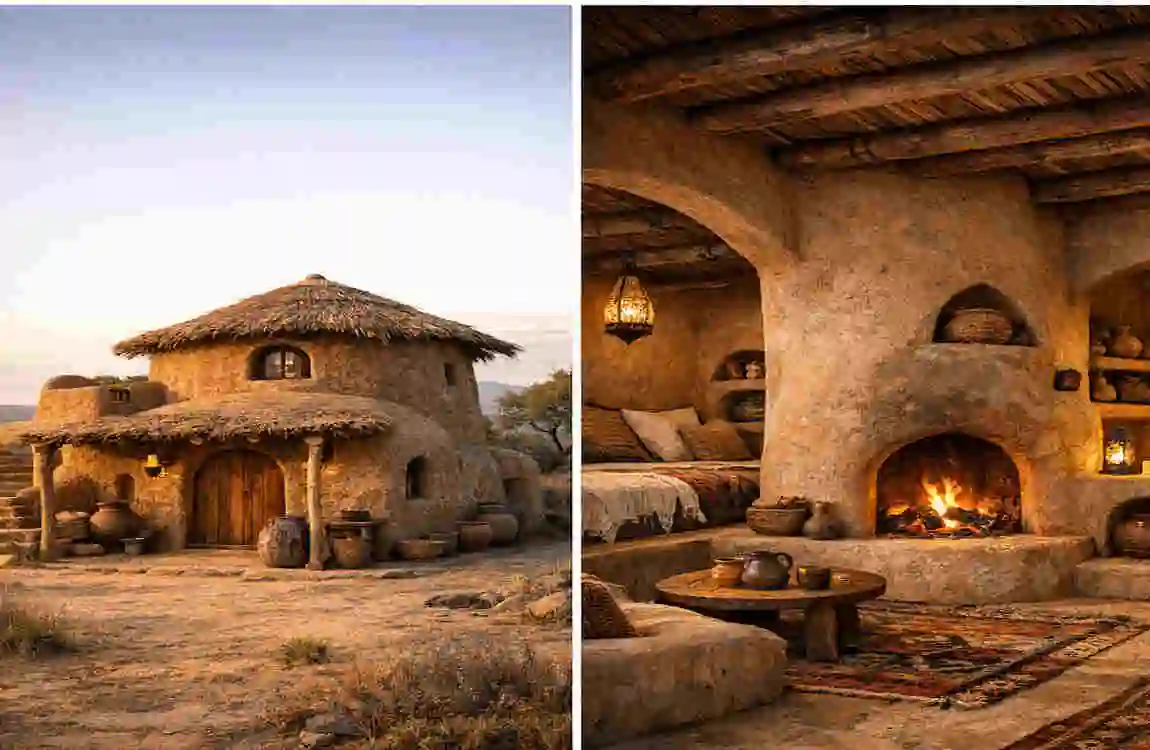
When most people hear the word “mud,” they think of a messy puddle after a rainstorm. But in the world of mud house design, mud is a sophisticated building material. It is a specific blend of soil, clay, sand, and organic fibres. When these elements come together, they create a structure that is incredibly strong and surprisingly beautiful.
The Science Behind Mud House Interiors
To understand how mud house interior systems function, we need to discuss thermal mass. This is the secret weapon of earthen homes. Think of a thick mud wall as a giant battery, but instead of storing electricity, it stores heat.
During a hot summer day, the thick walls soak up the sun’s heat, keeping the inside of the house refreshingly cool. Then, as the temperature drops at night, the walls slowly release that stored warmth back into the rooms. This natural regulation means you spend much less on heating and cooling.
There are three main types of construction you should know about:
- Adobe: These are sun-dried mud bricks stacked with a mud mortar.
- Rammed Earth: This involves packing damp soil into a wooden frame until it is as hard as rock.
- Cob: This is a free-form method where you use your hands to sculpt walls from a mix of clay, sand, and straw.
Key Advantages of Mud House Interior Design
Why are people ditching drywall for dirt? The benefits go far beyond just looking “boho-chic.” First off, it is the ultimate eco-friendly choice. You are using materials that come directly from the earth, which means there is almost zero waste. If you ever decided to knock down a wall, it would literally just turn back into soil.
Cost savings are another huge factor. If you have the time and the muscle, you can often source the materials for free or very cheaply. But perhaps the most underrated benefit is health. Mud walls are “breathable.” They naturally regulate humidity, helping prevent the growth of toxic mould. For anyone with allergies or respiratory issues, an earthen home can feel like a sanctuary of fresh air.
Essential Materials and Prep for Mud House Interiors
Before you start slapping mud on your walls, you need to know what you are working with. You can’t just dig a hole in your backyard and hope for the best. The “recipe” for a good mud interior is a bit like baking—you need the right proportions to keep it from cracking or crumbling.
Sourcing Mud and Natural Add-Ins
The foundation of your mix is clay and sand. The clay acts as the glue, while the sand provides the strength and prevents the mixture from shrinking too much as it dries. Most builders use a ratio of about 25% clay to 75% sand, but this can change depending on your local soil.
To make the walls even stronger, we use natural add-ins. Straw or hemp fibres act like “rebar” in concrete, holding everything together and preventing cracks. In modern times, some people add a little bit of lime or even a tiny amount of cement as a “stabiliser” to make the walls more water-resistant, especially in humid climates.
Tools for Short Mud House Interior Projects
You don’t need a massive warehouse of power tools to work on a mud interior. In fact, many of the best tools are ones you might already have in your garden shed.
The Essential Toolkit:
- Trowels: For smoothing out the mud plaster.
- Moulds: If you are making your own bricks.
- Natural Paints: Such as clay-based or lime washes.
- Sponges: For creating soft, textured finishes.
- Buckets: Lots of them!
When working on these projects, safety is simple but important. Wear gloves to protect your hands from the drying effects of the clay, and if you are mixing dry lime or fine sand, wear a mask to avoid breathing in the dust.
Material Comparison Table
Material Type: Best Use Case: Pros: Cons:
Adobe Bricks Structural walls. Easy to stack, DIY friendly. Requires lots of drying space.
Rammed Earth Modern, sleek walls , Incredible strength, beautiful layers, Requires heavy machinery/forms
Cob Organic, curved shapes , highly artistic, no tools needed very labour-intensive
Mud Plaster: Interior finishing can be applied over any wall. It requires multiple thin coats.
Short, Cosy Design Ideas for Mud House Interiors
Now for the fun part! How do you take a pile of dirt and turn it into a magazine-worthy living room? Here are seven design ideas that focus on cosiness, sustainability, and style.
Textured Wall Finishes for Instant Cosiness
One of the best things about mud house interior design is that your walls don’t have to be perfectly flat or boring. Unlike drywall, which is meant to be invisible, mud walls are meant to be felt.
You can use a wavy trowel technique to create gentle ridges that catch the light and create soft shadows. If you prefer something smoother, you can polish the mud with a stone to create a finish that feels like silk. To really lean into the cosy vibe, pair these textured walls with wool rugs and linen curtains. The contrast between the “hard” earth and the “soft” fabric creates a balanced, grounded feeling in the room.
Built-In Mud Benches and Nooks
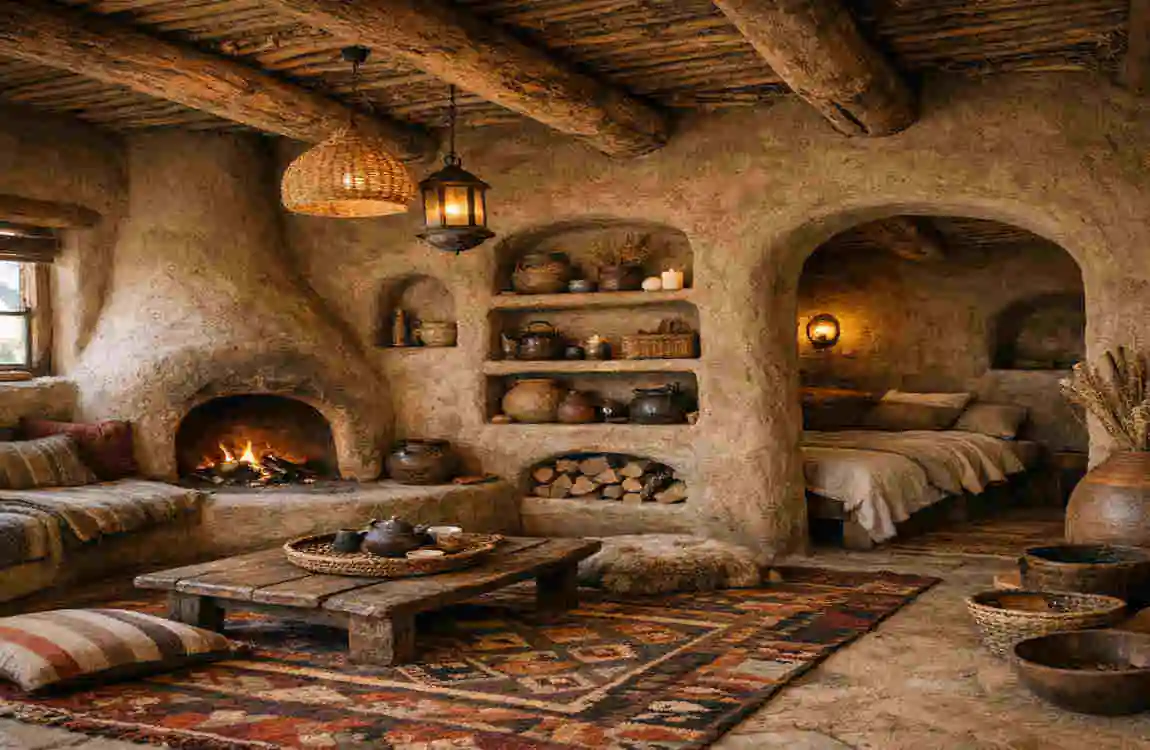
In a traditional home, you buy furniture. In a mud home, you build the furniture into the house. Imagine a living room where the wall gently curves outward to form a long, sturdy bench. This is a classic mud house interior seating trick.
Because mud is so easy to sculpt, you can create custom window seats or reading nooks that fit your body perfectly. Once the mud dries, you add a few thick cushions and some throw pillows. It saves space, looks incredibly integrated, and provides a “hygge” vibe that a wooden chair can’t match. Plus, these benches can even be designed to retain heat if built near a fireplace!
Arched Doorways and Niches
Forget about sharp, 90-degree angles. The beauty of mud is in the curve. Creating arched doorways gives your home an organic, ancient feel that is very popular in 2026’s “earth-core” aesthetic.
While you are at it, why not carve small niches directly into the walls? These are perfect for holding candles, books, or small indoor plants. Instead of buying plastic shelving units, you are using the house itself to display your treasures. You can even install small LED strips inside these niches for a sustainable lighting hack that highlights the texture of the mud.
Natural Flooring Integrations
What goes under your feet is just as important as what is on your walls. Polished mud floors (often called earthen floors) are a dream to walk on. They feel slightly soft, almost like leather, and they stay cool in the summer.
To make a mud floor durable, it is usually saturated with several coats of linseed oil, which hardens into a waterproof, plastic-like finish. If you want a bit more colour, you can lay down terracotta tiles directly into a mud bed. The earthy red of the tiles against the brown of the walls creates a warm, Mediterranean feel that never goes out of style.
Ceiling Beams and Exposed Elements
To keep your mud house from feeling like a cave, bring in some wood. Wood-mud hybrids are the gold standard for rustic charm. Using heavy timber beams across the ceiling provides structural support and a beautiful visual contrast.
These exposed elements aren’t just for looks; they also offer acoustic benefits. The combination of dense mud walls and porous wood beams creates a room where sound doesn’t bounce around. It makes the house feel quiet, peaceful, and solid. If you have a high ceiling, leaving the beams exposed makes the room feel larger while still keeping that “grounded” earthy energy.
Colour Washes and Pigment Pops
Who says mud has to be brown? While the natural shades of earth are beautiful, you can easily add colour using natural pigments. Think of colours like ochre, sienna, and burnt umber.
Instead of using chemical-heavy latex paints, you can create a clay wash. This is basically a very thin, watery mud mixed with a pigment. You brush it onto the walls in thin layers. This allows the wall to keep its breathability while giving you a pop of colour. It creates a “watercolour” effect on the walls that looks much more sophisticated than a flat coat of store-bought paint.
Greenery Walls and Vertical Gardens
Since your walls are made of earth, why not let something grow on them? Living mud planters are a huge trend right now. You can sculpt small pockets directly into the wall and line them with a waterproof sealant to keep moisture out.
Planting trailing vines or air-purifying ferns directly into these wall pockets creates a vertical garden that feels like a part of the architecture. It improves the air quality and brings a vibrant, living energy into the home. It’s the ultimate way to bridge the gap between “indoors” and “outdoors.”
Real-World Mud House Interior Inspirations
Looking at photos is one thing, but seeing how these homes work in the real world is truly inspiring. Around the globe, different cultures have mastered the art of the earthen home.
- Moroccan Riads: These homes often use a technique called Tadelakt. This waterproof lime plaster is polished with stones and treated with olive oil soap. The result is a high-gloss, luxurious finish that is used in bathrooms and kitchens.
- American Southwest Adobe: Think of the classic Santa Fe style. These interiors feature thick walls, rounded corners, and beautiful wooden “vigas” (ceiling beams). They are masters of using light to make mud walls look like glowing gold.
- Indian Cob Homes: In many parts of India, cob houses are being modernised with colourful murals and intricate carvings. These homes prove that mud can be used to create highly detailed, artistic spaces that reflect the owner’s personality.
When you look at these examples, you realise that how mud house interior designs look depends entirely on your creativity. You can go for a minimalist, modern look or a cluttered, cosy bohemian vibe. The earth is your canvas!
Common Challenges and Quick Fixes for Mud House Interiors
We have to be honest—living in a mud house isn’t always perfect. Like any home, it requires a bit of maintenance. However, most of the “scary” myths about mud houses are just that—myths.
Addressing Moisture and Cracks. The biggest enemy of mud is standing water. While a little bit of humidity is fine, you don’t want water pooling at the base of your walls. The fix? A good “hat and boots.” This means having a wide roof overhang (the hat) and a solid stone or concrete foundation (the boots) to keep the mud dry.
If you see small cracks forming, don’t panic! This is normal as the house settles or the humidity changes. The beauty of a mud wall is that it is self-healing. You can take a little bit of leftover mud, rub it into the crack, and smooth it over with a damp sponge. Try doing that with a cracked concrete wall!
Myth-Busting: “Mud homes are fragile” Some people think a heavy rainstorm will melt their house away. This is not true. There are mud structures in the Middle East and Africa that have stood for over 500 years! As long as the walls are finished with a proper sealant—like lime or linseed oil—they are incredibly durable.
Frequently Asked Questions FAQ
How do mud house interiors regulate temperature?
They use thermal mass. The thick walls absorb heat during the day and release it at night, keeping the interior temperature stable regardless of the weather outside.
Are mud house interiors durable?
Yes! When built on a proper foundation and protected from direct water, mud walls can last for centuries. They are much easier to repair than modern drywall.
What is the cost of a mud house interior makeover?
It is very budget-friendly. Most of the cost is labour. If you source your own clay and sand, the material costs are significantly lower than traditional renovation materials.
What are the best paints for mud walls?
Natural clay-based paints or lime washes are best. They allow the wall to “breathe,” preventing moisture buildup and maintaining the health benefits of the earthen structure.
Can I use mud house interior ideas in a small space?
Absolutely. Built-in mud furniture and wall niches are actually great for small spaces because they eliminate the need for bulky, standalone furniture.