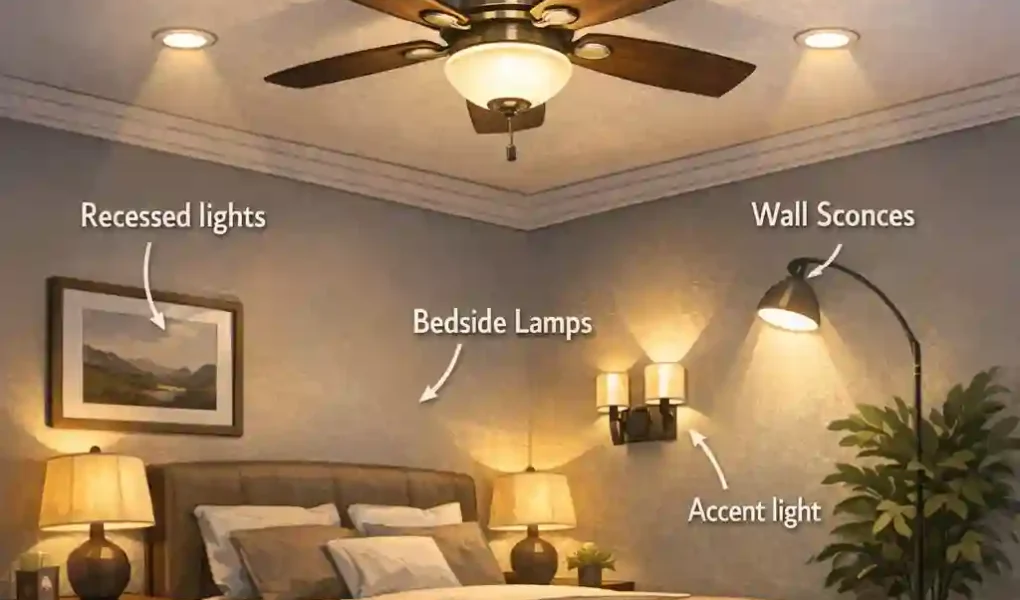
A bedroom ceiling fan has to do more than look suitable above the bed. It shares the ceiling with lighting, smoke alarms, wardrobes, and sometimes a pendant or recessed downlights. Homeowners comparing ceiling fans with integrated lighting should begin with the bedroom plan rather than a product photograph. The right choice depends on the position of the bed, the ceiling height, the role of the light, the controls used at night, and the amount of maintenance the room can accommodate.
Start with the bed and circulation plan
The fan is usually judged from the center of the room, but the useful position may be closer to the bed or seating area. Mark the bed, bedside tables, wardrobes, and the path to the door before deciding where the fixture belongs. Check that the blade circle will not conflict visually with a pendant, beam, or tall cupboard.
A bedroom often benefits from a calm ceiling composition. If the fan is placed where it supports the sleeping area, the rest of the lighting can remain focused on reading, dressing, and circulation rather than trying to make one fixture do everything.
Confirm height and mounting conditions
Record the ceiling height and note whether the ceiling is flat, vaulted, or interrupted by a bulkhead. A low-profile installation may help in a lower room, but the exact model still needs the required blade clearance and mounting support. Sloped ceilings may require a compatible adapter or a different installation arrangement.
Read the installation instructions for the exact model before assuming that a standard electrical box is adequate. A qualified installer should check the support point and wiring, especially when an existing light is being replaced.
Separate general light from bedside light
The integrated light can support general illumination, but it should not automatically replace bedside lamps or dedicated reading lights. Decide whether the ceiling fixture needs to light the whole bedroom, soften the evening atmosphere, or simply provide a convenient light when entering the room.
Compare the stated output, color temperature, and dimming requirements for the exact model. Warm, controllable light may suit a bedroom routine, while a brighter source can be useful for dressing. Keep the task light close to the task instead of asking the fan light to cover every visual need.
Make nighttime controls simple
The best control arrangement is the one occupants can use without searching in the dark. Consider whether the light and fan need separate controls, whether a remote will stay on the bedside table, and how the system behaves when the remote is misplaced.
Do not assume that a legacy wall dimmer or smart switch is compatible. Check the manufacturer’s control guidance and ask the installer to confirm the intended wiring. A quiet-looking bedroom can still feel inconvenient if the controls are difficult to understand.
Choose scale for visual calm
Blade span changes the balance of the ceiling. A small room may need a compact fixture that leaves clearance around wardrobes and doors, while a larger bedroom may look more settled with a fan that relates to the bed and rug below. Diameter alone is not enough; compare the manufacturer’s room guidance and the actual furniture layout.
Use the full blade circle when reviewing a plan. This is more reliable than judging the motor housing in a small product image.
Plan cleaning and service access
Dust, hair, and fabric fibres can collect on blades and around light diffusers. Before choosing a design, consider how the fixture will be reached for routine cleaning and whether replacement parts are available. A lower-maintenance room still needs a practical way to access the fan safely.
Review care instructions, warranty terms, and the lighting module information. The most attractive choice is easier to live with when its cleaning and service requirements are clear from the beginning.
Prepare a clear bedroom brief
Before ordering, write down the bedroom dimensions, ceiling height, bed position, preferred light level, and the control arrangement that feels easiest at night. This short brief helps separate essential requirements from preferences such as finish or blade color. It also gives the installer useful information before work begins.
Compare only models that satisfy the practical conditions first. Once the mounting, airflow, light, and control requirements are confirmed, the final appearance can be judged with more confidence. A bedroom fan should feel calm in daily use, not merely attractive in an online image.
A shortlist to take to the installer
| Room condition | Decision to resolve | Information to check |
| Lower ceiling | Suitable mounting profile | Mount type and required clearances |
| Open living area | Fan position and scale | Occupied zones and published airflow |
| Layered lighting | Role of the integrated light | Output and control compatibility |
| Bedroom | Convenient independent operation | Included controls and model specifications |
Choose the room before choosing the finish
A successful shortlist starts with the space and ends with a model whose documentation supports the design. Measure the room, map the ceiling, define the lighting role, and confirm the controls with the installer. Then compare finishes among the options that remain suitable. This sequence keeps a ceiling fan connected to the architecture and the people using it, rather than making it an isolated purchase.