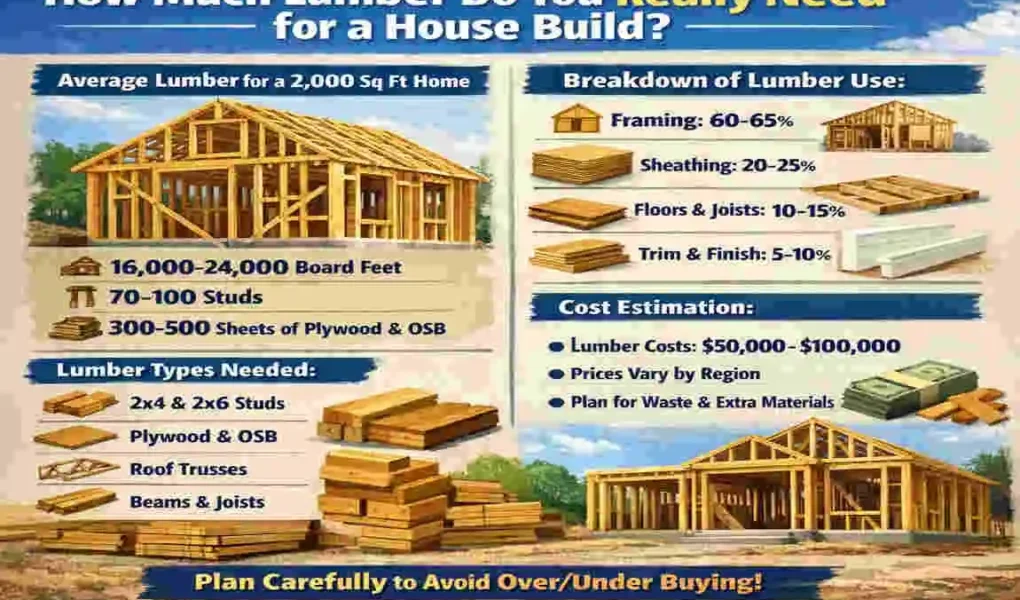
When you plan a house build, one of the first big questions is how much lumber you’ll need. This matters because lumber is not a small expense. It affects your budget, your timeline, and even how smoothly the whole project moves from one stage to the next.
Lumber prices can change fast. One month the cost may feel manageable, and the next month it can push your budget harder than expected. That is why accurate planning matters so much. If you order too little, work slows down. If you order too much, you waste money and storage space.
| House Size (sq ft) | Linear Feet of Wall | Total 2×4s (8-ft) | Board Feet (approx.) | Notes |
|---|---|---|---|---|
| 500 | 80 | 90 | 3,000–4,000 | Small 1-bedroom home |
| 1,000 | 120 | 135 | 6,000–8,000 | 2-bedroom ranch |
| 1,500 | 160 | 180 | 9,000–11,000 | Average 3-bedroom home |
| 2,000 | 200 | 225 | 12,000–15,000 | Standard 3–4 bedroom |
| 2,500 | 240 | 270 | 15,000–18,000 | Larger 4-bedroom |
| 3,000 | 280 | 315 | 10,000–12,000* | 2-story or complex design |
The amount of lumber a house needs depends on several things. House size, floor count, design style, framing method, and local building codes all play a part. A small single-story home will need far less wood than a large custom house with multiple levels, open spaces, and a complex roof.
Understanding Lumber Requirements for House Construction
What Is Lumber Used for in a House Build?
Lumber is the backbone of most home construction. It gives the house its shape, strength, and support. Without it, the structure would not stand safely or stably.
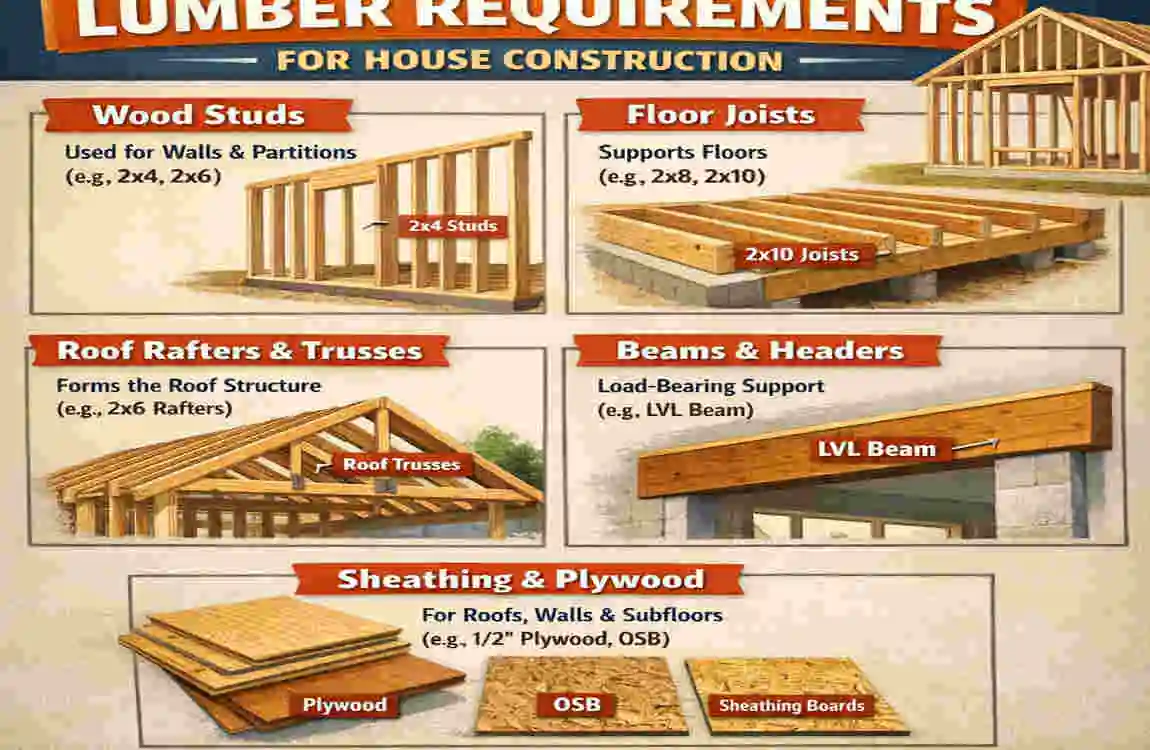
Here are the main uses of lumber in a house build:
- Wall framing for inside and outside walls
- Roof trusses or rafters that support the roof
- Floor joists that hold up the floors
- Subflooring under the finished flooring
- Ceiling structures that support the upper parts of the home
- Sheathing for walls and roofs
- Decking and exterior framing for porches, decks, and outdoor spaces
So, when people ask about lumber needs, they are really asking about the home’s full structural shell. That is why the answer is never the same for every project.
Why Lumber Estimation Is Important
Good lumber estimation does more than keep the project moving. It helps you build smarter.
First, it reduces material waste. If you know what you need, you avoid overbuying. Second, it helps create a more accurate budget. Third, it prevents delays because the crew does not have to stop and wait for more materials. Finally, it improves project scheduling, which is especially important when different trades depend on framing being finished on time.
In simple terms, better lumber planning means fewer surprises.
Factors That Determine How Much Lumber Is Needed to Build a House
House Size and Square Footage
The bigger the house, the more lumber it needs. The size of the increase can surprise people.
A small home around 800 to 1,200 square feet may use a fairly limited amount of framing lumber. A medium home between 1,500 and 2,500 square feet needs much more, especially in wall framing and roof structure. A large home of 3,000 square feet or more often requires a large amount of lumber because the footprint, roof area, and structural support all grow.
Square footage gives you a starting point, but it does not tell the full story.
Number of Floors
The number of floors significantly affects the lumber count.
A single-story house usually needs more roof coverage compared to its overall footprint, but it may be simpler to frame. A two-story house adds more wall framing, more floor framing between levels, and often more structural support. A multi-level home can use even more lumber because the framing must carry more load and often includes more complex stair and wall systems.
If you are comparing two houses with the same square footage, the one with more floors will often need a different lumber breakdown.
Architectural Design Complexity
A simple box-shaped home is easier to frame than one with many custom features.
For example, open floor plans may need stronger beams or engineered lumber because there are fewer walls in the middle of the house. Vaulted ceilings can change roof framing and add support needs. Large window openings require headers and additional framing. Custom framing almost always increases lumber use because more cutting, support, and shaping are involved.
So, when the design becomes more unique, the lumber estimate becomes less predictable.
Framing Material Dimensions
Not all lumber is the same. The size and type of material matter a lot.
Common framing materials include:
- 2×4 lumber for many interior walls and lighter framing
- 2×6 lumber for exterior walls and better insulation space
- Engineered wood for beams, joists, and structural spans
- Plywood and OSB for sheathing and subflooring
A house built with more 2×6 walls and engineered wood will usually cost more than a house framed mostly with standard 2x4s. The type of lumber changes both the quantity and the budget.
Local Building Codes
Building codes also affect how much lumber you need.
In some areas, homes must meet more stringent wind-resistance requirements. In earthquake-prone areas, you may need extra reinforcement. Some codes also require specific load-bearing standards, which can affect beam size, stud spacing, and the amount of structural lumber needed.
That means two homes with the same design can still use different amounts of lumber depending on where they are built.
Average Lumber Needed by House Size
Below is a simple table that gives you a rough idea of what to expect. These are estimates, not exact numbers. The final amount will depend on layout, roof style, wall height, and code requirements.
House Size Approx. Board Feet Needed General Notes
1,000 sq ft 6,300–7,500 board feet Smaller home, simpler framing
1,500 sq ft 9,500–11,250 board feet Moderate framing and sheathing needs
2,000 sq ft 12,600–15,000 board feet Common size with balanced lumber use
2,500 sq ft 15,750–18,750 board feet More structural lumber and roof support
3,000 sq ft 18,900–22,500 board feet Larger build with higher framing demand
How Much Lumber for a 1,000 Sq Ft House?
For a 1,000-square-foot house, the total lumber estimate is often around 6,300 to 7,500 board feet. This can rise if the house has high ceilings, a more complex roof, or thicker exterior walls.
At this size, wall framing is usually manageable, and roof framing is not too heavy. Still, you must include sheathing, joists, headers, and some waste allowance.
How Much Lumber for a 1,500 Sq Ft House?
A 1,500-square-foot house often needs around 9,500 to 11,250 board feet of lumber.
This size is common for family homes, so the breakdown usually includes enough wood for floor, wall, and roof framing, as well as sheathing. If the plan includes a garage, porch, or deck, the number rises quickly.
How Much Lumber for a 2,000 Sq Ft House?
A 2,000-square-foot house often needs about 12,600 to 15,000 board feet. This is one of the most common estimates people look for when asking how much lumber is needed to build a house.
At this size, you can expect a noticeable amount of lumber for studs, joists, rafters, headers, and sheathing. If the home has two stories, the wall framing and floor system between levels can further increase the total.
How Much Lumber for a 2,500–3,000 Sq Ft House?
For a 2,500- to 3,000-square-foot house, lumber use often falls in the 15,750- to 22,500-board-foot range.
These homes usually need stronger structural support, more wall framing, and larger roof systems. A custom design can push the number higher because of extra corners, open spans, larger rooms, and wider roof surfaces.
General Rule of Thumb
A useful rule of thumb is that an average home may require about 6.3 to 7.5 board feet per square foot.
That said, this is only a starting point. The real number changes based on floor count, framing style, and design complexity. If you use this method, always add a buffer for waste and site changes.
Lumber Breakdown by Construction Phase
Foundation Formwork Lumber
Before the concrete is poured, lumber is often used to create temporary forms. This wood helps shape the foundation and keep everything in place during the pour.
This lumber is not part of the final house structure, but it still counts toward the overall material need. For larger foundations, formwork can use a surprising amount of wood.
Floor Framing Lumber
Floor framing includes the pieces that support the first floor.
These usually include:
- Joists
- Beams
- Rim boards
- Blocking
The amount depends on the span of the floor and the spacing between framing members. Longer spans often need larger lumber or engineered support.
Wall Framing Lumber
Wall framing usually takes up a large share of the lumber budget.
You will need:
- Studs
- Top plates
- Bottom plates
- Headers
Exterior walls often require more material than interior partitions because they carry greater loads and must meet insulation and code requirements.
Roof Framing Lumber
Roof framing can vary a lot from one house to another.
A simple roof may use standard trusses, while a more custom roof may use rafters, ridge boards, and extra support pieces. Roof sheathing also adds to the total lumber use.
A steep roof, a hip roof, or a roof with multiple valleys usually needs more lumber than a basic gable roof.
Interior Framing and Finishing
Inside the house, you may still need lumber for:
- Partition walls
- Stair framing
- Door and window framing
- Blocking for cabinets or fixtures
This part of the build may look small compared to the main shell, but it still matters. Small framing pieces add up quickly.
Step-by-Step Method to Estimate Lumber for a House Build
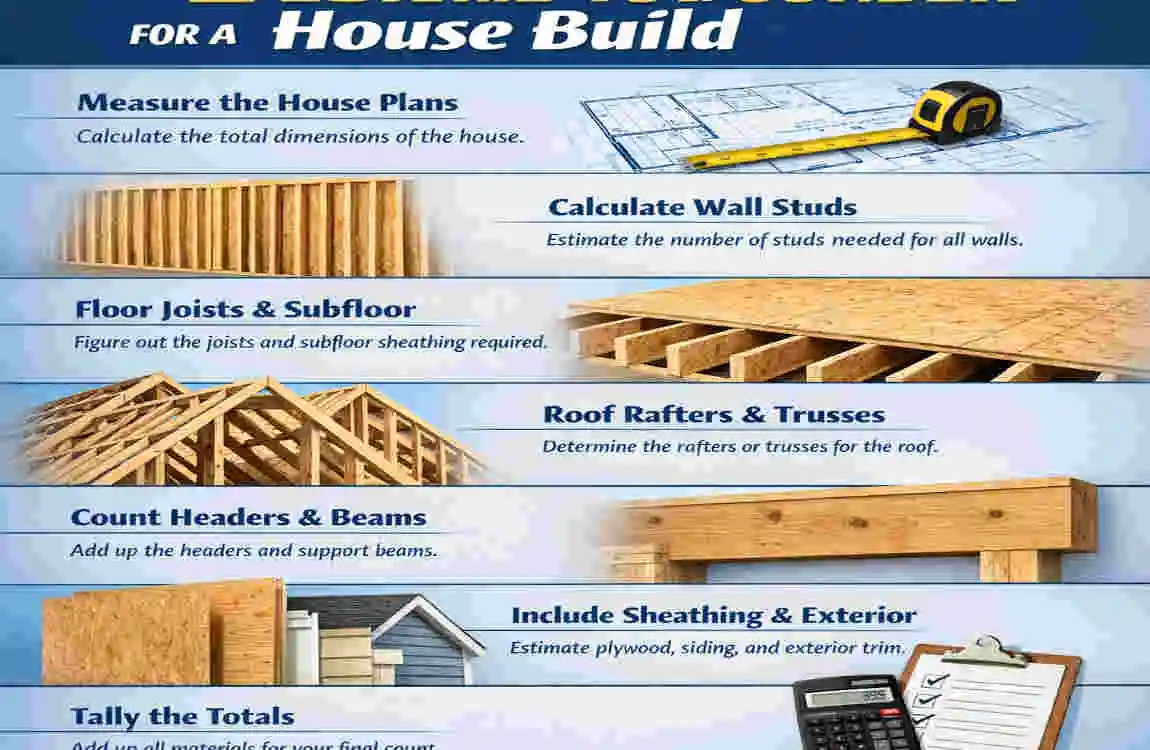
Measure Total Floor Area
Start with the blueprints. Confirm the exact floor area for every level. Do not guess.
If the plan includes porches, garages, bump-outs, or bonus rooms, include those too. A small change in layout can lead to a big change in lumber needs.
Estimate Wall Stud Count
A common method is to use this formula:
Wall Length ÷ 16 inches + extra corner studs
This works because many walls use a 16-inch stud spacing. If a wall is 32 feet long, for example, you can estimate how many studs fit across that length and then add extras for corners, openings, and support.
Remember that doors and windows also affect the stud count, as they require headers and additional framing.
Calculate Floor Joists
Next, look at the floor system.
Joists depend on spacing and span. Wider spans may need stronger lumber or engineered joists. Closer spacing uses more pieces. A longer room often means more joists or larger members.
If you are not sure, follow the span details in the building plan or ask a framer to confirm.
Roof Lumber Calculation
Now move to the roof.
The roof can be framed with trusses or rafters. Trusses are often easier to count because they are built in set spacing. Rafters can vary more because roof pitch and design affect the quantity.
A simple roof uses less material than a steep or complex roof. The more peaks, valleys, and angles you have, the more lumber you will need.
Add Sheathing Materials
Sheathing covers the wall, roof, and sometimes the subfloor. It is usually made from plywood or OSB.
To estimate it, divide the surface area by the panel size. Standard panels are often 4×8 feet, so planning is usually straightforward. Still, always allow for trimming around openings and edges.
Include Waste Factor
This step is easy to forget, but it is one of the most important.
Add 10% to 15% extra lumber for waste. This covers:
- Cuts
- Mistakes
- Damaged boards
- Site storage issues
- Small design changes
Without this buffer, you may fall short before the framing is complete.
Common Lumber Sizes Used in Home Building
2×4 Lumber
2x4s are one of the most common framing pieces. They are often used for interior walls and light structural work. They are affordable, easy to cut, and widely available.
2×6 Lumber
2×6 lumber is often used for exterior walls because it provides greater insulation depth and can offer greater strength in some designs.
2×8, 2×10, and 2×12
These larger sizes are often used for floor joists, roof rafters, and heavy load areas. The exact size depends on span and support needs.
Plywood and OSB
These are common sheet materials used for roof, wall, and subfloor sheathing. They add structural stiffness and help create a solid surface for finishing materials.
Engineered Lumber
Engineered products like LVL beams, I-joists, and trusses provide longer spans and stronger support. They are often chosen for modern homes with open layouts.
How Lumber Waste Can Affect Your Budget
Common Causes of Lumber Waste
Lumber waste can happen for simple reasons:
- Incorrect measurements
- Weather exposure
- Cutting errors
- Transportation damage
Even a small mistake can add up when you are dealing with hundreds of boards.
Smart Ways to Reduce Waste
Here are a few practical ways to control waste:
- Buy in bulk when possible to reduce delivery issues
- Protect materials on site from rain and sun
- Hire experienced framers who cut accurately
- Recheck blueprints before ordering
Waste control is not just about saving money. It also keeps the work area cleaner and more organized.
Cost Estimation: How Lumber Quantity Impacts Total House Build Budget
Lumber Price Fluctuations
Lumber prices do not stay fixed. They change due to market demand, seasonal shifts, and supply chain issues.
That means the same house can cost more to frame at one time of year than another. If you are budgeting early, always leave room for price movement.
Budget Planning Tips
A few simple habits can protect your budget:
- Buy early when possible
- Compare local suppliers
- Consider engineered wood when it improves efficiency
- Ask for updated quotes before final ordering
This is especially important on larger homes, where a small price change per board can create a big total difference.
Why Lumber Is One of the Largest Structural Costs
Lumber is not just a small line item. It is one of the biggest costs in the shell construction stage of a home.
The frame shapes the entire building. Because of that, wood materials, fasteners, and related labor often take a large share of the early budget.
DIY vs Professional Lumber Estimation
When DIY Calculation Works
DIY estimation can work well for small cabins, garages, and tiny homes. It also helps if you are learning and want a rough idea before speaking with a supplier.
When to Hire Professionals
For multi-story homes, custom designs, and complex framing, professional help is usually the better choice. Builders and framers can spot things that a beginner may miss.
If the home has unusual roof lines, large openings, or special code requirements, expert planning can save both time and money.
Common Mistakes When Estimating Lumber for a House
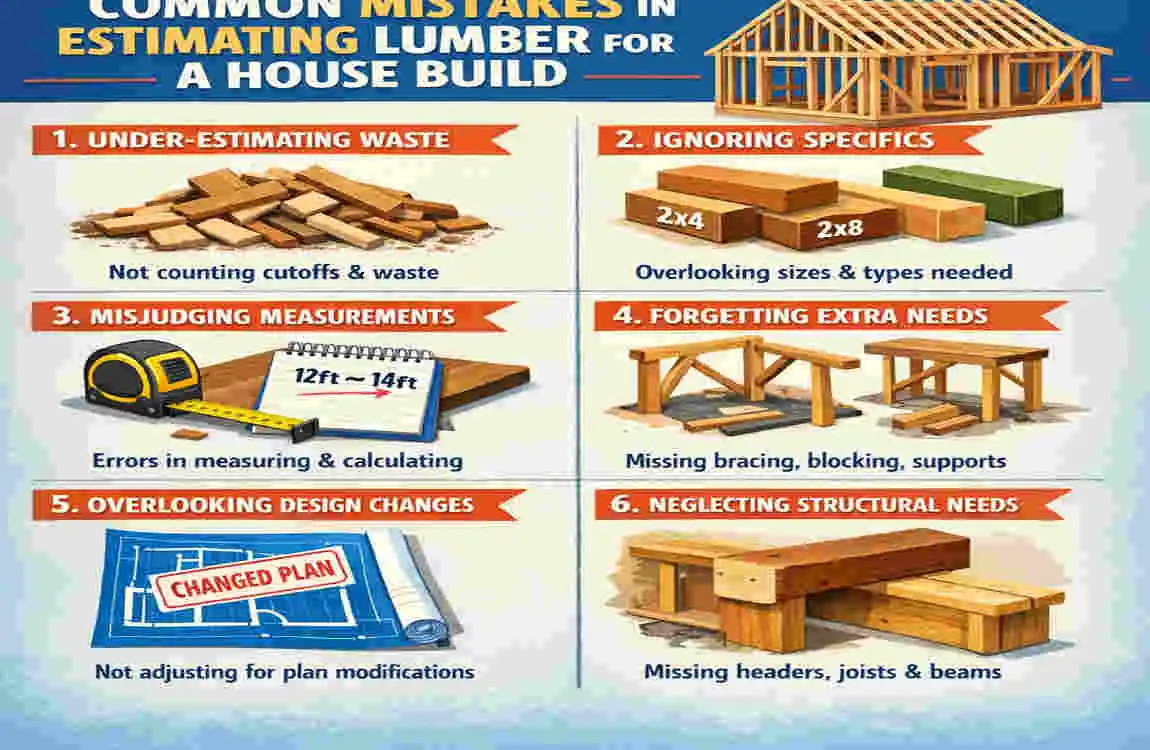
A lot of people make the same mistakes when they first estimate lumber:
- Forgetting waste allowance
- Ignoring roof framing
- Underestimating load-bearing walls
- Over-ordering expensive material
- Misreading blueprint scales
- Ignoring building code changes
These mistakes can increase costs or delay the build. A careful second check can prevent many of them.
FAQ
How many board feet of lumber are needed to build a house?
The average house may need roughly 6.3 to 7.5 board feet per square foot. That means a 2,000-square-foot home may need around 12,600 to 15,000 board feet, depending on the layout and framing style.
How much lumber does a 2,000 sq ft house require?
A 2,000-square-foot house often needs about 12,600 to 15,000 board feet of lumber. Complex designs, stronger codes, or extra floors can raise that number.
Is engineered wood better than traditional lumber?
It depends on the job. Engineered wood is often better for long spans and stronger support. At the same time, traditional lumber may be more affordable for standard framing. Many homes use both.
How much extra lumber should I buy?
A good rule is to add 10% to 15% extra for waste, cuts, mistakes, and damage. Some projects may need a little more if the design is complex.
Does roof design affect lumber quantity?
Yes, absolutely. A simple roof uses less lumber than a steep or complex roof. Roofs with valleys, dormers, and multiple angles usually need more framing material.