
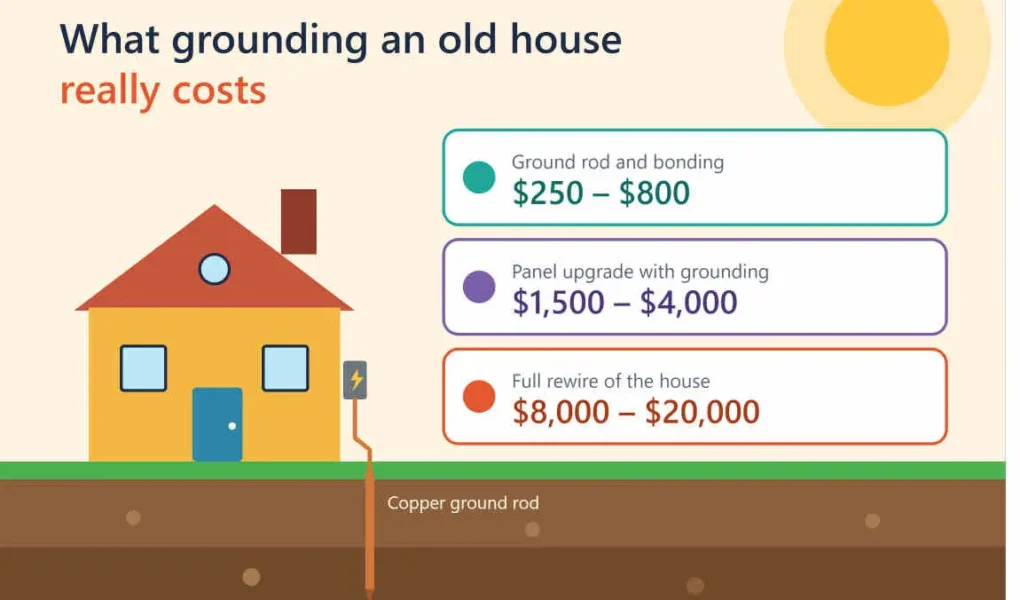
Grounding an old house costs $100 to $500 for a new ground rod, about $100 to $300 per outlet to run a new ground wire, and roughly $2,000 to $10,000+ to ground every outlet in the house. The final price depends on your wiring type, home size, how easy the walls are to access, and local permit rules.
What does it mean to ground an old house?
Grounding gives stray electricity a safe path to the earth if something goes wrong. Without it, a damaged appliance cord or a short circuit can leave metal surfaces live, and you could be the path that current takes.
Older homes often fall short here. Two-slot outlets are the classic giveaway, since they were installed before three-wire cable with a ground conductor became standard. Many houses have a mix, with a few grounded circuits added over the decades and the rest left as they were.
When contractors say “grounding,” they may mean one of three things:
- The grounding electrode system: the rod (or other electrode) and the wire connecting it to your panel.
- Equipment grounding on circuits: a ground wire running from each outlet back to the panel.
- Shock protection workarounds: GFCI protection on circuits that cannot get a true ground.
Always ask which one a quote covers. It is the number one reason two estimates for the “same” job look thousands of dollars apart.
How much does it cost to ground an old house in 2026?
Here are typical U.S. price ranges drawn from published cost guides. Your local quote will differ, but this gives you a realistic starting point.
| Grounding job | Typical cost | What you get |
|---|---|---|
| Install or replace a ground rod | $100 – $500 | Panel connected to the earth (Angi puts the average near $300) |
| Replace panel grounding wire | $100 – $300 | New conductor between panel and rod |
| Replace ungrounded outlet with a GFCI | $90 – $200 | Shock protection, but no true ground path |
| Ground one outlet | $100 – $300 | New ground wire from outlet to panel |
| Ground all outlets (rewire) | $2,000 – $10,000+ | Every circuit properly grounded |
Sources: HomeGuide for the outlet, GFCI, panel wire and whole-house figures; Angi for ground rod pricing.
Ground rod vs. grounding the whole house: what is the difference?
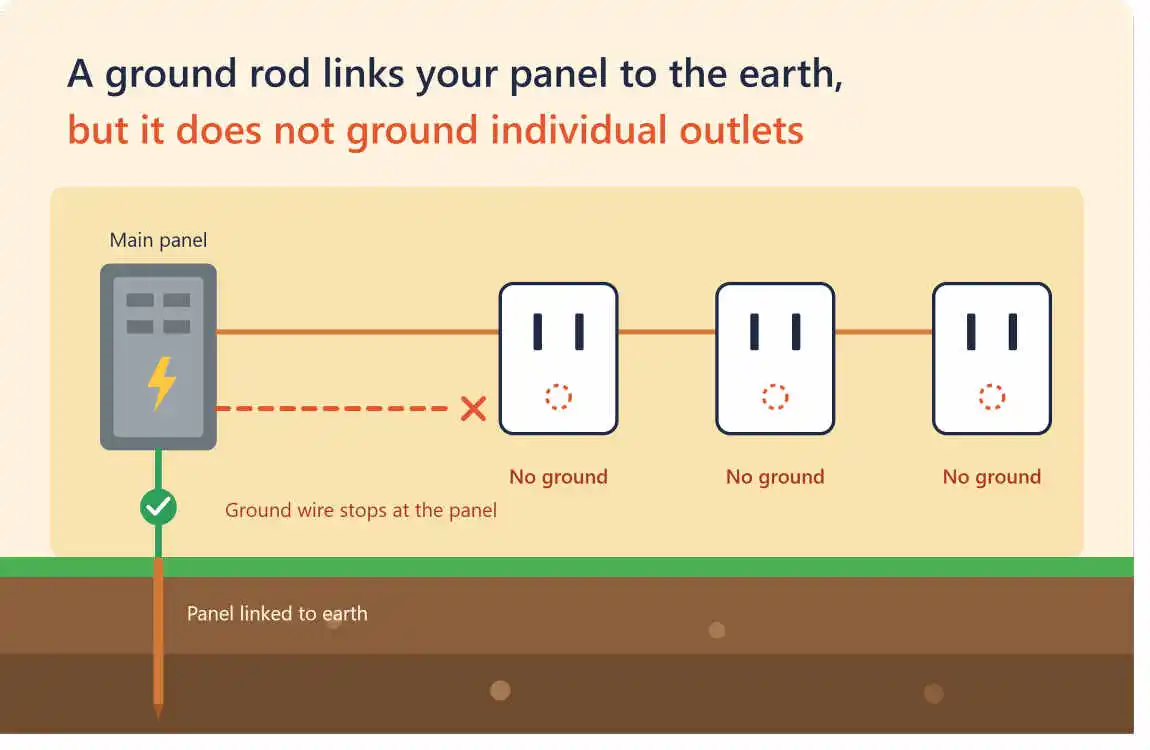
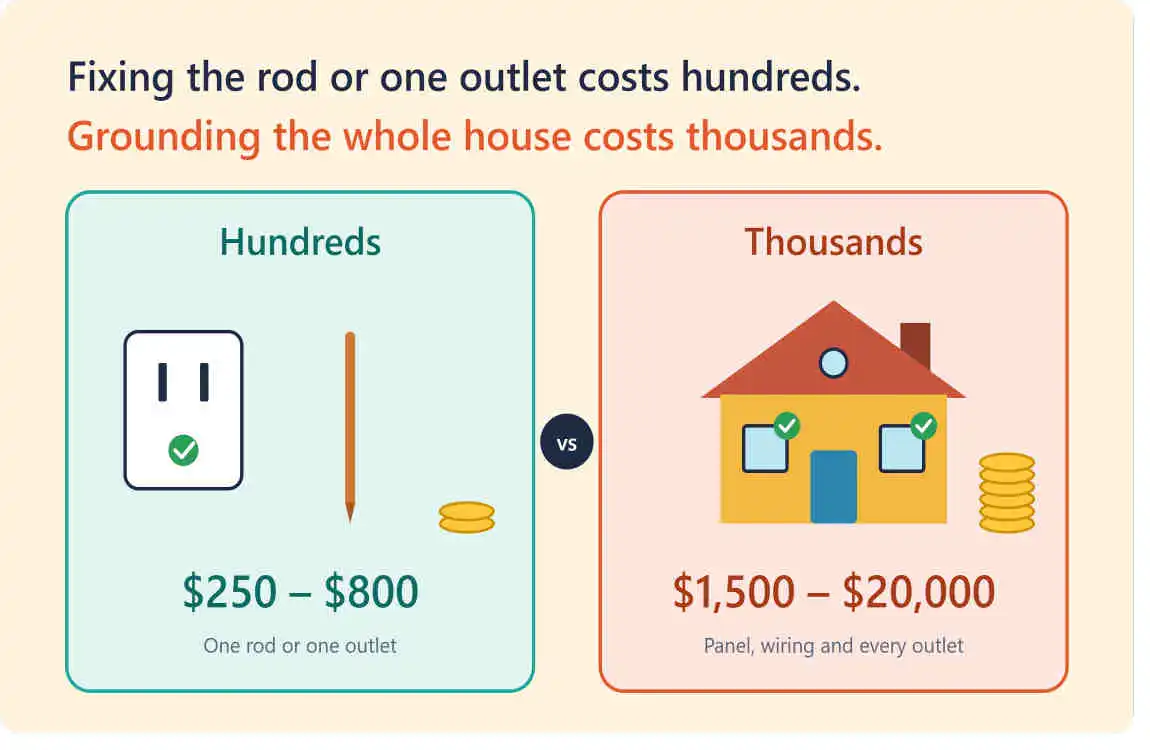
This is where homeowners get confused, and sometimes overcharged. Installing a ground rod ties your electrica service to the earth. It is a good upgrade, and many older homes need it. But HomeGuide is clear that a wire from the panel to an exterior ground rod does not ground the outlets throughout the house. Each receptacle still needs a ground wire running back to the panel.
Angi adds that if your home was built before 1970, you will likely need new wiring in addition to the rod. In other words, the $300 rod is often the first line item, not the whole bill.
What are your options if the wiring has no ground?
You do not have to jump straight to a rewire. The National Electrical Code gives three ways to replace a two-wire, ungrounded receptacle when no ground exists in the box. According to EC&M magazine’s code Q&A, you can use a GFCI-type receptacle marked “No Equipment Ground,” or a grounding-type receptacle that is GFCI protected and marked “GFCI Protected” and “No Equipment Ground.” (Replacing it with another two-slot outlet is also permitted.)
What affects the cost of grounding an old house?
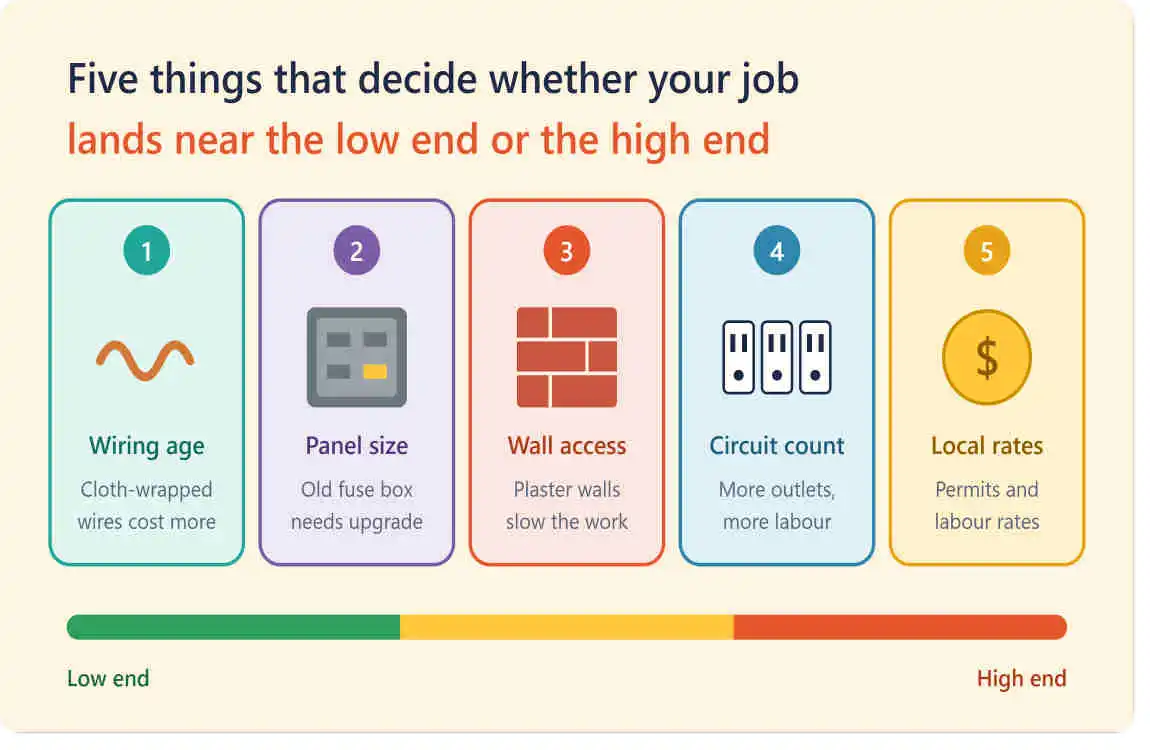
Wiring type and condition
If your home still has knob-and-tube wiring, you are not just adding grounds. You are looking at replacing much of the system, which is why costs climb into the thousands. Angi notes that ground wire itself can run up to $8 per linear foot, and the length adds up quickly in a big house.
Number of outlets and circuits
More outlets mean more labor. A house where most circuits already have a ground and only a few rooms do not will cost far less than one with two-wire cable throughout.
Access to walls, attic and basement
Open attic space or an unfinished basement lets an electrician fish wire without cutting into plaster. Finished plaster walls mean patching and paint house, which can add a lot to the total.
Panel condition
If the panel is outdated or undersized, the electrician may recommend an upgrade at the same time. That is a separate cost, but it is often smarter to do both in one visit.
Permits and local rules
Many areas require a permit and inspection for this kind of work. Fees and code details differ by city, so ask your electrician how local rules apply before you agree to a scope of work.
Is it worth grounding an old house?
For most owners, yes, at least in part. Electrical fires are a real, documented risk. In reviewing NFPA statistics from 2003 to 2014, NEMA reports that home electrical system fires averaged 25,366 a year, with 378 civilian deaths, 1,290 injuries and $1.4 billion in property damage annually. The U.S. Fire Administration notes that this risk is higher in homes more than 40 years old with older wiring, and that such homes may not meet modern code requirements.
Grounding is not a magic fix for fire risk, since fires often start from damaged or overloaded wiring rather than a missing ground alone. But it is part of bringing an old electrical system up to a safe standard, and it makes surge protectors and sensitive electronics work the way they should.
Do not DIY a “cheater ground.” Connecting an outlet’s ground terminal to the neutral, or labeling an ungrounded outlet as grounded, can make a fault look safe when it is not. Have a licensed electrician do the work and, where required, pull a permit.
How to keep the cost down
- Get an inspection first. Know which circuits are grounded before you ask for quotes, so every contractor prices the same scope.
- Prioritize high-risk rooms. Kitchens, bathrooms, laundry areas, garages and anywhere you use water or major appliances should come first.
- Use GFCI where a rewire is not practical. It is a legitimate, code-recognized step, not a shortcut, as long as it is labeled correctly.
- Bundle the work. Doing the rod, panel upgrade and circuit grounding in one project usually costs less than three separate callouts.
- Get at least three written quotes that spell out the number of circuits, whether wall repair is included and who handles the permit.
Frequently asked questions
How much does it cost to ground an old house?
A ground rod typically costs $100 to $500. Grounding a single outlet runs about $100 to $300, and grounding all outlets by rewiring generally costs $2,000 to $10,000 or more.
Can I ground an old house without rewiring it?
You can improve safety without a full rewire. The NEC allows GFCI outlets marked “No Equipment Ground” on ungrounded circuits, and an electrician can add ground wires to specific circuits. A GFCI protects people but does not provide a true ground.
Does a ground rod alone ground my outlets?
No. The rod connects the panel to the earth. Each outlet still needs a ground wire running back to the panel.
How do I know if my old house is grounded?
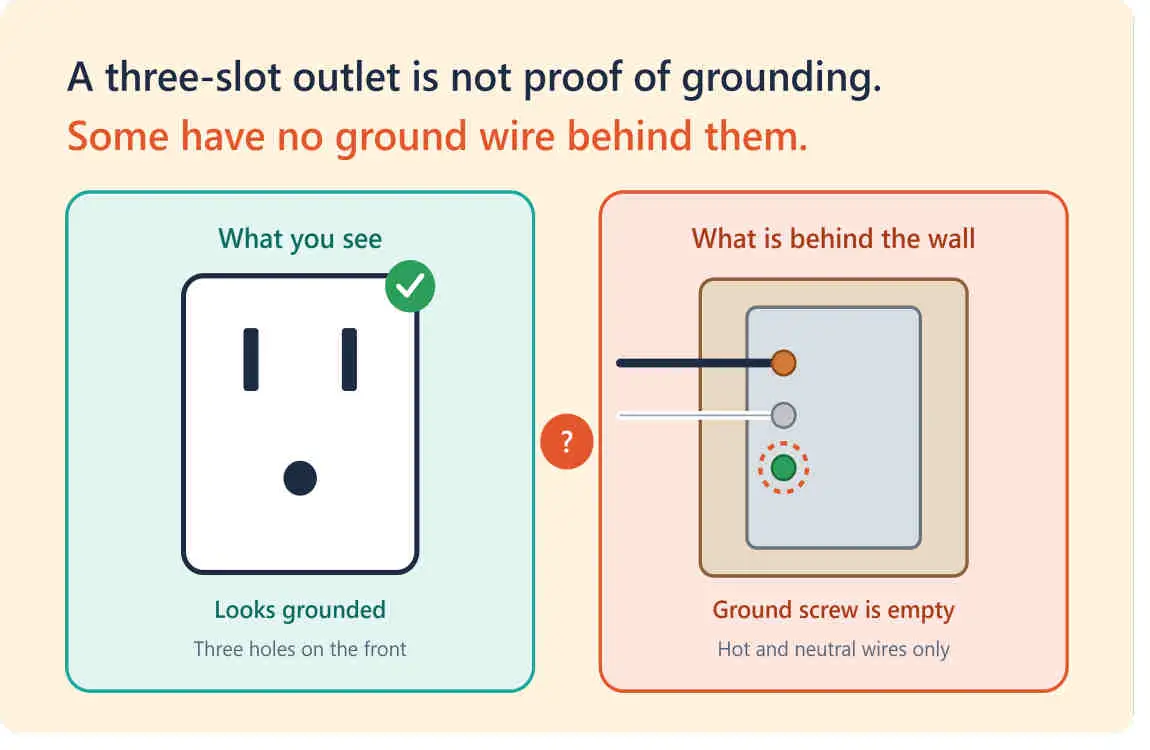
Two-slot outlets generally mean no ground. Three-slot outlets are not proof, because some were installed without a ground wire. A licensed electrician can test every circuit.
Is an ungrounded house dangerous?
It can be. A fault may leave metal on an appliance energized, which raises shock risk, and surge protection works less effectively without a ground. Older wiring is also linked to higher electrical fire risk.
Bottom line
If you only need a ground rod, expect a few hundred dollars. If you want every outlet properly grounded in an older home, budget for thousands, and ask your electrician about GFCI protection as a stepping stone. Either way, get a written quote that says exactly which kind of “grounding” you are paying for.