Have you ever been relaxing in your living room, enjoying a quiet evening, when suddenly the air conditioner kicks on and all the lights dim for a split second? Or maybe you have tried running the microwave and the vacuum cleaner at the same time, only to be plunged into darkness when a breaker trips. If you are experiencing these common household quirks, you might find yourself asking a very important question: what is the average amperage of a house, and more importantly, does my home have enough of it?
To give you the short answer right upfront, the typical home amps range from 100 to 200 amps for most modern homes. However, understanding the size of your residential electrical service is about much more than a number on a metal box in your basement. It is about the safety of your family, the reliable performance of your appliances, and your home’s readiness for modern upgrades like electric vehicles (EVs) and solar panels.
| Service Size | Home Type/Age | Power Capacity (at 240V) | Suitable For | Upgrade Recommended If |
|---|---|---|---|---|
| 60 Amp | Pre-1965 small homes | ~14,400 watts | Basic lighting, few outlets | Adding any modern appliances |
| 100 Amp | 1960s-1990s homes | ~24,000 watts | Gas appliances, small AC | Frequent trips, EV charger, electric heat |
| 200 Amp | New/renovated homes | ~48,000 watts | All appliances, EV, hot tub | Large homes need 400A |
| 400+ Amp | Luxury/large homes | 96,000+ watts | High-demand setups | Rare for standard homes |
What Amperage Means for Your Home

Before we can figure out if your house is up to speed, we need to decode some basic electrical jargon. What exactly does “amperage” even mean, and why should you care?
Decoding the Electrical Jargon
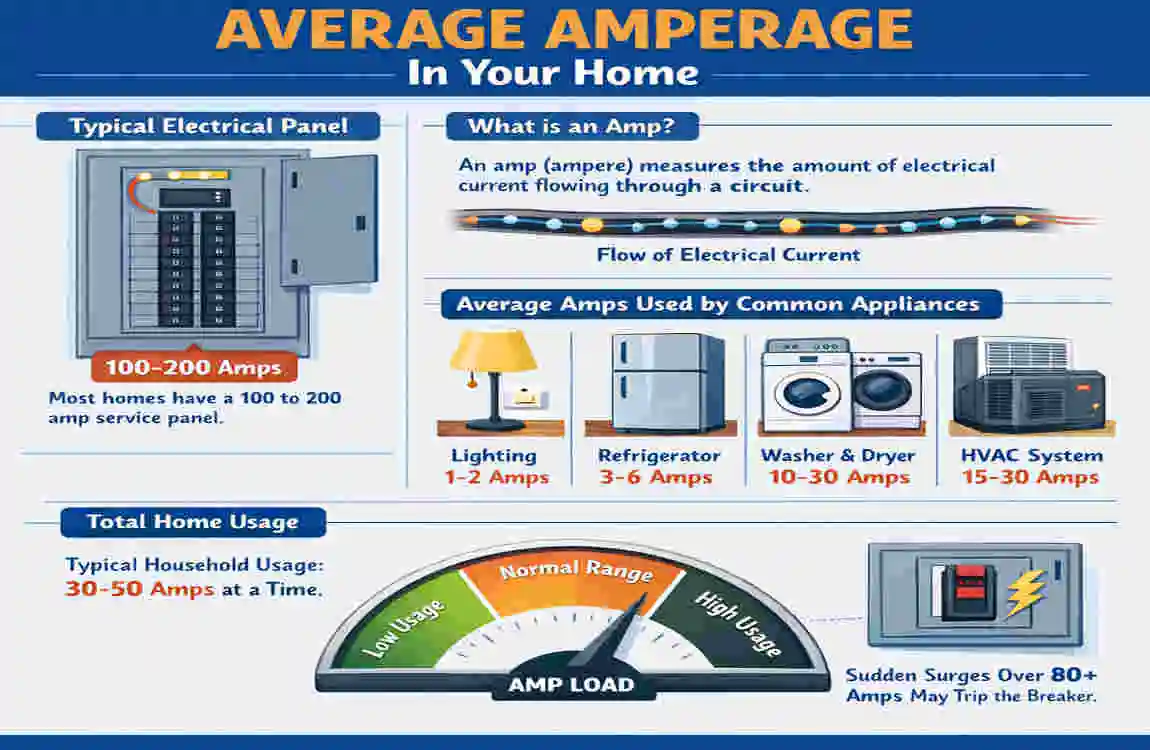
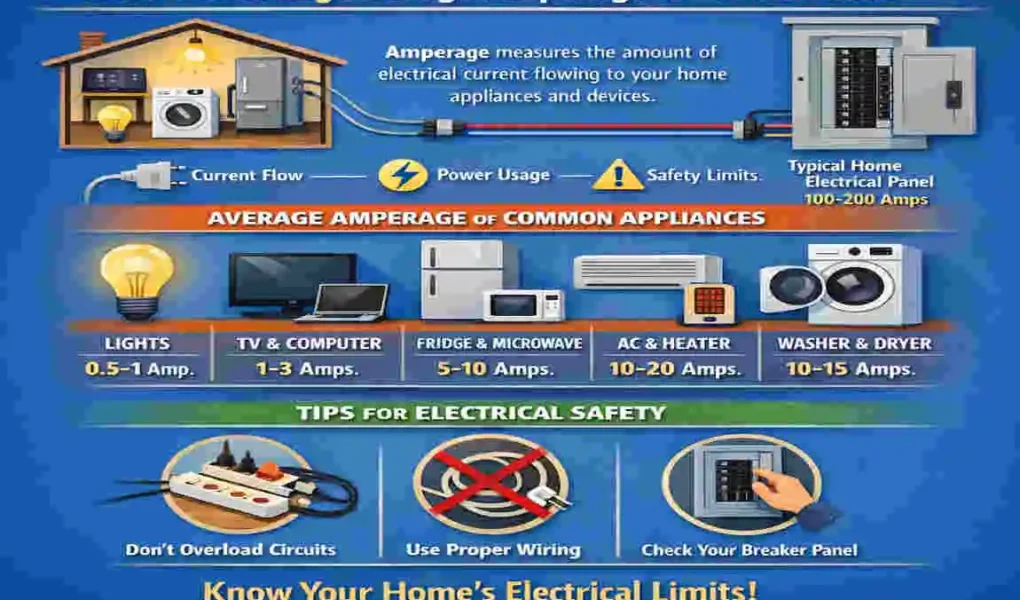
Think of your home’s electrical system like a network of plumbing pipes. In this analogy, the voltage (usually 120V or 240V in standard homes) is the water pressure pushing the water through the pipes. Wattage represents the total volume of water you are actually using for a shower or for running the dishwasher.
So, where does amperage fit in? Amperage (or amps) is the physical size of the pipe itself. It represents the maximum electrical “flow” capacity your home can safely handle at any given moment. If you try to force too much water through a narrow pipe, the pipe bursts. If you try to pull too much electricity through an undersized electrical panel, the circuit breaker trips to prevent a fire.
The Evolution of Home Power
When you ask, “what is the average amperage of a house,” the answer largely depends on exactly when your home was built. Our power hunger has grown massively over the decades.
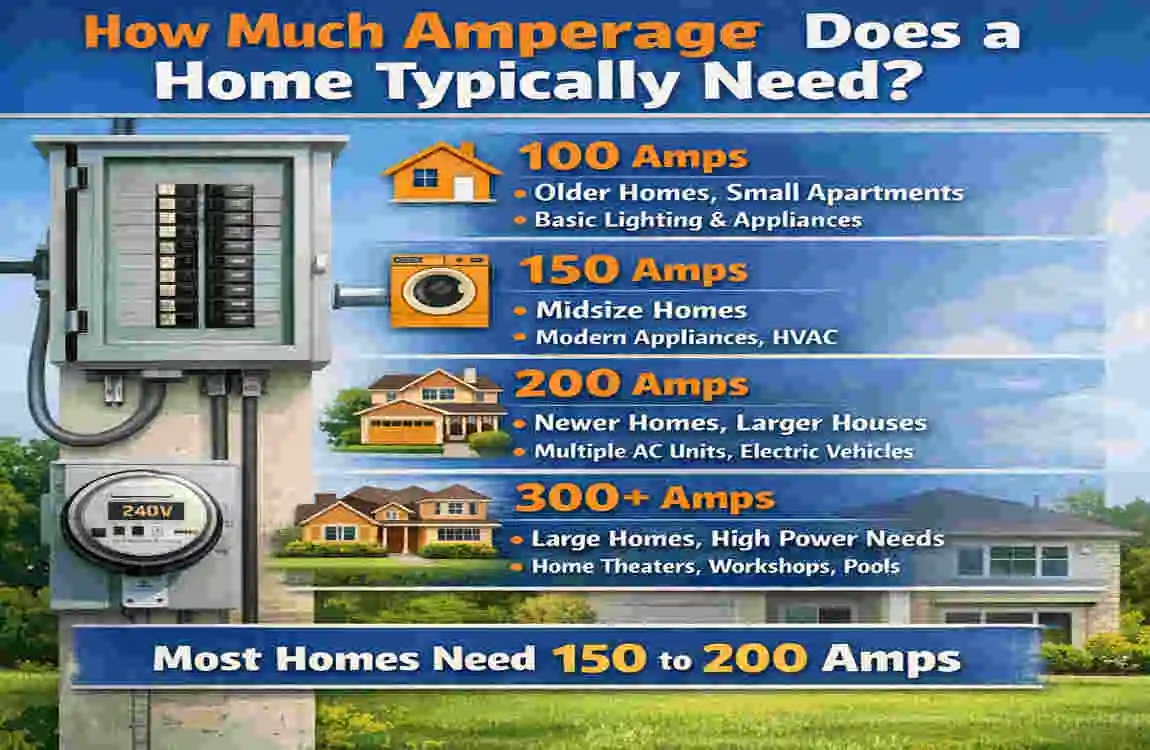
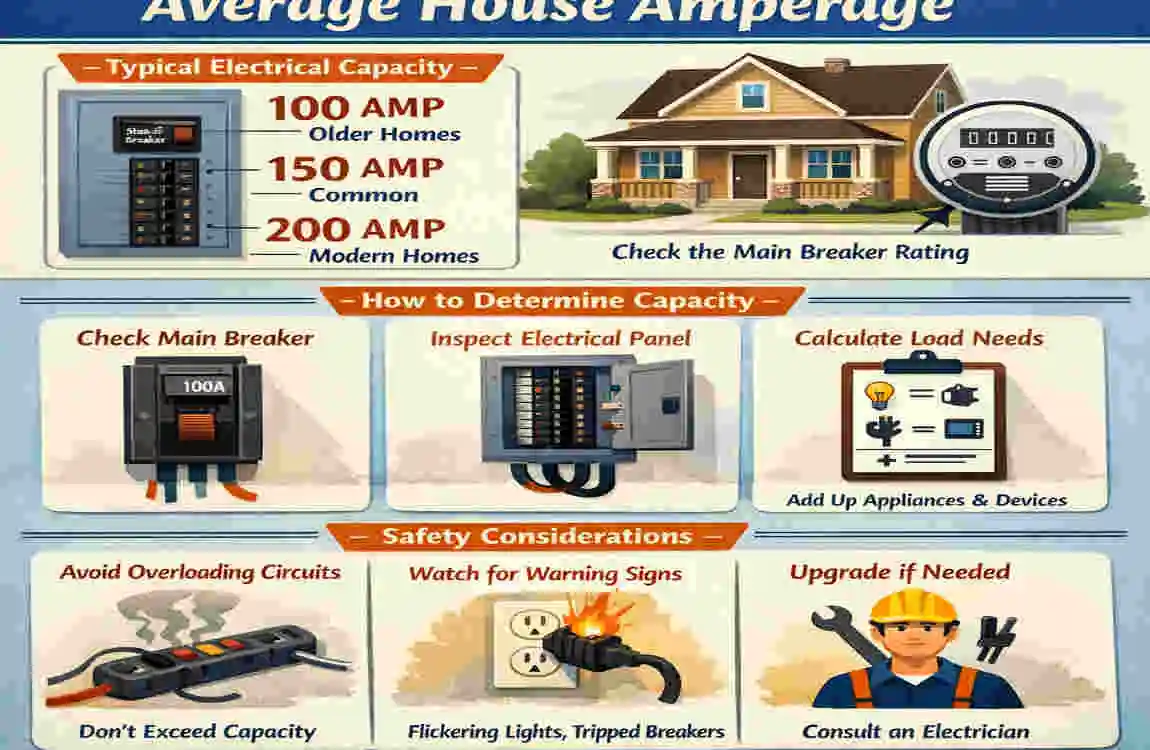
- 60A Service: If you live in a vintage home built before the 1950s that hasn’t been updated, you might only have a 60-amp service. Back then, homes only needed power for a few incandescent lights, a radio, and maybe a basic refrigerator. Today, 60 amps is barely enough to run a modern kitchen.
- 100A Service: Fast forward to the 1960s through the 1990s, and 100 amps became the golden standard. This average house amperage is perfectly fine for homes that rely heavily on gas utilities for heating, cooking, and drying clothes.
- 200A Service: Welcome to the modern standard. If you are building a new house today or buying a recently renovated property, 200 amps is the benchmark. It provides the breathing room needed for central air conditioning, electric ranges, and high-tech entertainment systems.
- 400A Service: For luxury estates or massive homes pushing over 3,000 square feet with multiple HVAC units, heated pools, and dedicated woodworking shops, 400 amps is the new frontier.
Visualizing Your Electrical Needs
To help you understand where your property fits into the grand scheme of things, take a look at this quick breakdown:
Service SizeHome TypeSq Ft FitMax Appliances
60-100A Older/Small < 1,500 sq ft Basic lighting + gas utilities
200A Modern 1,500-3,000 sq ft Full electric + EV ready
400A Large/Luxury 3,000+ sq ft High-demand + luxury amenities
Knowing what is the average amperage of a house helps you set realistic expectations for your own property. If you live in a 2,500-square-foot home built in 1975, you might be pushing a 100-amp panel to its absolute limits without even realising it.
Finding Your Home’s Amperage
Now that you understand what amperage is, it is time for a little DIY detective work. Finding the size of your residential electrical service is usually a quick and straightforward process, provided you know exactly where to look.
The Treasure Hunt: Locating Your Panel
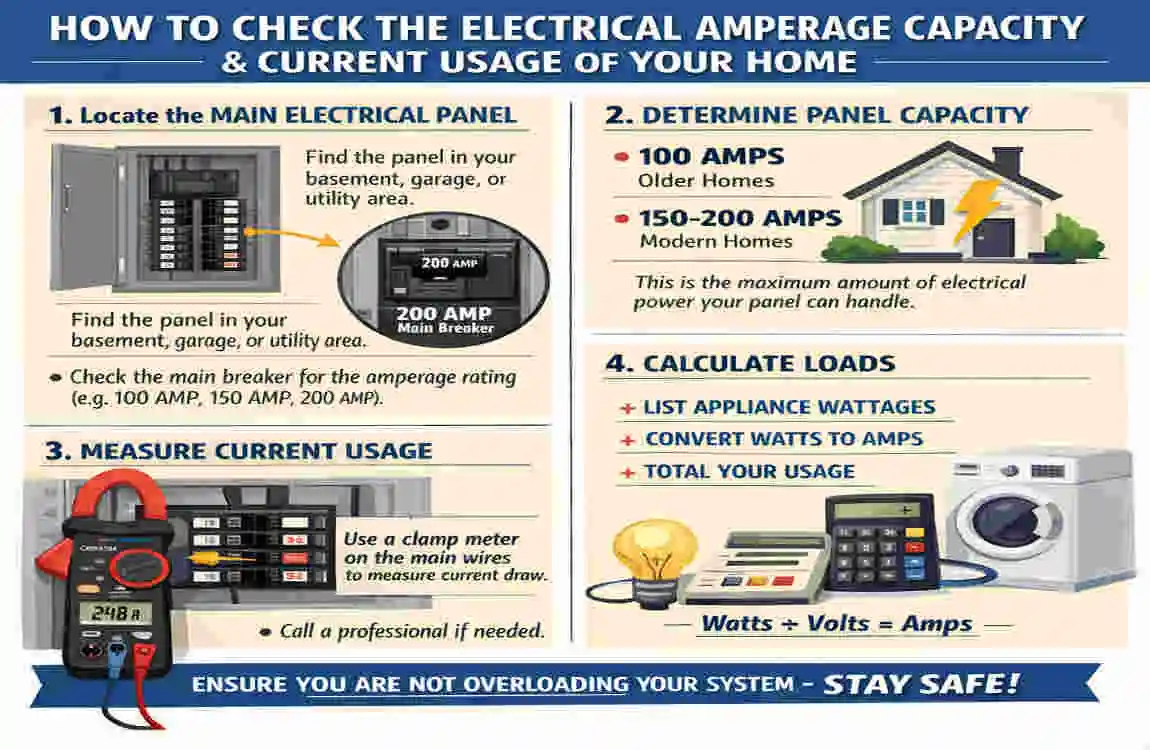
Your journey begins by finding your main electrical panel, commonly known as the breaker box. In most homes, builders hide these panels in out-of-the-way places to keep them from ruining the interior decor.
Start your search in the garage, the basement, or a dedicated utility room. If you live in an older home or a warmer climate, the main panel might even be mounted outside right next to the electric meter. Look for a gray metal box, typically mounted flush against the wall or recessed into the drywall.
Reading the Main Breaker
Once you find the box, open the metal door. You will see rows of smaller switches—these control individual rooms and appliances. But we are looking for the big boss: the main breaker.
The main breaker is usually a large double-pole switch located at the very top, the very bottom, or occasionally in the centre of the panel. Look closely at the handle of this main switch. You should see a number stamped or printed right on it. If it says “100,” you have a 100-amp service. If it says “200,” congratulations, you have a 200-amp service.
Clues from the Meter Base
What if the breaker number is worn off, or you have an old-school fuse box without a main breaker? You can step outside and look at your electric meter base (the glass dome where the utility company reads your usage).
Sometimes, the exterior meter box will have a label or a separate outdoor disconnect switch that clearly states the maximum amperage. However, be aware that a meter base rated for 200 amps doesn’t automatically mean your inside panel is 200 amps—the entire system is only as strong as its weakest link.
Safety First, Always!
Before you go poking around your electrical system, let’s talk safety. Electricity is incredibly unforgiving.
When you open your panel door, never remove the protective metal cover (the “dead front”) that surrounds the switches. Never touch exposed wires or metal components. Simply open the swinging door and read the numbers with your eyes, not your hands. If you are ever unsure, or if your panel looks damaged, rusty, or smells faintly like burning plastic, stop immediately and call a licensed professional.
FAQ: What is the average amperage of a house in 2026? If you are asking this today, the answer has firmly shifted. While 100A was common decades ago, 200A is the undeniable standard for all new residential builds to accommodate our increasingly electric lifestyles.
100A Service: Is It Enough?
If you checked your panel and discovered a “100” stamped on the main breaker, you might be feeling a little anxious. Don’t panic just yet! Let’s break down the reality of living with a 100-amp system.
The Pros of Staying at 100 Amps
No rule says you must upgrade just because 200 amps is the new standard. In fact, keeping your 100-amp service has a few distinct advantages.
First and foremost, it is highly cost-effective because you don’t have to spend thousands of dollars on a home electrical panel upgrade. If you live in a smaller home, an apartment, or a townhome, 100 amps is often plenty of juice. This is especially true if your heavy-hitting appliances—such as your furnace, water heater, kitchen range, and clothes dryer—run on natural gas or propane rather than electricity.
The Hidden Drawbacks and Overload Risks
The problems with 100-amp panels arise when you start trying to drag an older home into the modern era. We use significantly more electronic devices today than we did thirty years ago.
The biggest drawback is the lack of room for expansion. If you want to finish your basement, add a sprawling home theater, or install a central air conditioning system, a 100-amp panel will quickly become a roadblock. Furthermore, if you are dreaming of joining the green revolution by bringing home an Electric Vehicle, a 100-amp service will almost certainly disqualify you from installing a fast Level 2 charger in your garage.
A Real-World Load Calculation
To truly understand why 100 amps can feel restrictive, let’s do some simple, real-world math.
Imagine it is a hot summer evening. You have your central air conditioner running (pulling about 15 to 20 amps). You are cooking dinner on an electric stove (up to 40-50 amps if multiple burners are on). Your electric water heater kicks on (another 20 amps) because someone is showering. Your refrigerator is cycling (8 amps), and you toss a load of laundry into the electric dryer (30 amps).
If you add all those up, you are suddenly demanding over 100 amps of power at once.
When 100A Starts Tripping
What happens when you demand 110 amps from a 100-amp panel? The main breaker does exactly what it was designed to do: it trips, shutting off power to the entire house to prevent the wires inside your walls from melting and starting a fire.
If you find yourself actively negotiating with your family about who can use which appliance (“Don’t turn on the microwave while I’m blow-drying my hair!”), it is a glaring sign that your 100-amp service is no longer adequate for your lifestyle.
200A Service: The Modern Standard
When comparing a 100-amp vs 200-amp service, the larger option wins out in almost every modern scenario. Let’s look at why 200 amps has taken the crown as the ultimate average house amperage for today’s homeowner.
Why 200 Amps Rules the Roost
A 200-amp electrical panel gives your home a lot of breathing room. To put it in technical terms, a 200-amp panel operating at 240 volts can safely handle a total load of up to 48,000 watts (48kW).
This massive capacity means you can run your central air conditioner, bake a turkey in your electric oven, do a load of laundry, and have all the lights and TVs on in the house without even coming close to maxing out your system. You get peace of mind knowing your electrical foundation is rock solid.
Preparing for the Future: Solar and EVs
The shift toward 200 amps isn’t just about running more TVs; it is about fundamentally changing how we power our lives.
As gas prices fluctuate, more homeowners are buying electric vehicles. A dedicated Level 2 EV charger requires a 50-amp or 60-amp circuit all to itself. If you only have a 100-amp panel, giving up half your total power to your car simply isn’t feasible. A 200-amp panel absorbs that massive load effortlessly.
Furthermore, if you ever plan to install rooftop solar panels, local building codes and solar installers will almost certainly require a 200-amp panel to safely connect to the energy your roof generates.
Breaking Down the Differences
Here is a quick comparison to show exactly why modern builders have left the 100-amp standard behind:
Feature100A Panel200A Panel
Total Capacity 24kW (24,000 watts) 48kW (48,000 watts)
EV Charger Support No (Usually maxes out system) Yes (Easily accommodates)
Central Air & Electric Heat Struggles or trips Highly Reliable
Room for New Circuits Very Limited Plenty of expansion space
A Real Family Case Study
Consider the Smith family, living in a cozy 1980s ranch home. They managed perfectly fine on their original 100-amp panel for years. However, when they purchased a new electric SUV, they realised they could only charge it with a standard wall outlet, which took over 24 hours to fully charge.
When they hired an electrician to install a fast charger, they were told their panel was already at capacity. The Smiths opted for a full 200-amp upgrade. Not only did they get their lightning-fast car charger, but they also finally stopped experiencing annoying kitchen light flickers whenever their ancient refrigerator compressor kicked on.
When to Upgrade Your Electrical Service

Understanding what is the average amperage of a house is helpful, but how do you know when it is finally time to pull the trigger on an upgrade? You shouldn’t wait until your panel physically breaks down. Here are the undeniable signs that your home needs more power.
Telltale Signs Your Home is Struggling
Your house will usually try to communicate with you when its electrical system is under duress. Pay attention to these common symptoms:
- Frequent Breaker Trips: If you know exactly where the flashlight is kept because you have to visit the breaker box once a week, your system is overloaded.
- Dimming or Flickering Lights: Do your living room lamps dim significantly when the AC or washing machine starts up? That indicates a temporary voltage drop caused by an undersized electrical service.
- Warm or Buzzing Panels: Place your hand gently on the closed metal door of your breaker box. It should feel cool to the touch. If it feels unusually warm or if you hear a faint buzzing or crackling sound, call a professional immediately. This is a severe fire hazard.
- A Full Box: If you open your panel and see zero empty slots for new breakers—or worse, if an amateur has crammed “tandem” (double) breakers into every single slot to cheat the system—you are out of room.
The Math Behind the Decision
Electricians don’t just guess when recommending a home electrical panel upgrade; they use a specific formula dictated by the National Electrical Code (NEC).
While the exact math can get complicated, it generally starts with a base load of 10,000 volt-amps (10kVA) to cover general lighting and wall outlets. Then, they add up the specific wattage requirements of your large, dedicated appliances (HVAC, range, dryer, water heater). They apply a “demand factor” percentage (since you don’t use everything 100% of the time) to calculate your true required load. If that final number exceeds 100 amps, an upgrade is legally and practically required for any new additions.
Major Life Changes That Require More Power
Sometimes, you dictate the upgrade through home improvements. You will almost certainly need to step up to 200 amps if you are planning any of the following projects:
- Installing a hot tub or heated pool.
- Converting from a gas furnace to an electric heat pump.
- Building an addition or finishing a large basement.
- Adding a dedicated workshop with heavy-duty power tools.
Boosting Your Property Value and Safety
Upgrading your electrical service isn’t just a functional necessity; it is a smart financial investment. When it comes time to sell your property, a brand-new 200-amp panel is a major selling point. Modern homebuyers have modern electronics, and home inspectors will immediately flag a 100-amp panel as a potential limitation.
Furthermore, upgrading often results in hidden insurance savings. Many home insurance providers offer lower premiums for homes with updated, heavily regulated electrical systems because the statistical risk of electrical fires is dramatically reduced.
Upgrade Process and Costs
Okay, you have evaluated your typical home amps, recognised the warning signs, and decided it is time to upgrade your home electrical panel. What exactly does that process look like, and more importantly, how much of a dent is it going to leave in your wallet? Let’s map out the journey.
The Electrician’s Assessment
You absolutely cannot do this project yourself. The first step is to bring in a licensed, bonded, and insured residential electrician. They will perform a thorough load calculation, inspect your current wiring to ensure it is up to code, and determine the best physical location for the new, larger panel box.
Coordinating with the Utility Company
Upgrading to 200 amps isn’t just about changing the box inside your house; it also requires changing the amount of power the city delivers to your property. Your electrician will coordinate with your local utility provider.
The utility company will need to come out to temporarily disconnect your power at the street. In many cases, they will also need to upgrade the physical wires running from the utility pole to your house (the “service drop”) and install a new, higher-capacity electrical meter on the outside of your home.
Out with the Old, In with the New Panel
On the day of the installation, your house will be without power for several hours. The electrician will strip out your old panel, remove the old breakers, and install the new 200-amp enclosure.
They will carefully reconnect every single circuit in your home to new, modern breakers. This is tedious, meticulous work that requires an expert eye to ensure all connections are torqued to the proper tightness. Loose wires can cause electrical arcing, which can start fires.
Final Inspection and Powering Up
Once the work is complete, a local city or county building inspector must review the installation to ensure it meets strict National Electrical Code (NEC) standards. Only after passing this critical inspection will the utility company give the green light to restore power to your newly upgraded home.
What Will It Cost You?
Let’s talk numbers. The cost to upgrade from a 100-amp to a 200-amp service generally ranges from $2,000 to $5,000.
Why such a wide range? Several variables influence the final price tag:
- Geographic Location: Labor rates vary wildly depending on whether you live in a rural area or a high-cost metropolitan city.
- Accessibility: If your panel is buried behind a finished basement wall and requires demolition of the drywall, labour costs will increase.
- Underground vs. Overhead Wires: If your utility lines run underground and need to be trenched and replaced to handle 200 amps, the price will surge significantly compared to a simple overhead wire swap.
Despite the upfront cost, the return on investment is undeniable. You are buying decades of safety, unlimited convenience, and a highly sellable home asset.
Safety Tips and Common Myths

When dealing with electricity, misinformation can be incredibly dangerous. Let’s clear the air, bust a few persistent myths about your home’s power, and establish some best practices to keep your family safe.
Busting the “100A is Forever” Myth
There is a stubborn myth floating around neighborhood forums: “If a 100-amp panel was good enough for this house for 40 years, it’s good enough forever.”
This is fundamentally false. The way we consume electricity today looks nothing like it did in 1985. We work from home on multi-monitor computer setups. We run high-efficiency robotic vacuum cleaners. We stream 4K televisions in multiple rooms simultaneously. What is the average household amperage today? It is 200 amps, precisely because “forever” doesn’t account for the invention of high-speed electric vehicle chargers and heat pump water heaters. Upgrade if you are under 200A and planning any modern improvements.
Essential Safety Tips for Homeowners
To maintain a healthy electrical system, you should treat your breaker panel with the same respect you give your car’s engine. Adopt these simple habits:
- Schedule Annual Inspections: Have a licensed electrician visually inspect your panel and major circuits every few years. They can spot loose connections or signs of overheating long before they become catastrophic failures.
- Embrace GFCIs and AFCIs: Make sure your kitchen, bathrooms, garage, and outdoor outlets are protected by Ground Fault Circuit Interrupters (GFCIs) to prevent electrocution. Modern panels also utilize Arc Fault Circuit Interrupters (AFCIs) to detect dangerous sparking behind your walls.
- Label Your Breakers Clearly: Don’t wait for an emergency to guess which switch turns off the kitchen. Take an hour on a weekend to accurately map and label every breaker in your box.
Why DIY Electrical Work is a Hard Pass
We love a good weekend DIY project—painting a room, fixing a leaky faucet, or building a garden bed. But when it comes to your electrical panel, put the tools down.
Opening a live electrical panel exposes you to deadly voltage. Even a simple mistake, like installing the wrong size breaker for a specific wire gauge, can easily result in a hidden wall fire months down the line. Always, always hire a professional.
Smart Energy Habits to Lower the Load
If you are currently stuck with a 100-amp panel and saving up for an upgrade, you can protect your system by practicing smart energy management. Swap out old incandescent bulbs for ultra-efficient LEDs. Avoid running your dishwasher, washing machine, and heavy power tools at the same time. By spacing out your electrical demands, you can reduce the strain on your aging system.
If you are reading this on our business blog, remember that a professional energy audit is just a phone call away. We can easily assess your load and give you peace of mind!
Frequently Asked Questions
What is the average amperage of a house?
For most modern homes, the standard electrical capacity ranges from 100 to 200 amps . This amount of power is generally plenty to safely handle the daily demands of our technology-heavy lifestyles . While older homes built decades ago might only have 60 to 100 amps, today’s builders almost always install a 200-amp service to ensure you have enough power for the future.
How do I figure out my home’s exact amperage?
You can easily check your home’s capacity yourself in just a few minutes! Head to your basement, garage, or utility closet and look for a gray metal breaker box .
Open the inner door to look inside, but never remove the main metal cover. Look for the largest switch, which is usually positioned at the top or bottom and labeled “Main.” You will typically see a number like “100” or “200” stamped right on the handle, which tells you your exact panel amperage .
Is a 100-amp service enough for my family?
It depends entirely on your lifestyle and your major appliances. If you use natural gas for your stove, water heater, and furnace, 100 amps might work perfectly fine for your daily needs.
However, sticking with a 100-amp service can limit your ability to add extra breakers to your panel later on . If you plan to upgrade your home by installing heavy-duty electric appliances—like a new central air conditioning unit or a modern electric range—you will likely need to expand your electrical supply to handle the extra load .
What service sizes are common for different homes?
To make things simple, here is a quick breakdown of typical power needs based on home size and usage:
| Service Size | Best Fit For Your Home |
|---|---|
| 100 Amps | Smaller homes, older properties, or houses relying on gas appliances. |
| 200 Amps | The modern standard for homes with central AC and heavy electrical usage. |
| 400 Amps | Very large luxury homes (3,000+ sq ft) with extreme power demands . |
Keep in mind that 200 amps provides a massive amount of electrical current. In fact, standard electrical load calculations for even a sprawling 5,000-square-foot house often show a requirement of only about 150 amps .
Here is a quick checklist of things that might require you to jump from 100 to 200 amps:
- Buying an electric vehicle (EV) that needs a fast charger in the garage.
- Installing a new hot tub or heated pool in your backyard.
- Converting your gas appliances over to fully electric models.