How to Bid on Home Plumbing Jobs: Win More Contracts with Profitable Pricing Strategies
Plumbing

How to Bid on Home Plumbing Jobs: Win More Contracts with Profitable Pricing Strategies

Have you ever finished a grueling day on a job site, looked at your bank account, and wondered where all the money went? You worked hard, the customer was happy, and the leak is fixed—but after paying for parts and your helper, there’s barely anything left for you.

If this sounds familiar, you aren’t alone. Research shows that 80% of plumbing jobs are won by bids that strike a delicate balance between competitiveness and profitability. Yet a staggering number of local contractors underbid their work to “get the job,” only to find they’ve essentially paid for the privilege of working.

Understand Your Costs First: The Foundation of Every Bid

How to Bid on Home Plumbing Jobs: Win More Contracts with Profitable Pricing Strategies

Before you ever pick up a pen to write a quote, you have to know your numbers. You wouldn’t fix a slab leak without a blueprint of the pipes, right? Bidding without knowing your costs is just as dangerous. Accurate cost estimation is the only way to prevent underbidding on home plumbing jobs.

Direct Costs Breakdown

Direct costs are the “obvious” expenses. These are the things you can point to on the job site and say, “I paid for that specifically for this house.”

1. Materials and Supplies This includes everything from the heavy-duty stuff like water heaters and vanity units to the small things like PVC primer, Teflon tape, and flux.

  • Pro Tip: Always get updated quotes from your suppliers. Prices for copper and PEX can fluctuate wildly.
  • The Waste Factor: Never bid for precisely what you need. Always add a 10-15% waste factor. Why? Because pipes get cut wrong, fittings go missing, and sometimes a part arrives defective. You shouldn’t have to pay that cost.

2. Labor Costs Your time—and your team’s time—is your most valuable asset. When calculating labor for a plumbing bid, don’t just focus on “wrench time.” Think about:

  • Drive time to the job site.
  • Time spent unloading tools.
  • The actual installation (e.g., 2-4 hours for a standard kitchen faucet or 6-8 hours for a water heater).
  • Cleanup and testing.

3. Subcontractors and Permits: Are you doing a full repipe that requires a city inspector to sign off? Are you hiring an excavation crew for a central line repair? These costs must be baked into your bid from the start. Never assume a homeowner will “just pay the permit fee later.” Include it in the total so there are no surprises.

Overhead Essentials: The “Hidden” Profit Killers

Overhead is what kills most small plumbing businesses. These are the costs of keeping your doors open, whether you have a job scheduled today or not.

  • Fixed Overhead: This includes your business insurance, your truck payments, office rent, and software subscriptions. Generally, you should aim for your overhead to be about 10-20% of your direct costs.
  • Variable Overhead: Think about fuel, tool maintenance (that expensive drain snake won’t last forever), and marketing.

To help you visualize this, let’s look at how a typical kitchen remodel bid might break down:

Table: Cost Components for a Typical Kitchen Remodel Bid

Cost TypeExample Amount% of Total BidWhy It Matters

Materials $1,200 40% Covers fixtures, piping, and valves.

Labor : $1,500 (50% ); pays for your expertise and time.

Overhead $300 10% Keeps the truck running and the lights on.

Total : $3,000 , 100% . This is your “Break-Even” plus a tiny bit.

Master Profitable Pricing Models

Once you know what a job costs you, you need to decide how to present that price to the customer. This is where many plumbers get stuck. Should you charge by the hour or give a flat price? In the world of bidding on plumbing jobs, your pricing model defines your brand.

Flat-Rate vs. Time & Materials

Flat-Rate Pricing This is becoming the industry standard for a reason. With flat-rate pricing, you charge a fixed fee (e.g., $450 to clear a main line drain).

  • The Benefit: It builds immediate trust. Customers hate watching a clock and feeling like you are “milking” the time.
  • The Reward for Efficiency: If you get the job done in 30 minutes because you’re a pro, you still make the full $450. It rewards your skill, not your slowness.

Time & Materials (T&M) Pitfalls: T&M is simply charging an hourly rate plus the cost of parts. While it seems fair, it often leads to “scope creep.” If you run into a rusted bolt that takes an extra hour to remove, the customer might feel cheated when the bill arrives. Use T&M only for complex commercial repairs where the scope is impossible to determine upfront.

Markup Formulas and Value-Based Pricing

To make a profit, you can’t just cover your costs; you have to add a margin.

  • Cost + Markup: A common strategy is to multiply your total direct costs by 1.5 or 2.0. This ensures a 15-30% profit margin.
  • Value-Based Pricing: Think about the urgency of the job. If a homeowner has a burst pipe at 2:00 AM on a Sunday, the “value” of your service is much higher than a scheduled faucet install on a Tuesday morning. Don’t be afraid to charge a premium (1.5x to 2x) for emergency work.

List: Your Pricing Strategy Checklist

  • Know Your Competition: Don’t try to be the cheapest. If the “lowballer” in town is charging $50 an hour, let them. They’ll be out of business in a year. Bid 10% above the average to ensure you can provide quality service.
  • Adjust for Geography: Are you working in a high-traffic urban area? Add 20% to account for parking, traffic delays, and the higher cost of living.
  • The Power of Bundling: If you’re already at the house fixing a leak, offer a “Home Health Inspection” for a discounted rate. It’s an easy way to increase your ticket size without adding travel time.

Step-by-Step Guide: How to Bid on Home Plumbing Jobs

How to Bid on Home Plumbing Jobs: Win More Contracts with Profitable Pricing Strategies

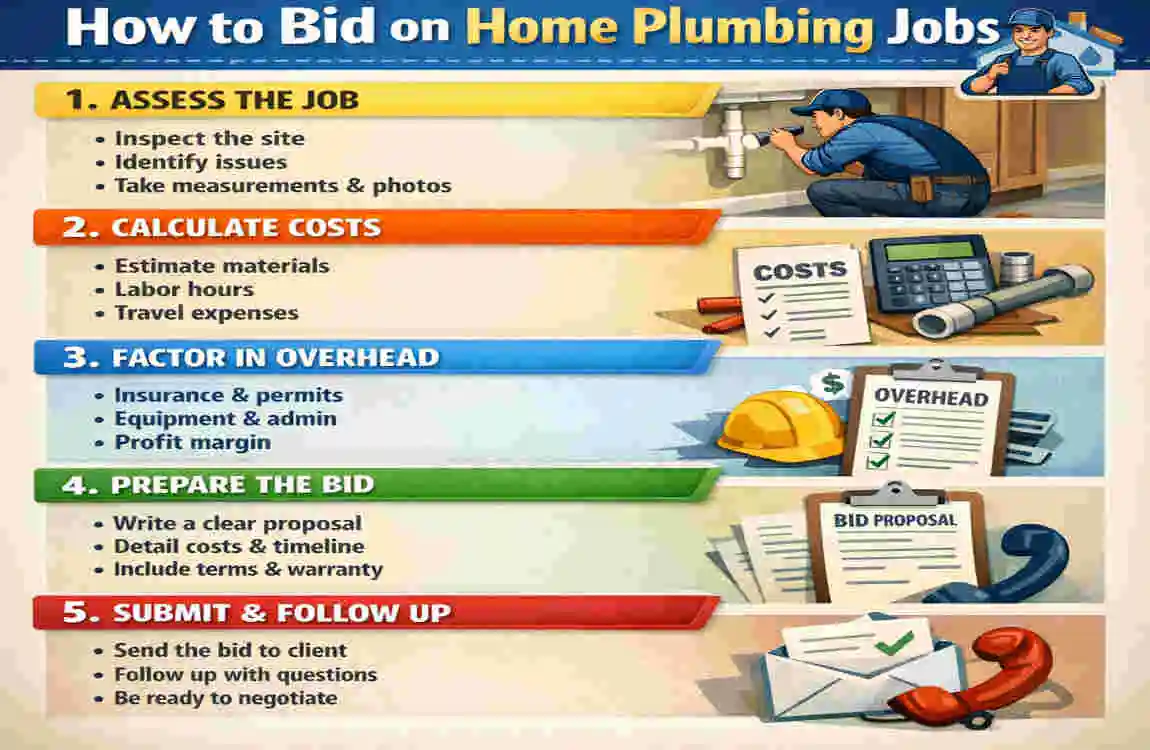
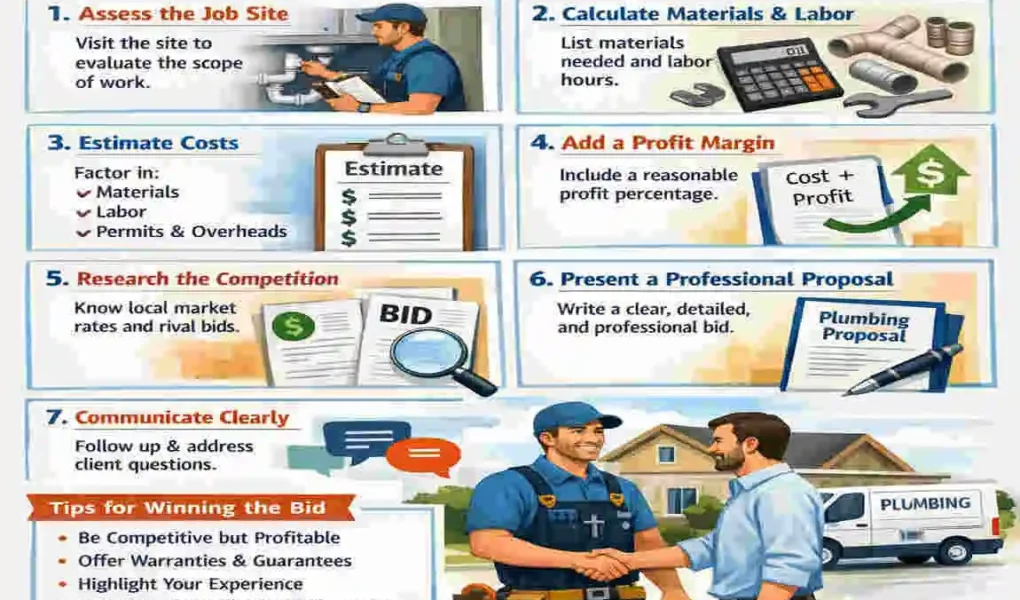
Now, let’s get into the “nitty-gritty.” How do you actually build the bid? Follow these steps to ensure you don’t miss a single penny.

Qualify the Lead and the Site Visit

Not every phone call is a good job. Before you drive across town, ask the right questions. What is their timeline? Do they have a budget in mind?

When you arrive at the home, don’t just look at the problem. Look at the environment.

  • Is the crawlspace tight?
  • Is the water shut-off valve corroded?
  • How far is the run from the main line to the fixture? Measuring the scope (e.g., a 50-ft pipe run vs. a 10-ft run) is the only way to be accurate.

Perform a Detailed Quantity Takeoff

“Takeoff” is just a fancy way of saying making a list of every single part you’ll need.

  • Review the blueprints if it’s a new build.
  • If it’s a repair, count every elbow, tee, coupling, and foot of pipe. Using software like PlanHub or a well-organized Excel template can help you avoid forgetting that one $50 valve that eats into your profit.

Estimate Labor Accurately

This is where most plumbers lose money. We are optimists by nature; we can do it faster than we actually can.

  • The Buffer Rule: Always take your “best guess” for labor time and add a 20-30% buffer.
  • Example: If a bathroom rough-in should take 16 hours, bid for 20. If things go perfectly, you will make an extra profit. If you hit a snag, you’re still covered.

Get Real-Time Supplier Quotes

Don’t guess what a water heater costs based on what you paid last summer. Call your supply house. For high-volume home jobs, such as a whole-house repipe, negotiate a bulk discount. Even a 5% savings on materials can add up to hundreds of dollars over the course of a month.

The Final Calculation (Overhead, Profit, and Contingencies)

Use this formula to ensure you are staying in the green: Total Bid = [Total Direct Costs x (1 + Overhead %)] x (1 + Profit %) + 10% Contingency.

The 10% contingency is your “safety net.” It covers the “oh no” moments—like finding out the subfloor is rotted once you pull the toilet.

Table: Sample Bid for Home Sewer Line Repair

TaskMaterialsLabor HoursSubtotal

Excavation & Prep $400 4 $900

Pipe Replacement $800 6 $1,400

Backfill & Testing $100 2 $300

Subtotal $2,600

Markup (25%) $650

Final Bid Price $3,250

Craft Winning Proposals That Close Deals

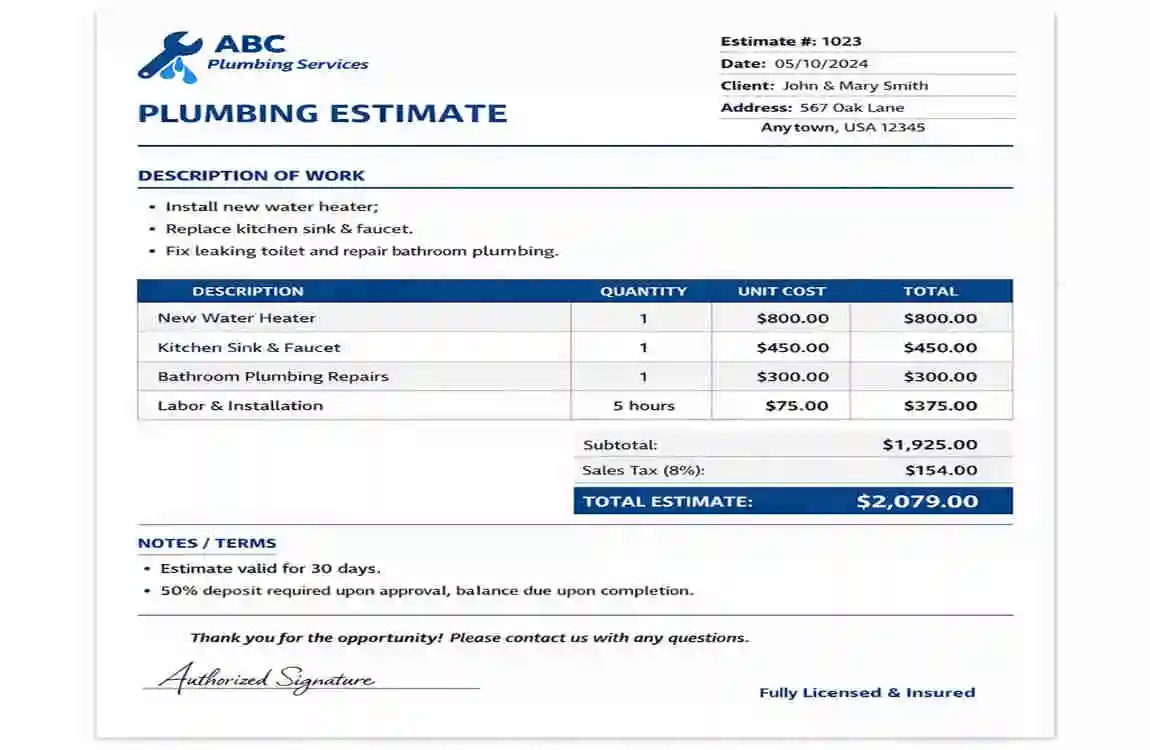
A bid is just a number; a proposal is a sales tool. If you hand a customer a scrap of paper with “$3,000” written on it, they will compare you solely on price. If you give them a professional, digital proposal, you are selling trust.

Key Proposal Elements You Must Include

  1. A Personalized Cover Letter: “Hi, Mr. Smith, thank you for letting us look at your master bath today. We’ve put together a plan to ensure your new fixtures last for decades.”
  2. Detailed Scope of Work: Be specific. Instead of “Fix leak,” write “Locate slab leak in kitchen, excavate 2×2 area, replace 3ft of copper piping, and pressure test system.”
  3. Clear Exclusions: This protects you. Write: “Drywall repair and painting not included.” This prevents the customer from expecting you to be a carpenter for free.
  4. The Timeline and Terms: When will you start? When will you finish? Do you require 50% upfront? (Hint: You should).

Professionalism and Speed

In the modern world, the first person to get the bid to the customer often wins. Use digital delivery. Sending a PDF via email with an e-signaturee-signature option lets the homeowner hire you with a single tap on their phone. It removes the friction of “let me think about it.”

Avoid Common Bidding Mistakes

How to Bid on Home Plumbing Jobs: Win More Contracts with Profitable Pricing Strategies

Even the best plumbers make mistakes. Here are the ones that will drain your bank account faster than a broken main:

  • Underestimating Labor: We’ve said it before, but it bears repeating. You are not a robot. Factor in the time it takes to find a parking spot and talk to the homeowner.
  • Ignoring Market Rates: You don’t have to be the cheapest, but you should know what the market will bear. Use tools like RSMeans data to see what the average costs are in your zip code.
  • The “No Follow-Up” Trap: Did you know that 70% of contracts are won by the person who follows up? If you haven’t heard back in 48 hours, send a friendly text: “Hey, just checking in to see if you had any questions about the water heater quote!”
  • Accepting Scope Creep: If the customer asks you to “just look at this other sink” while you’re there, that’s a Change Order. Document it and charge for it.

Leverage Tools and Tech for Efficiency

If you are still using a calculator and a yellow notepad, you are working too hard.

  • Bidding Software: Tools like ServiceTitan or PataBid can automate your estimates. They have pre-loaded price books so you can build a bid in minutes, not hours.
  • CRM (Customer Relationship Management): Use a CRM to track your “win rate.” If you are winning 90% of your bids, your prices are too low. If you are winning 10%, they are too high. Aim for a 30-50% win rate for high-profit jobs.
  • AI Add-ons: Modern tools can now provide real-time pricing updates from your local suppliers, keeping your material costs accurate to the penny.

Advanced Strategies to Win More Contracts

How to Bid on Home Plumbing Jobs: Win More Contracts with Profitable Pricing Strategies

As you grow, you need to stop thinking like a plumber and start thinking like a CEO.

  • Data Analysis: Look at your past year. Which jobs made you the most money? You may have realized that water heater swaps are high-margin, while whole-house repipes are a headache. Target the jobs that make you the most money.
  • Build Partnerships: Don’t just wait for the phone to ring. Build relationships with General Contractors (GCs). A single GC can keep your schedule full of home builds for the entire year.
  • Selective Bidding: As you get busier, you can afford to be picky. Target the “70% win-rate” opportunities—the jobs where the customer values quality over the lowest price.

FAQ: How to Bid on Home Plumbing Jobs

What’s the first step in bidding on a home plumbing job?

The first step is to understand the type of work you’ll be doing and gather details about the project. This usually starts when a homeowner contacts you by phone or email, followed by an on-site inspection to assess the job properly .

What documents or information do I need before preparing a bid?

For larger or more complex jobs, you’ll want the correct blueprints, drawings, or plumbing schematics to ensure you’re quoting accurately . For smaller home jobs, detailed notes and photos usually work.

How do I calculate material and labor costs?

Create a material takeoff—list every item needed—then calculate labor based on skill level and estimated hours. These steps are part of the standard plumbing bid process outlined in guides with 7–9 steps .

How do I make sure my bid is competitive?

Combine accurate takeoff, labor, and market-rate pricing. Some pros also cross-check by comparing how material costs typically relate to the total job value based on experience .

Should I include markup?

Yes. After estimating materials and labor, plumbers commonly add a markup and factor in overhead to create a competitive but profitable bid .

Where can I find more jobs to bid on?

You can join online service platforms like HomeAdvisor or Angie’s List, where homeowners actively search for providers and request bids directly .

How do I submit the bid?

Submit your proposal clearly and professionally—often by email. If working with general contractors, platforms like PlanHub let you send bids directly and follow up with scope clarifications if they request them .

How do I choose which plumbing jobs to bid on?

Identify the types of jobs you’re best suited for and focus on those. Many guides recommend selecting the most profitable or familiar job types before preparing your bid .

You may also like...

Leave a Reply

Your email address will not be published. Required fields are marked *