If you are planning a new home, one of the first questions you may ask is how many bricks for a 2000 sq ft house. This is an important question because brick quantity affects your budget, material planning, labor schedule, and waste control. If you buy too few bricks, work gets delayed. If you buy too many, your money gets tied up in extra material.
| Assumption / Case | Approx. wall area (sq ft) | Bricks per sq ft | Total bricks (approx.) |
|---|---|---|---|
| Medium 2000 ft² house (all‑brick) | ~1,500–2,000 wall area | ~5–7 bricks | 15,000–25,000 bricks |
| Simple 2000 ft² house (brick‑faced) | ~1,000–1,500 wall area | ~5 bricks | 8,000–12,000 bricks |
| With 10% extra for waste | same wall area | +10% | add ~1,500–2,500 bricks |
The exact number of bricks needed for a 2000 sq ft house depends on several things. The house layout, number of floors, wall thickness, window and door openings, and brick size all change the final count. That is why there is no single perfect number for every home.
Still, a typical single-story 2000 sq ft house may need around 16,000 to 25,000 bricks. In some designs, the number can be lower. In others, it can go much higher. So the best approach is to understand the basic calculation before you buy.
Understanding Brick Estimation for a House
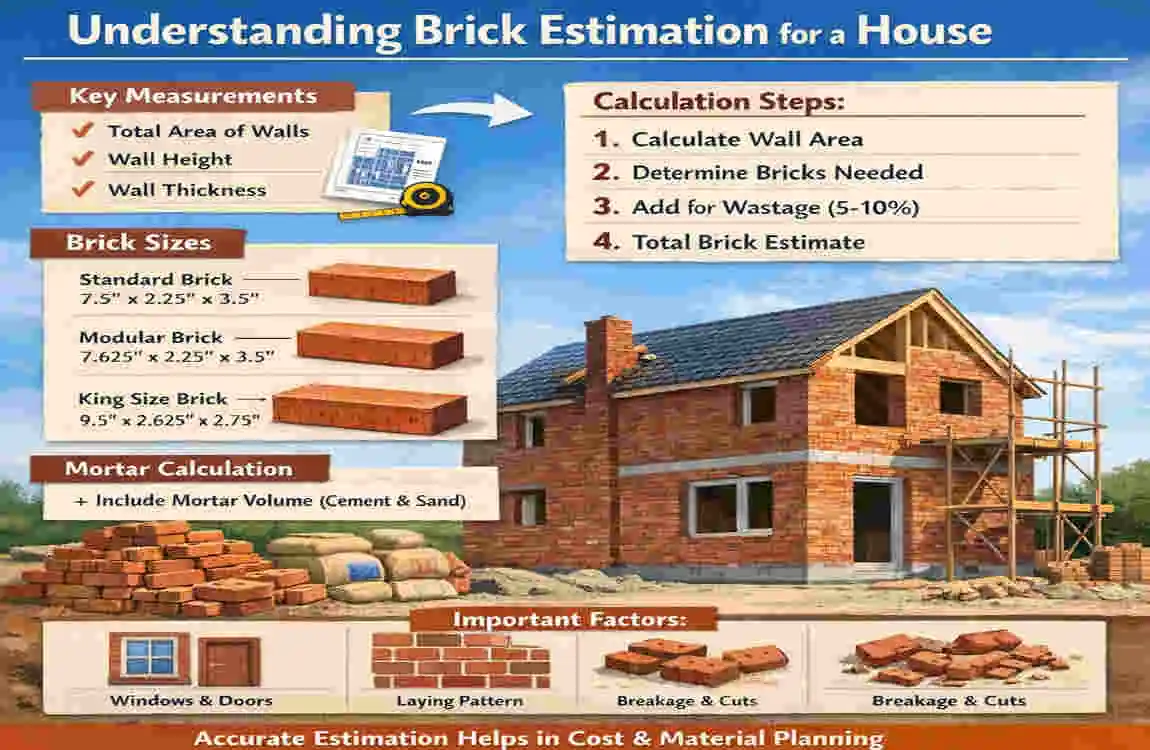
Brick estimation is not just about counting walls. It is about understanding the full structure of the house and the amount of masonry work it requires. A well-planned estimate helps you stay in control from the start.
Why Brick Calculation Matters
Brick calculation matters because it helps you avoid shortages and overspending. If your estimate is too low, construction can stop while you wait for more bricks. That delay can affect workers, schedules, and overall cost.
It also helps with budget planning. Bricks are only one part of the wall-building cost, but they often take a large share. Knowing the quantity early lets you compare supplier prices and choose better options.
Another big reason is project scheduling. When materials arrive on time and in the right amount, your builder can work faster and more efficiently. That keeps the project organized and reduces stress.
Basic Factors That Influence Brick Quantity
Several things change the final brick count. The most important are:
- House layout: A simple rectangular house needs fewer complex cuts and adjustments.
- Number of floors: A two-story house usually needs more bricks than a single-story home.
- Wall height: Taller walls need more bricks.
- Wall thickness: A thick wall uses more bricks than a thin wall.
- Window and door openings: Openings reduce the total number of bricks needed.
Even two houses with the same square footage can use very different amounts of bricks. That is why square footage alone does not tell the full story.
How Many Bricks for a 2000 Sq Ft House?
For many homeowners, this is the main question. The answer depends on the building style, but we can still give a useful average.
Average Brick Requirement Estimate
A single-story 2000 sq ft house may require about 16,000 to 25,000 bricks in many common construction setups. This range is only an estimate, but it gives you a solid starting point.
If the home has many internal walls, thicker exterior walls, or a more detailed design, the number can increase. If the house uses a framed structure with brick veneer, the number can be lower than a full brick home.
You should also remember that interior and exterior walls are not the same. Exterior walls are usually thicker and need more bricks. Interior partitions may use fewer bricks if they are thin and lightweight.
Typical Brick Count by Construction Type
Different construction styles use different amounts of brick. Here is a simple way to think about it:
Construction TypeTypical Brick UseGeneral Note
Load-bearing wall home Higher Bricks support more of the structure
Framed structure with brick veneer Lower Bricks are mainly for outer appearance and protection
Double-wall construction Highest Uses more bricks because of thicker wall systems
A load-bearing home uses bricks for both structure and enclosure, so the count is usually high. A framed house, on the other hand, relies more on steel, wood, or concrete for support, so the brick quantity may be much lower.
Regional Construction Variations
Brick usage also changes by region.
In the US, many homes use brick veneer instead of full brick walls. That means fewer bricks are needed compared to a solid brick house.
In the UK, cavity wall construction is common. This style uses two layers with a gap between them, so the number of bricks depends on the wall design and type.
In South Asian homes, solid wall construction is still common in many areas. These homes often need more bricks because walls are built thicker and more fully with brick masonry.
So when you ask how many bricks for a 2000 sq ft house, the answer always depends on where and how the house is built.
Step-by-Step Formula to Calculate Bricks Needed
If you want a more accurate estimate, you can calculate it step by step. This method is useful for homeowners, builders, and anyone preparing a budget.
Measure Total Wall Area
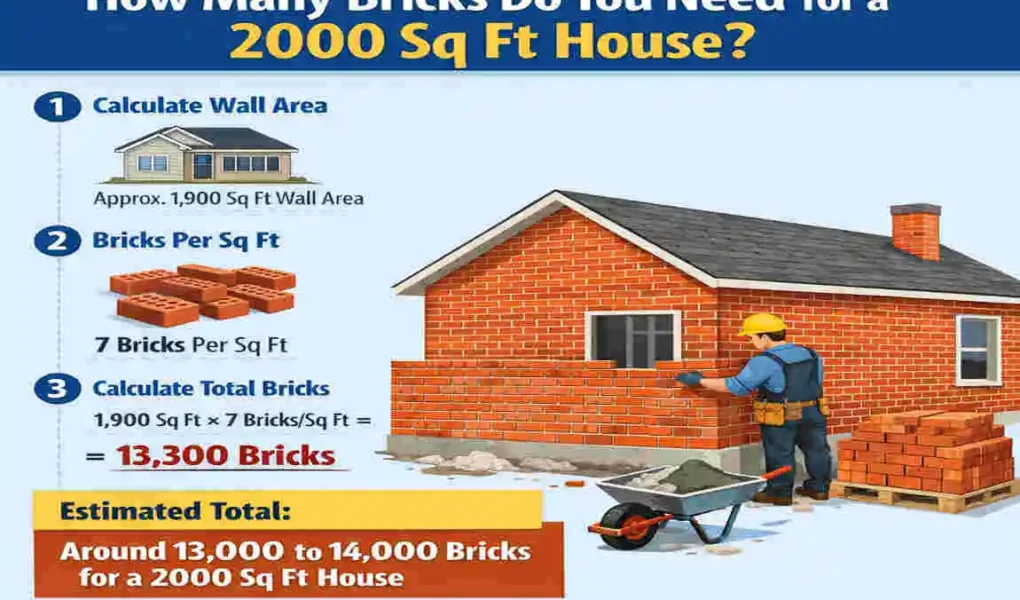
Start by measuring the outside walls of the house. If the house is 40 ft by 50 ft, the perimeter is:
40 + 50 + 40 + 50 = 180 ft
If the wall height is 10 ft, then the exterior wall area is:
180 × 10 = 1,800 sq ft
Then measure the internal partition walls. These are the walls inside the house that divide rooms. Their areas vary based on the layout, so they must be added separately.
Subtract Openings
Not every part of the wall uses bricks. You must subtract areas for:
- Doors
- Windows
- Ventilation spaces
These openings reduce the total wall area. If you skip this step, your estimate will be too high.
Choose Wall Thickness
Wall thickness changes the number of bricks needed.
- 4-inch wall: Common for thinner partition walls
- 9-inch wall: Common for standard exterior walls in many brick homes
- 13.5-inch wall: Used when extra strength or thicker masonry is required
Thicker walls need more bricks, mortar, and labor.
Divide by Brick Size
Now divide the wall area by the brick coverage area. Standard modular bricks have a known size, but local brick sizes may vary. That means a builder in one area may get a different count than someone in another region.
For a rough estimate, many builders use average brick coverage values to calculate quickly. But if you want precision, always confirm the exact local brick dimensions.
Add Wastage
Always add extra bricks for wastage. A good rule is 5% to 10% extra.
This covers:
- Broken bricks
- Transportation loss
- Cutting mistakes
- Storage damage
A small buffer can save you from delays later.
Brick Quantity Calculation Example for a 2000 Sq Ft House
Let’s look at a simple example to help you better understand the process.
Example House Dimensions
Assume the house is 40 ft × 50 ft, which gives a floor area of 2,000 sq ft.
Wall Height Assumptions
Let the wall height be 10 ft. This is a common residential height and gives us a practical estimate.
Exterior Wall Brick Count Estimate
The perimeter of the house is:
40 + 50 + 40 + 50 = 180 ft
Multiply that by the wall height:
180 × 10 = 1,800 sq ft of exterior wall area
Now subtract openings such as doors and windows. Let’s assume those openings take away about 200 sq ft.
That leaves:
1,800 – 200 = 1,600 sq ft of net exterior wall area
If we use a standard brick coverage estimate, the exterior wall brick count can fall in the several-thousand range depending on thickness and brick size.
Interior Partition Wall Estimate
Now add the interior walls. A 2000 sq ft house may have several rooms, bathrooms, corridors, and storage areas. These walls can add a large number of bricks, especially if they are built with masonry rather than lightweight materials.
Depending on the layout, internal walls may add 4,000 to 8,000 bricks or more.
Final Total
When you combine exterior walls, interior walls, and wastage, the final estimate for a typical single-story 2000 sq ft home often falls around:
16,000 to 25,000 bricks
If the design is more complex, the total may go higher. If the structure is framed and brick is used only for the outside layer, the total may be lower.
Factors That Affect How Many Bricks You Need
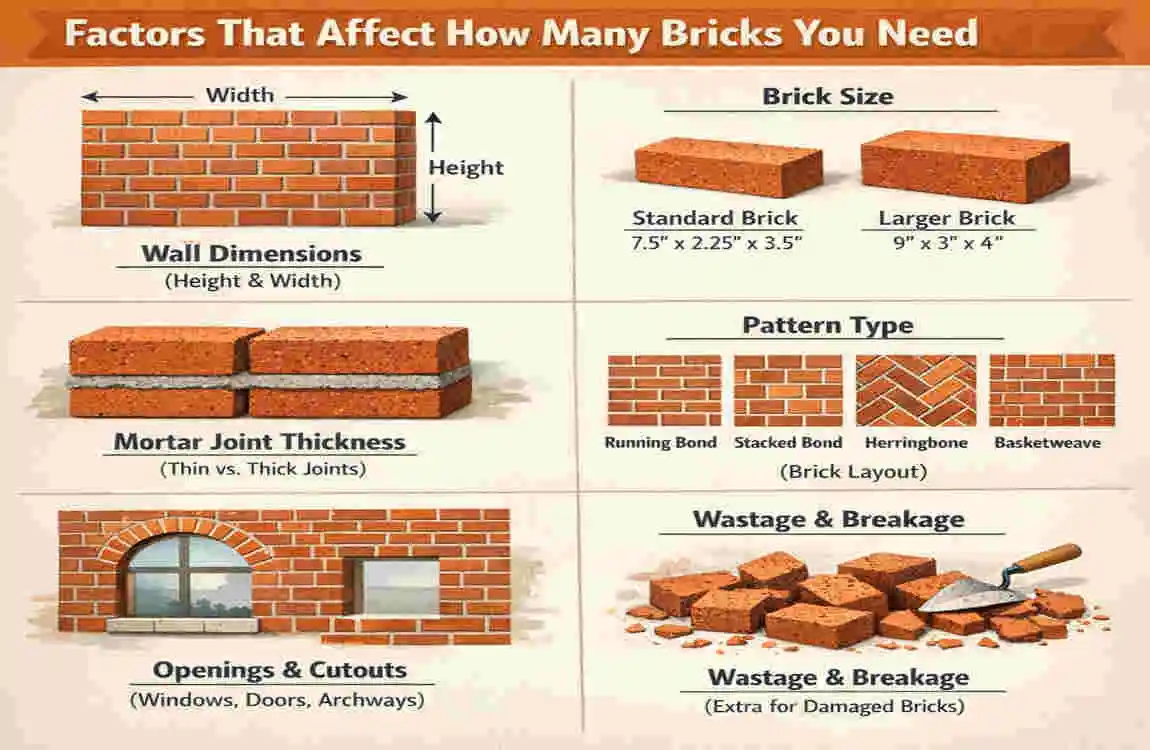
Even if two homes have the same floor size, their brick needs may be very different. Here are the main reasons.
Number of Floors
A single-story house generally needs fewer bricks than a two-story home. A two-story home adds more wall area, more structural demand, and often more internal partitions.
If your 2000 sq ft house is split across two floors, the brick count may increase significantly.
Wall Design
Simple straight walls are easier to plan. Curved walls, angled sections, and custom shapes require more cutting and more waste. That means more bricks overall.
Brick Type
Different brick types affect both quantity and cost.
- Clay bricks are common and traditional.
- Fly ash bricks are often more uniform in size.
- Concrete bricks may be used in certain projects for strength and speed.
Each type behaves differently during construction, which can slightly affect the final count.
House Design Complexity
A basic square house is easier to estimate than a home with:
- Pillars
- Decorative features
- Balconies
- Attached garages
These features add wall sections and detailing, which may increase the number of bricks needed.
Waste and Breakage
No construction project is perfect. Bricks can break during transport, loading, unloading, or cutting. That is why every estimate should include a waste margin.
A smart builder always plans for a little more material than the bare calculation shows.
Brick Sizes and Their Impact on Quantity
Brick size is one of the biggest reasons estimates differ from one place to another.
Standard Brick Sizes
Common brick sizes vary by region.
- US modular brick: Standardized for common housing work
- UK standard brick: Used in British wall systems
- Indian/Pakistani brick: Often larger or different in proportion depending on local practice
Since the size changes, the number of bricks required per square foot also changes.
Larger Bricks vs Smaller Bricks
Larger bricks cover more area with each piece. That means fewer bricks are needed.
Smaller bricks cover less area, so you need more bricks to finish the same wall.
This is why local brick size matters so much in any brick estimation for house planning.
Solid vs Hollow Bricks
Solid bricks are heavier and usually stronger for load-bearing work. Hollow bricks are lighter and may help reduce total wall weight.
The choice between them depends on the building purpose, budget, and local building style. Hollow bricks can also affect labor speed and cost.
Cost of Bricks for a 2000 Sq Ft House
Now let’s talk about money, because quantity only matters when you connect it to cost.
Average Brick Price
Brick prices change by location, season, and supplier. In some places, bricks are cheap and easy to source. In other places, transport makes them expensive.
Instead of using a fixed number, it is better to check your local price per brick.
Total Estimated Brick Cost
To estimate cost, use this simple formula:
Total cost = number of bricks × price per brick
For example, if you need 20,000 bricks and each brick costs a certain amount, multiply that unit price by 20,000.
This gives you a rough estimate of the brick budget for the house.
Extra Construction Costs
Bricks are not the only expense. You also need to pay for:
- Mortar
- Labor
- Transport
- Storage
Sometimes these extra costs become a major part of the total wall budget.
Budgeting Tips
A few small choices can save a lot of money.
- Buy in bulk when possible.
- Compare prices from multiple suppliers.
- Check brick quality before placing a large order.
- Plan delivery timing so bricks do not sit in the open for too long.
These simple steps help you control the overall brick cost for house construction.
Common Mistakes When Estimating Brick Quantity
Many people make the same errors when they try to guess the number of bricks. Avoid these problems early.
Ignoring Openings
Doors and windows take away a lot of wall space. If you forget them, your estimate becomes too high.
Forgetting Wastage
If you order only the exact number, you may run short. A small breakage margin is always wise.
Using Wrong Brick Dimensions
If you use the wrong brick size in your calculations, the total will be inaccurate. Always confirm local dimensions first.
Ignoring Internal Walls
Some people only calculate outer walls. That is a big mistake because internal partitions can use many bricks too.
A careful estimate should always include both exterior and interior walls.
Bricks vs Blocks: Which Is Better for a 2000 Sq Ft House?
This is a common comparison when planning wall construction.
Brick Construction Benefits
Bricks offer several strong benefits:
- Durability
- Classic appearance
- Good fire resistance
- Strong wall performance
Many homeowners like brick because it has a traditional look and feel.
Block Construction Benefits
Blocks can also be a smart choice.
- Faster installation
- Lower labor in some cases
- Larger wall coverage
- Often simpler handling
Blocks may save time, especially in large projects.
Which Is More Cost-Effective?
The answer depends on your region. In some places, bricks are cheaper and easier to find. In others, blocks reduce labor enough to make them the better choice.
When choosing between bricks and blocks for a 2000 sq ft house, consider material and labour costs, wall style, and local availability. The best option is not always the cheapest item. It is the one that best fits your project.
Expert Tips to Estimate Bricks Accurately
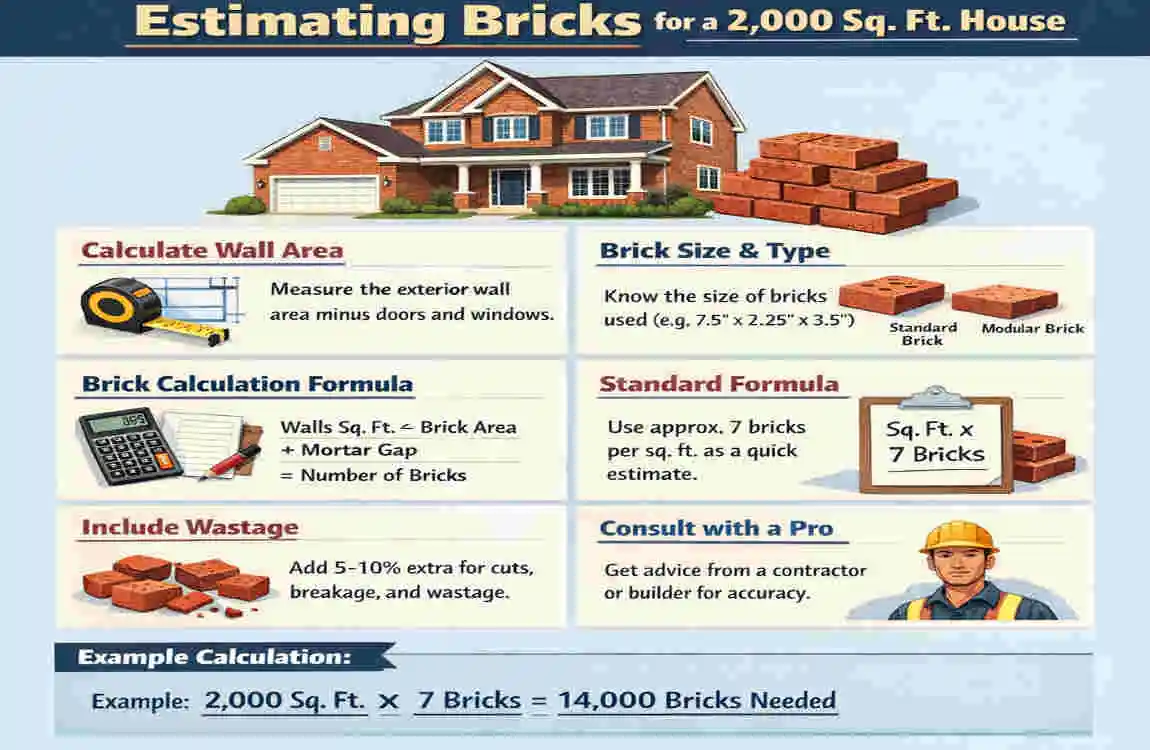
If you want a better estimate, keep these points in mind.
- Consult architectural drawings
- Verify wall thickness
- Confirm brick size
- Include breakage margin
- Use contractor verification
- Plan home extra inventory
These steps can save you from costly mistakes. Even a small measurement error can change the total by hundreds or thousands of bricks.
Frequently Asked Questions
How many bricks for a 2000 sq ft house on average?
A typical single-story 2000 sq ft house may need around 16,000 to 25,000 bricks, depending on wall thickness, design, and openings.
How much does brick wastage usually add?
Most builders add 5% to 10% extra bricks to account for wastage, breakage, and transport losses.
Are hollow bricks better than clay bricks?
Hollow bricks can be lighter and easier to work with. Still, clay bricks remain widely used for their strength and traditional construction. The better choice depends on your design and budget.
Can I calculate the number of bricks without architectural plans?
Yes, but only roughly. Without plans, your estimate will be less accurate because wall length, thickness, and openings are harder to measure.
How many bricks are needed for a two-story 2000 sq ft house?
A two-story house usually requires more bricks than a single-story home of the same total area, due to the added wall height, more complex layout, and structural requirements. The exact count depends on design.