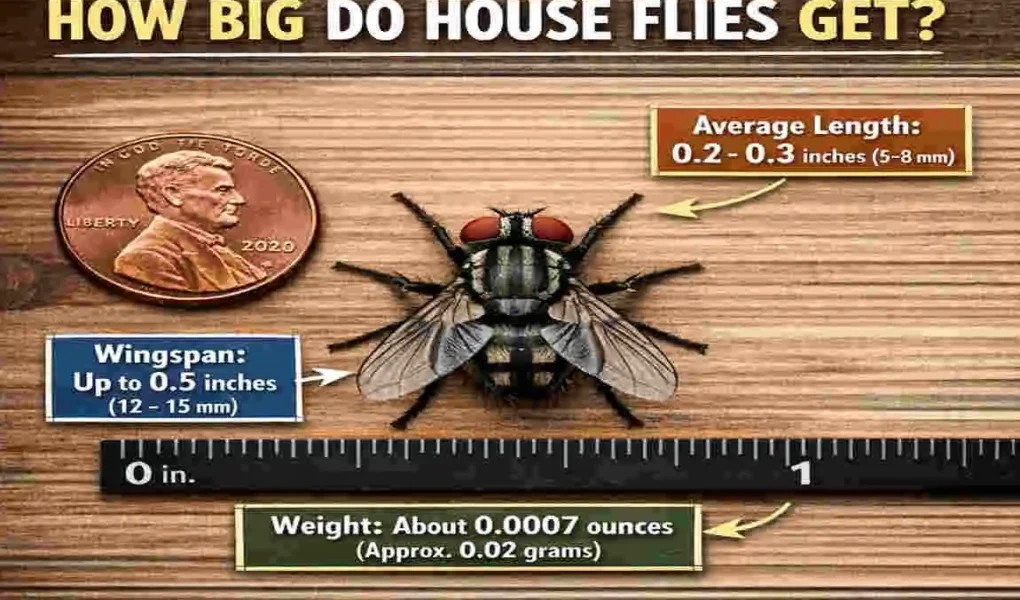
Ever swatted at a house fly buzzing around your kitchen counter and thought to yourself, “Was that thing always this big?” You’re definitely not alone. House flies have a way of looking absolutely enormous when they land right in front of you or zoom past your face at full speed. It’s one of those little everyday mysteries that most of us never really think about — until it’s 2 AM and a particularly chunky fly won’t leave you alone.
But here’s the thing — understanding how big do house flies get actually matters more than you might think. Their size can tell you a lot about the health of your living environment, the potential risks they carry, and even how bad an infestation might be. These aren’t just annoying little buzzers. They’re disease-carrying pests, and their size directly affects how much trouble they can cause.
| Measurement | Imperial (inches) | Metric (mm) |
|---|---|---|
| Body Length | 0.16–0.31 | 4–8 |
| Body Width | 0.05–0.1 | 1.3–2.5 |
| Body Height | 0.06–0.11 | 1.4–2.9 |
| Wingspan | 0.51–0.59 | 13–15 |
The Anatomy of a House Fly: Understanding Their Size

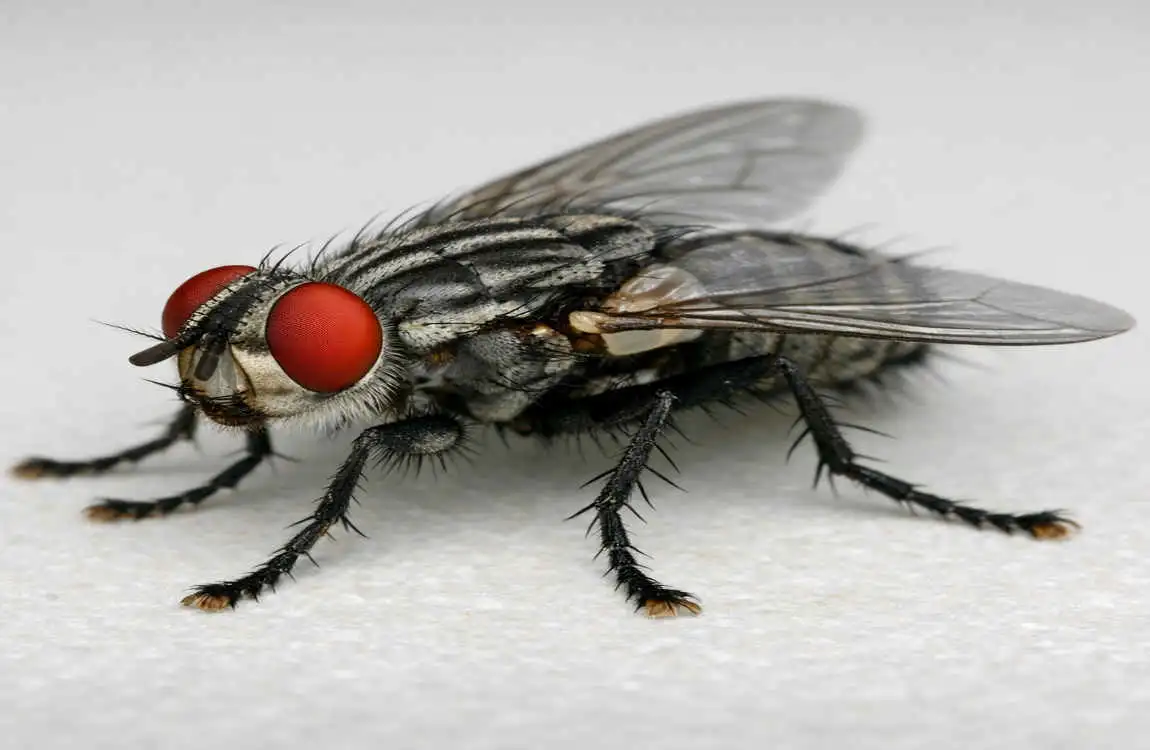
Before we start throwing numbers around, it helps to understand what you’re actually looking at when a house fly lands on your sandwich. A house fly’s body is divided into three main sections — the head, the thorax, and the abdomen. Each of these parts contributes to the overall size and the way we perceive it.
The head is relatively small compared to the rest of the body, but it’s packed with two massive compound eyes that cover most of its surface. These big, reddish-brown eyes are actually one of the reasons flies look larger and more intimidating up close. The thorax, which is the middle section, is where the wings and legs attach. It’s the bulkiest part of the fly and gives it that stocky, robust appearance. Then there’s the abdomen, which is the softer, rounder back section. In well-fed females, the abdomen can swell noticeably, making the fly look even bigger.
Average Dimensions
Now let’s talk precise numbers. When people ask how big do house flies get, here’s what the science tells us:
- Body length: 6 to 9 millimeters (roughly the size of a grain of rice)
- Wingspan: 12 to 18 millimeters (about the width of your pinky fingernail)
- Weight: 12 to 20 milligrams (lighter than a single raindrop)
Those measurements might seem tiny, but when a fly is hovering two inches from your nose, it doesn’t feel tiny at all.
What Influences Their Size
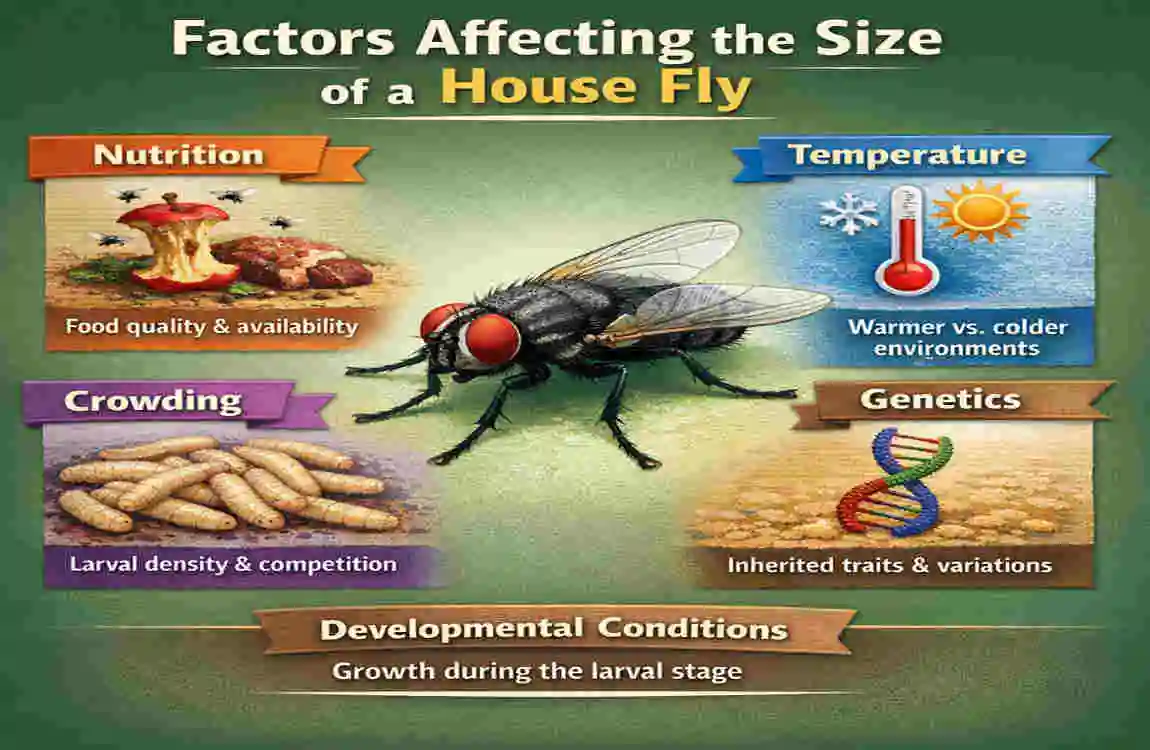
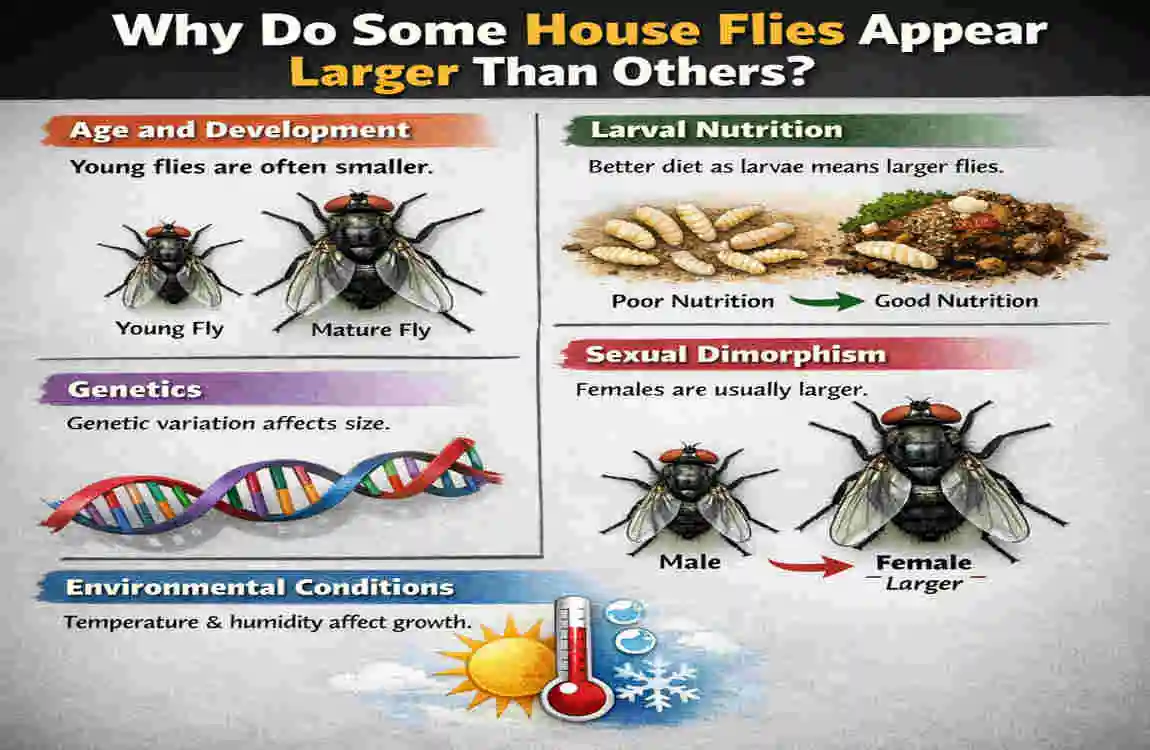
Not every house fly is created equal. Several factors determine just how big an individual fly will grow. Genetics play a foundational role — some flies are coded to be a bit larger or smaller. Nutrition during the larval stage is arguably the biggest factor though. Larvae that feed on rich, protein-dense organic matter tend to develop into larger adults. And then there’s the environment. Flies that grow up in warmer, more humid conditions often reach the upper end of the size spectrum.
Understanding this anatomy isn’t just interesting trivia. If you’re trying to manage pests in your home, knowing what a healthy, well-fed fly looks like versus a smaller, stressed one can tell you a lot about what’s attracting them and where they’re breeding.
House Fly Size Chart: Visual Guide to Growth and Comparisons
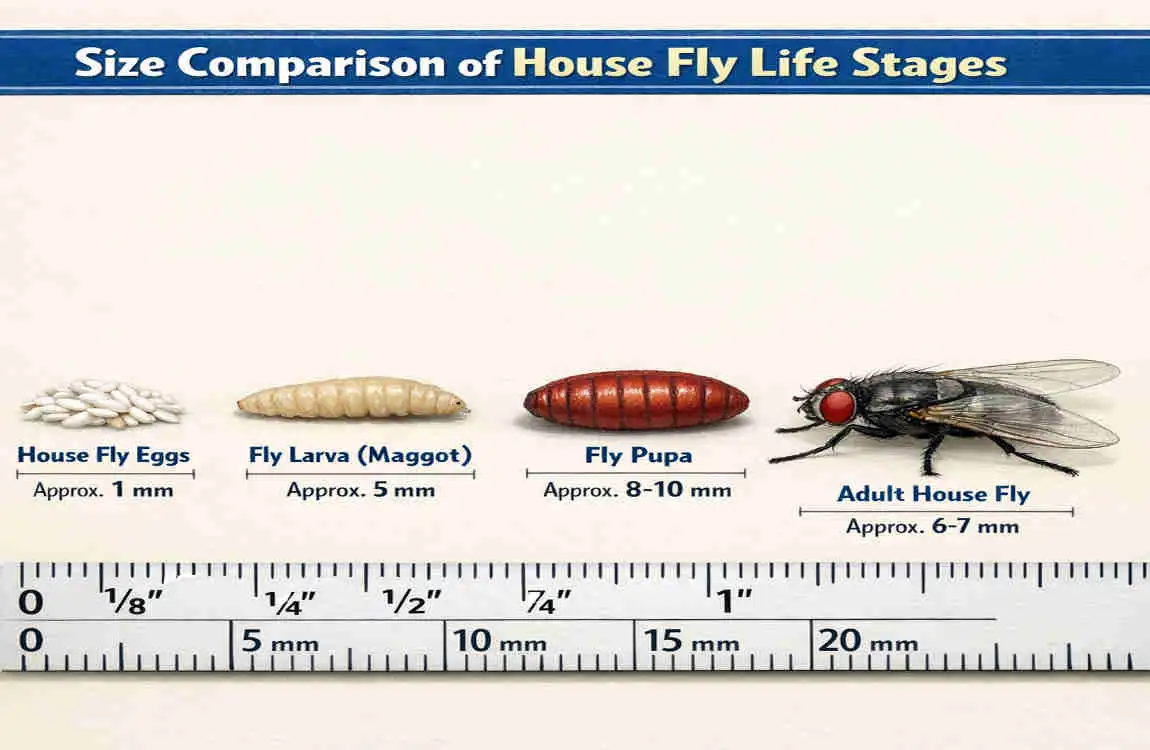
One of the best ways to truly understand how big do house flies get is to see the numbers laid out side by side. Below is a comprehensive house fly size chart that breaks down every life stage with real-world comparisons you can actually picture in your head.
Complete House Fly Size Chart
Growth StageBody LengthWingspanWeightReal-World Comparison
Egg ~1 mm N/A ~0.1 mg A single sesame seed
Larva (Maggot) 2–12 mm N/A 2–15 mg Tip of a pencil eraser
Pupa 6–9 mm N/A 10–18 mg A small coffee bean
Adult Male 6–7 mm 12–15 mm ~12 mg A small raisin
Adult Female 7–9 mm 15–18 mm 18–20 mg A large raisin
Take a moment to really look at those numbers. The jump from a 1-millimeter egg to a 12-millimeter maggot is absolutely massive in relative terms. That’s a 12-fold increase in body length over just a matter of days. It’s one of the fastest growth rates you’ll find in common household insects.
Why Are Female House Flies Bigger?
You’ll notice that female house flies consistently measure larger than males across every metric. This isn’t a coincidence — it’s biology doing its thing. Females need a larger abdomen to carry and produce eggs. A single female can lay over 500 eggs during her short lifetime, and all of that reproductive machinery takes up space. Their larger wingspan also helps them cover more ground when searching for ideal egg-laying sites.
Regional variations also play a role. Flies in warmer, more humid climates — like the sweltering summers in cities such as Lahore — tend to grow larger on average. The combination of heat, humidity, and abundant organic waste creates perfect conditions for maximum growth.
How Do House Flies Compare to Other Flies?
Here’s where things get really interesting. House flies sit right in the middle of the fly size spectrum. Fruit flies, those tiny little pests that hover around your bananas, measure only about 3 to 4 millimeters. That’s roughly half the size of a house fly. On the other end, cluster flies can reach 10 to 15 millimeters, making them noticeably bulkier and slower-moving.
Compared to other common insects, house flies are larger than most mosquitoes (which average 3 to 6 millimeters) but smaller than common wasps (which can reach 12 to 25 millimeters). So the next time you see a fly and think it looks huge, consider whether it is a cluster fly or a blow fly rather than a standard house fly. Proper identification is the first step toward effective control.
House Fly Growth Stages: From Tiny Egg to Full-Sized Pest

Understanding house fly growth stages gives you a complete picture of how these pests develop and, more importantly, where you can intervene to stop them. The house fly undergoes what scientists call complete metamorphosis, meaning it passes through four distinct life stages — egg, larva, pupa, and adult. Each stage looks completely different from the last, and the size changes are dramatic.
Let’s walk through each one in detail.
Egg Stage
Everything starts incredibly small. A house fly egg measures just about 1 millimeter in length. It’s oval-shaped, white, and almost impossible to spot with the naked eye unless you know exactly what you’re looking for. To put that in perspective, a single house fly egg is roughly the size of a sesame seed — maybe even smaller.
But here’s what makes the egg stage so alarming. Female house flies don’t lay just one egg at a time. They lay 100 to 150 eggs in clusters, and can produce multiple batches throughout their lifetime. That means a single female can be responsible for 500 or more eggs in just a few weeks.
These eggs are typically deposited on moist, decaying organic matter. Think garbage bins, compost piles, animal manure, rotting food, or even damp soil. The eggs need moisture and warmth to develop properly, which is why infestations tend to spike during hot summer months.
The incubation period is shockingly fast. Under ideal conditions — warm temperatures and high humidity — house fly eggs can hatch in as little as 8 to 24 hours. That’s less than a single day from egg to living, feeding larva. This rapid development is one of the main reasons house fly populations can explode seemingly overnight.
If you’ve ever wondered why a clean kitchen can suddenly have a fly problem, this is your answer. All it takes is one overlooked piece of rotting fruit or a trash bag left a day too long, and you’ve given a female fly everything she needs to start a colony.
Larva (Maggot) Stage
This is where the real growth happens. When a house fly egg hatches, what emerges is a tiny, legless, cream-colored larva — commonly known as a maggot. At birth, these maggots measure just about 2 millimeters long. But don’t let that small starting size fool you.
Over the next 3 to 10 days, depending on temperature and food availability, that 2-millimeter maggot will grow to a whopping 12 millimeters. That’s a six-fold increase in body length in less than two weeks. During this explosive growth period, the larva undergoes three molting stages, or instars. Each molt allows the maggot to shed its outer skin and expand to a larger size.
The secret behind this rapid growth? An absolutely relentless feeding frenzy. Maggots are eating machines. They burrow into whatever organic material they were born on and consume it nonstop, absorbing proteins, fats, and nutrients that fuel their development. The richer and more protein-dense the food source, the larger the resulting adult fly will be.
This is a critical point for homeowners to understand. The quality of the breeding material directly determines how large house flies become as adults. Flies that develop in nutrient-rich environments — like meat scraps or pet waste — tend to produce larger, healthier adults than those developing in less nutritious substrates.
The larval stage is also the most vulnerable point in the fly’s lifecycle. If you can eliminate breeding sites during this stage — by properly sealing garbage, cleaning up pet waste, and managing compost — you can dramatically reduce the size and number of adult flies in your area.
Pupa Stage
After the maggot has eaten its fill and reached maximum larval size, it enters the pupa stage. This is the transformation phase, and it’s genuinely one of the more fascinating processes in the insect world.
The maggot stops feeding, crawls away from its food source to a drier location, and its outer skin hardens into a dark, barrel-shaped pupal casing called a puparium. This casing measures about 6 to 9 millimeters in length — roughly the size of a small coffee bean. It starts light brown and gradually darkens to a deep reddish-brown or almost black color.
Inside this protective shell, something remarkable is happening. The larval body is breaking itself down and rebuilding into a completely different creature. Wings develop. Compound eyes form. Legs take shape. The entire internal structure reorganizes from a simple, worm-like maggot into a complex, flying adult insect.
This transformation takes anywhere from 3 to 6 days under warm conditions, though it can stretch longer in cooler temperatures. During this time, the pupa is completely immobile and doesn’t feed. It’s entirely dependent on the energy reserves built up during the larval feeding stage.
The pupa stage is important for understanding how big house flies get, because their size is essentially set at this point. Whatever size the larva reached before pupating determines the size of the adult that will emerge. There’s no additional growth after this stage — what you see is what you get.
Adult Stage
The final act. When the transformation inside the puparium is complete, the adult house fly pushes its way out of the pupal casing using a specialized inflatable structure on its head called a ptilinum. It’s a bizarre-looking process, but it works.
The newly emerged adult is soft and pale, with its wings crumpled. But within just a few hours, the exoskeleton hardens, the wings fully expand, and the fly takes on its familiar gray-and-black appearance. Within 24 hours, the adult house fly has reached its full size and is ready to fly, feed, and reproduce.
Adult house flies live for approximately 15 to 30 days, though some can survive up to two months under ideal conditions. During this time, females begin laying eggs within just 3 to 4 days of emerging, starting the entire cycle over again.
Here’s the staggering math. A single female lays 500+ eggs. If even a fraction of those survive to adulthood and reproduce, you’re looking at exponential population growth within a matter of weeks. This is why early intervention is so critical. By the time you’re seeing large numbers of adult flies, the breeding cycle is already well underway.
The complete journey from egg to adult takes as little as 7 to 10 days in warm conditions. That means in a single summer month, multiple generations can develop, each one potentially larger than the last if conditions are favorable.
Why House Flies Seem Bigger Than You Think: Myths vs. Facts
Let’s address the elephant — or rather, the fly — in the room. Almost everyone has had that moment where a house fly looks absolutely massive. Way bigger than 6 to 9 millimeters. So what’s going on? Are some flies genuinely growing to monstrous sizes, or is something else at play?
The answer is both, and it’s more interesting than you might expect.
The Optical Illusion Effect
The biggest reason flies seem larger than they are is simple optical illusion and perception. When a fly lands on a surface right in front of your face — say, on your phone screen or your dinner plate — you’re seeing it from just inches away. At that distance, even a 7-millimeter insect looks substantial.
Add to that the speed factor. House flies can fly at speeds up to 7.5 kilometers per hour and can change direction in milliseconds. Their wings beat approximately 200 times per second, creating a visible blur that makes the fly appear larger than its actual body. Your brain processes this fast-moving, buzzing object as a bigger threat than it really is.
There’s also the sound component. That distinctive buzzing sound house flies make is surprisingly loud for such a small creature. The combination of visual movement and auditory stimulus tricks your brain into perceiving a larger animal.
Environmental Factors That Create Bigger Flies
Now, here’s where it gets real. Not all of the perceived increase in size is an illusion. In certain environments, house flies genuinely do grow larger than average.
Urban areas with abundant food waste tend to produce bigger, healthier flies. Cities with hot, humid summers — like Lahore, Karachi, or other South Asian metropolitan areas — create ideal conditions for maximum fly growth. The combination of high temperatures accelerating development, abundant organic waste providing rich nutrition, and high humidity preventing dehydration means that flies in these environments often reach the upper end of the 9-millimeter range or even slightly beyond.
Overfed larvae that develop in particularly protein-rich waste can produce adults that push the boundaries of typical house fly size. While they won’t reach an inch (that’s a myth we’ll bust in a moment), they can look noticeably larger than flies from less favorable environments.
Debunking Common Myths
Let’s clear up some widespread misconceptions:
Myth: House flies can grow to 1 inch (25mm) long.Fact: No standard house fly (Musca domestica) reaches 1 inch. The maximum body length is approximately 9 millimeters. If you’re seeing a fly that’s an inch long, you’re likely looking at a different species entirely — possibly a cluster fly, a blow fly, or a horse fly.
Myth: House flies keep growing throughout their lives.Fact: Adult house flies do not grow at all after emerging from the pupal stage. Their size is fixed for life. An adult fly on day one is the same size as that fly on day 30.
Myth: House flies in your home are getting bigger each generation.Fact: While offspring can be larger if they have access to better nutrition, there’s no progressive “super-sizing” happening. Size is determined by larval conditions, not some evolutionary trend toward giant flies.
The Health Connection
Here’s why all of this matters beyond curiosity. Larger flies tend to carry more pathogens. A bigger fly has more surface area on its body and legs, which means more contact points for picking up and spreading bacteria like Salmonella, E. coli, and Shigella. Studies have shown that a single house fly can carry over 100 different pathogens at any given time.
So when you see a particularly large fly in your kitchen, it’s not just an annoyance — it’s a genuine health concern. Larger flies that have developed in rich organic waste have had more exposure to harmful bacteria and are more efficient at spreading them to your food and surfaces.
Factors Affecting House Fly Size: Environment, Diet & Genetics
Now that we’ve established how big do house flies get and why they sometimes appear even bigger, let’s dig deeper into the specific factors that determine an individual fly’s size. Understanding these factors isn’t just academic — it’s practical knowledge that can help you reduce fly populations around your home.
Nutrition During Larval Development
This is the single most important factor. The quality and quantity of food available to a maggot during its 3-to-10-day feeding period sets the ceiling for adult size. Larvae that feed on protein-rich substrates — like meat scraps, fish waste, or animal manure — consistently develop into larger adults compared to those feeding on less nutritious materials like plant matter or paper waste.
This has direct implications for your home. If your outdoor garbage bins contain unsealed meat scraps or pet waste, you’re essentially running a fly-growing operation that produces the biggest, healthiest flies possible. Proper waste management isn’t just about reducing odors — it’s about starving the next generation of flies.
Climate and Temperature
Temperature has a complex relationship with fly size. Warmer temperatures accelerate the development cycle, meaning flies reach adulthood faster. However, extremely rapid development can sometimes result in slightly smaller adults because the larvae don’t have as much time to feed.
The sweet spot for producing the largest flies seems to be moderately warm conditions — around 25 to 30 degrees Celsius — with consistent humidity above 50%. These conditions allow for rapid but not rushed development, giving larvae enough time to maximize their feeding while still developing quickly.
In regions with intense summers, like Punjab’s scorching May-through-August period, flies can complete their entire lifecycle in as little as seven days. The sheer speed of reproduction means that even if individual flies are slightly smaller, the overwhelming numbers more than compensate.
Genetics and Species Variation
While all house flies belong to the species Musca domestica, there is natural genetic variation within the population. Some flies carry genes that code for slightly larger body size, just like how some people are naturally taller than others.
There are also rare instances of what might be called “supersized” variants — individual flies that fall at the extreme upper end of the size distribution. These aren’t a different species or some mutant. They’re just statistical outliers who benefited from perfect genetics, nutrition, and environmental conditions all at once.
Human Behavior and Sanitation
Here’s the factor you have the most control over. Your sanitation habits directly influence the size of flies in your area. Homes and businesses that maintain clean environments, properly seal waste, and eliminate standing moisture tend to have smaller and fewer flies. Conversely, areas with poor waste management, open garbage, and abundant organic debris produce larger, more numerous fly populations.
This connection between human behavior and fly size is one of the most practical takeaways from understanding how big do house flies get. You’re not powerless in this equation — your daily habits have a measurable impact.
Health Risks & Why Size Matters for Homeowners

We’ve talked a lot about measurements and biology, but let’s bring this home — literally. Why should you, as a homeowner, care about how big do house flies get? The answer comes down to health, hygiene, and knowing when a minor nuisance has become a serious problem.
Disease Transmission
House flies are classified as mechanical vectors of disease. They don’t bite or sting, but they spread pathogens through contact. Every time a fly lands on a surface, it potentially deposits bacteria from whatever it was sitting on previously — which could be garbage, feces, rotting food, or worse.
The list of diseases associated with house flies is genuinely alarming:
- Salmonellosis (food poisoning)
- E. coli infections
- Cholera
- Typhoid fever
- Dysentery
- Tuberculosis
- Parasitic worm eggs
Larger flies have more body surface area, which means more bacteria hitchhiking on their legs, mouthparts, and body hairs. A large, well-fed house fly that developed in animal waste is a flying petri dish. This is why size isn’t just a curiosity — it’s a direct indicator of potential health risk.
Recognizing Infestation Signs
Knowing the typical size of house flies at various life stages helps you identify infestations early. If you’re finding maggots (those 2-to-12-millimeter cream-colored larvae) anywhere in your home, that’s a red flag that flies are actively breeding on your property. Finding pupal casings — those small, dark, bean-shaped shells — near walls or in dry corners means flies have already completed development nearby.
And if you’re consistently seeing large adult flies (at the upper end of the 7-to-9-millimeter range), it suggests they’re finding excellent breeding conditions somewhere close. Large flies indicate rich food sources, suggesting an organic waste issue that needs to be addressed.
When Annoyance Becomes a Health Hazard
A single fly buzzing through an open window is a minor annoyance. But when you’re regularly seeing multiple large flies indoors, the situation has crossed from inconvenience into potential health hazard. This is especially true in kitchens, dining areas, and other areas where food is prepared or stored.
For families with young children, elderly members, or anyone with a compromised immune system, the risks are even higher. Taking fly size and population seriously isn’t being paranoid — it’s being responsible.
Prevention & Control: Managing House Fly Size & Populations
Knowledge is power, and now that you understand how big do house flies get and why, let’s talk about what you can actually do about it. The good news is that effective fly management doesn’t require expensive equipment or harsh chemicals. It starts with simple, consistent habits.
Step-by-Step Prevention Tips
Here’s a practical action plan you can start implementing today:
- Seal all garbage bins with tight-fitting lids. This is the single most effective step you can take. No access to waste means no breeding sites.
- Clean up pet waste daily. Dog and cat feces are prime breeding grounds for house flies.
- Install window and door screens. Fine mesh screens (16 mesh or higher) will keep even the smallest flies out.
- Don’t leave food uncovered. This includes fruit bowls, pet food dishes, and compost containers.
- Clean drains regularly. Organic buildup in kitchen and bathroom drains can attract and sustain fly larvae.
- Manage compost properly. If you compost, use a sealed bin and maintain the right carbon-to-nitrogen ratio to minimize fly attraction.
- Fix moisture issues. Leaky pipes, standing water, and damp areas create the humidity flies need to thrive.
Natural Remedies That Actually Work
If you prefer to avoid chemical solutions, several natural approaches can help:
- Essential oils like lavender, eucalyptus, peppermint, and citronella act as natural fly repellents. Mix a few drops with water in a spray bottle and apply to entry points.
- Diatomaceous earth sprinkled around potential breeding sites can kill larvae by dehydrating them.
- Apple cider vinegar traps — a small bowl of apple cider vinegar covered with plastic wrap (poke small holes) will attract and trap adult flies.
- Herbs like basil and mint planted near doorways and windows can deter flies from entering.
When to Call the Professionals
Sometimes a fly problem goes beyond what DIY methods can handle. If you’re dealing with a persistent infestation despite maintaining good sanitation, or if you’re finding large numbers of maggots or pupae in your home, it’s time to call in professional pest control services.
Professionals can identify breeding sites you might have missed, apply targeted treatments that are safe for your family and pets, and set up monitoring systems to prevent future infestations. This is especially important for homes in warm, humid regions where fly populations can grow rapidly during summer months.
Frequently Asked Questions
How big do house flies get in millimeters? Adult house flies typically measure between 6 and 9 millimeters in body length. Males tend to be on the smaller end at 6 to 7 millimeters, while females are larger at 7 to 9 millimeters. Their wingspan ranges from 12 to 18 millimeters.
What are the main stages of house fly development? House flies go through four distinct growth stages: egg, larva (maggot), pupa, and adult. This process, called complete metamorphosis, can be completed in as little as 7 to 10 days under warm conditions.
Why do some house flies look so much bigger than others? Size differences among individual house flies are primarily caused by nutrition during the larval stage, environmental temperature, and humidity. Flies that develop in protein-rich waste under warm, humid conditions tend to be noticeably larger.
Can house flies grow to be 1 inch long? No, standard house flies (Musca domestica) do not reach 1 inch in length. Their maximum body length is approximately 9 millimeters. If you’re seeing inch-long flies, they are likely a different species such as cluster flies, blow flies, or horse flies.
How fast do house fly eggs hatch? House fly eggs can hatch in as little as 8 to 24 hours under ideal conditions. The eggs are laid in clusters of 100 to 150 on moist organic matter, and the emerging larvae begin feeding immediately.
Do house flies keep growing after they become adults? No, adult house flies do not grow after emerging from the pupal stage. Their body size is permanently set at the moment of emergence. An adult fly is the same size on day one as it is at the end of its 15-to-30-day lifespan.
What is the best way to prevent large house flies in my home? The most effective prevention strategy is eliminating breeding sites by sealing garbage bins, cleaning up pet waste, properly managing compost, and addressing moisture issues. Installing fine mesh screens on windows and doors also prevents adult flies from entering your home.