How Big Is a 4000 Sq Ft House? Real Size, Rooms & Lifestyle Guide
CONSTRUCTION

How Big Is a 4000 Sq Ft House? Real Size, Rooms & Lifestyle Guide

If you have ever wondered how big a 4000 square foot house is, the short answer is this: it is very large by everyday standards. For many people, it falls into the category of a luxury-sized home. It is much bigger than the average home, and it gives you enough room for large bedrooms, open living spaces, extra bathrooms, storage, entertainment areas, and even special-use rooms like a gym or office.

Still, numbers on their own can feel abstract. 4,000 square feet sounds impressive, but what does it actually look like when you walk through it? Is it a mansion? Is it just a large family home? Can it comfortably fit a family of five, guests, hobbies, and work-from-home needs? These are the questions that matter when you are trying to picture real life inside that amount of space.

To put things in perspective, the average home in the U.S. is often around 2,000 to 2,500 square feet. That means a 4,000 sq ft house is roughly one and a half to two times larger than what many households are used to. That extra square footage changes how a house feels. Hallways get wider. Bedrooms get larger. Kitchens become gathering spaces instead of just cooking zones. And suddenly, rooms like a media room, mudroom, and home office no longer feel like a dream.

Visualizing How Big a 4000 Square Foot House Is: Comparisons and Dimensions

How Big Is a 4000 Sq Ft House? Real Size, Rooms & Lifestyle Guide

When people search for how big a 4000 square foot house is, they usually want a mental picture. They do not just want a number. They want something they can imagine.

What 4,000 Square Feet Looks Like in Simple Dimensions

A 4,000 square foot house can take many shapes. If it were built as a simple rectangle, it could be around:

  • 80 feet by 50 feet
  • 67 feet by 60 feet
  • 100 feet by 40 feet

That is just the footprint, or the amount of ground the house covers, if it is on one level. If the home has two stories, each floor might be around 2,000 square feet. If it has three stories, each level might be closer to 1,300 square feet, not counting staircases and hallways.

This matters because the same total square footage can feel very different depending on how it is arranged. A wide, single-story home often feels open and spread out. A taller, multi-story home may feel more compact on the lot, even though it offers the same total indoor area.

Everyday Comparisons That Make the Size Easier to Understand

The easiest way to picture a 4000 sq ft house size is to compare it to things you already know.

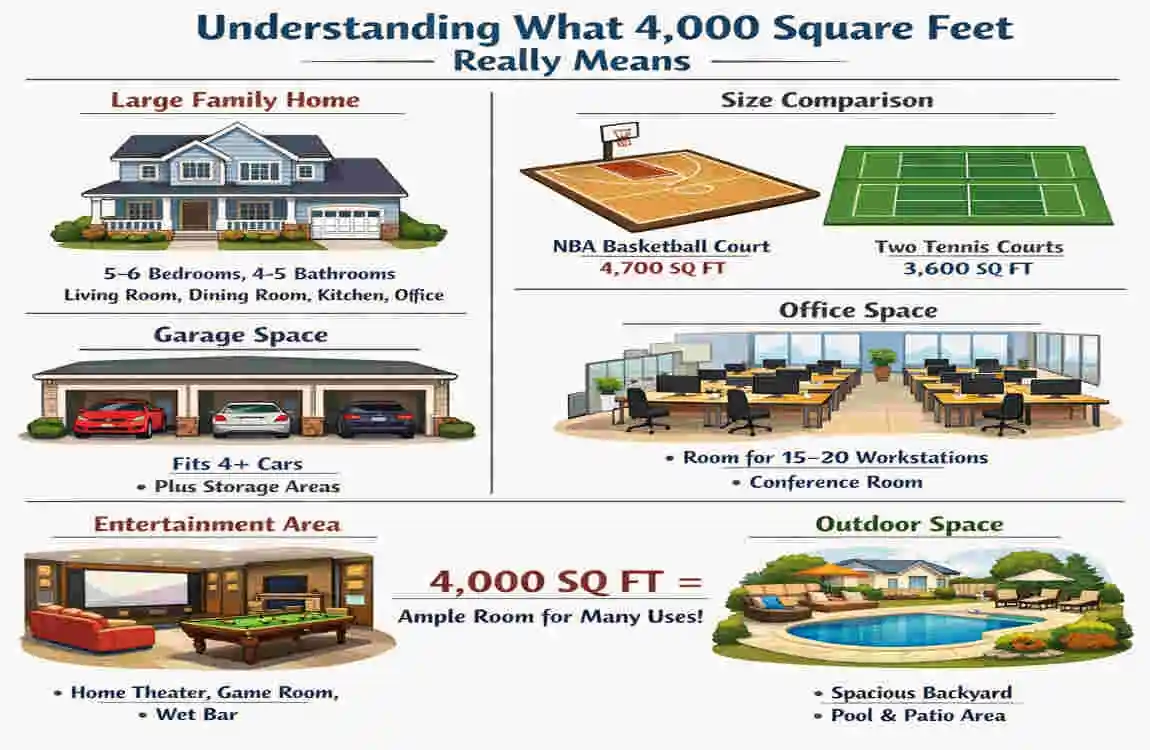
Everyday Item Approximate Sq Ft How It Fits in 4,000 Sq Ft

Tennis court 2,808 About 1.4 tennis courts

Two-car garage , 400 About 10 garages

Average main bedroom 200 About 20 master bedrooms

Small apartment 800. About 5 small apartments

Average hotel room: $325. About 12 hotel rooms

These comparisons help you see how much usable space 4,000 square feet really is. It is not justa bit biggerthan average. It is substantially bigger.

Another useful comparison is a basketball court. A full basketball court is around 4,700 square feet, so a 4,000 sq ft house is almost the size of one. That gives you a strong visual. Imagine nearly a whole basketball court, then divide it into bedrooms, bathrooms, kitchens, hallways, and living areas.

Does It Feel Huge in Real Life?

Yes, for most people, it does.

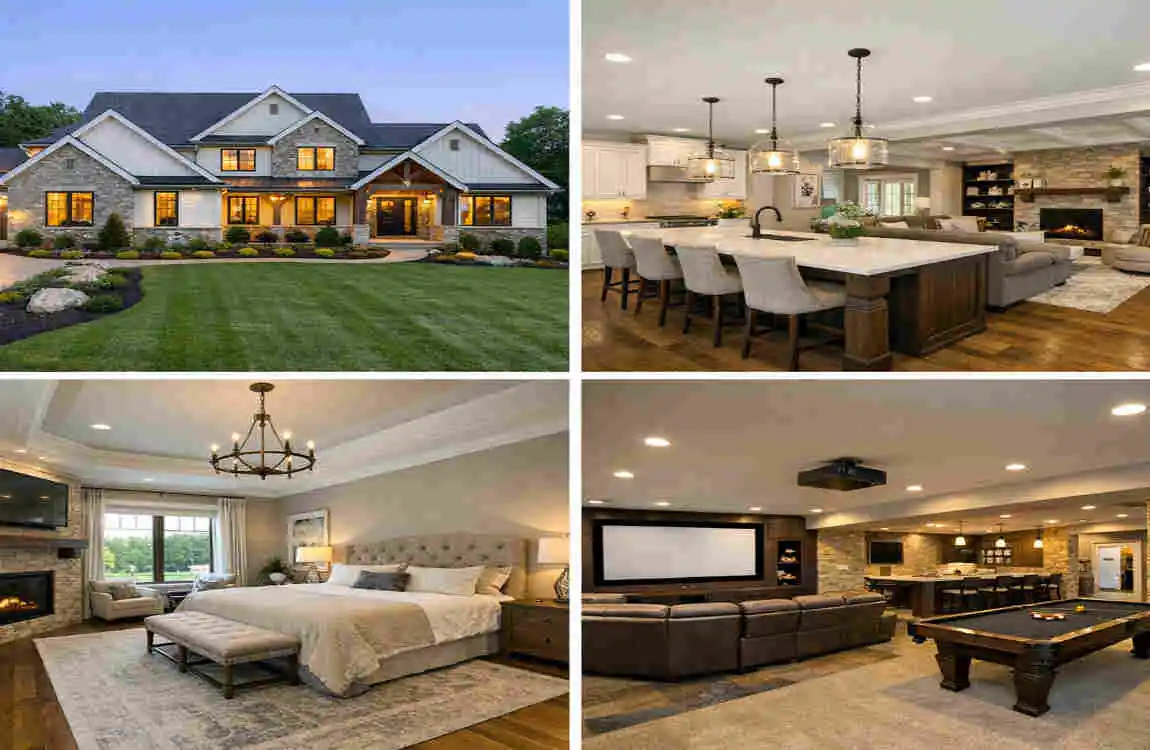
When you walk into a 4,000 sq ft home, you usually notice the scale right away. The ceilings may be taller. The entryway may be larger. The living room may feel like a space built not just for a couch and TV, but for conversation, entertaining, and movement. Bedrooms are often large enough to hold sitting areas. Bathrooms may include separate tubs, walk-in showers, and double vanities without feeling cramped.

The biggest difference, though, is not always in one room. It is in how the house breathes. You have space between rooms. You have room for people to spread out. You have fewer moments when the home feels crowded.

How Lot Size Changes the Experience

A 4,000 square foot house usually sits on a larger lot than a standard home, especially in suburban and semi-rural areas. It often appears on lots around half an acre to one acre, though this varies a lot by region.

In dense urban areas, a home this size may rise upward with two or three floors and a smaller yard. In suburban areas, it can stretch outward with a broad front, a long driveway, a backyard patio, and a pool.

So, if you are asking how big a 4000 square foot house is, remember that the feeling of size comes from both the house and the land around it. A large home on a small lot feels different from a large home on open land.

Standard 4000 Sq Ft House Layout and Floor Plans

The next big question after size is layout. A home can have 4,000 square feet and still feel awkward if the plan is poor. A smart layout makes the home feel useful, comfortable, and easy to live in.

Single-Story vs. Multi-Story Layouts

A single-story 4000 square foot home often feels expansive and luxurious. Everything is on one level, which makes it appealing for accessibility and convenience. You do not have to deal with stairs every day, and the home can feel connected and flowing.

This type of layout works well for:

  • Older homeowners
  • Families with young children
  • Anyone who wants easier movement from room to room

The downside is that it needs a larger lot. A one-story home with that much square footage takes up a lot of land.

A two-story 4000 square foot house is more common. It gives you the same amount of indoor space while using less lot area. Usually, the lower level holds the shared spaces like the kitchen, dining room, family room, office, and maybe a guest suite. Upstairs often includes the primary suite, children’s bedrooms, a loft, and extra bathrooms.

A three-story version is less common in typical suburbs but can be found in city settings or narrow-lot homes. In that setup, one level may be dedicated to special-use areas like a media room, gym, or rooftop access.

Common 4000 Square Foot Home Layouts

Many 4000 square foot home layouts follow a similar pattern because they balance privacy and togetherness well.

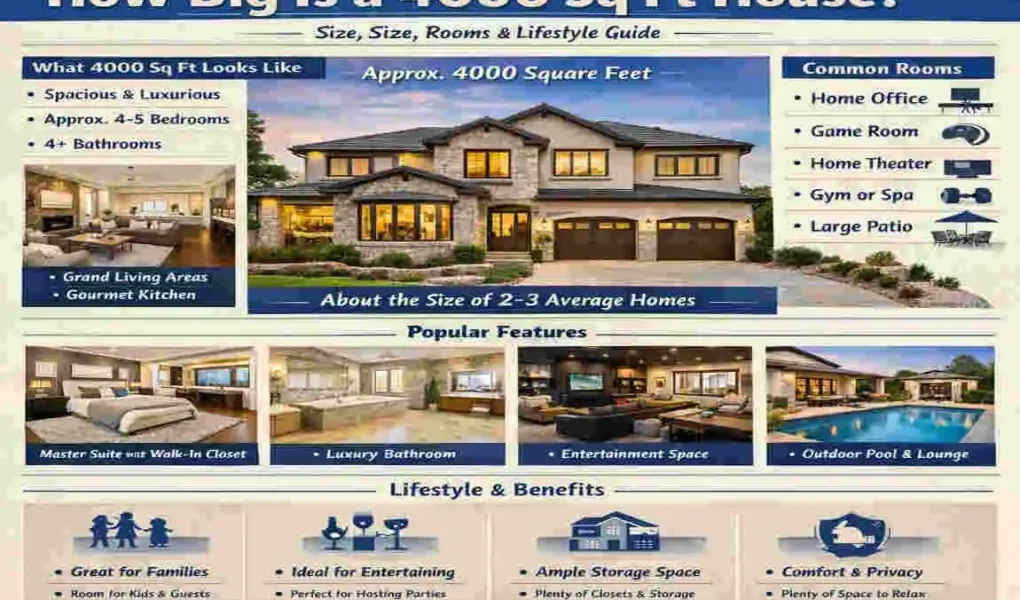
A typical layout may include:

  • 4 to 5 bedrooms
  • 4 to 5 bathrooms
  • A large kitchen with an island and a pantry
  • Open-concept living and dining areas
  • A home office
  • A mudroom and laundry room
  • A bonus room, media room, or playroom
  • A 2-car or 3-car garage

That is why this size is often seen as ideal for larger families or people who wantextraswithout stepping fully into mansion territory.

A Sample Floor Plan Breakdown

Let’s imagine a practical 4,000 sq ft two-story house.

Ground Floor

The first floor might include a grand entry, a formal or semi-formal dining area, and a large open kitchen connected to the family room. The kitchen alone could take up 400 to 500 square feet, especially if it includes an oversized island, a walk-in pantry, and a breakfast nook.

The family room could range from 500 to 700 square feet, depending on whether it blends with the dining area. Many homes this size also include a separate office, which is increasingly useful for remote work.

A guest suite with a full bathroom may also be placed on the first floor. This works well for visitors, older parents, or live-in support.

Upper Floor

The second floor often holds the main sleeping areas. The primary suite may take up 500 to 700 square feet when you include the bedroom, bathroom, and walk-in closet. Secondary bedrooms are often much larger than average and may each have their own bathroom or share a Jack-and-Jill setup.

There may also be a loft, homework nook, second family lounge, or media room upstairs. In a well-designed plan, upstairs does not just serve as a sleeping zone. It becomes a quieter, more private family space.

Open-Concept Living Is Very Common

One of the biggest trends in 4000 sq ft house floor plans is the open-concept design. Instead of chopping the house into many small rooms, builders combine the kitchen, breakfast area, and family room into one large shared space.

This approach makes the home feel even bigger because sightlines stay open. It also suits modern living. You can cook while talking to family. Guests can gather without getting separated into different rooms. Children can play while adults keep an eye on them.

At this square footage, open-concept rooms can become truly generous. A single combined kitchen and family area may reach 800 to 1,000 square feet.

Custom vs. Standard Designs

Some 4,000 sq ft homes are built from stock plans, while others are fully custom. Custom homes usually stand out through special features like:

  • Dual offices
  • Indoor-outdoor entertaining areas
  • Home theaters
  • Wine storage
  • Larger laundry and utility spaces
  • Dedicated hobby rooms

Regional style also changes the floor plan. In some places, especially parts of Texas or newer suburbs, homes at this size may include extra-large garages, covered patios, and expansive primary suites. In colder regions, you may see more finished basements, mudrooms, and insulated storage spaces.

So while the number stays the same, the actual experience of living in a 4000 sq ft house depends heavily on the floor plan.

Room-by-Room Breakdown: How Space Divides in a 4000 Sq Ft House

One of the best ways to understand how big a 4000 square foot house is to break it into rooms. Once you see how much space each area can get, the whole picture becomes much clearer.

Kitchen and Family Hub

In a house this size, the kitchen is rarely small. It usually becomes one of the most important rooms in the home.

A large kitchen in a 4,000 sq ft house often ranges from 400 to 600 square feet. That gives you enough room for:

  • A big center island
  • Plenty of cabinet space
  • A walk-in pantry
  • Double ovens or extra appliances
  • A breakfast area or casual dining spot
  • Wide walkways for several people to move around comfortably

This is not just a cooking space. It becomes the home’s social center. If you enjoy hosting, meal prepping, or having family gather around the island, this size feels very comfortable.

Primary Suite

The primary suite in a home this size can feel more like a private retreat than just a bedroom.

It often ranges from 500 to 700 square feet when you count the sleeping area, bathroom, and closet. In some homes, it may be even larger. A suite like this may include a seating area, two separate vanities, a soaking tub, a large shower, a private toilet room, and one or two walk-in closets.

For many buyers, this is one of the biggest advantages of a larger home. You are not just getting an oversized bedroom. You are getting a dedicated space to relax and recharge.

Secondary Bedrooms

Secondary bedrooms in a 4,000 sq ft home are usually generous. Instead of the smaller 10-by-10 or 10-by-12 rooms found in many standard homes, these rooms may range from 200 to 300 square feet each.

That means children’s rooms can comfortably fit:

  • A larger bed
  • A desk
  • Storage furniture
  • A reading chair or play corner

If the home has 4 or 5 bedrooms, the secondary rooms still tend to feel spacious rather than squeezed in.

Common Living Areas

The living and entertaining spaces are often where a 4,000 sq ft house really shows its size.

A great room may be around 500 square feet or more. If the dining area is separate, that room may still have enough space for large seating arrangements, built-ins, a fireplace, and wide circulation space.

Some homes also include a formal sitting room or a second lounge. Others use the extra square footage for a media room, game room, or playroom.

A media room may be around 250 to 350 square feet, which is enough for large sofas, a projector or oversized TV, and dim lighting for movie nights. A home gym may be around 150 to 250 square feet, which can easily hold cardio equipment, weights, and mats.

Bathrooms, Laundry, and Utility Spaces

In smaller homes, these support spaces can feel like afterthoughts. In a 4,000 sq ft home, they often get the attention they deserve.

Bathrooms are typically better spaced and more private. You may have:

  • An ensuite bathroom for the primary bedroom
  • Private or semi-private bathrooms for other bedrooms
  • A powder room for guests
  • A guest bathroom on the lower level

Laundry rooms are also larger. Instead of a narrow closet setup, you may get a full room with counters, cabinets, a sink, and sorting space.

Mudrooms become highly useful, too, especially for families. A mudroom of around 100 to 150 square feet can handle backpacks, shoes, coats, sports gear, pet items, and cleaning supplies without turning the entry into chaos.

Garage and Storage

It is also important to remember that some listings include garage space in the overall footprint, while others refer only to the heated living area. This can change how the home feels.

A 3-car garage often takes up around 600 to 800 square feet. If it is included in the total building footprint but not in the official living area, the home may actually feel even larger than expected overall.

Storage also improves dramatically in homes this size. You may find linen closets, walk-in storage rooms, attic access, under-stair storage, and built-ins throughout the house.

A Simple Way to Think About Room Distribution

While every plan differs, many homes this size divide space in a fairly predictable way.

Here is a helpful breakdown of how rooms in a 4000 sq ft house often spread out:

  1. Bedrooms and bathrooms usually take up a large share of the home, often around a quarter to a third of the total space.
  2. Common areas like the kitchen, living room, dining space, and family room often take up a large portion.
  3. Flexible spaces such as offices, media rooms, gyms, lofts, and playrooms fill the remaining square footage and give the home its luxury feel.

That is why 4,000 square feet feels so different from a basic family house. You are no longer forced to choose only the essentials. You finally have room for both needs and wants.

Lifestyle Fit: Who Thrives in a 4000 Square Foot Home?

How Big Is a 4000 Sq Ft House? Real Size, Rooms & Lifestyle Guide

A home this size is not just about square footage. It is about how you live. The real question is not only how big a 4000 square foot house is, but also who actually benefits from all that space.

Great for Growing Families

A 4,000 sq ft home works especially well for families of 4 to 6 people. Everyone can have their own room or enough personal space to feel comfortable. Morning routines run more smoothly because there are more bathrooms, wider hallways, and more than one place to get ready.

If you have teenagers, this size can be a huge help. Older children often want privacy, study space, and room to invite friends over. A larger house supports that stage of life much better than a smaller one.

Helpful for Multigenerational Living

Many people now live with parents, in-laws, or adult children. A 4,000 sq ft house gives you the flexibility to do that without everyone feeling on top of each other.

A first-floor guest suite, private bath, or separate lounge can help family members share one roof while still maintaining comfort and independence. This is one of the most practical benefits of a larger home.

A Strong Match for Remote Work and Hobbies

Working from home becomes much easier when your office is a real room instead of a corner in the dining area. In a 4,000 sq ft home, you can have one or even two offices without sacrificing bedrooms.

The same goes for hobbies. Whether you enjoy crafting, gaming, fitness, music, or reading, extra rooms create freedom. You do not have to pack things away to reclaim the living room constantly.

Entertaining Feels Easy

If you like hosting birthdays, holiday dinners, game nights, or overnight guests, a large home can change the experience completely.

You can fit a long dining table. Guests can gather in the kitchen without blocking movement. Children can play in another room. Visitors can stay overnight in a guest suite instead of on a sofa.

This size often works well for people who regularly host 20 or more guests. The house feels active and welcoming rather than crowded.

The Everyday Experience of Living in a 4000 Sq Ft House

Daily life in a large home often feels smoother because activities can happen at the same time without conflict.

You can cook in the kitchen while someone works in the office, another person watches a movie in the media room, and children do homework upstairs. Everyone has enough room to live without stepping on each other’s routines.

That said, the space only feels helpful if you actually use it. Empty rooms that sit untouched can make a home feel wasteful instead of luxurious.

Who It Is Best For

Here is a simple way to tell if living in a 4000 sq ft house may suit you:

  • You have a larger family or plan to grow your household
  • You host guests often
  • You work from home
  • You need flexible rooms for hobbies or aging family members
  • You want privacy and less crowding
  • You are comfortable with higher upkeep and utility costs

When It May Feel Too Big

A large home is not always the right fit. If you live alone, travel constantly, or prefer low-maintenance living, 4,000 square feet can feel like too much house. You may end up paying for space you rarely use.

So the best choice depends less on status and more on lifestyle. The right home size is the one that supports your real daily life.

Costs and Practical Considerations for a 4000 sq ft house

Space feels wonderful, but it comes with real costs. Before falling in love with the idea, it helps to understand what a home this size can mean financially and practically.

Building or Buying the Home

The cost of building a 4,000 sq ft house varies widely based on location, materials, labor, and design quality. A rough estimate often falls between $100 and $300 per square foot, and luxury builds can go much higher.

That means construction alone could range from $400,000 to $1.2 million or more. In premium markets, the final number can rise much further, especially with custom finishes, high-end appliances, and large outdoor features.

Buying an existing home depends just as heavily on the area. In some suburbs, 4,000 square feet may be attainable. In high-cost cities, it may be far beyond the average buyer’s budget.

Monthly Ownership Costs

The mortgage is only one part of the picture. A larger house usually brings larger monthly bills.

Utilities can easily reach $500 or more per month, especially if the house has tall ceilings, multiple HVAC zones, large windows, and heavy appliance use. Heating and cooling are often the biggest expenses.

Property taxes also rise with home value and lot size. Insurance tends to cost more as well, especially if the home includes premium finishes or extra structures.

Cleaning and Maintenance

A 4,000 sq ft house takes real effort to keep clean. More rooms mean more floors to vacuum, more bathrooms to scrub, more surfaces to dust, and more windows to maintain.

Many homeowners eventually hire cleaning help because the workload becomes hard to manage consistently. Lawn care, exterior maintenance, and repair work also grow with the size of the property.

This does not mean the home is not worth it. It just means you should go in with open eyes.

Energy Efficiency Matters More in a Large Home

The good news is that good design can lower long-term costs. In a large house, energy efficiency is not just a nice bonus. It makes a major difference.

Look for features like:

  • High-quality insulation
  • Zoned heating and cooling
  • Energy-efficient windows
  • Smart thermostats
  • LED lighting
  • Efficient appliances
  • Good roof and attic design

These details help control monthly bills and make the home more comfortable year-round.

Resale Value and Market Appeal

A 4,000 sq ft home can hold strong resale value in areas where larger family homes are in demand. Buyers often look for this size in suburban communities with good schools, larger lots, and newer developments.

Still, resale depends on the market. If the house is far larger than surrounding homes, or if the upkeep feels too high for local buyers, it may take longer to sell. Smart layouts and tasteful updates usually matter more than square footage alone.

In other words, the best large homes are not just big. They are well-designed, efficient, and functional.

How Big Is a 4000 Sq Ft House Compared to Celebrity Homes and More

Sometimes, the easiest way to understand how big a 4000 square foot house is to compare it with homes at both ends of the scale.

Compared to the Average Home

If the average home is around 2,000 to 2,500 square feet, then a 4,000 sq ft house is roughly double the size of many standard family homes.

That extra room changes everything. Instead of choosing between a guest room and an office, you might have both. Instead of squeezing everyone into one family room, you may have a second lounge or media room. Life spreads out more comfortably.

Compared to a Starter Home

A starter home of around 1,500 to 2,000 square feet often focuses on the basics: a few bedrooms, a couple of bathrooms, one living area, and a practical kitchen.

A 4,000 sq ft house goes far beyond that. It gives you not only the essentials, but also flexibility, privacy, and luxury touches. That is why many people see it as an upgrade to a more established lifestyle.

Compared to Mansions and Celebrity Homes

Now let’s keep it realistic. A 4,000 sq ft house is large, but it is not usually a mega-mansion. Many celebrity homes start at 6,000 square feet and rise far beyond that. Some estates are 10,000, 20,000, or even 30,000 square feet.

So, 4,000 square feet may seem modest in that world. But for everyday homeowners, it still feels substantial and upscale. It sits in a sweet spot where the home can feel impressive without becoming excessive.

Why It Is Often Seen asRight-Sized Luxury”

Modern buyers often want comfort, beauty, and function, but they do not always want the burden of an enormous estate. That is why 4,000 square feet often lands in the category of right-sized luxury.

It is big enough to give you premium features and room to breathe, but still manageable compared with much larger properties. For many families, that balance is exactly what makes it appealing.

You may also like...

Leave a Reply

Your email address will not be published. Required fields are marked *