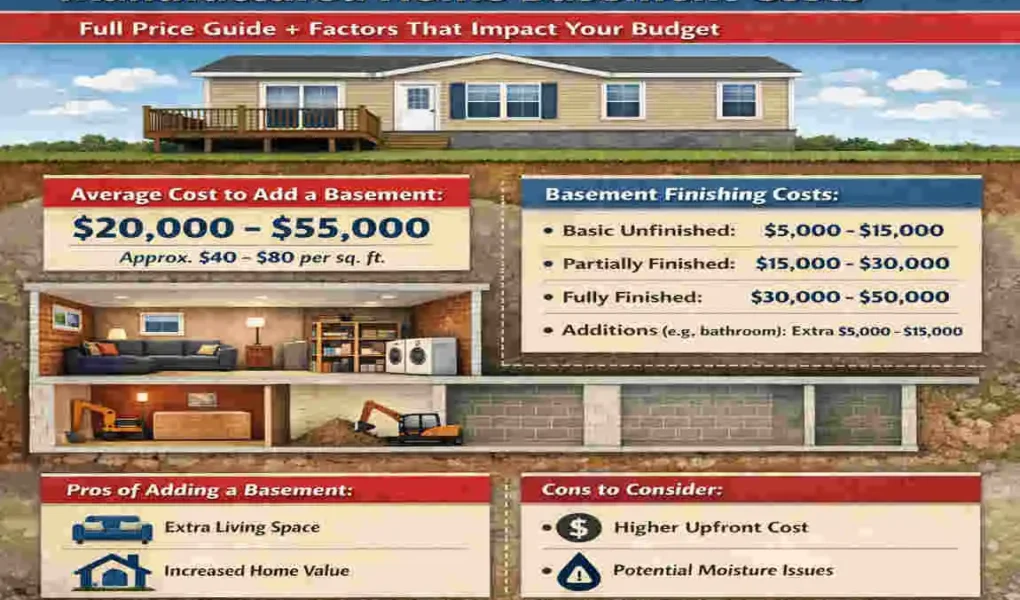
Have you ever looked at your manufactured home and wished you had just a little more room? You may need a quiet home office, a playroom for the kids, or a safe spot to hunker down during a storm. If so, you’ve probably asked yourself: how much does it cost to put a basement under a manufactured home? It is a big question, and the answer can change your entire way of life.
Adding a basement isn’t just about extra square footage; it’s about turning a house into a permanent estate. Did you know that adding a basement can boost your property value by 20% to 30%? That is a massive jump in equity. However, this project is a significant investment. Generally, you can expect to pay anywhere from $12,000 to over $50,000, depending on your goals and the condition of your land.
Why Add a Basement to a Manufactured Home?
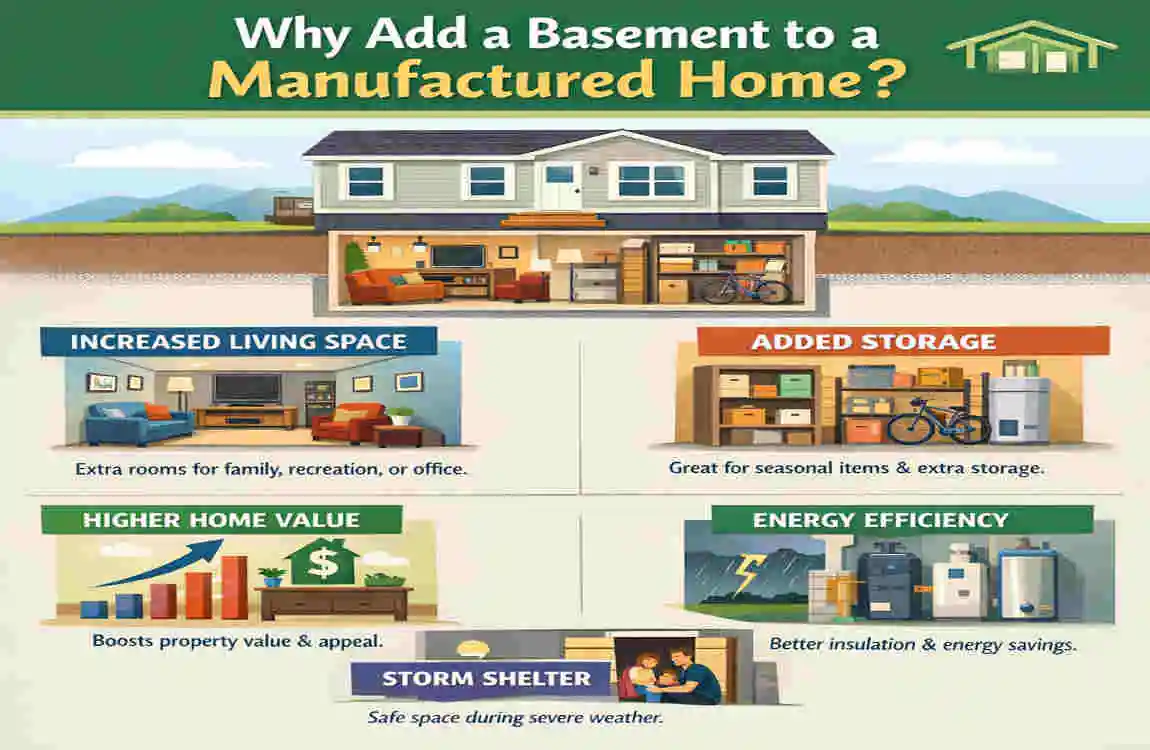
Before we talk about the “how much,” let’s talk about the “why.” Adding a basement is one of the most effective ways to upgrade a manufactured home, but it isn’t for everyone. First, make sure your home is eligible. Generally, only HUD-compliant homes can be placed on a permanent basement foundation. Not every single-wide or older double-wide will qualify without significant engineering work, so checking your home’s specs is the first step.
The Major Benefits of Going Underground
Why do homeowners choose to go through the trouble of excavating? Here are the top reasons:
- Massive Value Boost: As mentioned, a basement can increase your home’s resale value by 20-30%. It also makes your home much more appealing to traditional lenders, who often prefer homes on permanent foundations.
- Extra Living Space: You can easily add 500-1,000 square feet of usable space. This could be a guest suite, a gym, or a massive storage area that keeps your main floor clutter-free.
- Energy Efficiency: Earth is a natural insulator. Basements stay cooler in the summer and warmer in the winter, which can lower your cooling bills by 10-15%. Storm Safety: If you live in a tornado-prone area, a basement provides a level of safety that a standard pier-and-beam foundation cannot match. Challenges to Consider
It isn’t all sunshine and rainbows, though. Basements are prone to high moisture levels, especially if they aren’t waterproofed properly. You also have to navigate complex local building codes and HUD standards. To help you weigh the options, look at this quick comparison:
BenefitImpact
Property Value +20-30% appreciation
Space Gain 500+ sq ft of usable area
Energy Efficiency : Lower cooling bills by 10-15%
Safety High protection against severe weather
Full Cost Breakdown: What Are You Really Paying For?

Now, let’s get into the heart of the matter. When you ask how much it costs to put a basement under a manufactured home, you have to look at the project in stages. On average, a standard basement costs between $12,000 and $25,000, but if you want a fancy walk-out style, you could easily see that number climb to $50,000 or more. You break it down by the foot, and you’re looking at roughly $25 to $75 per square foot. Compare that to a simple concrete slab, which usually costs between $4,000 and $10,000, and you can see why this is considered a Premium upgrade. Itemized Cost Components
To give you a better idea of where your money goes, here is a breakdown of the typical expenses:
Cost ComponentPrice RangeNotes
Excavation $5,000 – $15,000 Depends heavily on soil type
Foundation Walls/Concrete $8,000 – $20,000 Poured concrete vs. precast panels
Waterproofing & Drainage $2,000 – $8,000 Essential to prevent humidity
Labor & Engineering $3,000 – $10,000 Includes HUD-certified inspections
Finishes (Floors/Stairs) $2,000 – $7,000 Optional for unfinished spaces
Regional Price Differences
Where you live matters just as much as what you build. If you are building in Texas, you might encounter heavy clay soils that require additional piers, which can add 20-50% to your excavation costs. Similarly, if your land is rocky, the cost of heavy machinery to break through that stone will eat into your budget quickly. For a standard 800 sq ft basement, a safe average to keep in mind is about $28,000.
Key Factors Impacting Your Budget
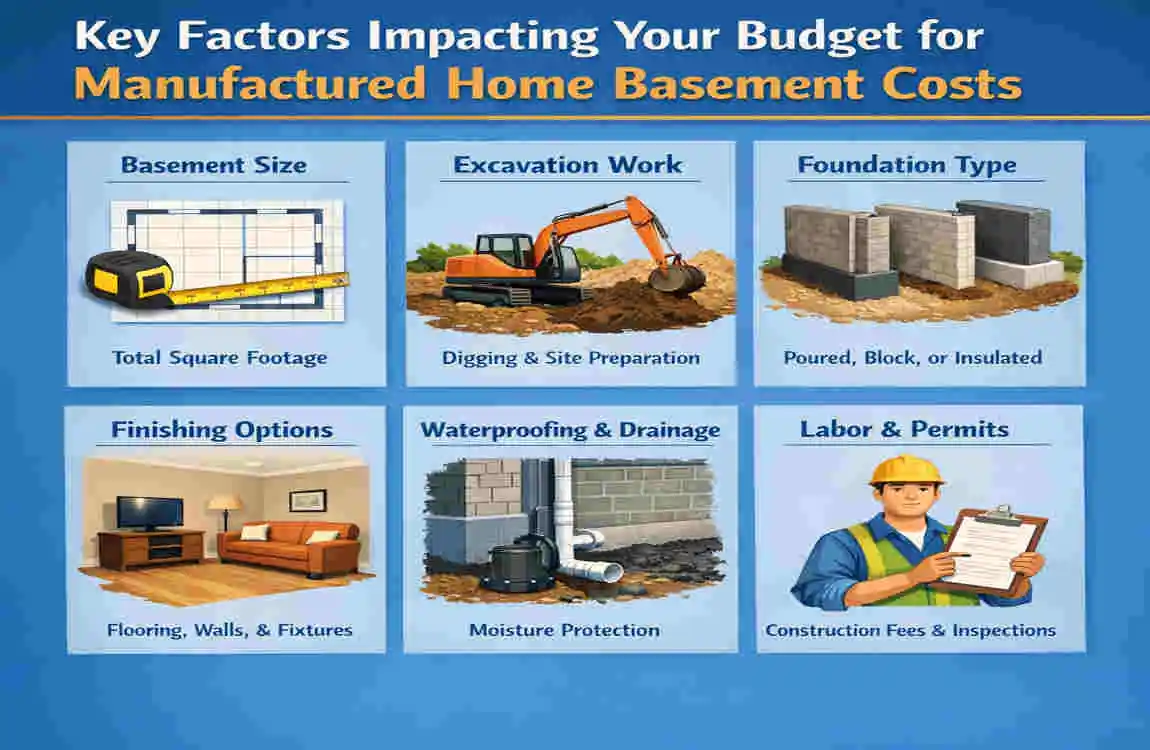
No two basement projects are the same. Several “invisible” factors can swing your final bill by thousands of dollars. Understanding these will help you avoid “sticker shock” later on.
Site Conditions and Soil Quality
Your land is the biggest wildcard. If your soil is rocky, the excavation team will need specialized equipment, which can increase costs by 30%. If your lot is on a slope, you might actually save on some excavation but pay more for a “walk-out” design. Drainage is also a huge factor; if your water table is high, you’ll need a more robust (and expensive) drainage system to keep the basement dry.
Home Specifications
The size and age of your home play a role. A double-wide home has a much larger footprint and a heavier load than a single-wide, meaning the foundation walls must be thicker and more reinforced. If you have an older home, you might also need to pay for retrofitting to ensure the structure can be safely lifted and placed onto the new basement.
Design Choices: Standard vs. Walk-out
Do you want a “daylight” basement with windows and an exterior door? A walk-out basement is beautiful and adds tons of light, but it typically adds $20,000 to $30,000 to the total price because of the extra grading and finishing required. Additionally, choosing a finished basement (with drywall, flooring, and electricity) will add another $10 to $40 per square foot to your budget.
Location and Regulations
Labor rates vary wildly. If you are in an urban area, expect to pay about 25% more for labor than in rural regions. Don’t forget the “paperwork” costs either. Permits can range from $1,000 to $3,000, and you must ensure the design meets FEMA standards if you are in a flood zone. 5. Material Selection Most people use poured concrete, but Insulated Concrete Forms (ICF) are becoming popular. While ICF might cost more upfront, it can save you 10-20% on energy bills over the long term thanks to its exceptional insulation.
- Soil Type Tip: Clay soil often requires piers ($2,000 extra), while sandy soil is generally the cheapest to excavate.
- Cost-Saver: Opting for an unfinished basement now and finishing it yourself later can save you $15,000+ upfront.
Comparison: Basement vs. Other Foundations
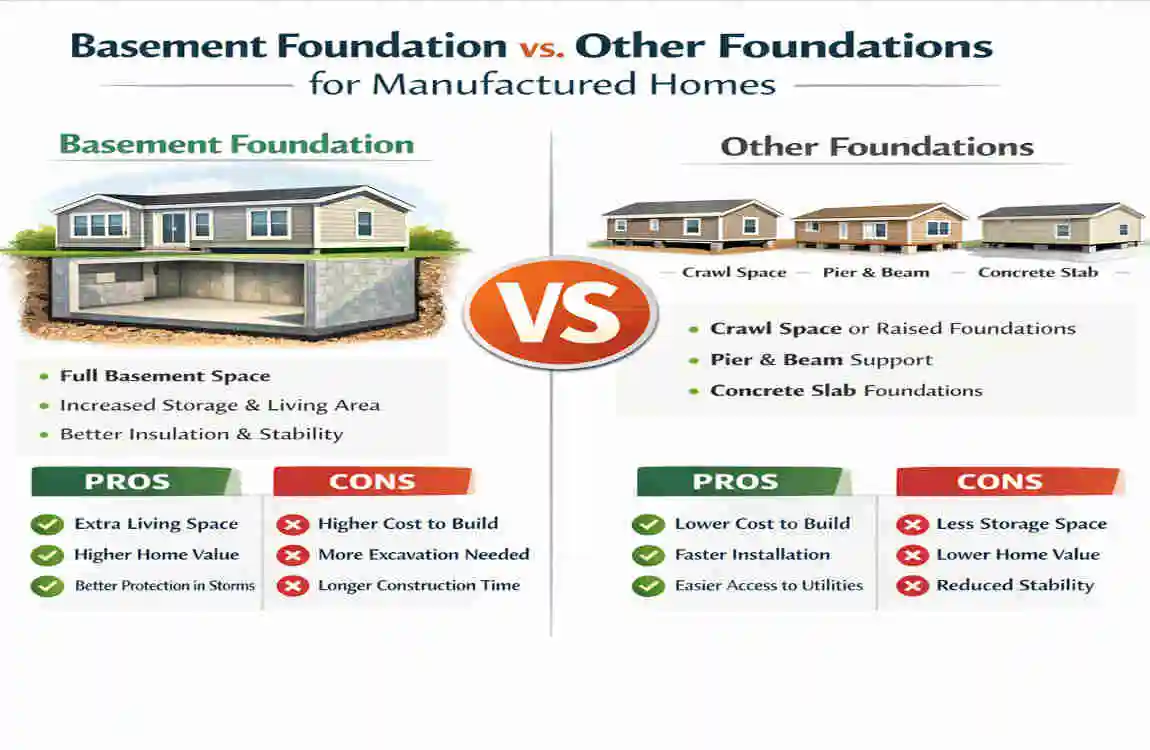
Is a basement really the best choice for you? Let’s look at how it stacks up against other common foundation types for manufactured homes.
Foundation Type Cost Range Pros Cons
Basement $12k – $50k Max space, high value Expensive, complex
Slab $4k – $10k Quick, affordable No storage or access
Pier & Beam $1k – $2k Very cheap Needs frequent re-leveling
When Should You Choose a Basement?
If you plan on living in your home for the next 10 to 20 years, a basement is almost always worth it. It provides the stability of a site-built home and allows your family to grow without moving. From a financial perspective, you can recoup 70% to 90% of your investment when you sell the home within five years. How to Budget and Save Money
Building a basement is a marathon, not a sprint. To keep your finances on track, follow these steps:
- Get Multiple Quotes: Don’t settle for the first contractor you find. Get 3 to 5 quotes from engineers who specialize in manufactured home foundations.
- Invest in a Soil Test: Spending $500 to $1,000 on a soil test now can save you thousands in “surprises” once the digging starts.
- Explore Financing: Look into FHA 203k loans. These are designed for home improvements and can often cover the cost of a permanent foundation. Pro-Tips for Saving Cash
- DIY Site Prep: If you are handy with a tractor or have friends in construction, clearing the land yourself can shave a few thousand off the bill.
- Off-Season Work: Contractors are often slower during late fall and early winter. You might snag a 10-15% discount by scheduling your project during their “down” time.
- Watch for Hidden Costs: Always set aside an extra 10% for things like utility extensions ($2,000–$5,000) and potential increases in your homeowners’ insurance (usually 1-2%).
Real-World Case Studies
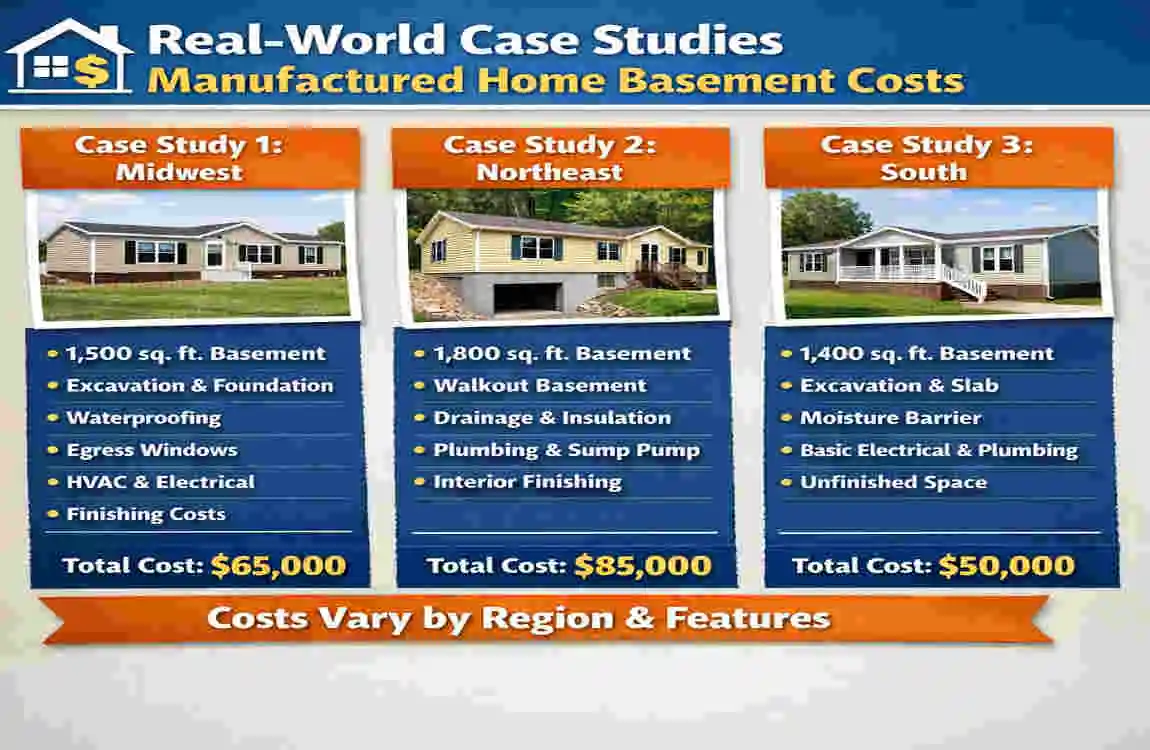
Sometimes, seeing real numbers helps the most. Here are two examples of what homeowners actually paid:
- Case Study 1: The Texas Double-Wide. A family on a flat lot in Texas wanted a standard, unfinished basement. Because the lot was easy to dig, their total cost came to $22,000. Case Study 2: The Sloped Site. A homeowner in a hilly area opted for a full walk-out basement. Between the extra excavation and the reinforced retaining walls, the total bill hit $48,000. Lesson:** Engineering and site prep are the most critical parts of the process. Getting these right upfront prevents massive cost overruns later.
How Much Does It Cost to Put a Basement Under a Manufactured Home? – Full FAQ
Q: Can you put a basement under a manufactured home?
A: Yes, it is possible to install a basement under a manufactured home. It requires careful planning and adherence to building codes, but it can be done.
Q: What is the average cost to put a basement under a manufactured home?
A: The average cost to put a basement under a manufactured home ranges from $20,000 to $50,000. This cost can vary based on factors such as size, location, and the level of finishing.
Q: How much does it cost per square foot to build a basement under a manufactured home?
A: The average cost to build a basement under a manufactured home is around $33 per square foot.
Q: What are the additional costs associated with adding a basement to a manufactured home?
A: Additional costs can include excavation, foundation walls, a concrete pad, and a “basement plug” which is an engineered hole in the home’s floor for access to the basement. The “basement plug” typically costs between $1,000 and $2,000.
Q: How does the size of the basement affect the cost?
A: The cost of a basement for a manufactured home can vary significantly with size. For example, a 1000 sq/ft basement might cost around $50,000 to $60,000, including excavation and other necessary work. Just the foundation walls and concrete pad for a 1000 sq/ft basement could cost approximately $30,000 and $14,000, respectively.