
Have you ever placed a marble on your floor, only to watch it roll quickly to the other side of the room all on its own? Or you may have noticed that the door to your bedroom jams every time you try to close it, or that jagged cracks are appearing in the drywall above your windows. If you are nodding your head, you aren’t alone. These are the classic, tell-tale signs of a foundation that has lost its footing.
Millions of homeowners face these settling issues every single year. It is a stressful discovery. Your home is likely your biggest investment, and the idea of it sinking or shifting can induce a lot of anxiety. Naturally, the first question that pops into your mind is: how much does it cost to level a wood-frame house?
Wood frame houses, which are incredibly common in suburban areas across the United States and are also frequently seen in specific construction styles in regions like Punjab, are unique. Unlike solid concrete block homes, wood frame structures often sit on pier-and-beam foundations. While this provides access to plumbing and electrical systems, it also makes them susceptible to soil shifts, rotting beams, and moisture damage.
What Is House Leveling and Why Do Wood Frames Need It
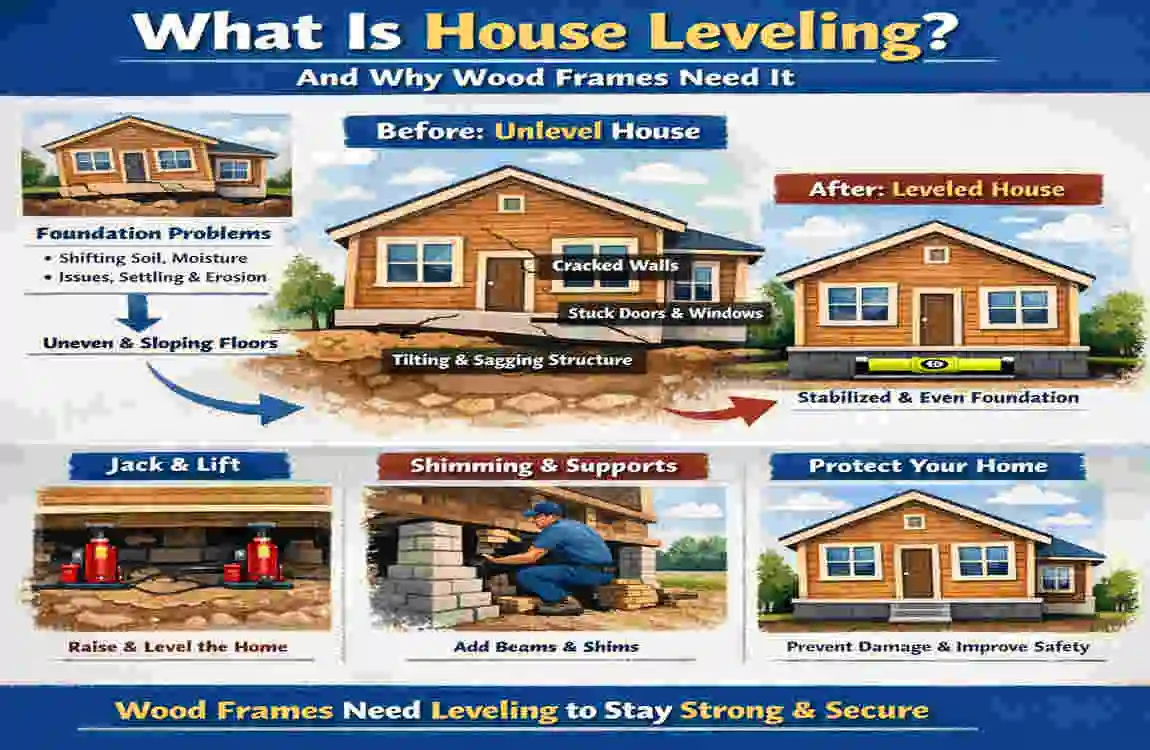
Before we dive strictly into the numbers, it is crucial to understand what you are actually paying for. House leveling isn’t just about making the floor flat; it is about stabilizing your home’s structural integrity.
House Leveling Defined
In the simplest terms, house leveling is the process of lifting a home back to its original position—or as close to it as possible. Over time, the ground beneath your house moves. Dirt compresses; clay expands with water and shrinks when it dries; and sometimes the foundation materials themselves degrade.
Leveling involves using hydraulic jacks to lift the sunken parts of the house physically. Once it is lifted, contractors will install new support piers, shims (wedges used to fill gaps), or beams to hold it in place permanently. Think of it like changing a tire on a car, but on a massive, permanent scale.
Wood Frame Specifics
Wood frame houses are distinct because they are often built on a pier-and-beam system. This means the house is elevated off the ground, sitting on concrete or wooden posts (piers) and long horizontal wood supports (beams).
This design is fantastic for flood-prone areas or places with heavy monsoon seasons because it keeps the living area away from ground moisture. However, because wood is an organic material, it reacts to the environment.
- Rot: If moisture gets into the crawl space, wooden beams can rot and compress.
- Termites: Wood frames are susceptible to pests that eat away at the support.
- Soil Shifts: Since the piers are individual points of contact with the ground, if the soil shifts under just one corner of the house, that specific corner will drop, twisting the wooden frame above it.
Signs You Need Leveling
How do you know if you are in the danger zone? Aside from the rolling marble test, look for these symptoms:
- Sticking Doors and Windows: When the frame twists, rectangular door frames become parallelograms, causing doors to catch.
- Drywall Cracks: Look for diagonal cracks coming off the corners of windows or doors.
- Separating Chimneys: If your chimney looks like it is leaning away from the house, that is a major red flag.
- Bouncy Floors: If walking across the living room feels like walking on a trampoline, your beams or joists may be failing.
According to engineering data, nearly 60% of homes built on expansive soil will experience some foundation distress within their first 30 years. Whether you are in the clay-heavy soil of the American South or dealing with the wet/dry cycles of South Asia, the earth moves, and your wood-frame house moves with it.
Average Costs: How Much Does It Cost to Level a Wood-Frame House?
Now, let’s get to the part you are really here for: the price tag. When you ask, “How much does it cost to level a wood-frame house?” the answer depends heavily on the footprint size and the extent of the damage.
National Averages
Based on current contractor data and material costs for 2026, here is what you can expect to pay on average:
- Small Home (<1,500 sq ft): For a smaller bungalow or cottage, prices typically land between $3,000 and $8,000. This usually assumes the damage is localized to one area or the settling is minor.
- Medium Home (1,500 – 3,000 sq ft): This is the most common category. For a standard family home, expect to pay between $8,000 and $20,000. This price often includes replacing some rotten wood and installing several new piers.
- Large Home (>3,000 sq ft): If you have a sprawling estate or a multi-story wood frame house, costs can easily exceed $20,000 to $30,000+. Larger homes are heavier, requiring more heavy-duty jacks and a larger crew to lift safely.
Cost Per Square Foot
If you prefer to calculate based on area, the industry standard runs between $5 and $15 per square foot. If you are using a more expensive method, like helical piers, the cost can be higher.
To give you a clearer picture, we have broken down the potential costs in the table below. This compares basic leveling (just shimming and minor adjustments) to advanced leveling (replacing beams and installing new piers).
Pricing Table: Estimated Costs by Size
House SizeBasic Leveling (Shimming/Minor Lift)Advanced (New Piers/Beam Replacement)Average Hourly Labor Cost
1,000 sq ft $3,000 – $5,000 $6,000 – $10,000 $100 – $200/hr
2,000 sq ft $8,000 – $12,000 $15,000 – $25,000 $100 – $200/hr
3,000+ sq ft $15,000 – $25,000 $25,000 – $40,000 $100 – $200/hr
Regional Variations
Location matters immensely. If you live in an urban center with a high cost of living, expect to pay a premium of about 20% above these averages. Conversely, in rural areas where labor is cheaper, you might find quotes on the lower end. However, rural areas might charge travel fees if the crew has to drive a long distance to reach your property.
Key Factors Affecting Wood Frame House Leveling Costs
You might get a quote for $5,000, and your neighbor might get one for $15,000, even if your luxyry houses look the same. Why the discrepancy? Several key variables influence the final bottom line.
Foundation Type
While we are focusing on wood frames, the type of support under that frame varies.
- Pier and Beam: This is generally easier to access. Crawl spaces allow workers to get underneath without digging up the entire floor. However, replacing rotted wood beams increases the cost.
- Stem Wall: If you have a continuous concrete perimeter, accessing the center of the house is harder, which increases labor hours.
Severity of Damage
Are you lifting the house one inch, or five inches?
- Minor Tilt: If the house has only settled slightly, a crew might need to insert metal shims to even it out. This is the cheapest scenario.
- Major Shifts: If the house has sunk significantly, it requires a synchronized lift using multiple hydraulic jacks. Lifting too fast can crack walls and break plumbing, so this must be done slowly and carefully, significantly increasing labor time.
House Size and Access
Accessibility is a huge “hidden” cost factor.
- Crawl Space Height: If your crawl space is tall and roomy, workers can move easily. If it is a “belly crawl” space with only 12 inches of clearance, crews have to dig tunnels to reach the piers. This creates a massive amount of manual labor, driving up the price by $1,000 to $3,000.
- Landscaping: If you have decks, porches, or elaborate flower beds blocking access to the foundation, these may need to be removed and replaced, adding to the total bill.
Soil Conditions
The soil is the culprit, and it can also be the expense. If you are building on expansive clay, simply putting the pier back on the dirt won’t work—it will just move again. You may need to pay for soil stabilization or deeper piers that reach bedrock, which can increase costs by 30% to 50%.
Materials Used
Are you using concrete blocks? Treated lumber? Steel?
- Concrete: Cheaper, but heavy.
- Steel/Helical Piers: These are screwed deep into the ground. They are the “gold standard” for stability but are significantly more expensive than concrete friction piles.
Impact Table: What Spikes the Price?
FactorPotential Cost IncreaseExample Scenario
Poor Soil +25% – 50% Clay soil requiring deep steel piers
Low Clearance +10% – 20% Crew must dig tunnels to access piers
Urgency +20% Emergency stabilization to prevent collapse
Plumbing +$1k – $5k Broken pipes discovered during the lift
House Leveling Methods for Wood Frames: Costs & Pros/Cons
Not all leveling jobs use the same tools. The method your contractor suggests will dictate the price and the longevity of the repair.
Mudjacking / Slabjacking
- Cost: $3–$8 per sq ft.
- The Process: This involves pumping a slurry of cement, sand, and water under a sinking slab and then pumping it back up.
- Pros: It is quick, relatively cheap, and creates little mess.
- Cons: It is heavy. If the soil failed because it couldn’t support the weight of the house, adding heavy concrete might cause it to sink. Pure pier-and-beam homes are less common, but they’re still common, and they’re wood-frame homes sitting on slabs.
Steel / Helical Piers
- Cost: $8 – $15 per sq ft (or $1,500 – $2,500 per pier).
- The Process: Large steel shafts with screw-like plates are driven deep into the earth until they hit solid soil or bedrock. The house is then bracketed to these piers.
- Pros: This is a permanent solution. It bypasses the shifting topsoil entirely.
- Cons: It is the most expensive option and requires heavy machinery.
Shim and Adjust
- Cost: $2,000-$5,000 (Flat rate typical for minor jobs).
- The Process: If the piers are in good shape but the wood beam has compressed, contractors force thin wedges (shims) between the pier and the beam to level the floor.
- Pros: Very affordable and non-invasive.
- Cons: It doesn’t fix the root problem if the ground is sinking; it just patches the gap.
Foam Jacking Polyurethane
- Cost: $10-$20 per sq ft.
- The Process: Similar to mudjacking, but uses a high-density expanding foam.
- Pros: It is incredibly lightweight, so it doesn’t burden the soil. It cures in minutes.
- Cons: It can be expensive, and some argue it isn’t as structurally sound for massive shifts as steel piers.
Pros/Cons Comparison Table
MethodEst. Cost / sq ft, Durability, Disruption Level
Mudjacking $3 – $8 5 – 10 Years Low
Helical Piers $10 – $15 50+ Years High
Shimming Low Flat Rate 2 – 5 Years Very Low
Foam Injection $10 – $20 10 – 20 Years Low
Step-by-Step Process: What to Expect When Leveling Your House
If you decide to go ahead with the project, it helps to know what the week will look like. It isn’t as chaotic as you might think.
The Inspection ($200 – $500) A structural engineer or a foundation specialist visits your home. They will measure the elevation of your floors using a zip level (a high-precision altimeter). They map out exactly where the house has dropped and by how much.
Quote and Permits (1 – 2 Weeks) You get the design plan. Once you sign off, the company pulls local building permits. This is crucial for your insurance and future resale value.
Prep and Lifting (2 – 5 Days) The crew arrives. They clear the crawl space and set up hydraulic jacks at strategic points under the beams. Then, the “lift” begins. This is done slowly. You might hear creaking and groaning sounds from the wood—this is normal! It’s just the house stretching back into place.
Stabilization and Finish (1 Week) Once level, they install the permanent piers or shims. They remove the jacks and clean up the job site.
Warranty Check Most reputable companies offer a warranty ranging from 10 to 25 years. Keep this paperwork safe!
DIY vs. Professional: Costs, Risks & Savings Tips
In an era of YouTube tutorials, you can grab some bottle jacks from the hardware store and try this yourself.
The DIY Reality
- Cost: You could buy jacks and wood for $1,000-$3,000.
- The Risk: This is incredibly dangerous. If a jack slips, the house can fall. Not only could this destroy your home’s plumbing and electrical systems, but it can also be fatal to anyone beneath it. Furthermore, DIY foundation repair usually voids your homeowner’s insurance and makes the home very difficult to sell later, as inspectors will flag unprofessional work.
The Professional Advantage
- Safety: They carry liability insurance.
- Warranty: If it sinks again, they come back for free.
- Equipment: They use synchronized lifting machines that one person cannot replicate.
How to Save Money on a Pro
- Get 3 Quotes: Prices vary wildly. Always compare.
- Off-Season Discounts: Contractors are less busy in the winter or dry seasons. Ask for a discount if you book then.
- Bundle Repairs: If you need drainage work (gutters, French drains) done too, ask the same company to bundle the price.
- Local Firms: National chains have high overhead. Local, family-owned foundation companies often have lower rates.
Financing Options & Insurance Coverage

Let’s be real: most people don’t have $15,000 sitting in a savings account for a rainy day. So, how do you pay for this?
Does Insurance Cover It? Usually, no. Standard homeowner’s insurance views settling as “wear and tear” or “earth movement,” which is excluded. However, if the settling was caused by a sudden “act of God,” like a flood or a burst plumbing pipe that washed away the soil, you might have a claim. Always check your policy.
Financing Options
- Home Equity Loans: Since this improves the value of the home, equity loans are a smart way to borrow at lower interest rates (typically 4-7%).
- Contractor Financing: Many large foundation companies partner with banks to offer payment plans, sometimes even with 0% interest for the first 12 months.
- Government Grants: In some regions, grants are available to rehabilitate older homes or to help low-income homeowners ensure safety standards are met.
FAQs
How much does it cost to level a wood-frame house? On average, homeowners spend between $3,000 and $8,000 for minor repairs and $8,000 to $20,000 for moderate leveling work on wood frame houses. Extensive damage can exceed $30,000.
Is house leveling worth the cost? Absolutely. Foundation issues do not get better with time; they get worse. Leveling restores your property’s value, ensures structural safety, and prevents costly secondary damage, such as roof collapses or plumbing breaks.
How long does wood frame leveling last? It depends on the method. Shimming might last 5-10 years, while steel helical piers can last 50 to 100 years. A quality job should be a near-permanent fix if soil drainage is also addressed.
Can I live in my house while it is being leveled? Yes, in most cases. For wood-frame houses, the work is primarily done outside and under the crawl space. You might feel some vibrations and hear noise, but you rarely have to move out.
Does leveling a house cause cracks? Paradoxically, yes. As the house is lifted back to its correct flat position, drywall that was patched while the house was crooked may crack again. New cracks can appear as the frame relieves tension. These are usually cosmetic and easily fixed with paint and spackle.