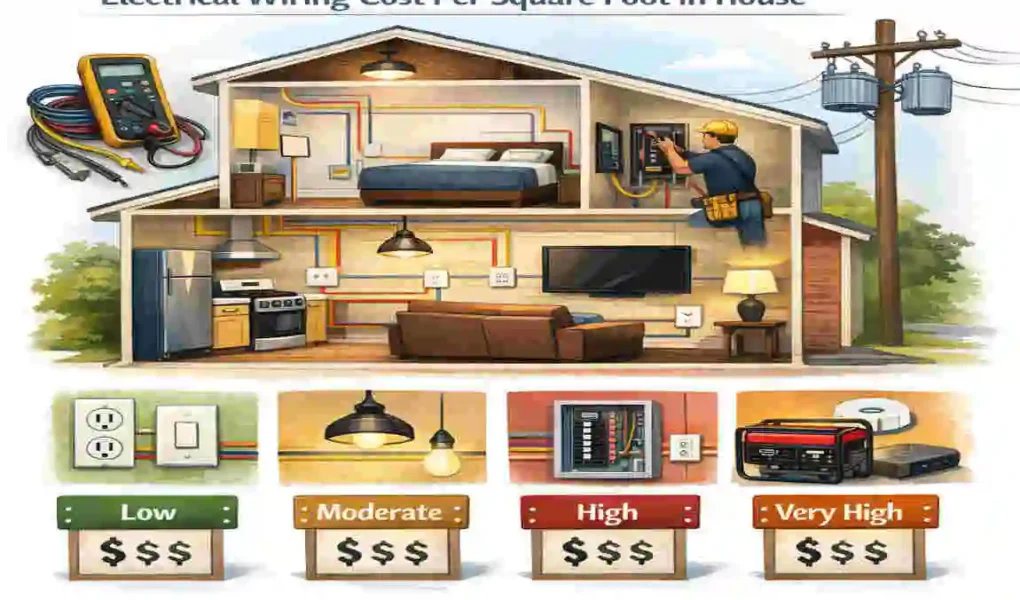
If you are building or renovating a house, one mistake can quietly damage your budget from the start: underestimating the electrical work. Many homeowners spend weeks comparing cement, tiles, paint, and kitchen finishes, but they leave wiring costs for later. Then, when the electrician’s quote arrives, it feels much higher than expected.
That is exactly why understanding the electrical wiring cost per square foot in a house is so important. This number gives you a practical way to estimate the total cost of electrical work before construction gets too far ahead. It also helps you compare quotes, control spending, and avoid last-minute surprises.
In simple words, the electrical wiring cost per square foot in a house means the average amount you may spend on wiring for each square foot of your home’s covered area. Instead of guessing one room at a time, this method helps you see the full picture. You may also hear people use similar terms like cost of electrical wiring per square foot in house or average wiring cost per sq ft in house. They all point to the same idea: budgeting electrical work in a way that is easy to measure and compare.
Why Electrical Wiring Cost Per Square Foot in a House Matters
Budgeting Starts With the Right Cost Base
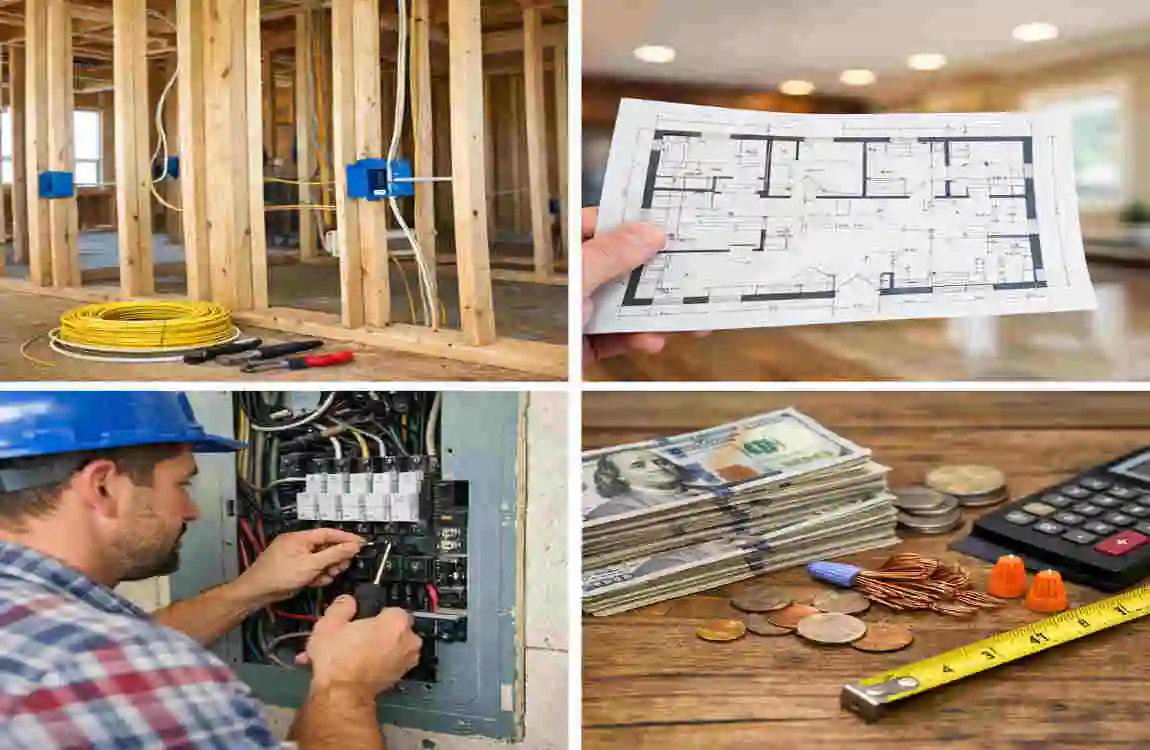
When people prepare a house construction budget, they often focus on the total project cost. That makes sense. But total numbers can be misleading if you do not know how the spending is distributed. Electrical work may look like a smaller category compared to structure or finishing, but it still takes a meaningful share of your budget.
That is why the cost of electrical wiring per square foot in a house matters. It gives you a simple benchmark. If your house is 2,000 square feet and you know the likely cost range per square foot, you can quickly build a rough estimate without waiting for complete drawings.
This approach helps you stay realistic. It also keeps your overall construction plan balanced.
It Affects Safety and Compliance
Electrical wiring is not just another finishing item. It is part of the home’s safety system. Poor-quality wiring, overloaded circuits, weak breakers, or badly planned outlet locations can create long-term problems. In the worst cases, bad wiring can lead to electrical shocks, appliance damage, or fire hazards.
So when you review the electrical wiring cost per square foot in the house, you are not only looking at a price. You are also looking at the level of protection and quality built into your home.
A very low quote may seem attractive at first. But if it skips proper cable sizing, good conduits, earthing, or a quality distribution board, you may pay much more later in repairs and risk.
It Supports Future Upgrades and Better Resale Value
Today’s homes use more power than older homes did. Air conditioners, water heaters, kitchen appliances, inverters, UPS systems, security cameras, and smart devices all add to the electrical load.
If your wiring is planned properly from the start, future upgrades become easier and safer. That improves the practical value of the home. It can also support better resale value, because buyers often notice whether a home feels thoughtfully built.
Understanding the electrical wiring cost per square foot in the house helps you avoid the trap of choosing the cheapest option now and paying for it later.
Costs Are Different by Region
One more reason this topic matters is that prices vary widely. The cost patterns you see in the US, UK, or Gulf markets are not the same as those. Even within , rates may differ from those in smaller cities or rural areas.
That is why a square-foot estimate must always be used with local context. Still, the method remains useful everywhere. It gives you a consistent way to compare costs, no matter where you build.
How Electrical Wiring Cost Per Square Foot in a House Is Calculated
Cost Per Point vs Cost Per Square Foot
Before you estimate anything, it is important to understand the difference between cost per point and cost per square foot.
Cost per point means the electrician charges based on each electrical point, such as a light point, fan point, socket, AC point, or switch point. This method works well when you already have a detailed electrical layout.
Cost per square foot, on the other hand, gives you a broader estimate based on the total covered area of the house. This is more useful in the early planning stage when you want a quick budget figure.
Both methods are valid. But if you want to compare different homes, budgets, or contractor estimates in a simple way, the electrical wiring cost per square foot in a house is usually easier to understand.
What Is Included in the Cost
The cost per square foot is not just the price of wire. It usually includes a mix of materials, labor, and installation complexity.
Here are the main parts that shape the number:
- Labor charges for electricians and helpers
- Electrical wires and cables
- PVC conduits or pipes
- Switch boxes and back boxes
- Sockets, switches, and plates
- Distribution board or DB board
- Breakers and safety devices
- Earthing materials
- Main panel connections
- Testing and installation work
If the project includes more advanced items like smart switches, generator changeover, UPS wiring, or network and CCTV points, the cost rises further.
Layout and Design Complexity Matter
Not all homes use the same amount of electricity per square foot. A simple rectangular house with a basic layout is easier to wire. A large house with multiple living zones, attached baths, AC points in every room, false ceilings, and outdoor lighting will cost more.
This is where many homeowners get confused. They assume that if two houses are the same size, they should have the same wiring cost. That is not always true.
The final electrical wiring cost per square foot in the house depends heavily on the number of circuits, point density, and overall design level.
Simple Formula You Can Use
A basic formula makes this easy:
Total wiring cost ÷ Total house area = Electrical wiring cost per square foot
For example:
- Total electrical wiring cost = Rs 800,000
- Total house area = 2,000 sq ft
So:
Rs 800,000 ÷ 2,000 = Rs 400 per sq ft
That means your approximate electrical wiring cost per square foot in the house is Rs 400.
Understanding how to calculate electrical wiring cost per square foot in a house helps homeowners compare contractors and check estimates. It gives you a simple number that is easy to test against your budget.
Typical Cost Ranges for Electrical Wiring Per Square Foot in House
International Reference Ranges
If you look at international construction discussions, you will often see rough wiring prices expressed in dollars. These can be helpful as a general benchmark, but they should not be copied directly into a budget.
For broad international reference, the electrical wiring cost per square foot in a house may fall into these rough categories:
Low-End Build
A basic build with standard wiring, limited outlets, fewer dedicated circuits, and simple switchgear may range around:
$3 to $6 per sq ft
This kind of setup is usually found in smaller homes or projects with simple electrical demand.
Mid-Range Build
A mid-level home with better-quality cabling, more sockets, basic safety upgrades, and a better room-by-room plan may range around:
$6 to $10 per sq ft
This range often reflects what many family homes choose because it balances cost and reliability.
High-End Build
A premium home with concealed conduits, branded materials, panel upgrades, smart-home preparation, heavier power loads, and more circuits may range around:
$10 to $18+ per sq ft
Luxury homes can go even higher depending on automation, backup systems, and imported electrical accessories.
Why These Numbers Vary So Much
These ranges are only broad guides. The actual electrical wiring cost per square foot in a house can shift based on:
- Country and city
- Labor market
- Material brand
- Home size
- Contractor quality
- Whether the price includes accessories and fittings
A quote that sounds expensive in one market may actually be normal in another.
Using Ranges the Smart Way
The best way to use these numbers is not to treat them as fixed prices. Use them as a benchmark. They help you decide whether your estimate looks reasonable or whether it needs a second opinion.
These ranges help you benchmark the electrical wiring cost per square foot in your house for your project. Once you have that benchmark, you can then adjust it for your local market, especially if you are building.
Specific Electrical Wiring Cost Per Square Foot in a House
Average Electrical Wiring Cost Per Square Foot in a House
For homeowners, local context matters much more than international averages. In 2025–2026, material costs and labor rates have changed noticeably due to inflation, import pressures, and brand pricing. This has pushed wiring budgets upward compared to previous years.
For a rough planning estimate, the electrical wiring cost per square foot in a house may look like this:
- Budget tier: Rs 180 to Rs 300 per sq ft
- Mid-range tier: Rs 300 to Rs 500 per sq ft
- Premium tier: Rs 500 to Rs 850+ per sq ft
These ranges usually reflect labor + basic materials, though actual scope can differ from contractor to contractor.
What These Tiers Usually Mean
A budget-tier home may use basic local brands, standard conduits, fewer socket points, and a simpler DB setup. This may suit smaller homes with limited electrical load, but the quality still needs careful checking.
A mid-range setup usually includes better wire quality, more thoughtful circuit planning, safer breaker arrangement, and a stronger finish overall. This is often the most practical option for families building long-term homes.
A premium setup may include concealed wiring throughout, higher-grade cables, branded switches, smart-home provisions, UPS separation, AC-heavy planning, or a larger panel with future expansion capacity.
Material Choices Matter a Lot
In the market, costs change quickly based on the materials selected. For example:
- PVC-insulated cables are common and generally more affordable
- Armored or more protected cabling can raise costs for special applications
- Local brands may reduce upfront expense
- Imported or reputed brands may offer more consistency and reliability
- Chinese, local, or regional brands vary widely in both price and performance
The same house can show a major difference in electrical wiring cost per square foot simply because one contractor uses trusted, branded cable and proper breakers while another uses low-grade products.
Cost Trend
Compared to earlier years, labor and material rates have generally gone up. Copper-based products, conduit materials, and switchgear have become more expensive. That means homeowners should allow room in the budget for fluctuations.
If you are planning a house today, it is wise to treat any estimate as time-sensitive. Even a delay of a few months can change the final cost.
Factors That Influence Electrical Wiring Cost Per Square Foot in a House
The Biggest Cost Drivers You Should Know
Many homeowners ask why one contractor quotes one number and another contractor quotes something very different for the same house size. The answer usually lies in the details.
These factors directly affect the electrical wiring cost per square foot in a house:
- House size and layout: Larger homes may benefit from some economies of scale, but complicated floor plans, double-height areas, and scattered utility zones increase cost.
- Quality of materials: Better wires, conduits, switches, breakers, and DB components cost more but usually perform better and last longer.
- Number and type of electrical points: A home with more sockets, lights, fans, AC points, geysers, exhausts, oven points, and outdoor fixtures will naturally cost more.
- Concealed vs. surface wiring: Concealed wiring requires wall chasing, conduit planning, and cleaner finishing. It usually costs more than surface wiring.
- Safety standards and compliance: Proper earthing, quality MCBs, RCD protection, and correct circuit distribution may increase the quote, but they improve safety.
- Electrician’s skill and reputation: Experienced electricians may charge more, but they often reduce mistakes and save you trouble later.
- Urban vs. rural location: Big cities like Lahore, Karachi, and Islamabad typically have higher labor rates than smaller towns.
A Small Change Can Affect the Whole Cost
You may think adding a few extra outlets or one more AC point is a small thing. But electrical work adds up fast. Extra points need wire, conduit, boxes, switches, labor time, and often separate circuit planning.
That is why you should never judge a quote only by the total area. The electrical wiring cost per square foot in a house is heavily shaped by how the house will actually be used.
Premium Choices Raise Cost but May Add Value
If you choose premium accessories, smart controls, elegant switch plates, heavy-load kitchen planning, or backup power separation, your cost per square foot will rise. But these upgrades may make sense if the home is for long-term family use.
The goal is not always to get the lowest number. The goal is to get the right number for your needs.
Difference Between New Construction and Rewiring Costs
Why Rewiring Usually Costs More
In a new build, electricians can work while the structure is still open. They can place conduits, boxes, and circuits before plaster and finishing are completed. This makes the job more straightforward.
In an old house, rewiring is harder. Walls may need to be opened. Existing conduits may be blocked or broken. Hidden lines can create confusion, and once the electrical work is done, patching and plastering may also be needed.
Because of these extra steps, the electrical wiring cost per square foot in a house is usually higher for rewiring than for new construction.
Simple Cost Comparison
Here is a general comparison:
- New construction wiring: Lower cost per sq ft because installation is easier and cleaner
- Rewiring an old house: Higher cost per sq ft because demolition, tracing, repair work, and limitations increase labor time
- Partial rewiring: Can sometimes cost even more per sq ft on a limited area because the job is broken and less efficient
Renovation Budgets Need More Cushion
If you are renovating an older home, budget more than you think you need. Hidden problems are common. Once work starts, you may discover weak old cables, damaged conduits, or overloaded old circuits.
Smart homeowners set a higher budget allowance for renovation work so they are not trapped halfway through the project. In most cases, the wiring cost per square foot during renovation should be treated with extra caution.
Cost Breakdown: Labor vs. Materials Per Square Foot
Both Sides Matter
When people hear a wiring quote, they often focus only on the material list. But labor is a major part of the final cost, too. The exact split changes depending on the city, the quality level, and the complexity of the house.
In many cases, materials account for about 50% to 60%, while labor accounts for around 40% to 50%.
In premium projects, the material share may become even higher because better wire, branded switchgear, and panel components cost more.
Typical Labor and Material Split
Build Type, Labor Share, Material Share, Notes
Budget-friendly build 45% 55% Basic layout, standard materials, lower point density.
Mid-range build 40% 60% Better cable quality, safer panel setup, more balanced planning
High-end build 35% 65% Premium branded materials, advanced circuits, smart-home readiness
Why the Split Changes
A smaller, simple house may have a higher labor share if the job is tight and less efficient. A larger premium house may show a higher material share because expensive items are involved.
No matter the split, both parts contribute to the electrical wiring cost per square foot in the house. So always ask your contractor to separate labor and material costs in writing.
How to Estimate Electrical Wiring Cost Per Square Foot in a House for Your Project
Measure the Total Covered Area
Start with the actual covered area of the house, not just the plot size. If you have multiple floors, add them together. Include the spaces that require wiring, such as bedrooms, lounge, kitchen, bathrooms, store, and utility areas.
This gives you the total square footage for your estimate.
Choose Your Wiring Standard
Next, decide the quality level you want:
- Budget
- Mid-range
- Premium
This decision shapes almost everything else, from wire brand to breaker quality to number of circuits.
If you are not sure, mid-range is often a practical balance between price and long-term reliability.
Make a Point List
Now list the main points you expect in the house:
- Lights
- Fans
- General sockets
- Heavy-load sockets
- AC points
- Geyser points
- Kitchen appliances
- Exhaust fans
- Outdoor lights
- Doorbell, CCTV, internet, or backup power points
This step helps you avoid vague quoting. A contractor who sees a point list can give you a more realistic estimate.
Written Quotes
Never depend on one verbal number. Ask at least two or three electricians or contractors for written quotations.
Each quote should mention:
- Materials included
- Labor included
- Brand level
- Number of points or scope of work
- Panel details
- Earthing arrangement
- Any exclusions
This is the stage where you can truly compare the electrical wiring cost per square foot in the house across different providers.
Convert Each Quote Into Per-Square-Foot Cost
Ask every contractor to present the total price, and then calculate:
Total electrical quote ÷ total house area
This gives you the electrical wiring cost per square foot in the house for each quote.
For example:
- Quote A = Rs 650,000 for 1,800 sq ft = Rs 361 per sq ft
- Quote B = Rs 790,000 for 1,800 sq ft = Rs 439 per sq ft
- Quote C = Rs 980,000 for 1,800 sq ft = Rs 544 per sq ft
Now you can compare them fairly.
Ask for Itemized Details
Always get an itemized quotation. This helps you catch hidden charges and understand what you are paying for.
A good quote is not just a number. It is a clear plan.
Divide your total electrical quotation by the house area to know your electrical wiring cost per square foot in the house. This one habit can save you from a lot of confusion later.
Red Flags and Overcharging: How to Spot a Bad Quote
Watch for Vague Pricing
A reliable contractor should be able to explain the price clearly. If the quote is just one lump sum with no breakdown, that is a warning sign.
Without details, you cannot tell whether the price includes proper wires, branded breakers, earthing, conduit quality, or future load planning.
Be Careful With Very Low Quotes
A very low per-sq-ft wiring cost may sound like a great deal, but it can hide serious problems. The contractor may be planning to use:
- Thin or poor-quality cable
- Unlabeled switchgear
- Too few circuits
- Weak safety protection
- Cheap accessories that fail quickly
Low-quality hidden work is one of the biggest risks in home construction because you often discover the issue only after the walls are finished.
Very High Quotes Need Justification Too
On the other hand, an extremely high electrical wiring cost per square foot in the house should also be questioned. High pricing may be valid if the house includes luxury systems, smart controls, premium imported accessories, or a heavy-load design. But if the quote is high without a solid explanation, ask more questions.
Compare Quotes Properly
Using the electrical wiring cost per square foot in-house metric helps you catch outliers quickly. If one quote is far below or far above the others, you know where to investigate.
Always request:
- A site visit
- A written scope
- A basic wiring plan
- Brand names for key materials
- Payment terms
The more transparent the quote, the safer your decision.
Tips to Reduce Electrical Wiring Cost Per Square Foot in a House
Save Money the Smart Way
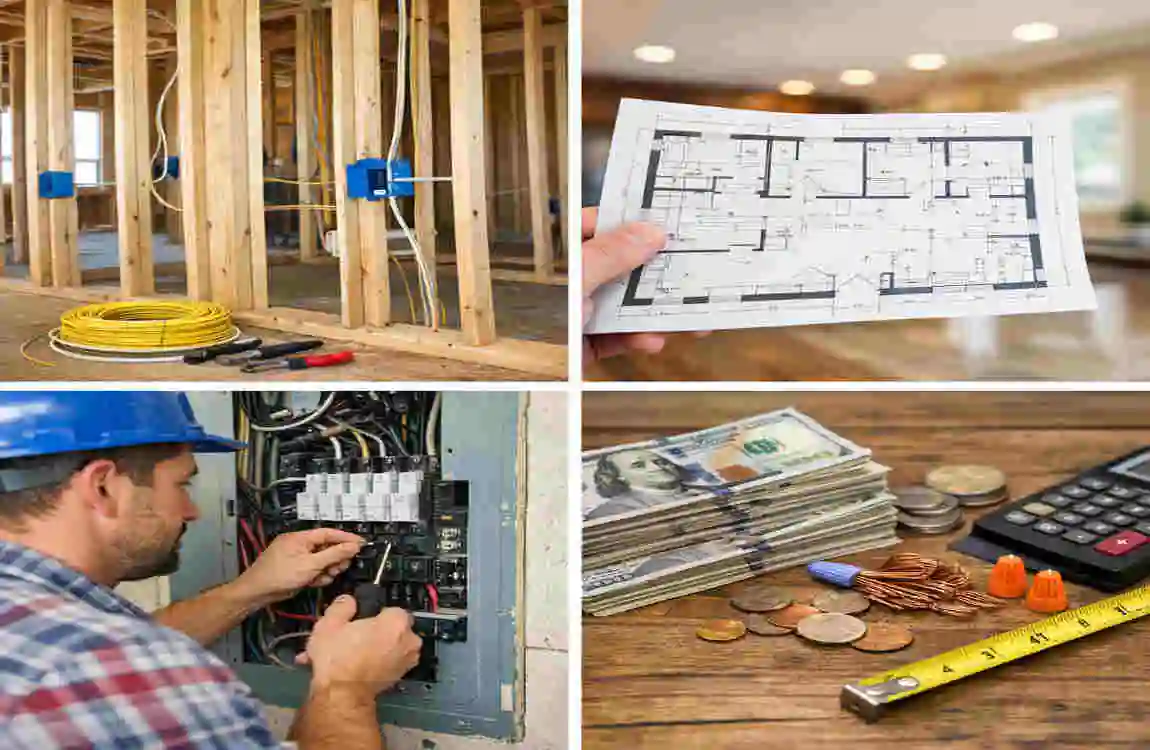
You can reduce costs without compromising safety if you plan early and make practical choices.
Here are some smart ways to control the electrical wiring cost per square foot in a house:
- Plan the electrical layout early: Last-minute changes cause rework, wasted material, and extra labor.
- Avoid unnecessary points: Too many outlets and fixtures can increase cost without adding much real value.
- Use standard quality brands: You do not always need ultra-premium products. Good standard brands can offer solid performance at a lower price.
- Coordinate with construction stages: When electrical work is aligned with masonry and plastering, labor becomes more efficient.
- Keep the layout practical: Shorter runs and more organized circuits can reduce waste.
- Prepare for future needs only where necessary: It is smart to leave some spare capacity, but overbuilding every room may cost too much.
Never Cut Costs on Safety
This point matters the most: do not save money by using substandard cables or weak protection devices. Cheap wiring is not a bargain if it causes appliance damage, overheating, or electrical hazards later.
The smartest budget is one that reduces waste, not one that cuts safety.
Safety, Codes, and Long-Term Value
Cheap Wiring Can Become Expensive
Electrical work is one of those parts of a home where poor decisions stay hidden behind walls. That is why low-grade wiring can be so dangerous. Problems may not appear immediately, but over time they can lead to tripping, overheating, short circuits, and damaged electronics.
A safer electrical setup may increase the electrical wiring cost per square foot in the house, but it also protects your family, appliances, and property.
Good Wiring Adds Long-Term Value
A well-wired home is easier to maintain, easier to upgrade, and more attractive to future buyers. It can also reduce the chance of costly repair work later.
So when you look at the electrical wiring cost per square foot in a house, do not think of it only as an expense. Think of it as an investment in safety, reliability, and long-term peace of mind.
FAQ: Electrical Wiring Cost Per Square Foot in a House
What is the average electrical wiring cost per square foot in a house
The average electrical wiring cost per square foot in a house depends on the quality level, city, and project type. As a rough estimate for 2026, many homes fall between Rs 180 and Rs 850+ per sq ft.
Budget homes may sit at the lower end, while premium homes with branded materials, concealed wiring, and advanced planning can go much higher. In cities like Lahore, the electrical wiring cost per square foot in a house is often slightly higher than in smaller towns because labor and material expectations are different.
Does concealed wiring increase the electrical wiring cost per square foot in a house?
Yes, concealed wiring usually increases the electrical wiring cost per square foot in a house. It requires wall chasing, conduit installation, careful box placement, and cleaner finishing work.
However, concealed wiring is often worth the extra cost. It gives a neater appearance, better protection, and a more modern finish. For most new homes, concealed systems are the preferred option, even if they raise the electrical wiring cost per square foot in the house.
How can I verify if my electrician’s quote for electrical wiring cost per square foot in the house is fair?
The easiest way to check fairness is to get two or three written quotes and compare them using the same house area and scope. Divide each total by the total covered area to compare the electrical wiring cost per square foot in the house clearly.
Also ask for brand names, point counts, panel details, and labor breakdown. A fair quote is not just about the number. It is about how clearly the electrician explains what is included in the electrical wiring cost per square foot in the house.
Is rewiring more expensive per square foot than new wiring?
In most cases, yes. Rewiring is usually more expensive because the electrician has to work around existing walls, old conduits, finished surfaces, and unknown conditions.
That means more labor, more time, and often repair work after installation. So the electrical wiring cost per square foot in a house for rewiring is generally higher than for new construction.
Can I reduce the electrical wiring cost per square foot in the house without compromising safety?
Yes, you can reduce the electrical wiring cost per square foot in a house by planning better, avoiding unnecessary points, choosing good standard brands, and coordinating the work with other construction phases.
What you should never do is cut the budget by using poor-quality cable, weak breakers, or unskilled labor. The right way to lower the electrical wiring cost per square foot in a house is to remove waste, not to remove safety.