If you have ever walked from one room to another and felt a sudden temperature change, you already know why this topic matters. One room feels chilly, another feels stuffy, and your energy bill keeps climbing month after month. That is when many homeowners start asking the same question: what’s the best insulation for a house?
The honest answer is simple. There is no single insulation type that is perfect for every home. The best choice depends on your climate, budget, the part of the house you want to insulate, and the amount of air leakage you need to stop. Still, a few insulation materials stand out above the rest. For most homes, spray foam, fiberglass, and cellulose insulation offer the best balance of comfort, energy savings, and cost.
Why House Insulation Matters for Energy Savings and Comfort
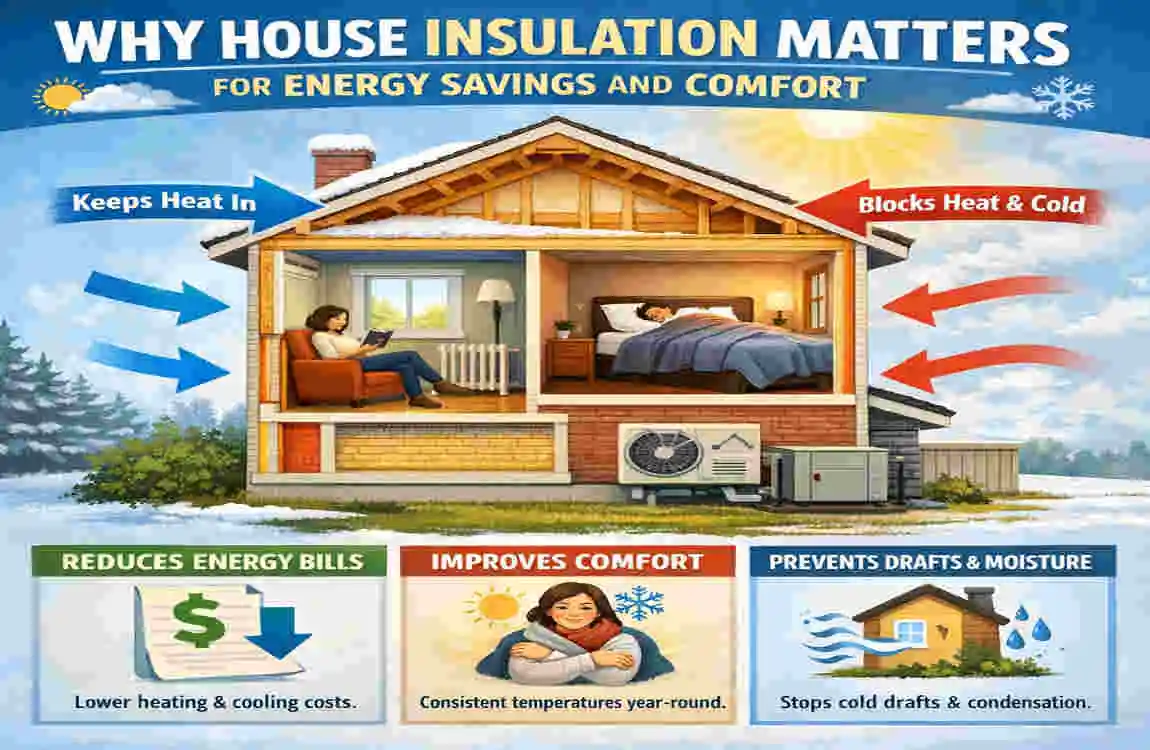
Before choosing a material, it helps to understand what insulation actually does. In simple words, insulation slows down the movement of heat. During winter, it helps keep warm air inside. During summer, it helps keep hot air outside. That means your heating and cooling system does not have to work as hard.
How Heat Moves Through a House
Heat usually moves in three ways: conduction, convection, and radiation.
- Conduction occurs when heat moves through solid materials such as walls, floors, and ceilings.
- Convection occurs when warm air rises and cool air sinks, creating airflow within walls, attics, and rooms.
- Radiation is heat traveling in waves, like the warmth you feel from the sun on your roof.
Here is a very simple way to picture it:
Heat Transfer Type What It Means Everyday Example
Conduction Heat moves through solid materials Hot roof warming the ceiling below
Convection Heat moves through air circulation Warm air escaping through attic gaps
Radiation Heat moves through invisible waves Sun heating your exterior walls
Insulation works like a protective layer that slows all of this down. Some materials are better at blocking air movement. Others are better at resisting moisture. Some do both.
Why Poor Insulation Costs You More Than You Think
Energy experts often estimate that poor insulation and air leaks account for 25% to 50% of a home’s heating and cooling energy loss. That is a big number. If your home feels drafty, uneven, or hard to keep comfortable, weak insulation may be a major reason.
This is why the question what’s the best insulation for a house is not just about materials. It is about solving real money and real comfort problems.
When insulation is missing, thin, wet, or badly installed, several things happen:
Your HVAC system runs longer. Your rooms heat and cool unevenly. Moisture may build up inside walls or attics. Outdoor noise enters more easily. And over time, your utility bills rise.
The Main Benefits of Better Insulation
A good insulation upgrade offers more than one reward.
First, it can lead to lower energy bills. Many homeowners notice significant savings after sealing air leaks and improving insulation. Depending on the home and the material used, savings can range from modest to significant.
Second, it improves everyday comfort. Rooms feel more balanced. Floors may feel warmer in winter. Bedrooms may stay cooler during hot afternoons. You stop dealing with that “too hot here, too cold there” problem.
Third, it can improve sound control. Some insulation types reduce noise from traffic, neighbors, or movement between rooms.
Fourth, it can support health and home value. Proper insulation and air sealing can help reduce drafts, control moisture, and support cleaner indoor air when the system is designed well. Many buyers also see energy efficiency as a major selling point.
If you are wondering whether upgrading insulation is worth it, the answer is yes for most homes. The best insulation for a house improves efficiency without breaking the bank, especially when you choose the right material for the right space.
Key Factors to Choose the Best Insulation for Your House
Not all insulation performs the same way. Some are cheap but basic. Others cost more but seal air better and last longer. To choose wisely, you need to look at a few key factors.
R-Value: The Number You Should Know
The first thing you will hear about insulation is R-value. This number tells you how well a material resists heat flow. In simple terms, the higher the R-value, the better the insulation resists heat movement.
But this does not mean the highest R-value is always the best choice in every situation. The right target depends on where the insulation goes.
For example:
- Attics often need higher R-values, such as R-30 to R-49 or more
- Exterior walls often use R-13 to R-21
- Floors and crawlspaces may need R-19 to R-30
The right level depends on local climate and building design.
Climate Zone Matters More Than People Realize
A home in a very cold area has different insulation needs than a home in a hot, humid region. If you live in a place with cold winters, strong air sealing and higher R-values matter more. If you live in a warm or mixed climate, moisture control and radiant heat reduction become more important.
For example, homes in places with hot summers and cool winters, such as parts of Punjab or Lahore, may benefit from insulation that effectively addresses both heat gain and air leakage. In colder areas, closed-cell spray foam or dense attic insulation can make a bigger impact.
DIY or Professional Installation?
Some insulation products are more DIY-friendly than others. Fiberglass batts are often the easiest for homeowners to install. Blown-in insulation can be manageable with rented equipment. But spray foam and complex air sealing jobs are usually best left to trained professionals.
Installation quality matters a lot. Even expensive insulation can underperform if it is compressed, poorly fitted, or installed with gaps.
Budget and Long-Term Value
Insulation costs vary widely. Installed costs can range from roughly $0.50 to $5.00 per square foot, depending on the material, the labor involved, and the destination.
A low upfront cost may look appealing, but you also want to think about long-term savings. Material that costs more today may save much more over the next 5 to 15 years.
Moisture Resistance, Fire Safety, and Eco-Friendliness
Some insulation types handle moisture better than others. This is important in basements, crawlspaces, and humid climates. If insulation absorbs water, it may lose performance and create conditions for mold.
Fire resistance also matters. Mineral wool performs especially well here. If you care about sustainability, cellulose and cotton denim are attractive options because they use recycled content.
Here is a quick comparison of the main decision factors:
Factor Ideal Range Impact on Savings
R-Value R-19 to R-49 depending on area Can reduce heating and cooling waste significantly
Cost About $1 to $3 per sq ft for many common options Better options often pay back in 2 to 5 years
Moisture Resistance Medium to high in damp spaces Helps prevent mold and performance loss
Air Sealing Ability High in leaky homes Can greatly improve comfort and lower bills
Fire Resistance Important near utility areas and walls Adds safety and peace of mind
When you ask, “What’s the best insulation for a house?” these are the factors that shape the real answer.
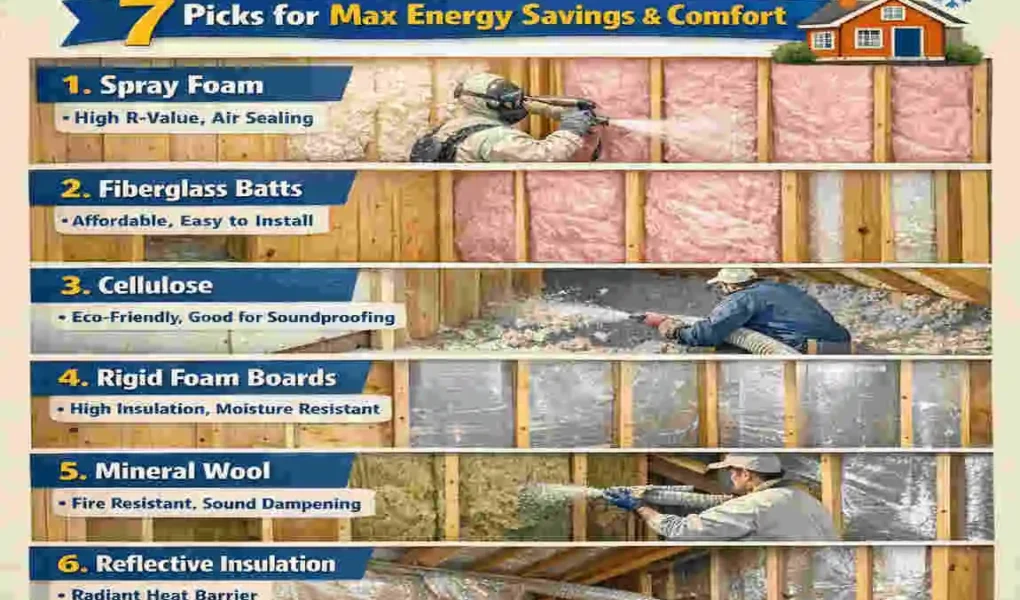
Top 7 Best Insulation Picks for Houses: Ranked for Energy Savings and Comfort
Now let’s get into the practical part. Below are the top 7 insulation options for homeowners, ranked by overall performance, comfort, energy savings, cost-to-value, and suitability for different parts of the house.
Spray Foam Insulation — Best Overall for Air Sealing
Spray foam insulation is often the top answer to the question, “What’s the best insulation for a house?” especially if your home has many air leaks. It expands after application, filling cracks, joints, and tiny gaps that other insulation materials miss.
There are two main types. Open-cell spray foam is lighter and softer, with an R-value around R-3.5 per inch. Closed-cell spray foam is denser, stronger, and offers an R-value of around R-6.5 per inch. Closed-cell foam also provides moisture resistance, making it useful in walls, crawlspaces, and areas exposed to damp conditions.
The biggest strength of spray foam is not just R-value. It is air sealing. Since it blocks drafts so well, homeowners often see major improvements in comfort and energy use. In some homes, especially older ones with many leaks, spray foam can lead to dramatic savings.
Pros:
- Excellent air sealing
- High R-value, especially closed-cell
- Helps control moisture
- Works well in attics, walls, and rim joists
- Can improve comfort fast
Cons:
- Higher upfront cost
- Usually requires professional installation
- Harder to remove or modify later
Real-world example:
If an older 1,500-square-foot home has a drafty attic and leaky wall cavities, upgrading key areas with spray foam can reduce HVAC strain and noticeably cut yearly utility costs.
Fiberglass Insulation — Best Budget-Friendly Option
Fiberglass insulation remains one of the most popular choices for a reason. It is affordable, widely available, and flexible enough for many common projects. It comes in batts, rolls, and blown-in form, making it useful for walls, attics, and floors.
Its R-value usually ranges from about R-2.9 to R-3.8 per inch, depending on the product. While it does not seal air leaks as effectively as spray foam, it can still provide solid thermal performance when installed correctly.
Fiberglass is a great fit for homeowners who want dependable insulation without spending too much. It is also one of the most common DIY materials, especially in unfinished attics and open wall cavities.
That said, installation quality is critical. If fiberglass is compressed, cut poorly, or leaves gaps around wiring and framing, performance drops quickly.
Pros:
- Low cost
- Easy to find
- Good DIY option
- Works in many areas of the home
- Decent energy savings for the price
Cons:
- Does not air seal on its own
- Loses performance if compressed
- Can irritate skin and lungs during installation
Real-world example:
A homeowner insulating an attic with fiberglass batts may see reduced heat gain in summer and less heat loss in winter, especially if the attic floor is sealed first.
Cellulose Insulation — Best Eco-Friendly Option
If sustainability matters to you, cellulose is one of the strongest choices. It is usually made from recycled paper products, treated for fire and pest resistance, and installed as blown-in insulation.
Its R-value is typically around R-3.2 to R-3.8 per inch, which is similar to fiberglass. But cellulose has one helpful advantage: it can settle into spaces more tightly, helping reduce some air movement in wall cavities and attics.
Because it uses recycled content, many homeowners choose cellulose insulation for a greener option without a major increase in cost. It performs especially well in enclosed wall cavities and attic retrofits.
However, cellulose should be installed carefully in areas with moisture risk. If it gets wet and stays wet, performance can suffer.
Pros:
- Eco-friendly and recycled
- Good thermal performance
- Great for attic top-ups and wall retrofits
- Can reduce air movement better than loose fiberglass
- Reasonable cost
Cons:
- Can settle over time if poorly installed
- Not ideal for repeated moisture exposure
- Usually requires blower equipment
Real-world example:
A homeowner adding dense-packed cellulose to exterior walls may notice rooms holding temperature better, especially in older homes with empty wall cavities.
Rigid Foam Boards — Best for Walls and Basements
Rigid foam boards are solid insulation panels that offer strong thermal resistance in a slim profile. Common types include polyisocyanurate (polyiso), extruded polystyrene (XPS), and, in broader rigid-panel applications, EPS boards.
These boards usually deliver R-5 to R-6.5 per inch, depending on the type. That makes them especially useful where you want more insulation without taking up too much space.
Rigid foam works well on foundation walls, basement walls, exterior sheathing, and certain roof assemblies. It also performs better than many soft insulation materials in damp environments, depending on the product selected.
One major advantage is moisture resistance. If you are dealing with cool basement walls or exterior applications, rigid foam can be a smart long-term choice.
Pros:
- High R-value per inch
- Good moisture resistance
- Excellent for basements and exterior walls
- Strong and durable
- Helps reduce thermal bridging
Cons:
- More expensive than fiberglass
- Must be cut and sealed carefully
- Some products need fire protection covering indoors
Real-world example:
Adding rigid foam to a basement wall can make the space feel drier, warmer, and more usable, while reducing cold transfer through concrete.
Mineral Wool — Best for Fire Safety and Soundproofing
Mineral wool, also called rock wool or slag wool, is a dense insulation material known for durability, fire resistance, and noise control. It usually provides R-3.0 to R-4.2 per inch.
This material handles moisture better than many people expect, and it does not burn easily. That makes it a smart option for homeowners who want extra safety and stronger sound reduction between rooms or floors.
Mineral wool batts fit snugly between framing, and because the material is denser than fiberglass, it often feels more solid in wall and floor systems. It also resists sagging well over time.
In humid or mixed climates, mineral wool can hold up nicely when installed properly. That is one reason it is often recommended in places that deal with both heat and moisture.
Pros:
- Excellent fire resistance
- Very good sound control
- Good moisture tolerance
- Durable and long-lasting
- Fits snugly in framing
Cons:
- Costs more than fiberglass
- Heavier to handle
- Not always as easy to find as fiberglass
Real-world example:
A family insulating bedroom walls with mineral wool may notice not just better temperature control, but also less noise from nearby rooms or street traffic.
Cotton Denim Insulation — Best Natural Choice
Cotton denim insulation is made from recycled cotton fibers, often from old jeans and textile scraps. It is one of the softer, safer-feeling insulation options to work with, and many homeowners like it because it contains fewer irritating particles than fiberglass.
It usually has an R-value around R-3.7 per inch, which is quite respectable. It also offers decent sound absorption, helping create a cozy indoor feel.
This is not the most common insulation on the market, and it is usually more expensive than fiberglass. But if you want a natural-feeling product and care about recycled materials, it can be a great fit.
It is important, though, to protect it from moisture and install it carefully in the right applications.
Pros:
- Made from recycled cotton
- Pleasant to handle compared with fiberglass
- Good sound absorption
- Solid thermal performance
- Attractive for green building projects
Cons:
- Higher cost
- Less common availability
- Needs moisture control
- Usually not the best choice for tight budgets
Real-world example:
In a home office or nursery, cotton denim insulation can support both comfort and quieter indoor spaces, while appealing to homeowners who prefer natural materials.
Polystyrene Foam — Best for Floors and Crawlspaces
Polystyrene foam, especially EPS rigid panels, is a practical and cost-effective insulation choice for floors, crawlspaces, and certain wall applications. It usually provides around R-4 per inch, though products vary.
This material is lightweight, easy to cut, and useful in areas where a rigid panel makes more sense than batts or blown-in insulation. It can also perform well in spaces where moisture resistance matters, depending on the product and installation method.
While it does not air-seal like spray foam, it offers good performance for the price, especially when seams are taped and edges are sealed.
Pros:
- Affordable rigid panel option
- Good for floors and crawlspaces
- Easy to cut and install
- Decent moisture resistance
- Useful in many retrofit situations
Cons:
- Lower R-value than some premium rigid boards
- Needs careful sealing around joints
- Indoor applications may require protective covering
Real-world example:
A homeowner insulating a drafty floor above a crawlspace with polystyrene panels may notice warmer floors and less winter discomfort.
Best for: Crawlspaces, floors, basement areas, and quick rigid-insulation upgrades.
Side-by-Side Comparison of the 7 Best House Insulation Options
Insulation Type R-Value per Inch Typical Cost per Sq Ft Energy Savings Potential Best For
Spray Foam 3.5 to 6.5 $1.50 to $5.00 High Attics, walls, air sealing
Fiberglass 2.9 to 3.8 $0.50 to $1.50 Moderate Budget homes, attics, walls
Cellulose 3.2 to 3.8 $1.00 to $2.50 Moderate to high Attics, wall retrofits
Rigid Foam Boards 5.0 to 6.5 $1.50 to $4.00 High in targeted areas Basements, exterior walls
Mineral Wool 3.0 to 4.2 $1.50 to $3.50 Moderate Fire safety, soundproofing
Cotton Denim 3.5 to 3.7 $1.50 to $3.50 Moderate Natural and recycled builds
Polystyrene Foam Around 4.0 $1.00 to $3.00 Moderate Floors, crawlspaces
If you want the shortest possible answer, spray foam is often the best overall insulation for a house. But if cost matters most, fiberglass may be the smartest choice. If sustainability is your top concern, cellulose is hard to beat.
Installation Tips for Maximum Energy Savings
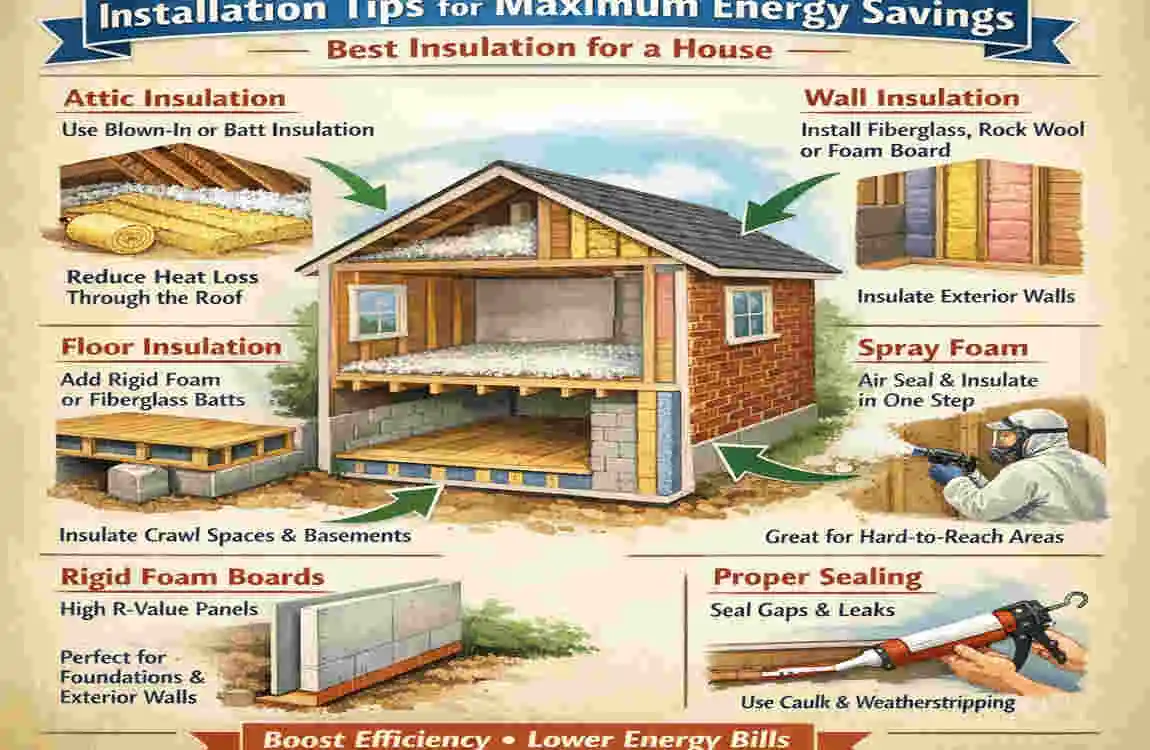
Even the best house insulation can disappoint if it is installed badly. That is why proper installation matters almost as much as the material itself.
Start With Preparation
Before adding new insulation, check for roof leaks, plumbing leaks, damp spots, pest activity, and electrical issues. Wet or damaged areas need to be fixed first. Otherwise, you may trap problems behind new insulation.
Air sealing should also come first in many homes. Seal obvious cracks, attic penetrations, rim joists, and utility openings before adding bulk insulation. This step can make a huge difference.
Use the Right Safety Gear
If you are handling insulation yourself, wear gloves, a dust mask or respirator, long sleeves, and eye protection. Fiberglass and other loose materials can irritate your skin and lungs.
Avoid Common Installation Mistakes
The most common problem is gaps. Small empty spaces around pipes, wires, corners, and framing reduce performance. Another mistake is compression. When soft insulation is squashed into a tight space, its R-value drops.
Some homeowners also forget about attic ventilation. Blocking soffit vents can cause moisture and heat buildup, which hurts both insulation performance and roof health.
Know When to Call a Professional
DIY can work for simple attic batts or open spaces. But if your home has moisture issues, complicated framing, old walls, or major air leaks, professional installation is usually worth it. Spray foam, dense-pack cellulose, and basement insulation jobs especially benefit from expert work.
A good rule is simple: if the job affects air sealing, moisture control, or hidden cavities, bring in a pro.
Costs, ROI, and a Simple Energy Savings Calculator
Insulation costs vary by material, labor, and the area being insulated. For a typical 1,500-square-foot home, a whole-house insulation project may cost between $2,000 and $8,000 or more.
Fiberglass is usually the lowest-cost option. Spray foam is often the most expensive upfront, but it can also deliver stronger long-term savings in drafty homes.
What Kind of Payback Can You Expect?
Many homeowners recover insulation costs in about 2 to 7 years, depending on current energy waste, local utility prices, and the type of upgrade. For example, if a better-insulated home saves $400 to $700 per year on heating and cooling, the return becomes easy to see.
Simple Savings Formula
You can estimate your payback like this:
Payback period = Total insulation cost ÷ Estimated annual energy savings
Example:
- Insulation upgrade cost: $3,000
- Estimated yearly savings: $600
- Payback period: 5 years
After that, the savings keep adding up. And remember, the value is not only financial. You also gain comfort, quieter rooms, and a home that feels easier to live in every day.
FAQs: What’s the Best Insulation for a House?
What’s the best insulation for a house in cold climates?
For cold climates, closed-cell spray foam, high-R attic insulation, and well-installed cellulose or fiberglass systems work well. Strong air sealing matters just as much as R-value.
Is spray foam insulation worth it?
Yes, for many homes it is. Spray foam costs more upfront, but it can seal gaps better than most other materials and often delivers strong long-term savings.
What is the cheapest insulation option?
Fiberglass insulation is usually the most affordable common option, especially in batt form.
What insulation is best for attics?
Blown-in cellulose, fiberglass, and spray foam are all popular attic choices. The best one depends on whether you need simple coverage or serious air sealing.
Which insulation is best for walls?
Spray foam, dense-pack cellulose, fiberglass batts, and mineral wool are all good wall options. The right pick depends on wall depth, climate, and budget.
What is the most eco-friendly insulation?
Cellulose insulation is one of the best eco-friendly options because it uses recycled paper. Cotton denim is another strong natural choice.
Can bad insulation really increase energy bills?
Absolutely. Poor insulation and air leaks force your HVAC system to work harder, which increases monthly heating and cooling costs.