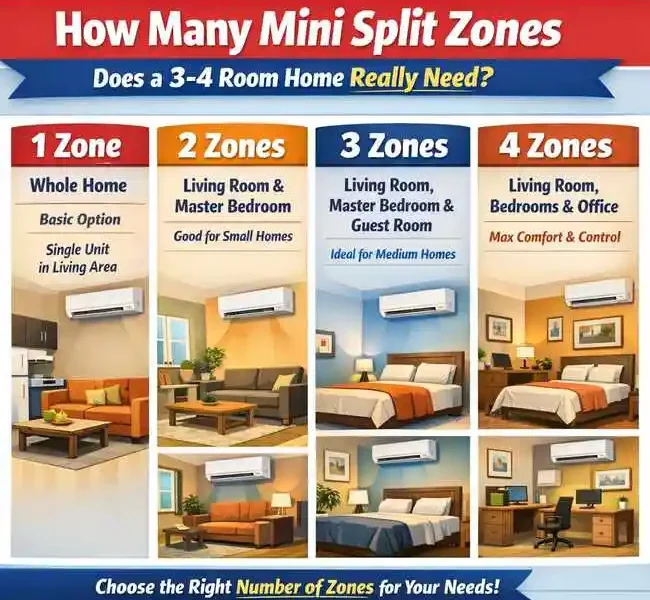
A three- to four-room home does not automatically need three or four mini split zones. The number of zones that keep a house comfortable depends less on the room count and more on how those rooms behave throughout the day. Some spaces run hot because of sun exposure. Others sit empty for hours. A floor plan tells you how many rooms exist, but it cannot tell you how many zones you need.
A better approach is to look at how the rooms are used, where heat builds up, and which spaces actually need their own temperature control. That usually makes the answer much clearer before you talk to an installer.
Look at How You Actually Use the House

Most homeowners start by matching zones to rooms on a floor plan. A more useful starting point is your daily routine. Which rooms do you spend the most time in? Which ones sit unused until evening?
A family with an open living and dining area plus two bedrooms may find that a 3 zone mini split handles the job well. The shared living space gets one zone, and each bedroom gets its own. If the kitchen opens into the living room, that shared area often behaves like one thermal space.
Another common layout puts the primary bedroom, a home office, and a kid’s room as the three most-used spaces. The living area stays comfortable with passive airflow or a ceiling fan. In setups like these, three zones line up with actual demand rather than square footage.
Three rooms do not always mean three equal cooling needs
A 150-square-foot bedroom with one shaded window is one thing. An upstairs bonus room with a west-facing wall and a vaulted ceiling is another. They may be similar in size, but they do not behave the same way once the afternoon heat builds up. The bonus room absorbs far more heat during the afternoon and holds it longer into the evening.
Rooms used only at night (like a guest bedroom) do not need the same cooling window as a home office occupied from 9 a.m. to 5 p.m. Sizing zones by room count treats every space as equal, and they rarely are.
Open living areas can change the math fast
An open-concept main floor where the kitchen, dining area, and living room flow together can absorb a disproportionate share of the home’s cooling load. That one zone may be covering a large connected area, a wall of windows, and extra heat from cooking appliances.
When one zone covers that much ground, the remaining zones have less work to do. This imbalance is common in newer homes with open layouts, and it changes how you think about distributing capacity across the system.
When Four Zones Are Worth It
Four zones are not an upgrade. They make more sense in homes where four separate spaces really need their own temperature control. A 4 zone mini split makes the most sense when daily life creates four separate comfort demands that cannot be grouped together.
Common scenarios include a two-story home where upstairs rooms run warmer than downstairs, a household where one person works from home while another sleeps during the day, or a layout where doors stay closed between rooms most of the time.
Separate schedules matter more than people think
A parent working from home needs a cool office by 8 a.m. A teenager’s bedroom does not need cooling until the afternoon. A nursery may need a steady, mild temperature around the clock. When schedules differ this much, sharing a zone forces compromises that leave at least one room uncomfortable.
Independent zones let each space follow its own schedule. That flexibility is more about comfort than energy savings, and for many families it is the deciding factor.
Sometimes the extra zone is really about one hard-to-cool room
Not every four-zone setup comes from having four busy rooms. Sometimes it comes from one room that refuses to stay comfortable. A garage conversion with thin insulation, a sun-drenched upstairs bedroom, or a bonus room above the garage can stay noticeably warmer than the rest of the house.
Adding a dedicated zone for that one problem space often solves a comfort issue that no amount of thermostat adjusting can fix.
The Most Common Mistakes People Make When Planning Zones

Zoning decisions go sideways when homeowners rely on assumptions instead of observation. The floor plan is a starting point, not an answer. Several recurring mistakes show up in homes where the zone count was chosen before the daily routine was considered.
- Deciding zone count by matching it to the number of rooms
- Ignoring how well (or poorly) the house is insulated and air-sealed
- Overlooking window orientation and afternoon sun exposure
- Assuming more zones always means better comfort
- Forgetting to account for whether interior doors stay open or closed
Counting rooms is not the same as planning comfort
A four-bedroom house where two bedrooms share a hallway and stay open to each other may function as a three-zone home. A two-bedroom house with a sunroom and a home office may need four. The layout on paper and the way a family lives in the space are two different things.
Sometimes the room is the problem, not the zone count
Before adding another zone, it helps to check whether the room itself is the issue. Poor attic insulation, single-pane windows, or gaps around doors and ducts can make a room uncomfortable regardless of how many zones the system has. Fixing the envelope first sometimes eliminates the need for an extra zone.
A Simple Way to Figure It Out Before You Call an Installer

Before you talk to an installer, it helps to write down which rooms matter most, when they are used, and which ones consistently feel off. That simple exercise often makes the zone count much easier to defend.
Once that pattern is clear, the zone count usually becomes easier to justify. In many modern homes, the right answer has less to do with the number of rooms and more to do with which spaces need reliable comfort every day.
How Many Mini Split Zones Does a 3–4 Room Home Really Need? – FAQ
Q What is a mini-split zoning system?
A mini-split zoning system uses one outdoor unit connected to multiple indoor air handlers, allowing you to control temperatures independently in different rooms or “zones.”
Q How many zones are typically needed for a 3–4 room home?
Most 3–4 room homes usually need 2 to 4 zones, depending on layout. Common setups include one zone per bedroom plus one for the living area.
Q Can I combine multiple rooms into one zone?
Yes. If rooms are small or used similarly, they can share a single indoor unit. However, this reduces individual temperature control.
Q What factors decide the number of zones needed?
Key factors include home layout, insulation quality, room usage patterns, sun exposure, and whether rooms are frequently occupied or left unused.
Q Is more zones always better?
Not always. More zones mean higher installation costs and more equipment. The ideal setup balances comfort, efficiency, and budget.
Q Can I start with fewer zones and expand later?
Many modern systems are modular, allowing homeowners to begin with fewer zones and add more indoor units later if the outdoor system supports it.