Have you ever looked at a massive house and wondered just how many windows it takes to fill those walls? If you’re planning to build, buy, or renovate a large home in 2026, understanding window counts isn’t just a fun trivia question—it’s a critical planning decision that affects your budget, energy bills, comfort, and resale value.
Windows are the eyes of your home. They bring in natural light, provide ventilation, and dramatically impact your home’s appearance and energy efficiency. For a 10,000 square foot house, getting the window count right can make the difference between a bright, welcoming space and one that feels like a cave—or an energy-draining glass box.
Whether you’re a homeowner planning your dream estate, a builder estimating materials, or an architect designing a masterpiece, you need to know how many windows are in a 10,000 square foot house. The answer isn’t as straightforward as you might think—it depends on numerous factors we’ll explore in detail.
You’ll discover the key factors that influence window quantity, typical ranges for different architectural styles, practical estimation methods, 2026 window technology innovations, cost breakdowns, and design considerations that will help you make informed decisions. Let’s dive into the fascinating world of windows and
large home design.
Quick Answer: How Many Windows Are in a 10,000 Sq Ft House?
For readers who want the bottom line up front:
- Modern/Minimalist homes: 50–80 window units (fewer but larger panels)
- Traditional/Transitional homes: 100–150 windows (standard sizes distributed throughout)
- Luxury/Ornate estates: 150–200+ windows (elaborate designs with abundant fenestration)
The most common range for a well-designed 10,000 sq ft home in 2026 is 80–150 windows, with the exact count depending on architectural style, floor plan, number of stories, and personal preferences. Read on for the detailed breakdown.
Factors Influencing Window Quantity in Large Homes

Building Design and Architectural Style
Your home’s architectural style plays a huge role in determining how many windows you’ll need. A modern minimalist design might feature large floor-to-ceiling glass panels, while a traditional Colonial might have smaller, uniformly distributed windows across its facade.
Think about it this way: a
contemporary home with open floor plans tends to maximize natural light through fewer but larger windows. In contrast, traditional homes with more divided rooms typically require more individual windows to illuminate each space adequately.
The exterior aesthetic also matters significantly. Some architectural styles celebrate abundant fenestration (the technical term for window arrangement and design), while others focus on solid wall space for a more imposing or fortress-like appearance.
Purpose of the Space
Not all rooms are created equal when it comes to windows. Your living room and master bedroom will likely have more windows than utility rooms or closets.
Basements, if finished, might have fewer or smaller windows due to their below-grade positioning.
Entertaining spaces like great rooms or formal dining areas often feature prominent window arrangements to create an impressive atmosphere. Meanwhile, bathrooms might have smaller windows or strategically placed ones for privacy while still allowing natural light.
Consider the function of each space carefully:
- Home offices need good natural light for productivity—studies show daylight exposure improves focus by up to 15%.
- Kitchens benefit from windows over sinks and near work areas for task lighting and ventilation.
- Bedrooms need windows for ventilation, natural light, and emergency egress according to building codes.
- Media rooms and wine cellars may intentionally minimize windows for light control and temperature stability.
Building Codes and Regulations (2026 Standards)
Here’s something many people overlook: building codes have specific requirements for windows. The 2024 International Residential Code (IRC)—widely adopted across U.S. jurisdictions by 2026—requires that every habitable room have a minimum glazing area equal to 8% of the room’s floor area for natural light, and a minimum openable area equal to 4% of floor area for
ventilation.
Every bedroom must have at least one egress window with a minimum net clear opening of 5.7 square feet (5.0 square feet at grade level), with a minimum clear width of 20 inches and minimum clear height of 24 inches. These are non-negotiable safety requirements.
The 2024 International Energy Conservation Code (IECC)—the standard governing new construction in 2026—sets maximum window-to-wall ratios and minimum performance standards based on your climate zone. In colder zones (4–8), the maximum U-factor for windows is 0.30 or lower, while warmer zones (1–3) focus more on Solar Heat Gain Coefficient (SHGC) limits of 0.25 or less. These regulations directly influence window selection, sizing, and quantity.
Energy codes vary by location, so always consult local authorities and a certified energy consultant during your planning phase.
Natural Light and Ventilation Requirements
Natural light isn’t just pleasant—it’s essential for healthy
living spaces. Research from the
WELL Building Standard v2 (increasingly applied to luxury residential projects in 2026) recommends that 75% or more of regularly occupied floor area achieve a minimum of 300 lux of daylight for at least 50% of occupied hours. A 10,000 square foot house has a lot of interior space to illuminate, and windows are your primary source of free, natural lighting during daylight hours.
Proper ventilation is equally important. Windows that open allow fresh air circulation, reducing humidity and improving indoor air quality. In
large homes, strategic window placement creates cross-ventilation that naturally cools your space without relying solely on HVAC systems—potentially reducing cooling costs by 10–25% during mild weather.
The deeper your rooms are, the more windows you’ll need to ensure adequate light penetration. The general rule of thumb: natural daylight effectively penetrates a room to a depth of approximately 1.5–2.5 times the window head height. For a room with 9-foot ceilings and windows topped at 8 feet, expect useful daylight to reach about 12–20 feet into the space. Rooms deeper than this may require additional skylights, clerestory windows, or light tubes.
Budget Constraints and Material Options (2026 Pricing)
Let’s be honest: windows are expensive. Quality windows for a large home represent a significant portion of your construction or renovation budget. As of 2026, here’s what you can expect to invest:
- Standard vinyl double-pane windows: $350–$700 per unit installed
- Premium fiberglass or wood-clad windows: $800–$1,500 per unit installed
- High-performance triple-pane windows: $1,000–$2,200 per unit installed
- Custom architectural or oversized windows: $2,000–$5,000+ per unit installed
- Smart glass/electrochromic windows: $2,500–$6,000+ per unit installed
For a 10,000 sq ft home with 100 windows, the total window budget (including installation) typically ranges from
$80,000 to $250,000+, depending on quality, style, and technology. This represents roughly 8–15% of total construction costs for a
luxury build home.
Standard-sized windows cost less than custom designs. If budget is a concern, you might opt for more standard sizes distributed strategically rather than fewer large custom windows. However, this approach requires careful planning to avoid a cookie-cutter appearance.
Material choices—vinyl, wood, aluminum, fiberglass, composite—affect both cost and performance. In 2026, fiberglass frames have become the preferred choice for luxury homes due to their superior thermal performance, durability, and slim profiles that maximize glass area. Wood-clad exteriors with fiberglass or aluminum cores offer the best of both worlds: traditional aesthetics outside with low-maintenance performance inside.
Privacy Considerations and Window Placement
Privacy becomes increasingly important as homes get larger and more luxurious. You’ll want generous windows facing private yards or scenic views, but might prefer fewer or smaller windows on sides facing neighbors or streets.
Master bedrooms, bathrooms, and private office spaces need careful window planning. Frosted glass, strategic positioning, smart glass with switchable opacity, or automated window treatments can provide privacy while maintaining natural light benefits.
Consider your property’s layout during window installation. If your 10,000 square foot house sits on a large, private lot (1+ acres), you can be more generous with window placement than if it’s in a denser neighborhood. In 2026, many luxury homeowners are opting for electrochromic (smart) glass on privacy-sensitive facades—these windows can switch from transparent to opaque at the touch of a button or on a schedule.
Climate Zone and Geographic Location
Your geographic location significantly impacts optimal window count and specifications. The U.S. Department of Energy divides the country into eight climate zones, each with different window performance requirements:
- Hot climates (Zones 1–2: Miami, Houston, Phoenix): Prioritize low SHGC (≤0.25) to block solar heat gain. Fewer west-facing windows reduce cooling loads. Larger north-facing windows provide light without excessive heat.
- Mixed climates (Zones 3–4: Atlanta, Nashville, Richmond): Balance solar heat gain in winter with cooling needs in summer. South-facing windows with proper overhangs are ideal.
- Cold climates (Zones 5–7: Chicago, Boston, Minneapolis): Maximize south-facing windows for passive solar heating. Triple-pane windows with low U-factors (≤0.22) are essential. Minimize north-facing glass.
- Subarctic (Zone 8: Fairbanks): Minimize total window area; every window must be triple-pane or better with U-factors below 0.20.
Understanding your climate zone helps you not only determine how many windows to include but also where to place them and what specifications they need to meet for optimal energy performance.
Typical Window Counts for Different House Styles & Layouts

Window Count Comparison Table by Architectural Style
Here’s a quick reference for how many windows are in a 10,000 square foot house based on common styles:
| Architectural Style |
Estimated Window Count |
Avg. Window-to-Wall Ratio |
Key Characteristics |
| Modern/Minimalist |
50–80 |
25–40% |
Fewer, larger panels; floor-to-ceiling glass |
| Colonial/Georgian |
80–120 |
15–25% |
Symmetrical, uniformly spaced double-hung |
| Craftsman |
90–130 |
18–28% |
Grouped windows, casement styles |
| Traditional/Transitional |
100–150 |
20–30% |
Mixed sizes, balanced distribution |
| Victorian |
100–150 |
20–30% |
Ornate, bay windows, turrets |
| French Country |
120–180 |
25–35% |
Multi-pane, shuttered, abundant |
| Mediterranean |
80–120 |
18–28% |
Arched windows, iron details |
| Contemporary Glass |
40–70 |
35–60% |
Glass walls, curtain wall systems |
Traditional Architecture vs. Modern Design
Traditional architectural styles typically feature a more predictable window pattern. Colonial homes, for example, might have symmetrical window arrangements with double-hung windows evenly spaced across the facade. A 10,000 square foot Colonial could easily have 80–120 windows, depending on the number of stories.
Victorian homes are known for their elaborate window designs, including bay windows, turrets, and decorative glass. These homes might have even more windows—potentially 100–150 for a house this size—due to their ornate nature and multiple
architectural details.
Modern and contemporary homes take a different approach. They might feature fewer but dramatically larger windows. Floor-to-ceiling glass walls, corner windows, and clerestory windows are common. A modern 10,000 square foot house might have only 50–80 window units, but the total glass area could be similar to—or even exceed—a traditional home with many more individual windows.
Craftsman Style Considerations
Craftsman homes blend functionality with natural materials and typically include multiple windows to bring the outdoors in. For a 10,000 square foot Craftsman estate, expect around 90–130 windows, including characteristic double-hung and
casement styles.
These homes often feature window groupings—sets of three or more windows clustered together—which technically count as multiple windows but create dramatic visual effects. The emphasis on natural light in Craftsman design means windows are generously incorporated throughout.
Custom Estate Variations
Custom estates at this size often blend multiple architectural styles and incorporate unique features that significantly impact window count. A Mediterranean-style mansion might feature arched windows and extensive glass doors opening to outdoor living spaces.
French Country estates typically include numerous multi-
pane windows, often with shutters, resulting in higher window counts—potentially 120–180 for 10,000 square feet. The romantic aesthetic of this style celebrates abundant windows as a key design element.
Ultra-modern estates might feature entire glass walls that blur the line between indoor and outdoor spaces. While these might technically count as fewer “windows,” the amount of glass can be extraordinary—sometimes exceeding 3,000 square feet of glazing in a 10,000 sq ft home.
Estimating Windows for a 10,000 Sq Ft House

Basic Calculation Principles
So, how do you actually estimate
window count? The most common method uses a
window-to-wall ratio (WWR). This expresses the percentage of exterior wall space dedicated to windows. Typical ratios range from 15% to 30%, though some modern designs exceed 40%.
Here’s a step-by-step calculation method:
Step 1: Calculate exterior wall area. For a 10,000 square foot
house, this depends on the number of stories, layout, and ceiling height.
- A two-story home with a roughly square footprint (70 ft × 71 ft per floor) would have a perimeter of approximately 282 linear feet. With 9-foot ceilings on each floor (18 feet total wall height), that’s approximately 5,076 square feet of exterior wall.
- A sprawling single-story home (100 ft × 100 ft) would have a perimeter of 400 linear feet × 10-foot walls = 4,000 square feet of exterior wall—but single-story designs often have more irregular footprints with wings and jogs, increasing the actual perimeter significantly.
Step 2: Apply your target WWR. If you apply a 20% window-to-wall ratio to 5,000 square feet of wall, you’d have 1,000 square feet of window glass.
Step 3: Divide by average window size. If your average window is 15 square feet (a standard 3 ft × 5 ft double-hung), that’s approximately 67 windows. If using larger 20 sq ft windows, that’s 50 units. If using smaller 12 sq ft windows, that’s 83 units.
This is a simplified starting point—actual counts will vary based on the detailed room-by-room analysis below.
Room-by-Room Breakdown
Let’s get more specific about where these windows typically go in a 10,000 sq ft home:
Living Areas and Common Spaces:
- Great room or living room: 4–8 large windows
- Formal dining room: 3–5 windows
- Kitchen: 3–6 windows (including over sink area)
- Breakfast nook: 2–4 windows
- Family room: 4–6 windows
- Home office: 2–4 windows
- Foyer/entry: 1–3 windows (plus sidelights and transoms)
Bedrooms:
- Master bedroom: 3–5 windows
- Additional bedrooms (4–6 rooms): 2–3 windows each
- Guest suites: 2–4 windows each
Bathrooms:
- Master bathroom: 1–3 windows
- Additional bathrooms (4–6): 1–2 windows each
- Powder rooms: 0–1 small window
Specialty Spaces:
- Home gym: 2–4 windows
- Library or study: 3–5 windows
- Media room: 0–2 windows (often minimal for light control)
- Wine cellar: 0–1 small window
- Mudroom/laundry: 1–2 windows
- Home theater: 0 windows (blackout environment)
- Indoor pool/spa: 4–8 windows (ventilation critical)
Upper Floors, Hallways, and Transitions:
- Hallways: 1–2 windows per floor
- Staircases: 2–4 windows (especially on landings)
- Bonus rooms: 2–4 windows
- Loft areas: 2–3 windows
Basement (if applicable):
- Finished basement rooms: 1–2 small windows per room (egress requirements)
- Walkout basement: Can have full-sized windows on the walkout side, potentially 8–15 windows
Realistic Estimation Ranges
Based on these considerations, here’s what you can typically expect for how many windows are in a 10,000 square foot house:
Conservative Estimate (50–80 windows): This range applies to homes with a minimalist approach, modern architecture with large window panels, or homes with significant basement space where windows are limited. These homes maximize natural light with fewer but larger window units. Total glass area: approximately 1,000–1,600 sq ft.
Standard Range (100–150 windows): Most traditional and transitional style homes fall into this category. This includes various window sizes and types distributed throughout the home, providing good natural light and ventilation without being excessive. Total glass area: approximately 1,500–2,500 sq ft.
Luxury/Ornate Range (150–200+ windows): High-end estates, homes with elaborate architectural details, properties featuring extensive window treatments, or
homes designed to maximize views can easily reach or exceed this range. Victorian or French Country estates often fall into this category. Total glass area: 2,500–4,000+ sq ft.
2026 Window Technologies and Innovations
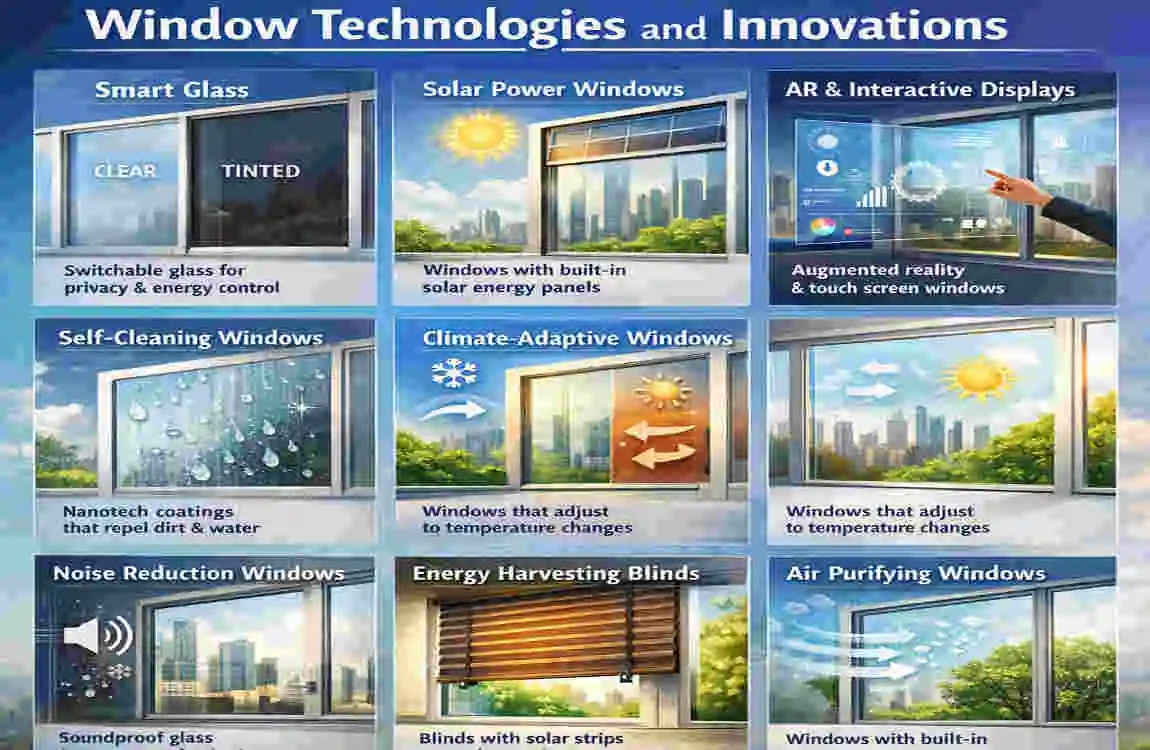
Window technology has advanced dramatically, and 2026 offers homeowners building a 10,000 sq ft home several game-changing options that didn’t exist just a few years ago:
Smart Glass (Electrochromic Windows)
Electrochromic glass—commercially available from manufacturers like View, SageGlass, and Halio—allows windows to tint automatically or on demand. In 2026, these systems have become more affordable and reliable for residential use. Benefits include:
- Eliminates the need for blinds or shades on many windows
- Reduces cooling costs by up to 20% by blocking solar heat when tinted
- Integrates with smart home systems (voice control, scheduling, light sensors)
- Preserves views even when tinted—no need to choose between privacy and scenery
At $2,500–$6,000+ per unit installed, smart glass adds significant cost but can reduce the need for window treatments throughout a large home—a savings that partially offsets the premium.
Vacuum-Insulated Glazing (VIG)
VIG technology—once limited to commercial applications—is now available for residential windows in 2026. These units achieve triple-pane thermal performance (U-factor as low as 0.10) in a package as thin as a single-pane window. This is especially valuable for:
- Historic-style homes where thick triple-pane units would look out of proportion
- Cold climate zones where maximum insulation is critical
- Homes where slim sight lines and maximum glass area are design priorities
Integrated Photovoltaic (Solar) Windows
Transparent solar windows—which generate electricity while allowing light to pass through—have reached commercial viability in 2026 for residential applications. While they currently generate modest power (approximately 30–50 watts per window), a home with 100+ windows could produce 3–5 kW of supplemental solar energy. As this technology matures, windows will increasingly serve dual duty as both lighting and power-generation surfaces.
Advanced Frame Materials
In 2026, the leading frame materials for luxury homes include:
- Fiberglass: Best overall thermal performance, extremely durable, slim profiles. The top choice for energy-conscious luxury builds.
- Thermally broken aluminum: Sleek and modern, with dramatically improved thermal performance compared to older aluminum frames. Ideal for contemporary and minimalist designs.
- Wood-clad (with fiberglass or aluminum exterior): Traditional interior aesthetics with weather-resistant exterior. Popular for Craftsman, Colonial, and transitional styles.
- Composite/Ultrex: Combines the strength of fiberglass with paintable surfaces. Offered by manufacturers like Infinity from Marvin.
Design Considerations & Aesthetic Impacts

Window Placement and Curb Appeal
Your home’s exterior appearance is dramatically influenced by
window placement. Symmetry creates a formal, traditional look, while asymmetrical arrangements can feel more contemporary and dynamic. For a 10,000 square foot house, the sheer scale means window arrangement becomes even more critical to visual balance.
Consider the view from the street. Front-facing windows create the first impression of your home. Too few windows can make a large house feel fortress-like and uninviting, while too many might compromise privacy or structural integrity.
Pay attention to vertical alignment. Stacking windows from floor to floor creates visual order, especially important in multi-story homes. Misaligned windows can create a chaotic appearance, particularly at this scale. A good rule: maintain consistent header heights across all windows on the same floor, even if window widths vary.
Energy Efficiency Implications (2026 Standards)
Here’s a crucial consideration: every window is a potential point of energy loss. While natural light reduces electricity needs, poor-quality windows or excessive glass area can dramatically increase heating and cooling costs in a 10,000
square foot home.
To put this in perspective: a well-insulated wall has an R-value of R-20 to R-30+, while even a high-performance triple-pane window achieves only R-7 to R-10. Every square foot of glass replaces insulated wall, so the energy tradeoff is real.
In 2026, the best approach combines:
- High-performance glazing: Triple-pane windows with low-E coatings, argon or krypton gas fill, and warm-edge spacers deliver U-factors of 0.15–0.25.
- Strategic orientation: South-facing windows (in the Northern Hemisphere) provide passive solar heat gain in winter while properly sized overhangs (12–24 inches) prevent overheating in summer. North-facing windows provide consistent, indirect light with minimal heat gain or loss.
- Right-sized WWR: Energy modeling software (such as EnergyPlus or REM/Rate) can optimize your window-to-wall ratio for your specific climate zone, orientation, and design goals. Most energy consultants in 2026 recommend keeping WWR below 30% for optimal efficiency, though higher ratios are achievable with premium glazing.
- Automated shading: Motorized exterior or interior shading systems that respond to sun position and temperature can reduce unwanted solar heat gain by 50–80%.
For a 10,000 sq ft home with 100 windows, the difference between standard double-pane and premium triple-pane windows can mean $3,000–$8,000 per year in energy savings, depending on climate and energy costs.
Integrating Architectural Details
Windows don’t exist in isolation. Shutters, trim work, and
window hoods all contribute to your home’s character. For a house this size, these details multiply significantly, affecting both aesthetics and budget.
Consider how windows relate to other exterior features. Do they align with columns or pilasters? Do they complement your roofline? Are they proportional to doors and other openings? These relationships matter more as house size increases.
Interior considerations are equally important. Window placement affects furniture arrangement, wall space for artwork, and room functionality. Large homes offer more flexibility, but poor window planning can still create awkward spaces—a beautifully proportioned room can be undermined by a window that prevents placing a sofa or bookcase where it logically belongs.
Natural Light Distribution
A 10,000 square foot house has deep
interior spaces that windows alone might not illuminate adequately. This is where strategic window planning becomes essential. Consider skylights, clerestory windows, light tubes (solar tubes), and internal windows between rooms to distribute light throughout.
Multi-story great rooms benefit from second-story windows that illuminate lower levels. Hallways and interior spaces need careful attention—they shouldn’t feel like tunnels. Transom windows above doors or strategically placed interior windows can solve this problem elegantly.
Remember that natural light changes throughout the day and seasons. South-facing rooms flood with afternoon light, while north-facing spaces have more consistent but dimmer illumination. Plan your room functions accordingly—home offices on the north side for glare-free light, living areas to the south for warmth and brightness.
Practical Examples & Ballpark Figures

Example 1: Minimalist Modern Estate
Picture a sleek, contemporary 10,000 square foot home with an open
floor plan and floor-to-ceiling glass walls in key areas. This design might include:
- Great room: 4 large window panels (each 8–10 feet wide)
- Master suite: 3 large windows plus glass sliding doors to private deck
- Additional bedrooms (5): 2 large windows each = 10 windows
- Kitchen/dining: 4 large window units (including a window wall)
- Bathrooms (6): 1 window each = 6 windows
- Home office: 2 large windows
- Hallways and staircases: 8–10 strategically placed windows
- Basement level: 10–15 smaller windows
- Various specialty rooms: 15–20 windows
Total: ~65–75 window units | Estimated glass area: ~1,800 sq ft | Window budget: $130,000–$300,000
This approach creates a minimalist exterior aesthetic while maximizing natural light through large glass panels. The total window count is lower, but the
glass square footage is substantial.
Example 2: Traditional Colonial Estate
A classic two-story Colonial with symmetrical facade, formal rooms, and a finished walkout basement:
- Formal living room: 4 double-hung windows
- Formal dining room: 4 double-hung windows
- Family room: 6 windows (including a bay window group)
- Kitchen: 4 windows plus a garden window
- Breakfast room: 3 windows
- Master suite: 5 windows
- 5 additional bedrooms: 3 each = 15 windows
- 6 bathrooms: 1–2 each = 9 windows
- Home office/library: 4 windows
- Mudroom/laundry: 2 windows
- Hallways and staircases: 8 windows
- Walkout basement: 12 windows
- Bonus/game room: 4 windows
- Front facade sidelights and transoms: 6 windows
Total: ~86–100 window units | Estimated glass area: ~1,400 sq ft | Window budget: $85,000–$180,000
Example 3: French Country Luxury Estate
An ornate
French home with multiple wings, dormers, and abundant fenestration:
- Grand salon: 8 tall casement windows
- Formal dining: 6 windows with divided lites
- Chef’s kitchen: 6 windows
- Morning room/sunroom: 12 windows
- Master suite wing: 8 windows
- 6 additional bedrooms: 3–4 each = 21 windows
- 7 bathrooms: 1–2 each = 10 windows
- Library: 6 windows
- Home office: 4 windows
- Wine room: 1 decorative window
- Dormers (8): 1 each = 8 windows
- Hallways, landings, and transitions: 15 windows
- French doors (counted as window units): 12 pairs = 24 units
- Basement: 10 windows
- Tower/turret: 6 windows
Total: ~145–165 window units | Estimated glass area: ~2,200 sq ft | Window budget: $150,000–$350,000
Window Costs and ROI for a 10,000 Sq Ft Home (2026)
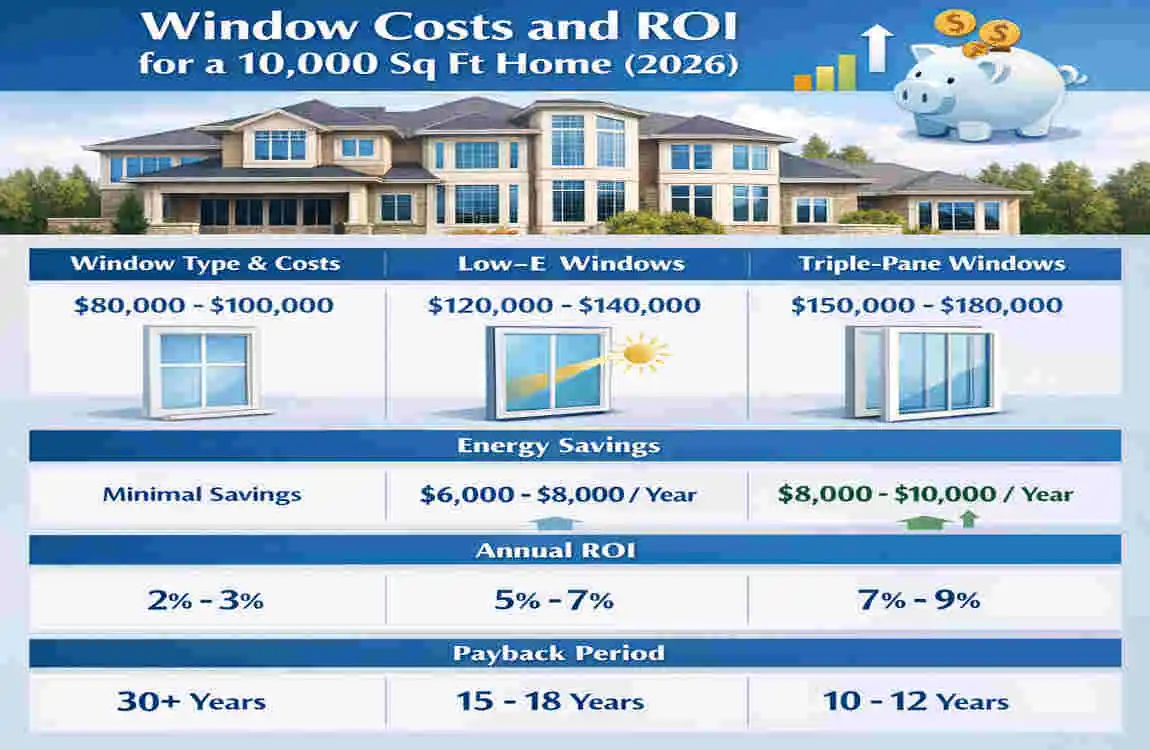
Total Cost Breakdown
Here’s a comprehensive cost summary for windows in a 10,000 sq ft home as of 2026:
| Cost Category |
Budget Range |
Mid-Range |
Premium/Luxury |
| Windows (materials) |
$35,000–$55,000 |
$60,000–$120,000 |
$120,000–$400,000+ |
| Installation labor |
$25,000–$40,000 |
$35,000–$60,000 |
$50,000–$100,000 |
| Trim, casing, and finishing |
$10,000–$20,000 |
$15,000–$35,000 |
$25,000–$60,000 |
| Window treatments |
$8,000–$15,000 |
$15,000–$40,000 |
$30,000–$100,000+ |
| Total |
$78,000–$130,000 |
$125,000–$255,000 |
$225,000–$660,000+ |
Impact on Resale Value
Quality windows are one of the highest-ROI investments in residential
construction. According to the 2025–2026 Remodeling Cost vs. Value Report, window replacement projects typically recoup 65–75% of their cost at resale. For new construction, premium windows can increase appraisal values by 5–10% compared to builder-grade alternatives.
In 2026’s luxury market, buyers specifically look for:
- Energy Star-certified or better window performance
- Smart glass features
- Consistent, high-quality brands (Marvin, Andersen, Pella Architectural, Kolbe, Loewen)
- Proper installation with verified air sealing
For a 10,000 sq ft home valued at $2–5 million, investing in premium windows is expected—not optional. Cutting corners on windows in a luxury build is one of the fastest ways to disappoint buyers and reduce long-term value.
Sustainability and Green Building Certifications

If you’re building or renovating a 10,000 sq ft home in 2026 with sustainability in mind, your
window choices directly impact certification eligibility:
- LEED for Homes: Requires compliance with ASHRAE 90.1 energy standards; window performance and WWR are key factors. High-performance windows can contribute 3–8 points toward certification.
- ENERGY STAR Residential New Construction: Requires windows to meet or exceed ENERGY STAR performance criteria for your climate zone. In 2026, this means U-factors of 0.27 or lower in most northern zones.
- Passive House (Phius/PHI): The most rigorous standard—requires triple-pane windows with U-factors of 0.14 or lower and careful attention to solar heat gain management. Window-to-wall ratios are carefully calculated through energy modeling.
- WELL Building Standard: Focuses on occupant health and wellbeing. Requires specific daylighting levels (300 lux minimum in 75% of occupied space) and views to the outdoors, which directly drives window quantity and placement.
Even if you’re not pursuing formal certification, these standards provide excellent guidelines for window planning that prioritizes both energy performance and occupant comfort.
Window Maintenance for a Large Home
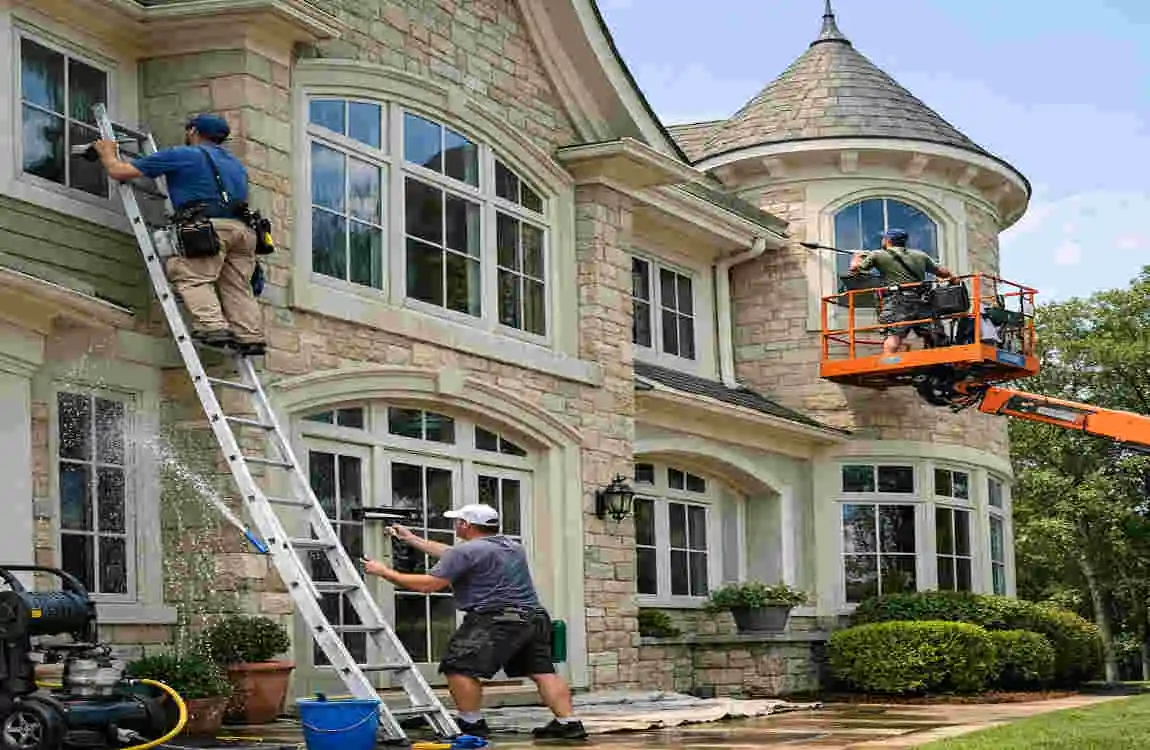
Owning 80–150+ windows in a 10,000 sq ft home means ongoing maintenance is a real consideration:
- Cleaning: Professional window cleaning for a home this size costs $500–$1,500 per visit (interior and exterior). Most luxury homeowners schedule 2–4 cleanings per year, totaling $1,000–$6,000 annually.
- Inspection: Annual inspection of seals, weatherstripping, and hardware is recommended. Failed seals (indicated by fogging between panes) should be addressed promptly to maintain energy performance.
- Hardware maintenance: Hinges, locks, and operators on operable windows should be lubricated annually. Casement and awning window operators are particularly prone to wear.
- Refinishing (wood windows): Wood-frame windows may need repainting or restaining every 5–8 years. For 100+ wood windows, this can cost $10,000–$25,000 per cycle.
- Warranty considerations: Premium window manufacturers offer 20-year to lifetime warranties. Keep all documentation organized—warranty claims on even a few windows can save thousands.
When to Hire a Professional Window Consultant
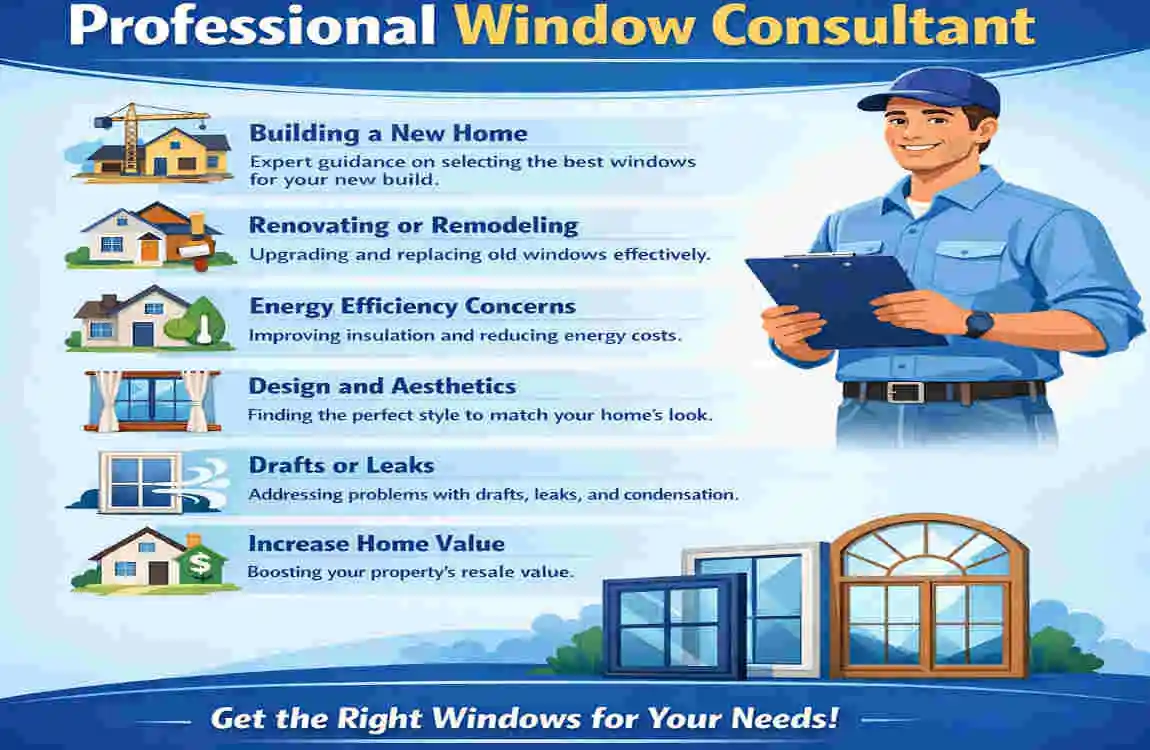
For a project as significant as a 10,000 sq ft home, professional guidance is strongly recommended. Consider engaging:
- A fenestration consultant: Specializes in window and glazing system design. They can optimize window placement, specify performance requirements, and ensure code compliance. Cost: $5,000–$15,000 for a project this size.
- An energy modeler: Uses software to simulate your home’s energy performance with different window configurations. This data-driven approach removes guesswork from WWR and glazing specification decisions. Cost: $3,000–$8,000.
- A daylighting designer: Uses tools like Radiance or DIVA to predict natural light levels in each room based on window size, position, and glazing type. Especially valuable for deep floor plans. Cost: $4,000–$10,000.
These professionals’ fees are a tiny fraction of your total
window investment and can prevent costly mistakes—such as oversized west-facing windows that turn rooms into ovens, or undersized north-facing windows that leave spaces perpetually dim.
FAQ: How Many Windows in a 10,000 Sq Ft House (2026 Edition)
How many windows does a 10,000 square foot house typically have?
Most 10,000 sq ft homes have between 80 and 150 windows, with the exact count depending on architectural style, floor plan layout, number of stories, and personal preference. Modern minimalist homes may have as few as 50 large window units, while ornate Victorian or French Country estates can exceed 180.
How much do windows cost for a 10,000 sq ft home in 2026?
Total window costs (including materials, installation, trim, and treatments) typically range from $80,000 to $250,000+ for a luxury home of this size. Premium options with smart glass, custom sizes, or triple-pane glazing can push costs above $400,000.
What is the ideal window-to-wall ratio for a large home?
Most architects recommend a window-to-wall ratio of 15–30% for optimal balance between natural light, energy efficiency, and structural integrity. Modern designs may push to 40% or higher with advanced glazing. Energy codes in most U.S. climate zones cap the default WWR at 30%, though higher ratios are permitted with compensating energy measures.
Are smart glass windows worth the investment in a 10,000 sq ft home?
Smart glass (electrochromic) windows cost 2–4 times more than conventional windows but eliminate the need for window treatments, reduce cooling costs by up to 20%, and offer instant privacy control. For a luxury home with 100+ windows, the savings on high-end motorized shades alone can offset a significant portion of the smart glass premium.
How often do windows need to be replaced in a large home?
Quality windows from premium manufacturers typically last 25–40+ years with proper maintenance. Vinyl windows generally have shorter lifespans (20–30 years), while fiberglass and aluminum-clad wood can last 40+ years. Budget for seal failures and hardware replacement on individual units starting around year 15–20.
What window type is most energy-efficient for a large home in 2026?
Triple-pane windows with low-E coatings, krypton gas fill, warm-edge spacers, and fiberglass frames offer the best combination of thermal performance and durability. Vacuum-insulated glazing (VIG) is an emerging option for maximum performance in a thin profile. For the best results, specify windows with a U-factor of 0.22 or lower and an SHGC appropriate for your climate zone.
How can I reduce window costs without sacrificing quality?
Use a mix of window sizes: invest in large, high-impact windows for public-facing and entertaining areas, and use standard-sized, quality windows for bedrooms, bathrooms, and secondary spaces. Also consider using fixed (non-operable) windows where ventilation isn’t needed—they’re typically 20–30% cheaper than operable units and offer better air sealing.
Do more windows increase home value?
Well-designed window placement that maximizes natural light, views, and energy efficiency positively impacts home value. However, simply adding more windows doesn’t automatically increase value—poorly placed or low-quality windows can actually hurt resale. Quality, placement, and performance matter more than quantity.