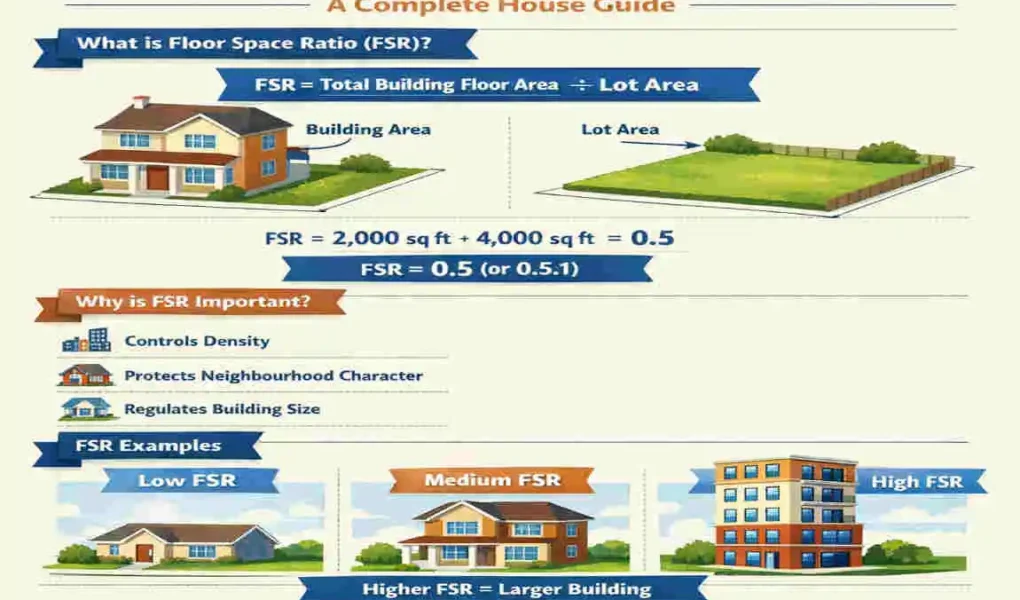
If you are planning to build, buy, or invest in property, understanding land-use rules is very important. Cities do not allow unlimited construction on a plot because they need space for roads, light, air, parking, and public services. That is where Floor Space Ratio comes in.
| Aspect | Details |
|---|---|
| Definition | Floor Space Ratio (FSR) is the ratio of total built-up floor area to total plot area |
| Other Name | Floor Area Ratio (FAR) |
| Formula | FSR = Total Built-up Area ÷ Plot Area |
| Purpose | Controls building density and land usage in urban planning |
| Example | 1,000 sq ft plot with FSR 2.0 = 2,000 sq ft construction allowed |
| Includes | All floors (ground + upper floors) |
| Excludes | Sometimes basements, parking, balconies (depends on local rules) |
| Importance | Helps manage city growth, infrastructure, and open space |
| Regulated By | Local development or planning authorities |
What is Floor Space Ratio?
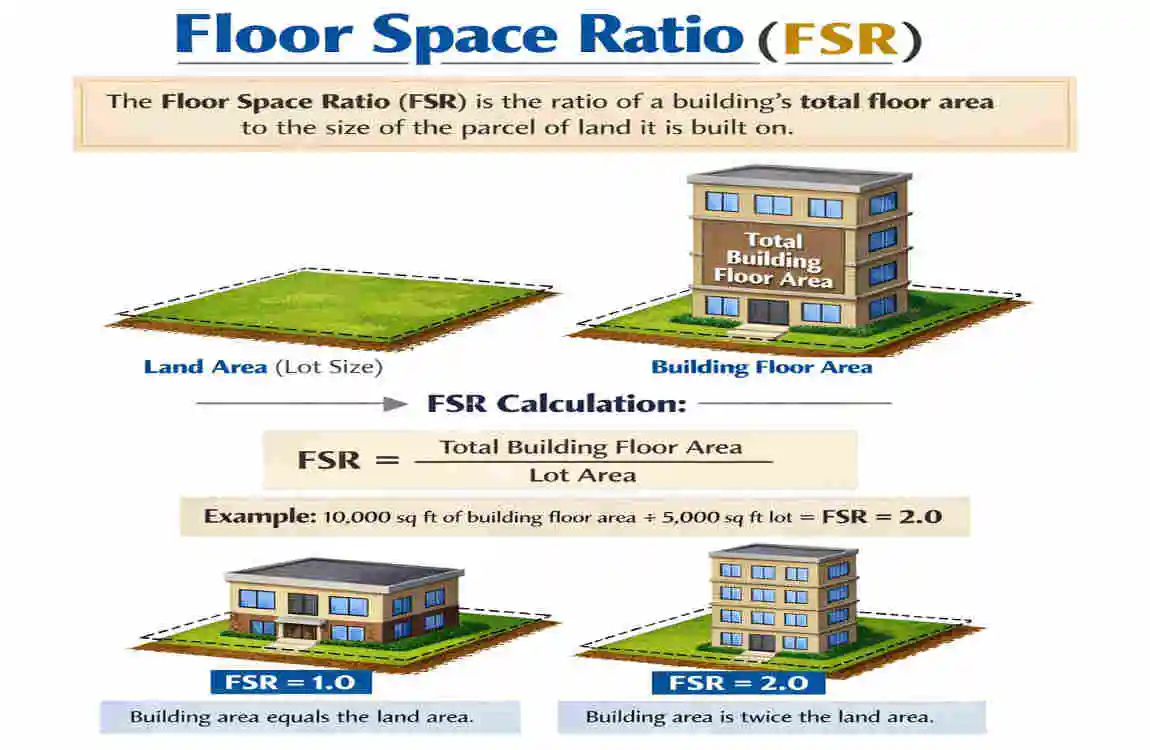
Floor Space Ratio (FSR) is the relationship between the total built-up area and the total plot area. Many places also refer to it as Floor Area Ratio (FAR). It is a key rule used by urban planning authorities to control how much a building can grow on a site.
The formula is simple:
FSR = Total Built-up Area / Plot Area
For example, if your plot is 1,000 sq ft and the allowed FSR is 2.0, then you may build up to 2,000 sq ft in total. This could be spread across one or more floors, depending on local rules.
In everyday use, what is the floor space ratio really telling you? It is telling you how much construction is allowed without overcrowding the land. That is why it matters so much in housing and city design.
Why Floor Space Ratio is Important in Construction
FSR plays a big role in keeping cities planned and balanced. It helps prevent overcrowding and makes sure buildings do not block too much sunlight, airflow, or open space.
For homeowners, it shows how much they can build on their land. For builders, it helps shape a project that is both legal and practical. For governments, it supports better control over city density and infrastructure.
A higher FSR usually means more vertical building, like apartments or taller homes. A lower FSR often means more open space and fewer floors.
How to Calculate Floor Space Ratio
Calculating FSR is easy once you know the numbers. First, measure the plot area. Then find the total built-up area allowed by local rules. Finally, divide the built-up area by the plot area.
For example:
- Plot area: 2,000 sq ft
- Built-up area: 3,000 sq ft
- FSR: 1.5
Another example:
- Plot area: 500 sq ft
- Built-up area: 1,000 sq ft
- FSR: 2.0
Keep in mind that rules can differ by location. Some places include all floors in the calculation, while others may exclude basements or treat balconies and parking separately. So how to calculate the floor space ratio depends on local building rules, too.
Floor Space Ratio Example Scenarios
Plot Size Allowed FSR Max Built-Up Area Building Type
1,000 sq ft 1.0 1,000 sq ft Low-rise house
1,000 sq ft 2.0 2,000 sq ft Duplex house
1,000 sq ft 3.0 3,000 sq ft Small apartment
5,000 sq ft 2.5 12,500 sq ft Mid-rise building
Floor Space Ratio vs Floor Coverage Ratio
These two terms sound similar, but they are not the same.
FSR/FAR looks at the total built-up area across all floors. It controls how much you can build vertically. On the other hand, ground coverage ratio looks only at the building footprint on the ground. It controls how much street-level land the building occupies.
FeatureFSR/FARGround Coverage
Measurement Total floors Ground footprint
Controls Height and density Open space
Focus Vertical expansion Land utilization
So, if you are comparing floor area ratio vs. coverage, remember this: one tells you the total built-up area, and the other tells you how much of the land is covered at ground level.
Factors That Affect Floor Space Ratio Rules
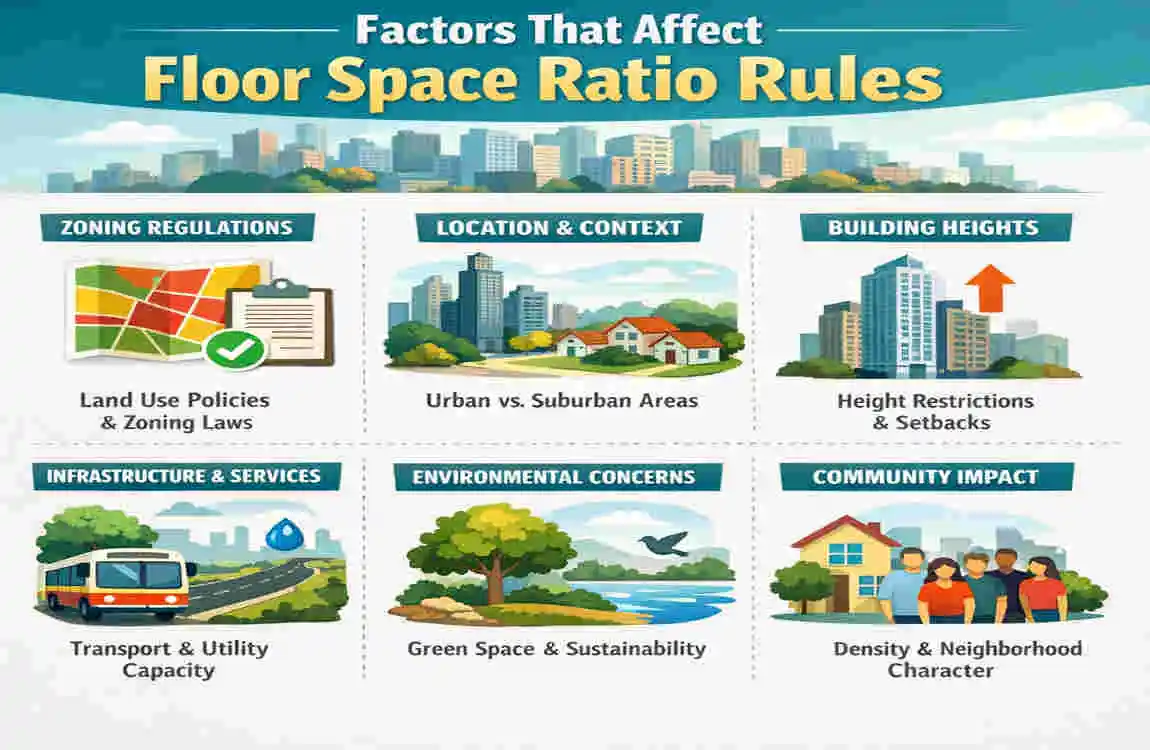
FSR rules are not the same everywhere. They depend on many local factors, such as zoning laws, road width, land location, and infrastructure capacity. Environmental rules can also affect what is allowed.
In many cases, wider roads allow a higher FSR because the area can handle more traffic and services. Dense city centers may also permit more vertical growth to save land. Rural areas, however, often have lower limits to control development.
Local development authorities decide these rules, so it is always wise to check the exact requirements before starting a project.
Floor Space Ratio in Modern Urban Planning
FSR is a major part of modern city planning. It helps prevent random construction and supports organized growth. It also makes it easier to create smart, livable cities.
It is closely linked to sustainability because it helps protect green space, reduce congestion, and manage population density. In real life, you will see FSR used in residential zones, commercial towers, and mixed-use areas where homes, shops, and offices share the same space.
Advantages and Disadvantages of Floor Space Ratio
Advantages include better city planning, improved infrastructure control, and fair land usage. It also helps keep neighborhoods more balanced and livable.
Disadvantages can include limits on building size, higher property costs in high-demand areas, and confusion for homeowners unfamiliar with planning rules.
Common Misconceptions About Floor Space Ratio
Many people think a higher FSR always means a higher property value, but that is not always true. Value also depends on location, design, and demand.
Another common myth is that FSR applies only to apartments. In reality, it can apply to residential and commercial buildings. Also, basements are not always excluded; it depends on the local rules.
Practical Example for Homeowners
Suppose you own a 1,200 sq ft plot with an allowed FSR of 2.0. That means you may build up to 2,400 sq ft in total.
You could use that space in different ways. For example, you may build a two-floor house with 1,200 sq ft on each floor, or create a compact three-floor design if the local setback rules allow it. This is why checking FSR early can help you design better.
Expert Tips for Understanding Floor Space Ratio
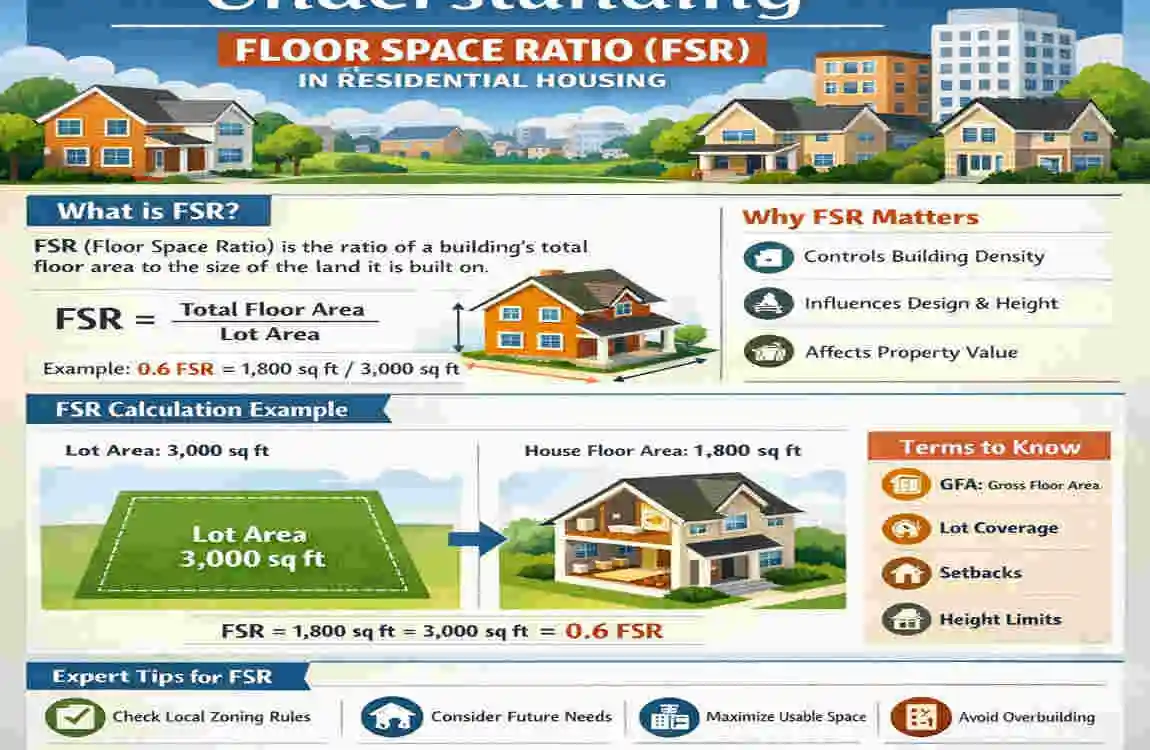
Before planning construction, always check with your local building authority. A small difference in rules can change your entire design.
It also helps to speak with an architect, think about future expansion, and compare FSR values before buying land. That way, you make a smarter and more flexible property decision.
Frequently Asked Questions
What is the floor space ratio in simple words?
It is the rule that sets the maximum floor area you can build on a plot of land.
Is FSR the same as FAR?
Yes, in many places, FSR and FAR mean the same thing. The term used may change by country or city.
How does FSR affect house design?
It decides how big your house can be and how many floors you may build.
Can FSR be increased?
Sometimes yes, but only if local rules allow it or if you get special approval.
Who decides floor space ratio rules?
Local urban planning or development authorities usually decide the rules.