For decades, most people assumed a home build would take six months to a year, sometimes even longer. That was the normal pace. You bought land, cleared the site, waited on permits, scheduled crews, dealt with rain delays, and slowly watched the frame, roof, walls, and finishes come together.
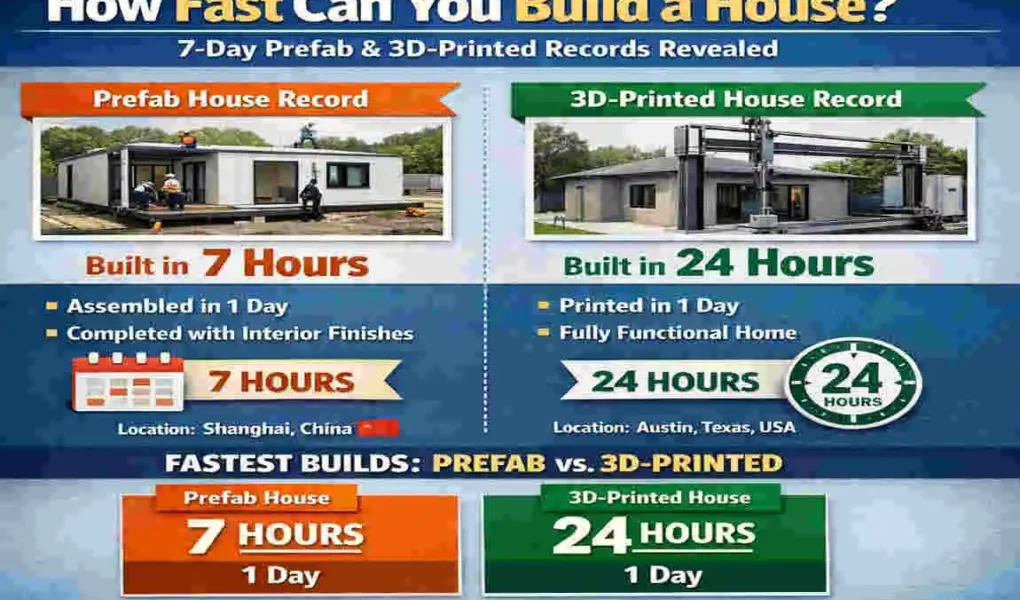
Today, prefab home kits and 3D-printed houses are proving that a home does not always require months of construction. In some real-world cases, a small prefab structure can go up in 7 days or less. In other cases, large-scale printers have produced the main shell of a home in under 80 hours.
That does not mean every house can be completed in a week. It also does not mean speed replaces quality. What it does mean is this: if you are asking how fast you can build a house, you now have options that did not exist a few years ago.
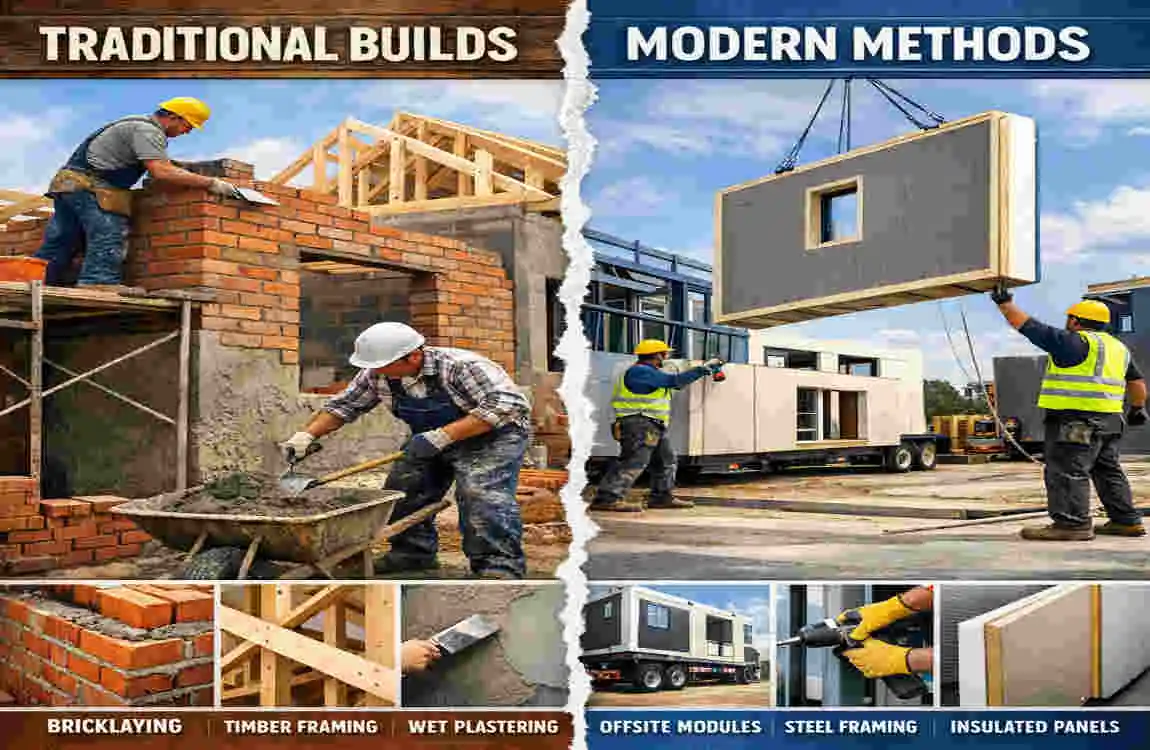
Traditional Builds vs Modern Methods
Before we look at records and speed claims, it helps to understand the baseline.
Traditional house building still takes months.
A standard stick-built home usually takes 6 to 12 months from the start of construction to completion. In many cases, the average lands somewhere around 9 months, especially if the build is custom, the weather is poor, or labor is limited.
That timeline makes sense when you think about how traditional construction works.
Everything happens on-site. Materials arrive in phases. Different subcontractors come and go. One delay creates another. If the framers are late, the roof crew waits. If the roof is late, the interior is exposed. If rain shows up, progress slows even more.
Even efficient systems such as ICF homes—which use insulated concrete forms—often take 8 to 10 months once all project components are included.
So when people ask how fast you can build a house using conventional methods, the honest answer is still: not very fast.
Prefab and 3D printing change the process.
Modern methods save time by reducing the amount of work done outdoors.
With prefab construction, many parts of the home are designed, cut, and prepared in advance. In some systems, wall panels arrive ready to install. In others, the home comes as a pre-engineered kit that a small crew can assemble quickly.
With 3D-printed construction, a robotic printer lays down layers of a special concrete mix to create the wall system. Instead of a framing crew building wall by wall, the printer follows a digital design. It extrudes the structure continuously.
Both methods remove a lot of the slowest parts of construction.
Why modern methods are faster
The biggest time savings usually come from four areas:
- Less weather exposure
- Fewer material errors
- Less dependence on large crews
- More repeatable, factory-controlled production
If your wall system is already cut and ready, you skip measuring mistakes and wasted labor. If your printer runs from a digital model, you avoid many framing delays. If your roof goes on quickly, you protect the structure sooner.
That is why the fastest houses being built today are not traditional builds. They are almost always prefabricated, modular, panelized, or 3D-printed.
Timeline comparison table
Method, Typical Time, Key Factors
Traditional 6–12 months Weather, labor availability, inspections, custom work
Prefab 1–4 weeks onsite , pre-cut kits, factory prep, minimal crew, simpler assembly
3D-Printed Hours to days for printed structure , Printer speed, wall system, foundation readiness, manual finishing
Speed does not mean “instant.”
Here is an important point: when companies say a house was built in 7 days or printed in 80 hours, they usually mean the main structure or shell, not every final detail from permit to move-in.
That distinction matters.
You can raise the frame or print the walls at record speed. However, utilities, inspections, interior finishes, and approvals still take time. So the better question is not just how fast you can build a house, but also which part of the house we’re measuring.
Once you understand that, the real numbers become much more useful.
7-Day Prefab Records
Prefab is one of the clearest answers to the question of how fast you can build a house without turning the project into a giant industrial operation.
For many buyers, it is also the most realistic fast-build method because it blends speed with familiar construction practices.
What a 7-day prefab house really means
A 7-day prefab house is a small or mid-sized structure that can be assembled on-site from a prepared kit. These kits often include pre-cut framing members, labeled components, roof parts, hardware, and a step-by-step plan.
In some A-frame systems, a crew of four people with basic building skills can assemble the shell in 7 days or less. Some brands even position this as a DIY-friendly option because the kit is designed to reduce guesswork.
That is a huge shift from the old model, where even a modest cabin could take months of work.
Why A-frame prefab kits are so fast
A-frame designs are naturally efficient.
The shape is simple. The roofline is steep. The structure has fewer complicated corners than many standard homes. That means fewer cuts, fewer framing details, and fewer points where construction slows down.
Many 7-day kits are also built around these speed advantages:
- Pre-engineered structural design
- Factory-cut parts
- Straightforward geometry
- Smaller overall footprint
- Reduced need for heavy equipment
That last point matters more than people realize. If a project can be assembled without cranes or large machinery, setup gets easier, and site logistics improve.
A simple 7-day assembly flow
The exact schedule changes by kit and site, but the process often looks something like this:
Site prep and foundation check
The crew confirms the foundation or platform is ready, squares the base, organizes materials, and stages tools.
If the foundation is already complete before the kit arrives, the rest of the job moves much faster.
Floor and base framing
The base system is assembled, and the crew begins preparing for vertical framing.
This is where kit precision really helps. Parts are already sized, so you spend less time correcting measurements.
Day 3: Main wall or frame assembly
Large structural elements start to take shape. In an A-frame build, this can mean raising major side sections or truss-like frame elements.
The visual change is dramatic. What looked like a pile of materials suddenly starts looking like a house.
Structural enclosure
More framing goes up, roof sections connect, and the main shell begins to close in.
This stage often shows why prefab construction time is so much shorter than normal site-built timelines.
Roof installation and weatherproofing
With the roof on, the building gets protection quickly. That helps avoid one of the biggest traditional build problems: weather damage during construction.
Exterior closure
Windows, doors, exterior sheathing, and weather barriers may go in depending on the package and crew experience.
Shell completion
By the end of the week, the core structure is usually complete. In some cases, the home is dried in. In others, it is structurally assembled and ready for utility and interior trades.
Real-world example: fast prefab assembly in action
There are well-known examples online showing double-story prefab structures assembled in around 7 days. These demonstrations matter because they show speed in practice, not just in marketing language.
What stands out in these builds is not just the pace. It is the coordination. Materials arrive labeled. Teams follow a clear sequence. The design avoids unnecessary complexity. Every hour has a purpose.
That is the real lesson behind the fastest house builds: speed comes from planning, not rushing.
Cost range of a 7-day prefab house
For many buyers, the appeal is not only speed but also predictability.
A typical prefab A-frame or compact cabin-style build may fall roughly in the $50,000 to $150,000 range, depending on size, shell package, materials, finishes, and location. On a per-square-foot basis, many fast prefab builds can land around $80 to $150 per square foot, especially for simplified designs.
That often makes prefab feel more approachable than a custom home.
Pros of 7-day prefab construction
It is fast in the way buyers actually care about
You are not waiting month after month for framing to start. You can see visible progress right away.
It can be more DIY-friendly
Some kits are designed for owner-builders or small crews. That opens the door for people who want more control over the project.
It reduces labor complexity.
You do not always need a huge team. A smaller, organized crew can make serious progress quickly.
It can lower financing pressure.
A shorter build timeline often means paying less construction loan interest before you can use the home.
Limits and trade-offs
Prefab is fast, but it is not magic.
Size can be a limiting factor.
The easiest 7-day builds are usually smaller homes, cabins, guest houses, or simple primary residences. Very large custom homes still take longer.
Finishes still take time.
Even if the shell goes up in a week, plumbing, electrical, insulation, drywall, flooring, cabinets, and inspections add more time.
Site conditions still matter.
A remote lot, difficult slope, or poor access can erase some of the speed advantage.
So yes, if you are asking how fast you can build a house, a prefab kit can absolutely get you into record territory. But the fastest outcomes happen when the design stays simple, and the site is ready.
3D-Printed House Speed Records
If prefab makes fast construction feel practical, 3D printing makes it feel futuristic.
And yet it is not just a concept anymore. Some of the most talked-about answers to the question of how fast you can build a house now come from large-scale construction printers.
How 3D-printed houses are built
A construction printer works like a giant robotic nozzle system. It follows a digital design file and extrudes a cement-like material in layers. Over time, those layers form the home’s wall structure.
The printer does not usually build the entire house from scratch with no human help. Instead, it handles a specific part of the project very efficiently: the wall system.
A typical process looks like this:
- The site is prepared, and the foundation is completed.
- The printer is set up over or around the foundation area.
- The machine prints the walls layer by layer.
- Crews return to install roofing, windows, doors, utilities, and interior finishes.
So when you hear about a house printed in 20 hours, 80 hours, or a few days, that usually refers to the printing time for the structural shell or wall system, not the full move-in-ready schedule.
How fast is the printing itself?
Construction printers can extrude material at speeds often described as 2 to 3.5 meters per hour, depending on the system, material, design, and setup.
That may not sound fast at first, but remember: the machine is producing walls continuously, with high consistency, and often with less manual framing labor than a traditional build.
This is why 3D printed house speed has become such a major topic in construction.
The 80-hour full-house milestone
One of the most impressive modern examples comes from the use of a very large construction printer capable of producing a full house structure in under 80 hours.
That number matters because it shifts 3D printing from a novelty to something closer to real production potential. If a wall system can be produced in that time, the technology becomes relevant for housing supply, emergency shelter, and planned community development.
In practical terms, this means a printed home shell can move from concept to a visible structure in a matter of days rather than months.
Other fast-build records in Europe and beyond
There have also been major demonstrations of printed buildings completed in about 140 hours, along with growing claims that weekly output could become the norm in some production settings.
That is the larger story here.
The goal is not just one headline-grabbing prototype. The goal is repeatable, scalable speed.
If printers can reliably produce house shells every few days, developers and governments will take the technology much more seriously.
Why 3D printing saves so much time
It automates a labor-heavy part of the build.
Traditional wall construction needs measuring, cutting, lifting, fastening, and coordinating multiple people. Printing reduces much of that into one guided process.
It follows a digital plan exactly.
There is a lower chance of layout drift, framing inconsistencies, or onsite improvisation that slows work down.
It can reduce waste.
Because the printer deposits material where it is needed, material handling can be more controlled.
It can work well for repeated designs.
If you are printing the same or similar home models across multiple sites, speed improves even more.
What still needs to be done by people
This is where expectations need to stay realistic.
A 3D printer does not usually handle everything. Humans still manage:
- Foundation work
- Reinforcement steps were required
- Window and door installation
- Roofing
- Plumbing and electrical systems
- Insulation and interior finishes
- Final inspections
That means a printed house can be incredibly fast at a single core stage while still requiring a standard finishing phase afterward.
Benefits beyond speed
The appeal of printed homes lies in more than just the clock.
They may help in housing shortages.
Rapid wall production could support faster responses where affordable housing is urgently needed.
They can support disaster recovery.
After storms, fires, or displacement events, speed matters. Printed systems offer a path to faster rebuilding.
They encourage design innovation.
Curved walls, efficient layouts, and new forms become easier to produce when the printer follows software rather than manual framing traditions.
Current limitations
3D printing is exciting, but it still has limits.
Scale and approvals remain a challenge.
Not every town, inspector, or code system is ready for printed homes. Adoption varies widely.
Finishing work still slows the project.
The printed shell may be quick, but completing the home can still take time.
Equipment is specialized
You cannot simply rent one from the average local supplier. The equipment, material, and training are still niche in many markets.
So, how fast can you build a house with 3D printing? For the structural shell, the answer can be hours to a few days. For a complete, livable home, the answer is still much faster than traditional construction—but not yet as instant as headlines sometimes suggest.
Step-by-Step: Building in Record Time
If you want the fastest, most realistic path, the smartest approach is often a hybrid strategy.
That means you combine fast planning, a prepared site, a simplified design, and either prefab assembly or 3D-printed wall construction. Here is what a record-minded timeline can look like.
Prep and permits: 1–2 days on site, longer on paper
The physical prep may only take a day or two.
Crews can quickly clear the site, mark layout points, stage materials, and verify access. But the bigger issue is usually paperwork. Permits and approvals can take weeks or even months before the first crew arrives.
So if you are serious about speed, you have to start with admin, not hammers.
Foundation: 1–3 days for fast systems
A fast house still needs a solid base.
Depending on the design, foundation work may be simplified through slab systems, piers, or efficient poured walls. Some builders save time by using methods that reduce curing delays or eliminate extra steps.
The foundation is one of the most important speed points in the whole project. If it is not ready, nothing else matters.
Assembly or printing: 3–7 days
This is the stage where modern methods shine.
A prefab kit can be assembled rapidly once the site and foundation are ready. A 3D printer can produce the wall shell in a short window, often measured in hours or days rather than weeks.
This is also the moment buyers notice the biggest difference compared with traditional construction. The house appears almost overnight.
Roofing and weatherproofing: 1–3 days
Getting the structure sealed matters.
The sooner the roof, exterior wrap, and openings are protected, the lower the risk of moisture, warping, and weather delays.
Fast builders prioritize this stage because it protects all later work.
Mechanical systems and interiors: 1–2 weeks
This stage includes plumbing, electrical, HVAC, insulation, wall finishes, flooring, kitchen work, and fixtures.
Even when the shell is built at record speed, this phase still needs skilled labor and inspection sign-offs. But because the structure is already in place, these trades can often move faster and with fewer interruptions.
Final checks and move-in prep
Punch lists, inspections, cleanup, and occupancy approval close the loop.
In a well-managed fast build, the total time from on-site start to near-completion can fall under 30 days. That is not every project, but it is increasingly possible.
What helps speed the project up?
Here are the biggest factors that improve results:
- Simple design
- Ready permits before day one
- Flat, accessible land
- Experienced crew
- Reliable weather
- Factory-prepared materials
- Clear schedule with no trade overlap confusion
What slows a fast build down?
Just as important, these issues can wipe out speed gains:
- Late permits
- Utility connection delays
- Change orders during construction
- Remote or difficult sites
- Poor coordination between trades
- Custom finishes added too late
If you want the real answer to how fast you can build a house, this is it: the build can be extremely fast, but only if the planning is even faster.
Costs and Savings Breakdown
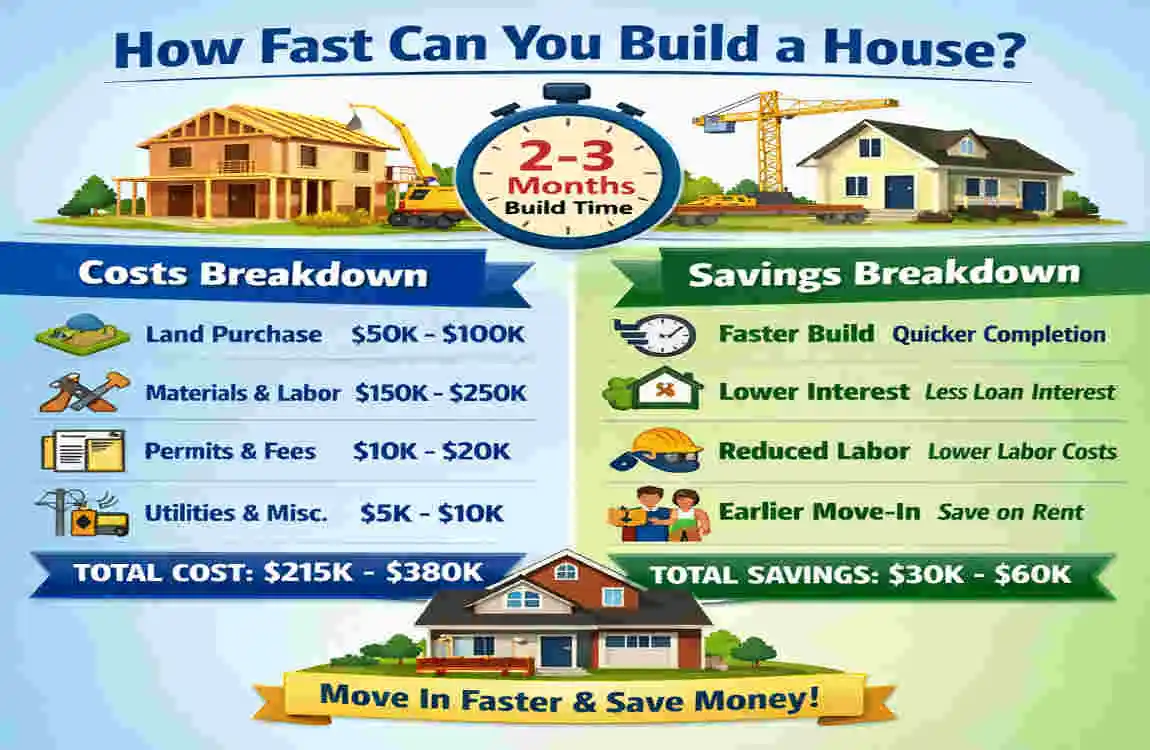
Speed is exciting, but most buyers eventually ask the same question: Does fast construction actually save money?
In many cases, yes.
Not always on every line item, but often in the total project picture.
Why do faster builds often cost less
The biggest savings usually come from labor and time-related overhead.
A long build means more site supervision, more crew scheduling, more equipment rental, more exposure to delays, and more months of financing costs. A fast build cuts many of those expenses.
Prefab and 3D printing also reduce some kinds of waste. When parts are factory-cut or machine-produced, there are often fewer mistakes, fewer scrap materials, and less rework.
Cost comparison table
Build Type Cost per Sqft Time Savings
Prefab 7-Day $80–150 Up to 90% faster in onsite assembly
3D-Printed $50–100 Up to 95% faster for wall/shell production
Traditional $150–300 Baseline
These numbers vary by region, labor market, size, finish quality, and code requirements. Still, they show why fast construction gets so much attention.
Prefab cost advantages
Lower labor demand
Many prefab systems are designed so that a small team can assemble them efficiently. That alone can significantly reduce labor costs.
Predictable material packages
You often know what comes in the kit and what needs to be purchased separately. That makes budgeting easier.
Less exposure to delay inflation
The longer a build runs, the more likely you are to face price shifts, scheduling gaps, or repeated mobilization costs.
3D printing cost advantages
Reduced wall labor
Wall production is one of the most labor-intensive parts of a normal build. Printing changes that equation.
Potential for affordable housing use
Because the process can be repeated, printed homes work especially well for smaller, standardized housing models.
Material control
The printing process can reduce some forms of waste and create efficient wall forms.
Where costs can rise
Fast does not always mean cheap in every category.
Specialized technology can cost more upfront.
3D printing equipment, technical setup, and expert operators can raise early-stage costs.
Higher-end finishes erase savings.
You can build the shell quickly, but premium kitchens, custom windows, and luxury interiors still cost what they cost.
Site complexity changes everything.
A steep lot, difficult soil, or remote location can make even a fast system more expensive.
The hidden ROI of building faster
This is where the conversation gets more practical.
A faster build can mean:
- Lower construction loan interest
- Faster move-in
- Earlier rental income
- Reduced holding costs on land
- Lower weather-related repair risk during construction
If you plan to use the property as a rental, vacation unit, guest house, or primary home, speed creates financial value beyond the sticker price.
2026 money-saving opportunities
In 2026, some buyers are also watching for support tied to green building, energy efficiency, or innovative housing methods. While programs vary by location, modern construction systems may sometimes align with incentives focused on sustainability, housing access, or reduced material waste.
The key takeaway is simple: when people ask how fast you can build a house, they are often really asking how quickly they can stop spending money on an unfinished project.
And that is where fast builds can truly win.
Challenges and Realities
Rapid construction sounds great, but it is important to stay grounded.
Not every project can or should be pushed into record-speed territory.
Permits often take longer than the build.
This is one of the biggest surprises for first-time buyers.
The house shell might go up in a week. Still, permits, approvals, design review, utility planning, and inspections may take 2 to 4 months or more, depending on the area.
In other words, the paperwork can outlast the physical construction.
Fast building still needs skilled people.
Even DIY-friendly kits work better with experienced supervision. And while 3D printing automates part of the build, trained operators and knowledgeable finish crews are still essential.
Speed without coordination causes mistakes.
Rushing and speed are not the same thing.
A quality fast build is organized, sequenced, and checked carefully.
A bad fast build skips details, cuts corners, and creates future repair problems. That is why strong quality control matters so much. Moisture sealing, structural alignment, utility work, and inspection compliance must still be handled properly.
Local regulations vary a lot.
Some regions are more open to prefab and printed homes than others. Areas with strict seismic, wind, fire, or snow-load requirements may require additional engineering or review.
That does not make fast building impossible. It just means you have to fit the method to the local code.
The honest reality
So, how fast can you build a house in the real world?
Very fast—if the site is ready, the design is simple, the approvals are in place, and the team knows the system.
Without those pieces, even the fastest method slows down.
Future of Fast House Building
The next few years will likely push this industry further.
AI and automation will improve planning.
AI-assisted design tools are already helping builders optimize layouts, material use, and sequencing. That means fewer delays, fewer mistakes, and faster adaptation to site conditions.
In simple terms, software will help builders make smarter decisions before work starts.
Hybrid systems will become more common.
The future may not be a choice between prefabrication and 3D printing.
It may be prefab plus 3D printing.
For example, a project could use a printed wall system with prefabricated roof sections, factory-made floor cassettes, and preassembled utility modules. That kind of hybrid workflow could cut time dramatically while keeping quality under control.
Sub-24-hour shells may become normal.
By 2030, it is reasonable to expect much faster shell production to become more common, especially for compact homes, emergency units, and standardized developments.
That does not mean every full home will be move-in ready in a day. But the idea of producing a weather-protected house shell in under 24 hours may no longer feel extraordinary.
What this means for you
If you are planning a build soon, you are entering the market at a good time.
You now have more choices than ever:
- Traditional custom build
- Prefab kit home
- Modular home
- Panelized system
- 3D-printed wall structure
- Hybrid fast-build approach
That is the real future of the industry: more flexibility, more speed, and more ways to match the building method to your budget and timeline.
FAQs
How fast can you build a house traditionally?
A traditional house usually takes 6 to 12 months, and many build land around 9 months once framing, roofing, mechanical work, finishes, inspections, and delays are included.
What is the 7-day prefab record?
The phrase usually refers to prefab A-frame or cabin-style kits that a small crew—sometimes as few as four people—can assemble in 7 days or less for the main structure or shell.
Can 3D printers build full homes?
They can build the main wall structure of a home very quickly, and some large systems have demonstrated full-house shell production in under 80 hours. Human crews still complete roofing, windows, utilities, and finishes.
Is fast building safe?
Yes, if quality checks are built into the process. Fast construction can be safe and durable when it follows engineering plans, approved materials, correct installation steps, and local code requirements.
Is a prefab house always cheaper than a traditional home?
Not always, but it often can be. Prefab homes usually save money by requiring less labor, generating less waste, and shortening onsite timelines. Final cost still depends on land, location, foundation type, finishes, and local regulations.
What slows down a “fast” house build the most?
The biggest delays usually come from permits, utility approvals, site issues, weather, and last-minute design changes. The structure may go up quickly, but poor planning can still stretch the full timeline.
Can you move into a house in 7 days?
Usually, no. A 7-day timeline often means the shell or main structure is assembled in that time. A move-in-ready home still needs interior systems, finishes, inspections, and occupancy approval.