Where to Start Flooring in a House
FLOOR

Where to Start Flooring in a House: Expert Tips for a Flawless Home Install

Have you ever walked into a beautiful home and noticed how the floors seem to flow perfectly from one room to the next? It feels magical, but the truth is, it comes down to careful planning if you are taking on a home renovation. One of the biggest questions you will face is figuring out exactly where to start with flooring in a house.

It might seem like a simple choice. Pick a corner and start laying planks. Unfortunately, it is not that easy. The flooring installation order matters immensely. Many eager homeowners make the mistake of starting in a random back bedroom, only to reach the main hallway and realize their planks are crooked or they have to make awkward, ugly cuts.

Location Why Start Here Best For Flooring Type Key Tips
Longest exterior wall Most level surface; keeps rows straight house-wide Laminate, vinyl plank, hardwood Snap chalk line; run perpendicular to joists; use spacers (8-10mm gap).
Hallway (open flow areas) Fully exposed for centering; balances entire house All plank styles Install first rows dry; stagger seams 12+ inches; check squareness after 3 rows.
Room center (patterns) Ensures symmetry in herringbone or multi-room setups Patterned or luxury vinyl Measure diagonals; start with full planks; avoid walls until rows are tested.
Kitchen/entry (high traffic) Aligns with door/light entry for visual flow Tile, LVP Prep subfloor level; leave expansion gaps; cut around cabinets last.

Why Flooring Order Matters in a House

Where to Start Flooring in a House

You might be wondering why you cannot just start in the room that is easiest to clear out. The truth is, the starting point of your flooring project dictates the success of the entire house. Let us break down exactly why this matters so much.

Impact on Visual Flow and Design

When you walk through your front door, your eyes naturally follow the floor’s lines. Creating seamless transitions between rooms is the secret to a high-end look. If you start in a back room and work your way forward, you risk the planks looking slightly skewed by the time they reach your main living areas. Starting in the right place ensures you maintain consistent patterns and a straight direction throughout your entire home.

Structural and Practical Considerations

Flooring is not just about looks; it is about structural integrity. Your subfloor leveling and preparation play a huge role in how your final floor performs. By planning your starting point, you can manage uneven terrain much more effectively. A well-planned starting line helps you avoid leaving large gaps near walls, prevents uneven finishes, and stops you from having to tear up your hard work to do rework.

Cost and Time Efficiency

Let us talk about your wallet and your weekend. Starting in the wrong place almost always leads to complicated cuts later on. Complicated cuts mean wasted materials, and wasted materials mean wasted money. By determining the optimal flooring installation order, you prevent ruined planks and significantly reduce labor time and the risk of errors.

Key Factors to Consider Before Starting Flooring

Before you even open a box of flooring, you need to step back and look at the big picture. Every house is unique, and several specific factors will influence your game plan.

Type of Flooring Material

First, think about what you are actually putting down. Hardwood, laminate, vinyl, tile, and carpet all have very different installation requirements. For instance, luxury vinyl planks often click together seamlessly, allowing you to float the floor across multiple rooms. Traditional hardwood, however, might need to be nailed down, which changes how easily you can reverse direction if you get stuck in a hallway.

House Layout and Floor plan

Take a good look at your floor plan. Do you have an open concept home or a layout with heavily segmented rooms? Open layouts require a highly strategic starting point because there are no walls to hide transition mistakes. You also need to consider hallways, stairs, and entry points. Hallways act as the spine of your home, and your flooring needs to run parallel down them to look correct.

Subfloor Condition

What is hiding beneath your old floors? Concrete and plywood subfloors behave differently. A concrete slab might hold more moisture, so you’ll need a heavy-duty vapor barrier before you start. You must also check the moisture levels and the floor’s leveling. If the living room dips in the middle, you must address that before laying a single plank.

Traffic Flow in the Home

Think about how your family actually moves through the house. You have high-traffic areas, like the main hallway and kitchen, and low-traffic areas, like a guest bedroom. Entryways and living spaces take a beating, so you want to ensure the flooring in these areas is laid perfectly, with no weak joints or awkward slivers of wood near the main walking paths.

Climate and Environment

Wood and wood-look products respond to the environment. Humidity and temperature effects are very real. You have to consider expansion and contraction. If you start in a room that gets massive amounts of afternoon sun, the floor might expand differently than in a cool, shaded basement. Planning your layout helps you leave the appropriate expansion gaps around the perimeter.

Where to Start Flooring in a House (Core Section)

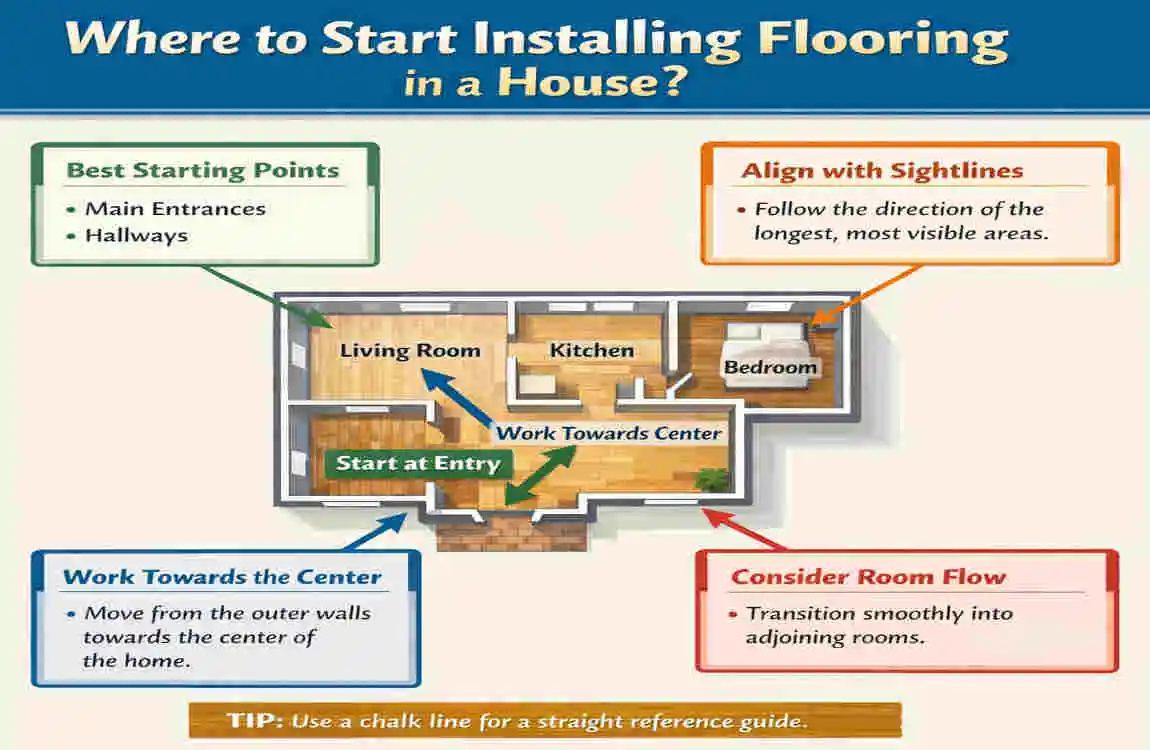
Now we arrive at the million-dollar question: where to start flooring in a house? While every home is different, there are golden rules that professionals use to ensure a flawless finish.

Start from the Main Entry Point

For many homes, the best place to start is the longest, straightest wall nearest the front door. Your entryways set the visual tone for the entire house. When guests walk in, those first few feet of flooring give the all-important first impression. By starting here, you guarantee that the alignment at the front of your house is absolutely perfect, with full, beautiful planks greeting anyone who enters.

Begin with the Largest Room

If your front door opens into a weird, angled foyer, pivot and start in the largest room, which is usually the living room or the main common area. The biggest room is where the eye takes in the most flooring at once. Starting here helps maintain consistency. You establish a strong, straight baseline in your main living area, then build outward from there.

Work Toward Smaller Rooms

Once your main living space or entryway is established, work your way out. The goal is to move from the large spaces into the bedrooms, closets, and bathrooms. This method ensures clean transitions. If a plank ends up needing to be cut at a slightly awkward angle because a wall is not perfectly square, it is much better to hide that strange cut inside a dark closet than right in the middle of your living room.

Direction of Flooring Installation

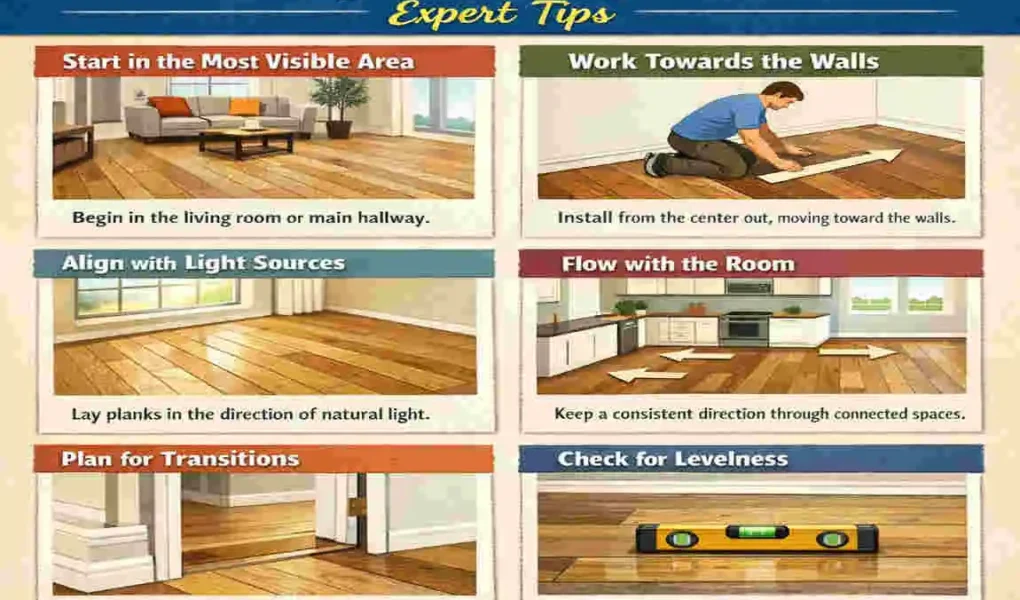
Deciding where to start is closely tied to your flooring direction tips. Should you run planks parallel or perpendicular to the walls? Generally, you want to lay planks parallel to the longest wall in the room or the house. Additionally, try aligning with natural light sources. If planks run the same direction as the sunlight streaming through a large window, the seams become nearly invisible, making the floor look incredibly smooth.

Open Floor plan Strategy

If you have an open floor plan, your strategy changes slightly. Your main goal here is continuous flooring for a seamless look. You want to pick the longest uninterrupted sightline in the house—perhaps from the front door all the way through the kitchen to the back door—and use that as your starting guide. This keeps you from having to use awkward transition strips that break up the beautiful flow of an open space.

Room-by-Room Flooring Installation Order

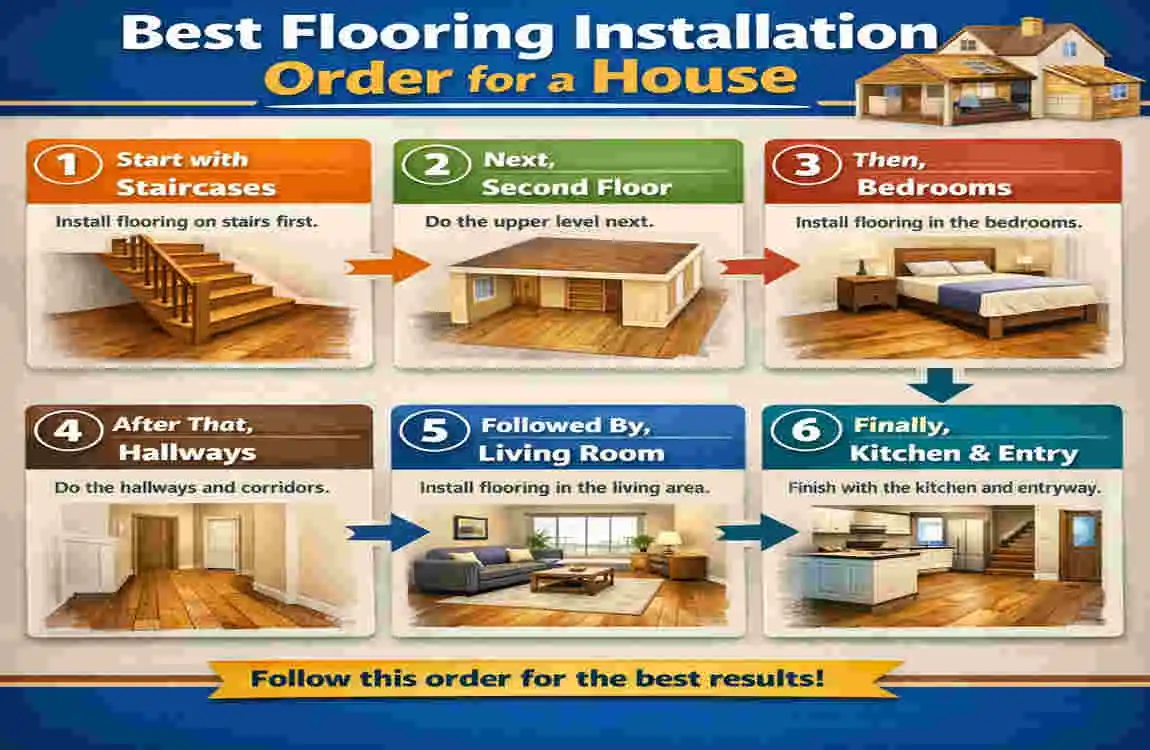
If you are replacing the floors in your entire house, it helps to have a specific room-by-room sequence in mind. Here is a reliable schedule to follow.

Living Room First

As we mentioned, the living room is the home’s central hub. Because this space gets so much visual attention, you want your primary straight lines established here. Laying this room first gives you a massive sense of accomplishment and sets a geometric anchor for the rest of the house.

Hallways and Corridors

Once the living room is done, move into the hallways. Hallways are connecting spaces, and handling them logically is vital. The golden rule is that planks should run the length of the hallway, never across it like a ladder. If you transition from the living room into a hallway, ensuring the boards run straight down the corridor will instantly make the house feel longer and more spacious.

Kitchen and Dining Areas

Next up are the eating and cooking spaces. Kitchens require more thought. You might be using moisture-resistant materials, such as luxury vinyl tile, here. If you are changing flooring types—say, from hardwood in the living room to tile in the kitchen—this is where you will install transition strips. Tackle this area after the main living spaces so you can match up the transition lines perfectly.

Bedrooms

Bedrooms are your privacy areas, and they should be installed later in the process. Because bedrooms have doors that can be closed, you have a bit more freedom here. If you make a tiny measuring mistake, it is easily hidden under a bed or behind a door frame. Work your way into each bedroom, finishing off inside the closets.

Bathrooms and Utility Rooms

Always leave bathrooms, laundry rooms, and utility rooms for last. These spaces almost always require special tile or heavily waterproof flooring. Because these are small, highly segmented spaces with unique plumbing obstacles (such as toilets and floor drains), they are their own separate puzzles. Finish the dry areas of your house first before tackling the wet zones.

Best Direction to Lay Flooring

We touched on this briefly, but let us dive deeper. The direction you lay your planks has a significant psychological effect on how big or small your home feels.

Follow the Longest Wall

The most common rule of thumb is to run your flooring parallel to the longest wall in the room. This trick creates visual length. If you have a rectangular living room, running the planks along the length makes the room feel grand and expansive. Running them the short way can make the room feel choppy and narrow.

Align with Natural Light

Whenever possible, align your flooring so the planks point toward the primary source of natural light. If you have a giant picture window, the planks should run straight toward it. The light will wash over the long edges of the boards, minimizing visible seams and giving the floor a beautifully smooth, unified appearance.

Consistency Across Rooms

If you are carrying the same flooring throughout the house, strive for consistency across rooms. Avoid changing direction unnecessarily. It can feel very jarring to walk from a living room where planks run north-to-south, into a dining room where they suddenly run east-to-west. Keep the flow going unless a physical barrier forces you to change.

Special Cases (Diagonal or Patterned Layouts)

Sometimes, you want to break the rules. Diagonal layouts, herringbone, or chevron patterns are beautiful special cases. When and why do you use them? You use them when you want the floor to be a bold statement piece, or if your home has aggressively angled, non-square walls. A diagonal floor can magically disguise slightly crooked walls!

Tools and Materials Needed for Flooring Installation

You cannot do a professional-level job without the right gear. Before you start ripping up old carpet, make sure you have gathered everything you need. Having your tools staged and ready is a massive stress reliever.

Essential Tools and Materials

To keep this simple, here is a handy table that breaks down exactly what you will need for a standard floating floor installation.

Item Name, Category, Purpose for Installation

A measuring tape is an essential tool for accurately measuring room dimensions and plank cuts.

Spacers: Essential tools for maintaining the crucial expansion gap around the walls.

A miter saw and a jigsaw are essential tools for making straight, detailed cuts around doorways.

Tapping Block & Mallet Essential Tool: To gently lock planks together without damaging the edges.

Underlayment Material provides sound dampening, moisture protection, and softness.

Adhesives or nail material are necessary only if you are gluing or nailing down hardwood.

Transition Strips Material: To cover the gaps between different types of flooring.

Optional Tools for Professionals

If you want to take your project to the next level, consider renting some pro tools. A laser level is amazing for ensuring your starting line is perfectly straight across a massive room. A floor roller is essential when using glue-down vinyl, ensuring the adhesive bonds perfectly to the floor.

Step-by-Step Flooring Installation Process

You have your plan, you have your tools, and you know where you are starting. Now, let us look at how to lay flooring step by step, so you achieve that flawless finish.

Prepare the Subfloor

This is the most important step. Your new floor is only as good as the subfloor underneath it. Start by thoroughly cleaning the area. Sweep and vacuum every bit of dust and debris. Next, focus on leveling. If there are high spots on a concrete floor, grind them down. If there are dips in a wood floor, use a self-leveling compound. Finally, repair any loose, squeaky floorboards.

Acclimate Flooring Materials

Never bring flooring home from the store and install it the same day. Wood and laminate are porous materials. You must let them sit in the room where they will be installed for at least 48 to 72 hours. This prevents expansion issues. If you skip this, the planks might swell and buckle after installation, ruining your entire project.

plan Layout and Dry Fit

Before using any glue or making permanent cuts, do a dry fit. Lay out a few rows of planks without locking them in. This helps you avoid mistakes before installation. You want to make sure your final row at the opposite wall won’t be a tiny, half-inch sliver. If so, you can trim an inch off your starting row to balance the room.

Begin Installation

Head to your chosen starting wall. Place your spacers against the wall to create an expansion gap (usually about a quarter-inch). Lay your first plank. Getting the starting row alignment perfect is non-negotiable. If a fraction of an inch crooks the first row, the final row across the room will be crooked by several inches. Take your time here.

Continue Room by Room

Once the first few rows are locked in straight, the process speeds up. Continue locking the planks together, staggering the seams so they do not line up like a grid. Maintaining spacing and alignment is your main focus as you transition from the living area into the hallways and bedrooms.

Finishing Touches

When the floor is down, the job is not quite done. Remove the spacers from around the edges. It is time to install the baseboards, quarter-round trims, and transitions. These trims cover the expansion gap you left around the edges, locking the entire visual aesthetic together and giving you a magazine-worthy finish.

Common Mistakes to Avoid

Even the most enthusiastic DIYers can stumble. To save you time, money, and headaches, here is a list of the most frequent errors people make during home flooring installations:

  • Starting in the wrong room: As discussed, starting in a small bedroom and working backward into a living space almost always leads to crooked lines in the most visible parts of the house.
  • Ignoring subfloor issues: Laying gorgeous new luxury vinyl over a bumpy, uneven subfloor will result in bouncy planks that eventually snap at the joints.
  • Poor alignment and spacing: Forgetting to use spacers against the walls will cause the floor to buckle up like a tent when the weather changes and the house gets humid.
  • Not acclimating materials: Rushing the process and skipping the 72-hour acclimation period is a guaranteed way to warp your brand-new floors.
  • Mixing flooring directions unnecessarily: Changing the direction of the planks in every single room creates a chaotic, dizzying look instead of a calm, unified flow.

Pro Tips for a Flawless Flooring install

Want to make sure your project looks like you paid a Premium contractor thousands of dollars? Keep these insider tips in your back pocket:

  • Use spacers for expansion gaps: We cannot say it enough. Floors breathe. They need room to grow and shrink. Use proper plastic spacers, not just scraps of wood.
  • Invest in quality underlayment: Do not cheap out on the padding. A great underlayment makes a cheap floor feel expensive to walk on. In contrast, a cheap underlayment makes an expensive floor sound hollow and clicky.
  • Plan transitions carefully: Think about how the new floor will meet the carpet in a bedroom or the tile in the bathroom. Buy your T-moldings and reducer strips early so they match perfectly.
  • Work in natural light for accuracy: Dimly lit rooms hide mistakes. Open the blinds and work during the day so you can easily spot any tiny gaps between planks before moving on to the next row.
  • Double-check measurements: Measure twice, cut once. It is the oldest rule in construction for a reason. Always double-check your math before putting a saw blade through a twenty-dollar plank.

Flooring Installation Cost Considerations

As you plan your layout, you also need to plan your budget. The final price tag goes far beyond just the cost of the planks in the box.

First, consider the cost differences by material. Sheet vinyl is incredibly budget-friendly, while solid oak hardwood is an investment. Luxury vinyl plank usually sits comfortably in the middle, offering great durability for a reasonable price.

Next, weigh the pros and cons of DIY vs. professional installation. Doing it yourself saves you thousands of dollars in labor, but it will cost you several weekends of hard work. If you hire pros, you are paying for speed and guaranteed expertise. Finally, do not forget hidden costs. You need to budget for underlayment, new baseboards, transition strips, floor prep leveling compounds, and tool rentals.

DIY vs Professional Installation

Deciding whether to swing the hammer yourself or hire a crew is a major choice. Both options are perfectly valid depending on your situation.

When to DIY

If you are dealing with small rooms, square walls, and simple materials like click-and-lock laminate or vinyl planks, DIY is an amazing option. Floating floors are specifically designed to be user-friendly. If you have basic power tools, a free weekend, and a bit of patience, you can absolutely achieve a stunning result on your own.

When to Hire Professionals

On the flip side, some jobs demand a pro. If your house has complex layouts, winding stairs, curved walls, or massive subfloor damage, bring in the experts. Furthermore, if you are installing high-end materials such as solid, nail-down hardwood or custom-patterned ceramic tile, the risk of a costly mistake is too high. A professional crew will ensure your heavy investment is installed flawlessly.

Maintenance Tips After Installation

Where to Start Flooring in a House

You just spent days (and plenty of money) installing a gorgeous new floor. Now, you need to protect it so it looks brand new for the next decade.

First, establish cleaning routines by flooring type. Hardwood hates water, so use only a slightly damp mop and specific wood cleaners. Luxury vinyl is waterproof, making it much easier to clean. However, you still want to avoid harsh, abrasive chemicals that can dull the top wear layer.

Preventing scratches and damage is your daily mission. Put high-quality felt pads under the legs of every chair, table, and sofa in your house. If you have dogs, keep their nails trimmed. Finally, for long-term care, place heavy-duty welcome mats at all your entryways to stop dirt and small pebbles from being tracked onto your beautiful new floors.

FAQs

Even after all this information, you might still have a few lingering thoughts. Here are some of the most common questions homeowners ask during a flooring project.

Where should you start laying flooring first? You should generally start on the longest, straightest wall in your main living area or near the front entryway. This establishes a straight baseline that carries throughout the most visible parts of the home.

Should flooring be the same throughout the house? While it is not a strict law, having the same flooring throughout the house—especially in open floor plans—makes the home feel significantly larger, more cohesive, and more modern. You can, however, switch to tile or waterproof options for bathrooms and laundry rooms.

Do you install flooring before cabinets? If you are installing a “floating floor” (like click-lock vinyl or laminate), you must install the cabinets first, and run the flooring up to the edge of the cabinets. You cannot put heavy cabinets on a floating floor, as it will restrict the floor’s ability to expand. If you are gluing or nailing down solid hardwood, you can install the floor first.

Which direction should the flooring run? For the best visual appeal, flooring should run parallel to the longest wall in the room or follow the main sightline from the front door. Aligning the planks with the natural light streaming through your windows is also a fantastic design choice.

Can you install flooring room by room? Yes, you absolutely can! If you are living in the house during the renovation, going room by room is the most practical approach. Just make sure you use transition strips in the doorways if you are breaking up the installation over a long period.

You may also like...

Leave a Reply

Your email address will not be published. Required fields are marked *