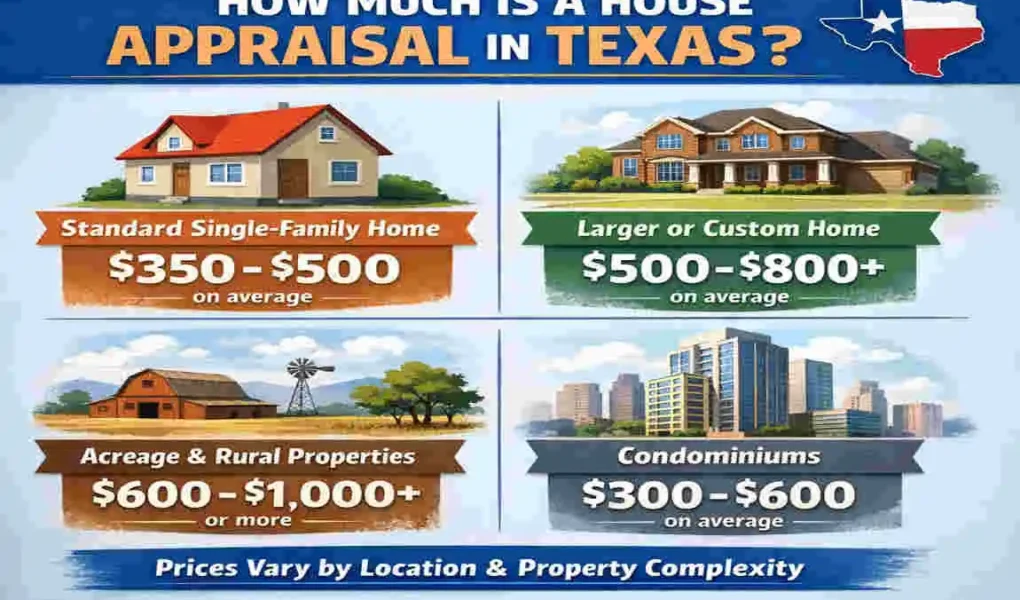
how much is a house appraisal in texas
REAL ESTATE

How to Determine House Appraisal Costs in Texas

If you are buying a home in Dallas, Austin, Houston, or a smaller Texas town, one question can show up right in the middle of closing stress: how much is a house appraisal in texas?

It is a fair question because the appraisal is one of those costs many buyers hear about early but do not fully understand until the bill arrives. And when you are already dealing with down payments, inspections, loan fees, and moving costs, even one more expense can feel like a lot.

A home appraisal is simply a professional opinion of a property’s value. In Texas, lenders usually require it before approving a mortgage to confirm that the home is worth what the buyer is paying. In other words, the appraisal protects the lender, but it also protects you. If the home is overpriced, the appraisal can help you avoid overpaying.

Property type / situation Typical price range in Texas
Standard single‑family home $350 – $650
Condo or townhome $400 – $700
Multi‑unit property (2–4 units) $600 – $1,200+
FHA or VA loan appraisal $400 – $900 (often higher than conventional)
Rural or acreage property $700 – $1,200+
Rush or expedited appraisal +$100 – $250 on top of base fee

What Is a Home Appraisal?

how much is a house appraisal in texas

A home appraisal is a written estimate of a property’s market value. It is usually completed by a licensed or certified appraiser who looks at the home, studies the local market, and compares the property to similar homes that recently sold nearby.

That sounds simple, but there is more to it than just driving by the house and guessing a price. A proper appraisal usually includes a physical inspection, a review of the home’s size and condition, and an analysis of comparable sales, also called comps. The appraiser then prepares a formal report containing the findings for the lender to review.

The basic purpose of the appraisal

The main goal is to answer one question: What is this home really worth today?

That matters because a lender does not want to loan more money than a house is worth. If a buyer agrees to pay $400,000 for a home but the appraisal shows it’s only worth $375,000, the lender may reduce the loan amount or require a larger down payment. That is why this report can shape the entire deal.

For buyers, the appraisal adds a layer of protection. For lenders, it helps reduce risk. For sellers, it can confirm that the asking price makes sense in the current market.

What appraisers look at in Texas

In Texas, appraisers usually focus on the same core details they would in any other state:

  • Total square footage
  • Number of bedrooms and bathrooms
  • General condition of the home
  • Age of major systems like HVAC, roof, and plumbing
  • Upgrades and renovations
  • Lot size and location
  • Recent sales of similar homes nearby

The appraiser may also note special features such as pools, garages, guest houses, acreage, or energy-efficient upgrades. These can raise or lower the final value depending on how common they are in the neighborhood.

Why Texas appraisals matter so much

Texas has a wide range of housing markets. A home in central Austin may behave very differently from a similar-sized property in a rural county. That variation makes the appraisal especially important.

Texas mortgages often depend on it, and some loan programs, such as FHA and VA loans, can require extra attention during the process. The appraisal is not just a formality. It is one of the steps that can decide whether the transaction moves forward smoothly or gets delayed.

Average House Appraisal Costs in Texas

If you are asking how much is a house appraisal in texas, the most useful place to start is with the average range.

For a standard single-family home, Texas home appraisal fees often range from $300 to $600, with many buyers paying between $450 and $650, depending on the market and property size. More complex properties can cost much more.

Typical cost by property type

Below is a simple breakdown of common appraisal costs in Texas.

Property TypeTypical Texas Cost RangeNotes

Single-Family Home $300–$600 Standard homes are usually the least expensive to appraise

Condo / Townhome $400–$700 More complex if there are fewer comparable sales

Multi-Unit Property (2–4 units) $700–$1,200 Income analysis makes these more involved

Rural Home or Acreage Property $700–$1,200+ Distance and limited comps can raise the price

FHA or VA Loan Appraisal $500–$900 May include extra checks and requirements

Rush Appraisal Fee +$100–$250 Added when the turnaround time is very short

This table gives you a realistic starting point, but remember that house appraisal price by city and property type can move those numbers up or down.

Why single-family homes usually cost less

A standard single-family home is usually the easiest type of property to evaluate. The appraiser can compare it to similar homes in the same area, and the report is often straightforward.

If the property is larger, older, unusual, or in a neighborhood with fewer comparable sales, the process becomes more time-consuming. More time usually means a higher fee.

How Texas compares to the national picture

Texas appraisal fees are generally competitive, but they are not always the cheapest in the country. In large, fast-moving markets, prices can rise because appraisers are busier and local demand is stronger.

In 2026, many buyers are seeing modest increases in appraisal fees due to inflation, labour costs, and ongoing housing demand. A small increase of 5% to 10% is not unusual when comparing today’s fee structure to older averages.

That means if a home appraisal used to cost about $450, it may now be closer to $475 or $500 in some areas. The exact number depends on your local market, your loan type, and the appraiser’s workload.

What drives the average up or down

The average is useful, but it does not tell the whole story. Two homes in the same city can still get very different quotes if one is a simple suburban house and the other is a large custom property on acreage.

That is why it helps to think of the appraisal as a service shaped by complexity. The more work the appraiser must do, the more the fee tends to rise.

Factors Affecting Appraisal Costs

how much is a house appraisal in texas

If you want to understand how much a house appraisal costs in Texas, you also need to understand what factors affect the price. Appraisal fees are not random. They usually reflect time, travel, property complexity, and market demand.

Location matters a lot

The biggest cost driver is often location. A house in a dense metro area usually costs less to appraise than a home far outside the city because the appraiser can get there faster and find more comparable sales nearby.

In places like Houston, Dallas, or Austin, appraisers may have plenty of data to work with. That helps keep the process efficient. In rural areas, they may need to travel farther and search harder for comps, which raises the fee.

This is one reason appraisal costs by city can look so different across Texas.

Size and features of the home

Bigger homes usually cost more to appraise. That is because the appraiser has more square footage to review, more details to measure, and more features to compare.

A home with a pool, detached garage, workshop, guest house, barn, or extra acreage can also cost more. These features do not automatically make the appraisal expensive, but they do add complexity.

If the home has unusual design choices, custom construction, or recent additions, the appraiser may need to spend more time sorting out its value. That can push the fee higher by $50 to $200 or more, depending on the property.

Type of appraisal

Not all appraisals are the same.

A standard purchase appraisal is common for a mortgage approval. A refinance appraisal is similar, although some refinance loans may use alternate valuation methods depending on the lender and the situation.

Some properties may qualify for desktop or exterior-only appraisals, which can cost less because the appraiser does less in-person work. These are not available for every loan, but when they are, the fee may be $200 to $400 lower than a full appraisal.

Market demand in your area

When the market is busy, appraisers may charge more because their calendars are full. This can happen in high-demand cities, fast-growing suburbs, or neighbourhoods with a lot of new construction.

Austin is a good example of a market where appraisal prices can feel a little higher. The housing market is active, properties can be unique, and appraisers may need to spend extra time finding the right comps.

The same thing can happen in competitive parts of Dallas or Houston. If appraisers are stretched thin, you may see higher fees or longer wait times.

Appraiser experience and certification

More experienced appraisers often charge more than trainees or newer professionals. That is not always a bad thing. A seasoned appraiser may be worth the higher fee if your property is more complex.

In Texas, appraisers are regulated through state licensing rules, and lenders usually want someone qualified to handle the property type. A more advanced certification can increase the cost, especially for larger homes, investment properties, or rural acreage.

How to keep appraisal costs under control

You cannot control every fee component, but you can take a few smart steps to avoid unnecessary charges.

Here are five simple ways to keep the cost down:

  1. Choose a local appraiser whenever the lender allows it, especially for rural or hard-to-reach homes.
  2. Be ready with your home details so the appraiser does not need extra follow-up.
  3. Schedule early to avoid rush fees.
  4. Keep the property easy to inspect by unlocking doors, gates, and outbuildings in advance.
  5. Know your home’s recent improvements so the appraiser has accurate information.

These steps will not change the market, but they can make the process smoother and more efficient.

City-by-City Appraisal Fees in Texas

One of the best ways to understand how much a house appraisal costs in Texas is to compare major cities and regions.

House appraisal prices vary by city across the state. Local property values, traffic, appraiser demand, and the number of comparable homes all play a role.

Average appraisal costs by city

Texas CityAverage Cost RangeKey Influences

Houston $425–$650 High demand, varied neighborhoods, flood considerations

Dallas $400–$600 Urban density, larger homes, active market

Austin $450–$700 Strong demand, unique properties, fast-changing values

San Antonio $350–$550 More stable pricing in many neighborhoods

Rural West Texas Areas $500–$900+ Distance, travel time, limited comps

Why Houston and Dallas often fall in the middle range

Houston and Dallas are both large metro areas with plenty of homes to compare, which makes the appraisal process easier. At the same time, these markets can be busy, and some neighbourhoods include larger or older homes, or homes in special-risk areas.

In Houston, flood zones and local property differences can make an appraisal more detailed. In Dallas, fast-moving neighborhoods and larger suburban homes can also shape the fee.

Why Austin is often on the higher side

Austin is one of the strongest examples of a city where the appraisal can cost more. The market has seen major growth, and many homes have unique designs or rapid price changes. That means the appraiser may have to work harder to find the right comps and support the final value.

If you are buying in Austin, it is smart to budget near the upper end of the Texas home appraisal cost range.

Why San Antonio may be more affordable

San Antonio often lands in a more moderate price range. Many homes are easier to compare, and the market can be more predictable than some of the hottest Texas cities.

That does not mean every appraisal will be cheap. A larger or more unusual home can still cost more. But for a standard home, San Antonio is often one of the better-value cities for appraisal fees Texas buyers pay.

Why rural areas cost more

Rural homes, especially in West Texas or on larger acreage, are usually the most expensive to appraise. That is because the appraiser may need to travel a long distance, and there may be fewer homes nearby that match the property.

When comps are hard to find, the appraiser has to spend more time on research and analysis. That extra work usually shows up in the fee.

Who Pays for the Appraisal, and When?

how much is a house appraisal in texas

A common question after how much is a house appraisal in texas is who actually pays the bill.

In most mortgage transactions, the buyer pays for the appraisal upfront. The lender orders it, but the cost is usually included in the buyer’s closing costs.

Buyer, seller, or lender?

Most of the time, the buyer pays. That said, there are situations where the seller may agree to cover part of the cost as a concession, or the lender may offer a promotion that offsets some fees.

Still, it is safest to assume you will pay the appraisal fee yourself unless your contract says otherwise.

When the appraisal is paid

The appraisal is usually ordered after the purchase contract is signed. The lender needs the report before final loan approval, so timing matters.

Once ordered, the appraisal typically takes 3 to 7 days, though busy markets or complex properties may take longer. Rush fees may shorten that timeline if you need the report very quickly.

Refinance and other situations

For a refinance, the borrower usually pays the appraisal fee directly. If the appraisal is needed for a divorce, estate settlement, tax issue, or legal matter, the party requesting the report usually pays for it.

So no matter the reason, the rule is simple: the person who benefits from the appraisal or needs it for the transaction generally pays for it.

How to Prepare for a Texas Appraisal

You cannot control the market, but you can help the appraiser do a better job. Good preparation can keep the process efficient and reduce the chance of delays.

A simple prep checklist

Here is an easy list to follow before the appointment:

  1. Clean the home so it looks well cared for.
  2. Complete minor repairs, such as broken lights, loose handles, or minor leaks.
  3. Make major areas easy to access, including the attic, garage, and backyard.
  4. Gather a list of upgrades, such as a new roof, a remodelled kitchen, or an HVAC replacement.
  5. Share recent comparable sales if you know of any nearby homes that sold recently.

Why presentation matters

An appraiser is trained to look past décor, but condition still matters. A tidy, maintained home sends a better signal than one that looks neglected. Even small details can shape perception.

If your home has meaningful improvements, do not assume the appraiser will know about them. Tell them. A finished bathroom, energy-efficient windows, or a new roof may add value if the work is permitted and documented.

Avoid these common mistakes

A few missteps can slow things down or affect the outcome:

  • Leaving clutter in key rooms
  • Blocking access to storage spaces, the attic, or mechanical systems
  • Forgetting to share receipts for major work
  • Failing to mention unpermitted additions
  • Assuming cosmetic upgrades always increase value

Texas buyers and sellers should be especially careful with additions or remodels that were not properly permitted. If a room was added without approval, the appraiser may not count it fully in the final value.

Appraisal Outcomes and Next Steps

Once the appraisal is complete, you will usually end up in one of three situations: the value is lower than expected, it matches the contract price, or it comes in higher.

If the appraisal is low

A low appraisal is the outcome most people worry about. If the home appraises for less than the purchase price, the lender may only finance part of the deal based on the lower value.

That does not always mean the sale is dead. You may still be able to:

  • Renegotiate the price
  • Increase your down payment
  • Ask the seller for concessions
  • Challenge the appraisal if there is an obvious error

If you believe the report missed recent comps or misread a key detail, you may have a path to appeal. The Texas appraisal system gives consumers a way to question the report when needed.

If the appraisal is high

A high appraisal is the good-news version. If the home appraises above the purchase price, you may gain some extra equity right away.

That can help your loan terms and may strengthen your position if you plan to refinance later. For buyers, it is a nice cushion. For sellers, it confirms the market supported the asking price.

If the appraisal is right on target

This is the most common outcome. The home is worth about what you agreed to pay, and the deal moves forward with fewer problems.

That is why appraisals are often seen as a quiet but important checkpoint in the transaction. They do not always grab attention, but they can make or break the last steps of closing.

Tips to Save Money on Texas Home Appraisal Fees

If you are trying to stay within budget, the good news is that you do have some control over the final bill.

Smart ways to reduce your cost

  • Ask your lender about the type of appraisal needed. Some loan programs allow simpler valuation methods.
  • Avoid rush service unless necessary. Faster turnarounds often come with extra charges.
  • Choose a local appraiser when possible. Travel time can raise the price.
  • Prepare the home properly. A smooth inspection reduces follow-up work.
  • Keep your paperwork organized. Clear records can save time and confusion.

What not to do

Do not try to pressure the appraiser or argue value before the inspection is finished. That usually does not help.

A better approach is to provide clean, factual information. Let the data speak for itself. That is the best way to support an accurate value and maintain a professional process.

Why Texas Appraisal Costs May Keep Rising in 2026

The question of how much a house appraisal costs in Texas is also tied to the broader economy. In 2026, costs may still rise slightly as inflation, labour shortages, and strong housing demand continue to affect professional services.

Why costs may edge upward

Appraisers are independent professionals, and like everyone else, they face higher business costs. Fuel, insurance, software, licensing, and continuing education all add up.

At the same time, Texas housing markets are still active in many regions. When demand is high, appraisers can take on fewer jobs at once, which can push prices upward.

What that means for buyers

For most buyers, the change is not dramatic, but it is worth planning for. A $30 or $50 increase may not seem huge on its own, yet it can matter when you are stacking many closing costs together.

That is why your full budget should include the appraisal, inspection, lender charges, title fees, and moving costs. A smart budget always leaves room for small price shifts.

Frequently Asked Questions

How much is a house appraisal in Texas for a $400k home?

For a $400,000 home, the appraisal usually falls between $450 and $650. However, the final price can be higher or lower depending on the city, home size, and property complexity.

Can I shop around for appraisal fees?

Sometimes. In many mortgage deals, the lender selects the appraiser, so you may not choose the provider directly. But you can still compare lender fee estimates and ask whether a different appraisal type is available.

Is the appraisal fee refundable?

Usually, no. If the appraisal has already been completed, the fee is typically non-refundable even if the loan does not go through. Some lenders may refund related fees in special cases, but you should not count on it.

Do cash buyers need appraisals?

Cash buyers do not always need one for financing reasons, but many still order an appraisal to avoid overpaying. It is a smart move when you want confidence in the purchase price.

What if my home has land or acreage?

Acreage can increase the cost because it adds complexity. The appraiser may need to analyze land value, access, and comparable sales from a wider area. Rural acreage properties often sit at the higher end of the price range.

You may also like...

Leave a Reply

Your email address will not be published. Required fields are marked *