It is the middle of July. The sun is blazing, the humidity is off the charts, and you are sitting on your living room couch trying to enjoy a cold drink. Suddenly, you realize the gentle hum of your air conditioner has stopped. Instead, it is blowing lukewarm, muggy air. You check the thermostat, and the temperature is climbing. Panic sets in.
You are not alone in this search. In 2026, navigating the world of HVAC refrigerants (commonly referred to by the brand name “Freon”) has become a bit more complex than it used to be. With changing environmental regulations, rising costs, and strict safety protocols, buying refrigerant isn’t as simple as picking up a gallon of milk.
But don’t worry—I’m here to help you navigate this maze. Whether you are a handy DIY enthusiast looking to save a few hundred dollars or a homeowner trying to understand why your repair quote is so high, this guide covers everything you need to know. We will explore what Freon actually is, the legal hurdles of buying it in 2026, the best physical and online stores to find it, and—most importantly—how to handle it without voiding your warranty or hurting yourself.
What Is Freon and Why Do Home AC Units Need It?
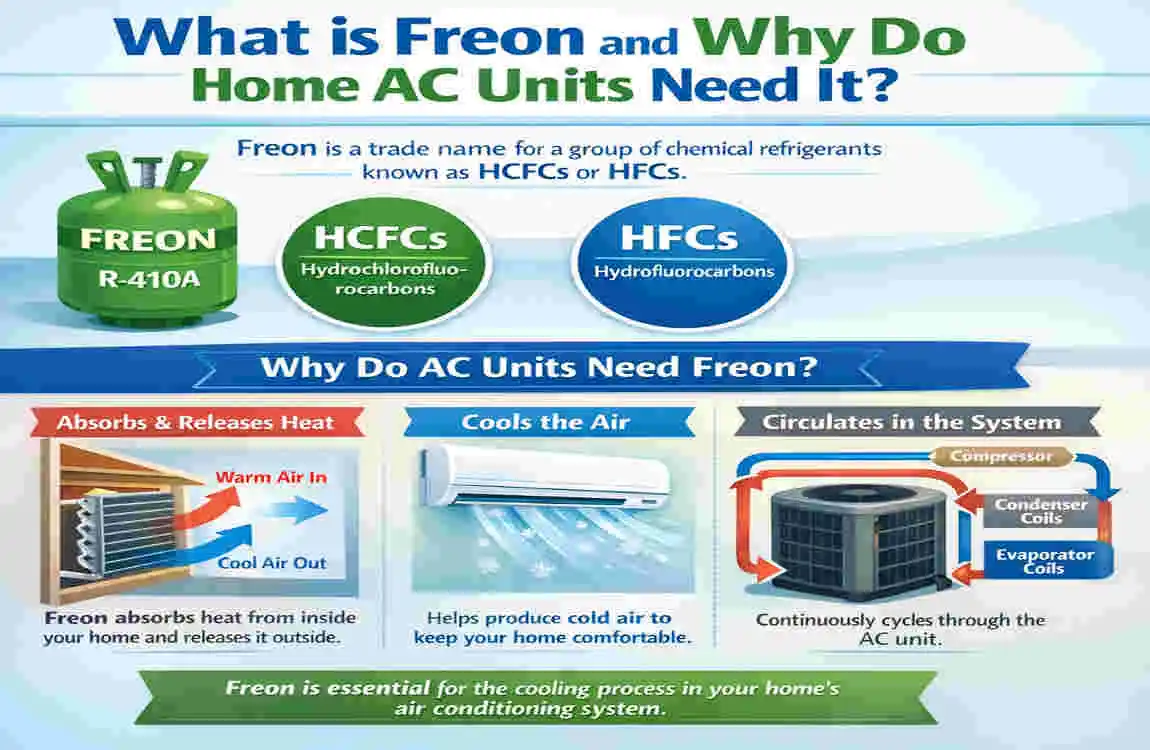
Before we talk about where to swipe your credit card, we need to clarify exactly what you are buying. “Freon” is actually a brand name (originally owned by DuPont/Chemours) that became the generic term for refrigerants, much like we call facial tissues “Kleenex.”
In the world of home air conditioning, refrigerant is the lifeblood of the system. It isn’t fuel; your AC doesn’t “burn” it like a car burns gas. Instead, it’s a chemical compound that circulates in a closed loop, shifting between liquid and gas states to absorb heat from inside your home and release it outside.
The Main Players: Types of Refrigerant
In 2026, you will likely encounter three main types of refrigerant, and knowing which one your system uses is non-negotiable.
- R-22 (The Old Guard): If your AC unit was built before 2010, it might use R-22. This is an HCFC (hydrochlorofluorocarbon) that was notorious for damaging the ozone layer. It has been completely phased out of production and importation. If you need R-22 today, you are buying “reclaimed” or recycled gas, and it is incredibly expensive.
- R-410A (The Standard): This is likely what is in your system if it was installed between 2010 and 2024. It is an HFC (hydrofluorocarbon) known as Puron. While better for the ozone, it is a greenhouse gas, and as of 2026, regulations are tightening on this, too, driving prices up.
- R-32 and R-454B (The New Wave): If you bought a brand-new AC in late 2025 or 2026, it likely uses these newer, more eco-friendly refrigerants (often labeled A2L). They are mildly flammable but highly efficient.
Why Does Your AC Need It?
Think of the refrigerant as a sponge. When it travels through your indoor coil (evaporator), it “soaks up” the heat from your indoor air. It then travels to the outdoor unit (condenser), where the compressor squeezes the “sponge,” forcing the heat out into the yard.
Symptoms of Low Freon: How do you know you need to buy this stuff in the first place?
- Warm Air: The vents are blowing, but the air isn’t cold.
- Ice on Coils: Paradoxically, low refrigerant causes the indoor coil to get too cold, freezing the moisture in the air until the unit turns into a block of ice.
- Hissing Noises: A bubbling or hissing sound near the refrigerant lines usually indicates a leak.
- Sky-High Electric Bills: Your unit is running 24/7, trying to cool the house but failing to do so.
Important Note: An AC system is a sealed loop. If you are low on Freon, you leak. Simply “topping it off” without fixing the leak is like putting air in a punctured tire—it will just go flat again.
Is It Legal to buy Freon for a home air conditioner in 2026?
This is the most critical section of this guide. Before you drive to the store, you need to understand the law. In the United States, the Environmental Protection Agency (EPA) strictly regulates the sale and handling of refrigerants under Section 608 of the Clean Air Act.
The Certification Requirement
In 2026, you cannot legally walk into a store and buy a large cylinder of regulated refrigerant (like R-410A or R-22) without an EPA certification. The government divides these certifications into types:
- Type I: For small appliances (like refrigerators).
- Type II: For high-pressure appliances (this covers most residential central AC units).
- Type III: For low-pressure appliances (industrial chillers).
- Universal: Covers all of the above.
If you try to buy a standard 25lb jug of R-410A online or in-store, the seller is legally required to verify your certification.
The “Small Can” Exception
There is a gray area that many DIYers utilize. In some states, small cans (usually under 2 lbs) of certain refrigerants designed for DIY use might be available without a certification. However, this is far more common for automotive AC (R-134a) than home AC. However, as of 2026, regulations have tightened even on these small HFC containers to prevent greenhouse gas emissions.
State-Specific Rules
Where you live matters.
- California: California has stricter environmental laws than the federal standard. The sale of high-GWP (Global Warming Potential) refrigerants is heavily restricted here.
- Rest of USA: Generally follows EPA guidelines, but local distributors may have their own “wholesale only” policies to protect trade professionals.
Can You Get Certified?
Yes! The good news is that the EPA 608 Type I or Type II certification isn’t just for career HVAC techs. You can take an open-book test online for a fee. If you are serious about maintaining your own system, getting certified is the legal and responsible route.
Certification Cost Table (2026 Estimates)
Certification TypeDifficultyCostAllowable Purchase
EPA 608 Type I Low (Open Book) $25 – $50 Small appliances, limited refrigerants
EPA 608 Type II Medium (Proctored) $100 – $150 Residential Central AC Refrigerants
Universal High $150 – $200 All regulated refrigerants
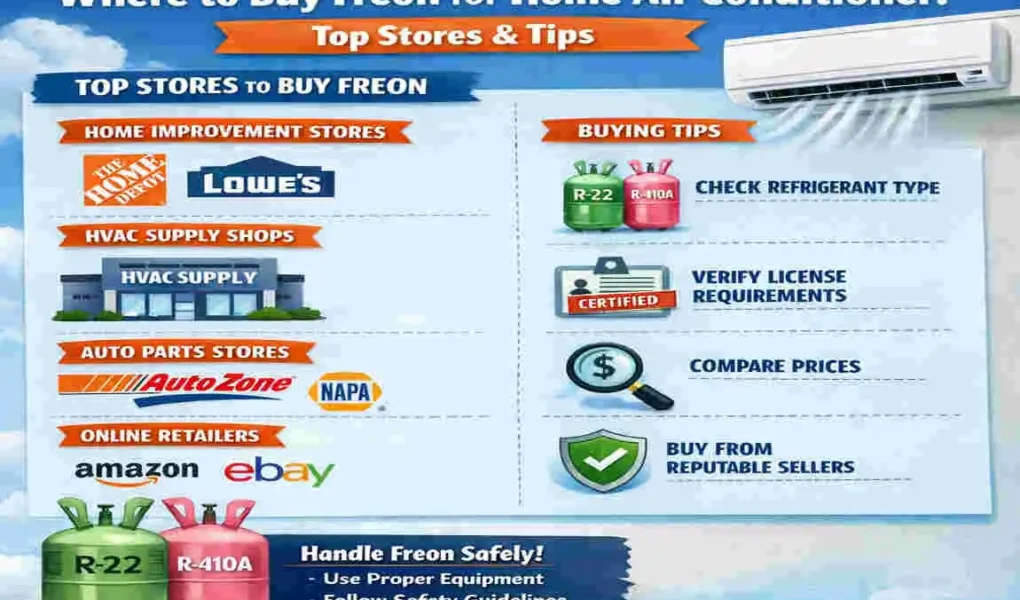
Top Physical Stores: Where to Buy Freon for a Home Air Conditioner Near You
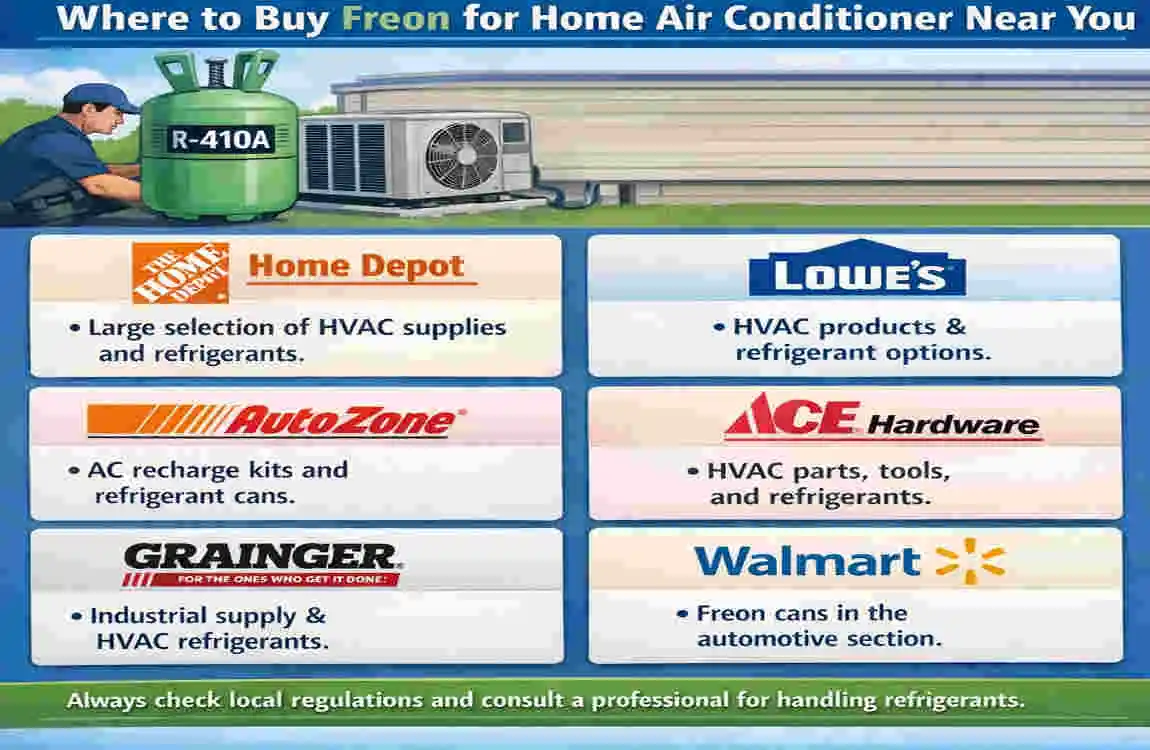
If you have your certification card in hand (or are looking for small recharge kits where legal), here are the best brick-and-mortar locations to check.
Home Depot or Lowe’s
These big-box retailers are often the first stop for homeowners.
- What they sell: You typically won’t find 25lb cylinders of R-410A sitting on the shelf next to the hammers. However, they often stock AC recharge kits (mostly for window units) and sometimes carry small cans of refrigerant in their “Pro” section.
- Pros: Convenient locations, open late/weekends, easy return policies.
- Cons: Very limited stock for central AC units. You usually need to go to the “Pro Desk” and show certification to order the real stuff.
- Price: $$ (Moderate markup).
HVAC Supply Houses (Ferguson, Johnstone Supply, Carrier Enterprise)
This is where the professionals shop.
- What they sell: Everything. R-410A, R-22 (if available), R-454B, plus all the tools you need.
- The Catch: Most of these stores are “Wholesale Only.” They often will not sell to you unless you have a business license or a contractor account. However, some locally-owned supply houses are more lenient if you walk in with an EPA card and cash.
- Pros: Professional-grade products, expert advice from counter staff.
- Cons: Intimidating for DIYers, strict account requirements.
- Price: $$$ (Standard wholesale pricing).
Ace Hardware / Local Hardware Stores
Don’t overlook the smaller guys.
- What they sell: In rural areas, especially, Ace Hardware or True Value stores often stock items that big-box stores don’t. You might find “Stop Leak” kits or small refrigerant cans.
- Pros: Helpful staff, easier to navigate than a warehouse.
- Cons: Selection is hit-or-miss.
- Price: $$$ (Convenience pricing).
Auto Parts Stores (AutoZone, O’Reilly, Advance Auto)
- Important Distinction: These stores sell R-134a and R-1234yf by the pallet load.
- Can you use it? NO. Do not put auto refrigerant in your home’s central AC. It will destroy the compressor.
- Exception: Some very old window units might use R-134a, but verify the label first. Generally, avoid auto stores for home AC needs.
Specialized Refrigerant Distributors (Refrigerants Inc.)
There are chains specifically dedicated to selling gas.
- What they sell: Bulk refrigerant.
- Pros: They always have stock.
- Cons: Strictly B2B (Business to Business).
Best Online Stores: Convenient Places to Buy Freon for AC Units
In 2026, buying online is often the easiest route for a prepared homeowner. Online retailers generally have better stock and clearer pricing, provided you can upload your certification.
HVACDirect.com or SupplyHouse.com
These are the giants of online HVAC retail.
- Why choose them: They are legitimate, reliable businesses. They adhere to federal laws, meaning they will ask for your EPA number before shipping, but the process is smooth.
- Selection: They carry all cylinder sizes (5lb, 10lb, 25lb).
- Shipping: Usually free ground shipping on orders over a certain amount (e.g., $99).
Amazon
Yes, the “Everything Store” sells Freon.
- The Experience: You will find listings for R-410A and alternatives.
- Warning: Listings often disappear quickly if Amazon bots flag them. You are buying from third-party sellers so that quality can vary.
- Certification: Amazon has integrated systems that require you to upload your license to complete checkout for regulated items.
- Price: Competitive, but watch for shipping costs on heavy items.
eBay
eBay is a treasure trove for hard-to-find items, especially R-22.
- R-22 Availability: If you have an old system, eBay is one of the few places to find “New Old Stock” or reclaimed R-22.
- Risk: Buyer beware. Ensure the seller has a 99% positive rating. You don’t want a cylinder filled with a mixture of propane and air.
- Price: Can be expensive due to bidding wars.
Refrigerant Depot / FrostyFreeze
These are smaller, niche websites dedicated solely to refrigerants.
- Pros: They know their stuff. They often sell “drop-in” replacements (alternatives) that are legal to buy for DIY use in some jurisdictions.
- Cons: Shipping times can be slower than Amazon.
Safety Note on Shipping: Refrigerant is classified as a Hazardous Material (Hazmat). It cannot be shipped via air (no overnight shipping). It must go via Ground transport, so plan for a 3-7 day delivery window.
Price Guide: How Much Does Freon Cost for Home AC in 2026?
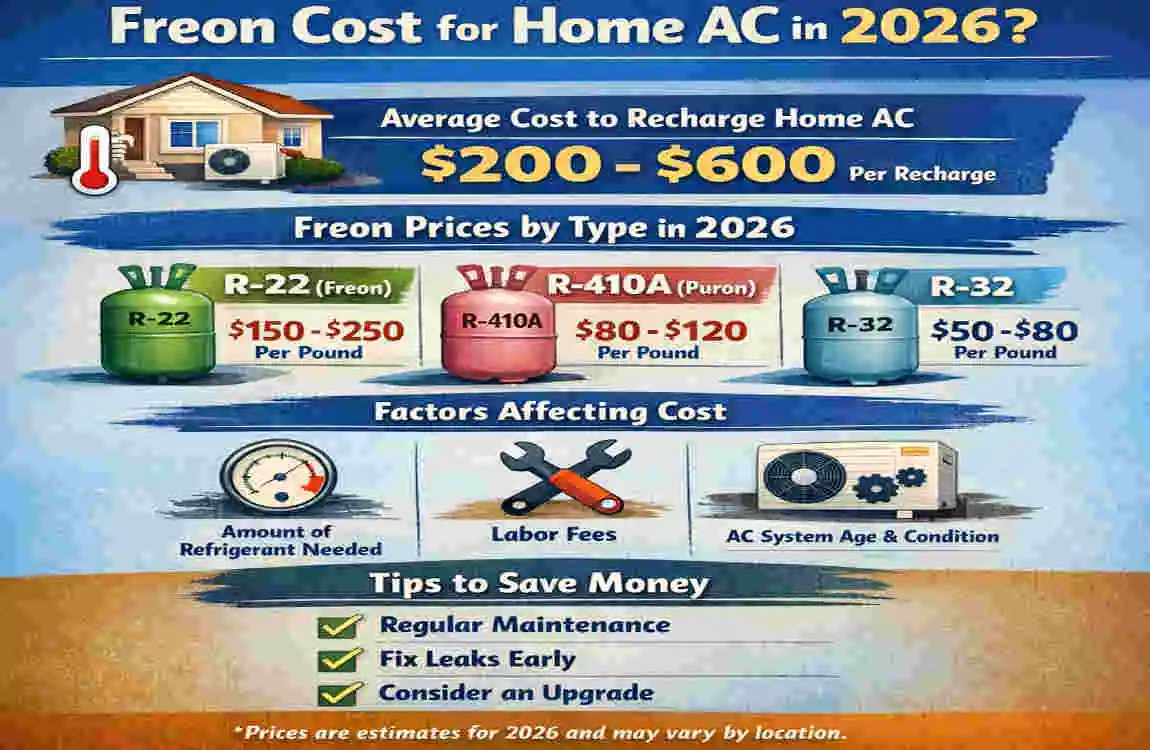
Let’s talk money. Inflation and environmental regulations have driven prices up significantly over the last five years. The cost depends entirely on what you need and how much you need.
Factors Influencing Price
- Phase-Out Status: R-22 is like liquid gold because it is no longer made. R-410A is becoming more expensive as production limits kick in.
- Container Size: Buying a 25lb jug is cheaper per pound than buying a 2lb can.
- Seasonality: Prices spike in June/July and drop in December.
2026 Price Estimates
Here is what you can expect to pay for the refrigerant itself (excluding tools):
Refrigerant Type, Typical Container Size, Price Per Pound (Approx), Total Container Cost
R-410A (Pink) 25 lb Cylinder $40 – $60 $1,000 – $1,500
R-410A (Pink) 5 lb Mini-Jug $70 – $90 $350 – $450
R-22 (Green) 30 lb Cylinder $150 – $200+ $4,500 – $6,000
R-22 (Green) 5 lb Mini-Jug $180 – $220 $900 – $1,100
R-454B (Red top) 25 lb Cylinder $50 – $70 $1,250 – $1,750
Drop-in Alternatives 10-25 lb $30 – $50 $300 – $800
The Professional Markup: If you hire a technician, they aren’t just charging you for the gas. They charge for the truck roll, insurance, expertise, and tools. A professional recharge typically costs between $250 and $600 for the first few pounds and $100+ per pound thereafter. While DIY is cheaper, the risk of error is yours to bear.
Step-by-Step Tips: How to Safely Buy and Recharge Freon in Your Home AC
If you have decided to go the DIY route, have your certification and bought the jug—what now? Here is a high-level overview of the process to ensure safety.
Required Tools:
- Manifold Gauge Set (R-410A compatible)
- Refrigerant Scale (Crucial!)
- Thermometer
- Safety Glasses and Gloves (Refrigerant causes instant frostbite)
Verify the Leak
Before adding anything, ensure your coils are clean, and your air filter is new. Dirty filters mimic the symptoms of low Freon. If you are sure it is low, locate the leak. Look for oil stains on the copper lines.
Identify the Refrigerant
Go outside to your condenser unit. Look at the rating plate sticker. It will say clearly “Factory Charge: X lbs X oz” and “Type: R-410A” (or R-22). Never mix refrigerant types.
Hook Up the Gauges
With the system off, connect your blue hose to the low-pressure service port (the larger insulated pipe) and the red hose to the high-pressure port (the smaller pipe). Note: Some residential systems only need charging via the low side.
Purge the Hoses
When you connect the yellow hose to your new Freon tank, loosen the connection at the manifold briefly to let a little gas escape. This pushes the regular air out of the hose so you don’t push air into your AC system.
Weigh It In
This is the pro tip. Do not just guess by looking at the dials. Place your Freon tank on a digital scale. Zero it out. Turn the AC on. Slowly open the blue valve on your manifold to let refrigerant flow into the system. Watch the scale. If you know you are 2 lbs low, stop exactly when the scale reads -2.0 lbs.
Monitor Pressures
For R-410A on a standard 75°F day, you generally want to see a low-side pressure (suction) of 110-130 PSI, but this varies significantly with humidity and indoor load.
Warning: If you hear the compressor making a loud banging noise, stop immediately. You are “slugging” the compressor with liquid.
Common Mistakes to Avoid When Buying Freon for a Home Air Conditioner
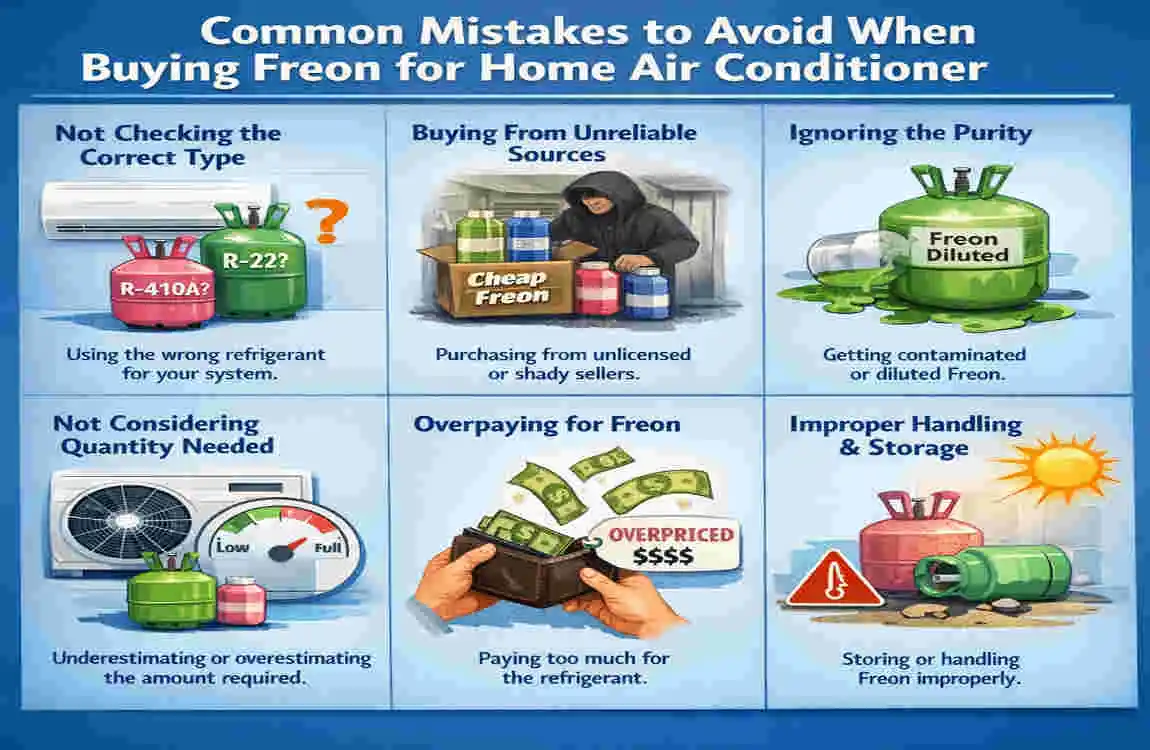
I have seen many homeowners try to save money and end up costing themselves thousands. Avoid these pitfalls:
Buying the Wrong Gas
I cannot stress this enough. If you put R-410A into an old R-22 system, the oil in the compressor will react with the refrigerant, turn into a sludge, and kill your unit within hours. Always double-check the label.
Overcharging the System
“More is better,” right? Wrong. An AC unit needs a precise amount of refrigerant. If you overcharge it, the pressure gets too high, and the compressor will burn out or the internal valves will break. It is better to be slightly undercharged than overcharged.
Ignoring the Certification
Buying black-market refrigerant or trying to bypass EPA rules can result in fines up to $44,539 per day per violation. It is rare for a homeowner to get raided, but sellers are watched closely.
Venting to Atmosphere
It is illegal just to cut the line and let the old Freon spray out into the air. If you need to empty the system, you must use a recovery machine to suck it into a recovery tank.
Buying “Refrigerant with Stop Leak.”
Many DIY cans come with “Stop Leak” additives. HVAC pros hate this. The sealant can gum up your expansion valve or capillary tubes, permanently ruining the system. Buy pure refrigerant.
Alternatives to Freon: Eco-Friendly Options for Your AC
If you have an old R-22 system and the recharge costs $800+, stop. Do not buy the Freon. Consider these alternatives:
Drop-In Replacements
There are refrigerants designed to mimic R-22, such as MO99 (R-438A), NU-22B, or RS-44B.
- Pros: Much cheaper than R-22.
- Cons: You slightly lose cooling capacity (about 5-10%). You still need a certification to buy them.
System Upgrade (Heat Pumps)
In 2026, tax incentives for high-efficiency Heat Pumps are massive. Instead of spending $1,000 on Freon for a dying unit, put that money toward a down payment on a new R-454B or R-32 system. You will save on monthly electric bills, and you won’t have to worry about leaks for years.
FAQs: Where to Buy Freon for a Home Air Conditioner
Q: Can I buy Freon at Walmart? A: Generally, no. Walmart typically sells R-134a for cars. They do not stock 25-lb R-410A cylinders for home use.
Q: Is R-410A being phased out in 2026? A: Yes. While it is not “banned” for use in existing systems, the manufacturing of new equipment using R-410A was restricted starting in 2025. This production cutback means R-410A prices are rising.
Q: How much Freon does a 3-ton AC unit hold? A: A general rule of thumb is 2 to 4 pounds of refrigerant per ton of cooling. So, a 3-ton unit holds roughly 6 to 12 pounds total. If it is empty, it will be expensive to fill.
Q: What is the best Freon specifically for older homes? A: If the unit is 15+ years old, it’s likely R-22. The best “Freon” is actual R-22, but the most economical choice is a drop-in replacement like MO99.