It is the middle of July. The sun is blazing, the humidity is so thick you could cut it with a knife, and your thermostat is creeping up despite your air conditioner roaring in the background. We have all been there. In a moment of desperation, you stare out the window at your outdoor AC unit (the condenser) and think: “If I’m hot, that machine must be boiling. Maybe I should spray it with the garden hose?”
It seems like a logical quick fix, doesn’t it? After all, water cools things down. But before you unspool that hose and start spraying, we need to answer the core question that plagues homeowners every summer: Does spraying the AC condenser with water help cool the house effectively, or are you just setting yourself up for a costly repair bill?
How AC Condensers Work: The Heart of Your Cooling System
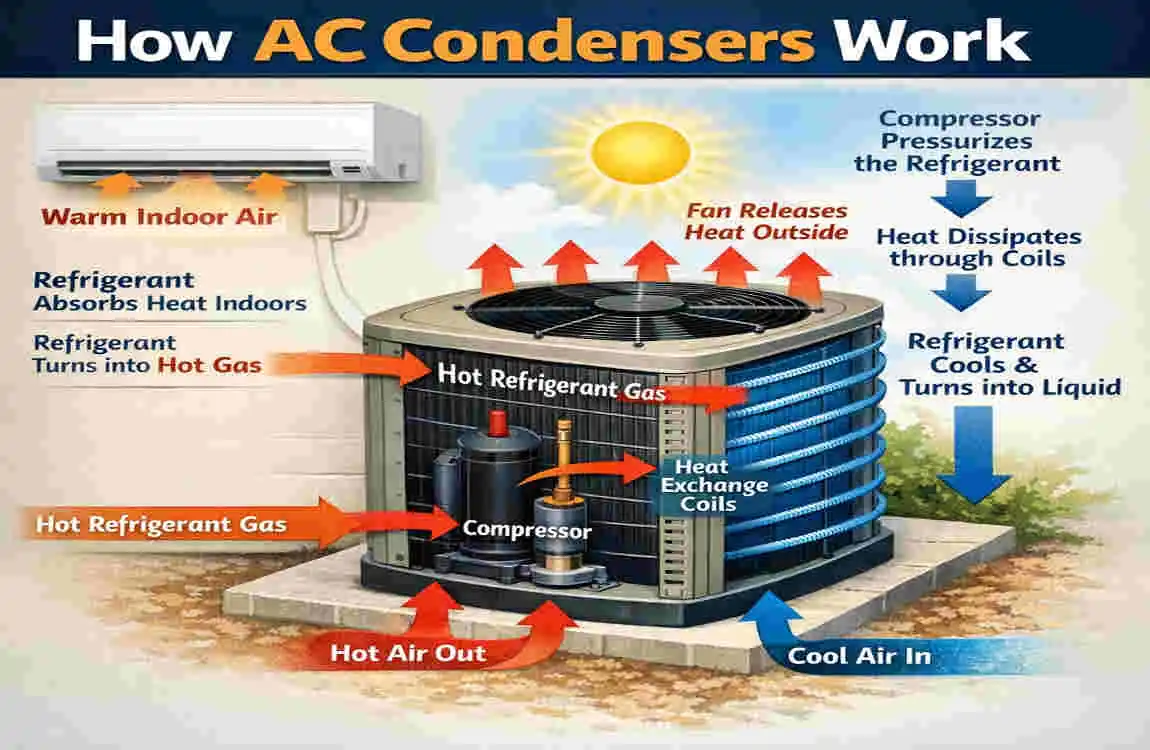
To understand why water might—or might not—help, we first have to understand what that noisy box outside your house is actually doing. It is not just a fan blowing air; it is a complex heat exchange machine.
The Refrigerant Cycle Simplified
Think of your air conditioner as a sponge. It doesn’t “add” cold air to your house; it “removes” heat.
- Absorption: Inside your home, the evaporator coil (the cold part) is filled with refrigerant that absorbs heat from your indoor air.
- Transport: That heat travels through the refrigerant lines out to the backyard unit.
- Release: This is where the condenser comes in. Its sole job is to take that absorbed heat and dump it into the outdoors.
When the refrigerant arrives at the outdoor unit, it is incredibly hot and under high pressure. The compressor squeezes it, raising its temperature even higher—often hotter than the outside air.
The Role of the Coils and Fins
If you look closely at your condenser, you will see delicate metal fins surrounding copper or aluminum tubes. These are the condenser coils. The large fan on top of the unit pulls outdoor air through these fins. As the air moves over the hot coils, it picks up the heat from the refrigerant and blows it away.
Here is the critical part: Airflow is everything.
If those coils are covered in dirt, pollen, or grass clippings, the air cannot reach the metal to pick up the heat. Industry data suggests that dirty coils can reduce your system’s efficiency by 20-30%. This forces your compressor to work much harder to achieve the same level of cooling, driving up your electric bill and shortening the unit’s life. This is usually why people reach for the hose—they intuitively know the unit is struggling to shed heat.
The Science Behind Spraying Water
So, why do people think adding water helps? It comes down to a concept called evaporative cooling.
The Physics of Evaporation
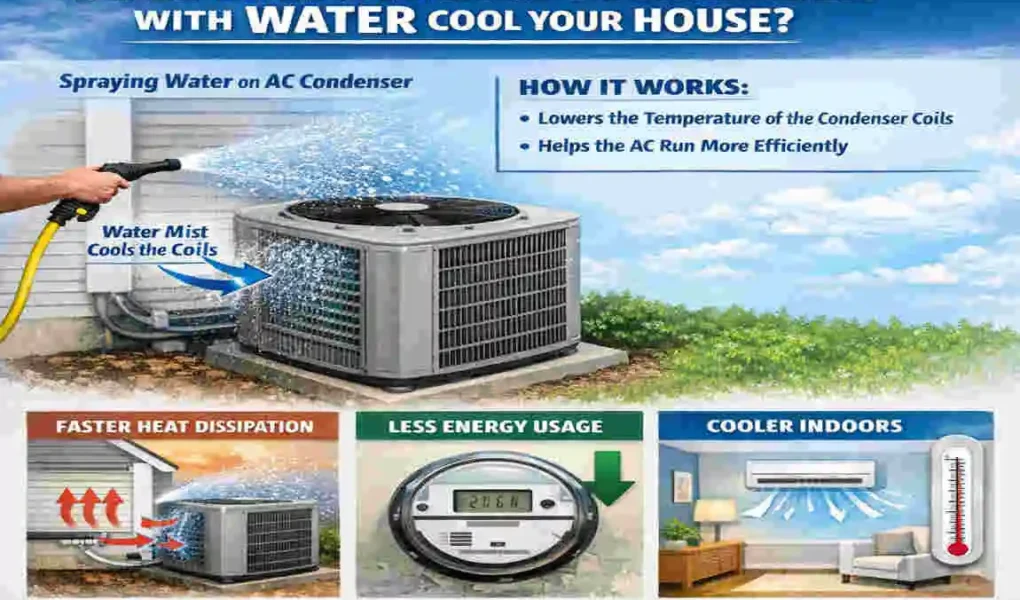
When water evaporates, it changes from a liquid to a gas. This phase change requires energy, which it absorbs as heat. When you spray water on your AC’s condenser coils, which can reach ~120°F or higher on a hot day, the water evaporates rapidly.
As water turns to steam, it pulls a massive amount of heat from the metal coils. This is based on the physics equation: Heat absorbed = mass of water × latent heat of vaporization.
In simple terms, The water “steals” the heat from the coils to turn itself into a gas. This immediately lowers the coils’ temperature, allowing the refrigerant inside to cool faster and condense back into a liquid more efficiently.
The Climate Factor: Dry vs. Humid
This is where the “magic hack” hits a reality check. The effectiveness of spraying water depends entirely on where you live.
In Dry Climates (e.g., Arizona, Nevada): The air is thirsty. It wants moisture. When you spray water on the coils, it evaporates almost instantly. This rapid evaporation can boost the unit’s efficiency by 5-10% in the short term, as heat transfer is rapid and efficient.
In Humid Climates (e.g., Florida, Louisiana): The air is already saturated with water vapor. It is like trying to dry a wet towel in a steam room. If you spray water on the coils, it doesn’t evaporate quickly. Instead, it creates a layer of water on the fins. Water actually conducts heat differently than air, and if it’s not evaporating, it might simply insulate the coil or block airflow, offering negligible gains.
Here is a quick breakdown of how climate changes the game:
FactorDry Climate EffectHumid Climate Effect
Evaporation Rate High: Water flashes to vapor, efficiently pulling heat from the environment. Low: Water sits on coils, evaporating slowly.
Efficiency Gain 5-10% (Temporary): Noticeable drop in head pressure. Negligible: minimal impact on cooling capacity.
Duration of Effect 30-60 Minutes: Coils dry faster, requiring constant respraying. <15 Minutes: Effectiveness drops as soon as water temperature equalizes.
Does It Actually Cool Your House?

The short answer is: Yes, but marginally and only temporarily.
When you hit those hot coils with cool water, the compressor’s head pressure drops immediately. This means the compressor doesn’t have to push as hard against the pressure, which reduces its workload.
The “Feeling” vs. The Reality
You might notice the air coming out of your vents inside drops by 1-3°F shortly after spraying the unit. This feels like a victory! However, this effect is fleeting. Once the water evaporates (which takes roughly 15 to 20 minutes on a hot day), the coils return to their previous hot temperature, and the efficiency gain vanishes.
The Energy Savings Myth
Real-world tests indicate that while you might save 1-3% energy during the actual time the water is evaporating, the effort required to maintain this is unsustainable. Unless you are standing there with a hose all day (which wastes water), you aren’t changing the overall temperature of your house for the day.
The “Cleaning” Benefit
There is one side effect that does help cool your house: cleaning. If you are gently spraying the unit, you might be washing away layers of dust and pollen. Removing that debris clears the airflow path, which indirectly aids cooling. However, a simple spray down is not a replacement for a chemical coil cleaning done by a pro, as water alone often can’t strip away the grime bonded to the aluminum fins.
Step-by-Step Guide to Safe Spraying
If you are determined to try this to survive a heatwave, do so safely to avoid damaging your $5,000 system.
Tools Needed:
- A standard garden hose.
- A spray nozzle with a “Gentle” or “Shower” setting.
- NO pressure washers.
Power Down (Optional but Recommended)
While some people spray the unit while it is running (to see the steam), the safest bet for beginners is to turn the thermostat to “Off” or pull the disconnect switch outside. This stops the fan from sucking water into the motor.
The Water Technique
Do not blast the coils directly with a high-pressure jet.
- Aim the hose at a 45-degree angle or straight down.
- Start at the top of the coils and work your way down. Gravity will help wash debris down to the base.
- Use a gentle shower setting. You want to wet the coils, not bend them.
Avoid the “Kill Zone.”
Every condenser has an electrical access panel where the wires connect to the house. Avoid spraying this area directly. While outdoor units are built to withstand rain, a direct pressurized hose stream can force water into electrical contactors, causing shorts or blowing fuses.
Frequency
How often should you do this? If you are doing it for cleaning purposes, once a month during the summer is plenty, especially if you live in a dusty area or near cottonwood trees. If you are doing it for cooling, remember it is only a temporary fix.
Risks and Downsides: Why It’s Dangerous
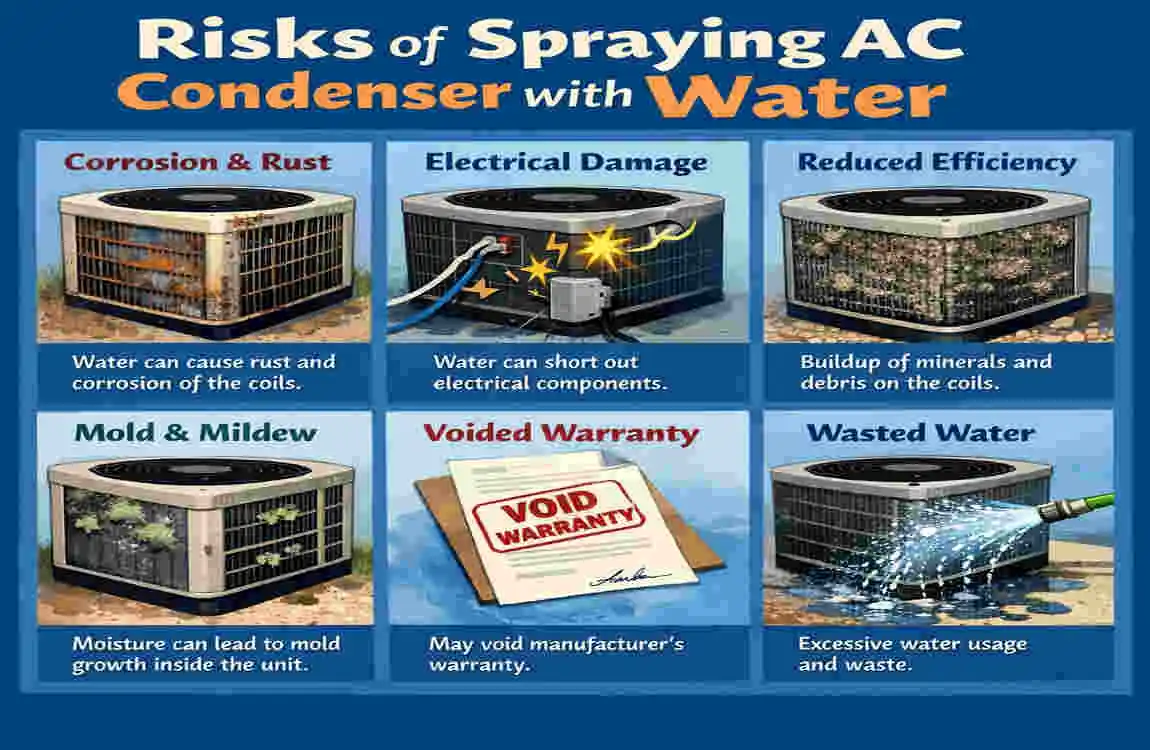
This is the part most DIY hacks skip. Water is not harmless, especially when mixed with delicate metals and electricity.
The “Bent Fin” Disaster
The aluminum fins on your condenser are incredibly soft—think heavy-duty aluminum foil. If you use a pressure washer or even a hose nozzle on “Jet” Mode, you will flatten these fins.
- Result: Flattened fins permanently block airflow.
- Consequence: Your AC can no longer release heat, causing the compressor to overheat and fail.
Mineral Buildup (The Hard Water Problem)
Rainwater is soft; tap water is usually “hard,” meaning it contains calcium, magnesium, and lime. When you spray tap water onto hot coils, the water evaporates, leaving the minerals behind. Over time, this creates a white, crusty scale on your coils.
- The Irony: This scale acts as an insulator (like a blanket), meaning your attempt to cool the unit actually makes it harder for the coils to release heat in the long run.
Corrosion
Constant wetting and drying cycles accelerate corrosion (rust), especially if your coils are made of different metals (copper tubing and aluminum fins). This galvanic corrosion can lead to refrigerant leaks, which are expensive to fix.
Better Alternatives for Cooling
If you want sustained cooling power without standing outside with a hose, consider these proven alternatives.
Professional Coil Cleaning
This is the gold standard. A technician applies a foaming chemical cleaner that pushes dirt out from deep inside the coils (where water can’t reach).
- Benefit: Restores near-factory airflow.
- Efficiency Gain: 15-25% sustained improvement.
Misting Kits / Evaporative Pre-Coolers
If you love the idea of water cooling, buy a system designed for it. These gadgets attach to your condenser and release a fine mist before the air hits the coils.
- Why they are safer: They use nozzles that create mist so fine it evaporates before it touches the metal, cooling the air without soaking the coils (preventing scale).
- Cost: $50-$150.
Shade and Airflow
Keep shrubs trimmed back at least 2 feet from the unit. If your unit is in direct sunlight during the hottest part of the day, installing a shade awning (that doesn’t block vertical airflow) can lower the ambient temperature around the unit.
Comparison of Methods
MethodEfficiency BoostCostLongevity of EffectRisk Factor
Water Spray (DIY) 1-5% (Temporary) Free Short (<1 hour) Moderate (Scale, Bent Fins)
Professional Cleaning 20%+ $100 – $200 Seasonal Low (Done by Pros)
Misting Kit 10-20% $50 – $150 Permanent Low (If treated for hard water)
FAQs: Answering Your Burning Questions
Q: Does spraying the AC condenser with water help cool the house while it is running? A: Yes, it creates an immediate evaporation effect that lowers the head pressure. However, ensure you do not spray water directly into the fan motor at the top, as this can burn out the bearings.
Q: Can I use rain barrel water? A: Actually, yes! Rainwater is naturally soft and lacks the minerals found in tap water, reducing the risk of scale buildup. Just make sure it is filtered so you aren’t spraying algae or sediment onto the coils.
Q: Will rain help my AC work better? A: Absolutely. A heavy rainstorm is nature’s way of cleaning and cooling your unit. You might notice your house feels cooler during a summer storm—that is the condenser working at peak efficiency.